René MoreauLivre Rare Book
5 261 résultats
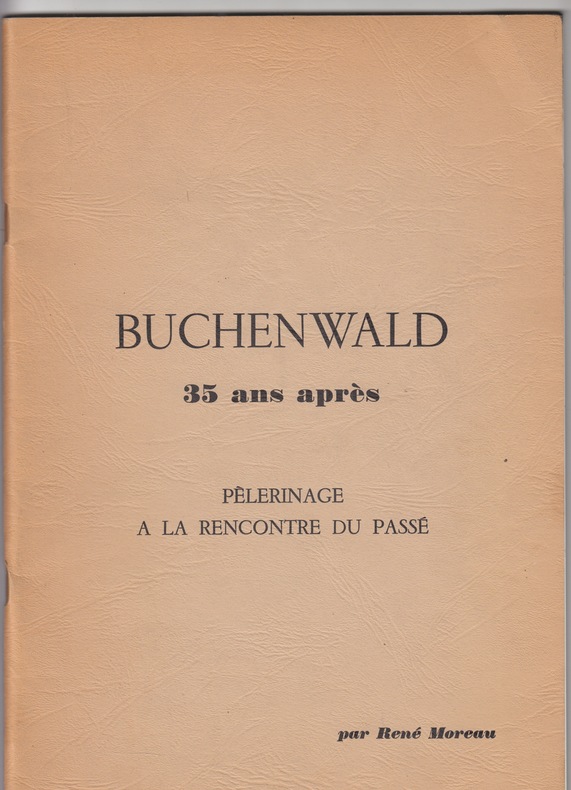
1980réf. 228541980 Editeur: R. Moreau (1980),IN4,Broché: 67 pages,illustrations,bon etat
1967réf. 009206Frankfurt am Main, Insel, 1967. 403 S. Orig.-Leinenband mit Schutzumschlag. Der Kopfschnitt etwas stockfleckig, sonst gut erhaltenes Exemplar mit nur leichten Gebrauchsspuren.
1960Original Cloth. Folio (large) . 187, [4] pages. 34 cm. First edition. In German, Russian, French and English. Attractively printed and bound multilingual dedication book for the Buchenwald Memorial; includes preface, speeches, and text by Herbert Sandberg; pages 65-159 illustrated, detailing the history of Buchenwald, photographs of the liberation, post-war memorial ceremonies, opening of the Buchenwald Memorial, extensive photographs of various portions of the Memorial; last pages contain the Buchenwald Oath and Pledge. Contains list of sculptors, architects, workers, artists, etc. Who worked on the Buchenwald Memorial. Published by the Komitee der Antifaschistischen Widerstandskämpfer (KdAW) [Committee of Anti-Fascist Resistance Fighters]. Subjects: Buchenwald (Concentration camp) . Memorial. OCLC lists 20 copies. Light wear to cloth, otherwise very fresh and clean. Very good condition. (HOLO2-117-20)
1983réf. 132364Weimar: Ständige Kommissionen Kultur der Stadtverordnetenversammlung Weimar und des Kreistages Weimar-Land, 1983. 96 S. ; 19 x 12 cm ; broschiert.
1991réf. 02965Münstereifel, Westkreuz, 1991. kt, 72S, gutes Exemplar
1959réf. 112917ABBerlin, Kongress-Verlag, (1959). 4° (33,5 x 23,5 cm). 187 S., 2 Blatt mit Holzschnittinitialien und 76 teils ganzseitigen Photos von Ernst Schäfer. Original-Leinenband mit geprägter Einband-Zeichnung.
1960réf. F199Frankfurt am Main, Röderberg, 1960. Erste Ausgabe. Gutes und sauberes Exemplar.
réf. 21182° (39 x 29 cm). 13 Bll., 78 teils kolorierten Tafeln. Farbig illustrierte Original-Broschur. Mit äußerst selten erhaltener Original-Chemise im Original-Schuber. Sehr gut erhaltenes, sauberes Exemplar. Der fast immer fehlende Schuber stark lädiert. Innen tadellos.
réf. 21202° (39 x 29 cm). 13 Bll., 78 teils kolorierten Tafeln. Farbig illustrierte Original-Broschur. Rücken lädiert. Innen sehr sauber und gut erhalten.
1960Original Paper Wrappers. 21 pages. Illus. 20 cm. In German. Title translates to English as, Buchenwald: A Guide Through the Memorial. Includes maps, significant dates. SUBJECT (S) : Buchenwald (Concentration camp) . Wrappers worn but solid. Internal pages are tanned, but not fragile. Good Condition. (HOLO2-93-17)
1983réf. 14225Weimar-Buchenwald, Nationale Mahn- und Gedenkstätte, 1983. Nr. 1 (14. April 1945) - Nr. 28 (16. Mai 1945). Hrsg. und eingeleitet von Bodo Ritscher. 4°. XVII,2 S. 74 einseitig beduckte Bl. (dazwischen 2 Tafeln), S. XIX-XXV,1 OLeinen.
1987réf. 09812buchenwald, NMG, 1987?. kt, 94S, gutes Exemplar
19451st edition. Original color paper wrappers. 8vo, 47 pages. Black and white photographs throughout. Holocaust-era imprint calling on American's to reject racism, bigotry, and Antisemitism. "Christian young people are increasingly aware of the implications of religious and racial antagonisms, and are determined to make concrete their religious professions of love and brotherhood. To help them in the human engineering problem of bridging the gulfs between men is the purpose of this booklet. " (from foreword by author) Describes different religions and includes questions to discuss and things to do for each one. Table of Contents: Who are we Americans? , Roman Catholics, The Jewish People, Protestants, Our Racial Minorities, Cooperating for Common Ends. SUBJECT(S) : Minorities -- United States. Prejudices. Minorities. Race relations. OCLC: 638880464, OCLC lists 4 copies worldwide. (HEBREW UNION COL; TRINITY UNIV, COATES LIBR; WISCONSIN HISTL SOC LIBR; TEL AVIV UNIV) Blue cover with illustration of bridge. Few pencil notes on cover, previous owner's stamp on title page, light wear to front and back cover, else clean copy. Very Good Condition overall. Scarce. (HOLO2-159-1-2) xx
1937Volume 3, Number 9. December 30, 1937. Wrappers; 16mo. 35 pages. Also includes "The Ludlow Resolution" by General William C. Rivers and Major George Fielding Eliot, and "After the Town Meeting" by Edward Hodnett. A transcript of a broadcast from the League for Political Education's Town Hall in cooperation with the National Broadcasting Company. Debates and debating -- Periodicals. Radio addresses, debates, etc. -- Periodicals. Social problems -- Periodicals. Title Subject: America's town meeting of the air -- Periodicals. Pages brown; lower right-hand corner bent; small piece of back page gone. Good condition. (H-31-4)
1986Softbound periodical. 12mo. 144 pages. 21 cm. Trimestrial bulletin Nr. 11, March 1986. In French and Dutch. One of three thousand copies printed. With essays in French and Dutch theorizing fascism, the European parliament, a contemporary NYC exposition on the holocaust, an essay by Elie Wiesel on Auschwitz, a tract denouncing revisionist literature in California, poems, information, book reviews and letters. Subjects: Holocaust, Jewish (1939-1945) - Belgium - Periodicals. Jews - Persecutions - Belgium - Periodicals. Auschwitz (Concentration camp) - Periodicals. Belgium - Ethnic relations - Periodicals. OCLC lists 33 copies worldwide. Faded pencil marks on top left of cover, light stains to backstrip and back of cover, very clean. Near fine condition. (HOLO2-80-2)
1985Softbound periodical. 12mo. 116 pages. 21 cm. Trimestrial bulletin Nr. 8, April-June 1985. In French and Dutch. One of fifteen hundred copies printed. With essays commemorating the opening of the Library of the Auschwitz foundation, commemoration of fourty years since the liberation, a lengthy correspondence between Albert Einstein and Sigmund Freud in 1932, poems, book reviews, letters, and more. Subjects: Holocaust, Jewish (1939-1945) - Belgium - Periodicals. Jews - Persecutions - Belgium - Periodicals. Auschwitz (Concentration camp) - Periodicals. Belgium - Ethnic relations - Periodicals. OCLC lists 33 copies worldwide. Very light pencil markings and stains on cover, pages fresh. Near fine condition. (HOLO2-80-3)
1984(FT) Original Paper Wrappers. 4to. 65, 15 pages. Illus. 26 cm. In English and Yiddish. Cover Subtitles: Israels 36th Anniversary Year, 1948-1984, Dedicated to 20 Years Monument, 1964-1984. SUBJECT(S) : Jews -- Pennsylvania -- Philadelphia -- Periodicals. Jewish refugees -- Pennsylvania -- Philadelphia -- Periodicals. Holocaust survivors -- Pennsylvania -- Philadelphia -- Periodicals. Association of Jewish Holocaust Survivors (Philadelphia, Pa. ) -- Periodicals. OCLC lists two copies worldwide (University of Southern California, US Holocaust Memorial Museum) . Covers stained, slightly wavy from water, but still solid. Internal pages are clean. Good condition. (HOLO2-64-16)
1956Paper Wrappers, 8vo, 164 pages. 23 cm. In German. "mit einer Einfuhrung von H. G. Van Dam, mit Gesetz zur Aenderung des BEG (Mantelgesetz) ...Verordnung zur Durchführung des [sect. ] 31d des Gesetzes zur Regelung der Wiedergutmachung nationalsozialistischen Unrechts für Angehörige des öffentlichen Dienstes vom 6. Juli 1956." Inscribed by the author in year of publication to Moses Leavitt, chairman of the Claims Conference negotiating delegation at the Hague. Subject(s) : World War, 1939-1945 --Claims --Germany (West) . Very Good Condition. (h2-3-13)
1997réf. ZEIT1510Lodz, Oficyna Bibliofilow 1997. 71 S., mit 2 Abb., OKart. In polnischer Sprache
199624x16cm. XII+510 pages. Hardcover. Cover edges and corners slightly bumped. Spine edges slightly bumped. Else in good condition. PLEASE NOTE: This item is overweight. We may ask for extra shipping costs.
1957Publishers cloth. 8vo. 252 pages. 22 cm. First edition. With 18 black and white plates. Subtitle: On the work of Sue Ryder on behalf of displaced persons in Germany. With plates, including portraits. A biography and history of the relief work done by Sue Ryder for Displaced Persons and Holocaust Suvivors. Born in Yorkshire in 1924, Sue Ryder served with the Special Operations Executive (SOE) during the Second World War. Established by Winston Churchill in 1940, the SOE promoted and coordinated resistance activity in German occupied Europe. Her life's mission became clear after World War II. During the post-war reconstruction in Europe, she worked as a volunteer amongst displaced and stateless refugees. During this time she opened her first home, St Christopher's in Germany. It was designed as a haven for refugees, many of whom were survivors of concentration camps. On her return to England, she established the Sue Ryder Foundation with the aim to provide care where it is needed most. Sue Ryder was married for many years to war hero and fellow charity founder the late Leonard Cheshire VC, who died in 1992. Lady Ryder was made a life peer in 1978 and was a Companion of the Order of St Michael and St George in 1975. She also received the Order of the British Empire (OBE) in 1957. (Sue Ryder Foundation) Subjects: Refugees. Britain. Biographies. Ryder. Social issues. Refugees. Organizations S. I. R. World War 1939-1945. German camps and prisons. Britain. Biographies. Ryder. Social issues. Refugees. Organizations S. I. R..World War 1939-1945. German camps and prisons. Outer edges lightly soiled, light wear to cloth. Without jacket. Very good condition. (HOLO2-100-15) XX
1980Hardcover, xiii, 262 pages, 8vo, 24 cm. SUBJECT (S) : Holocaust, Jewish (1939-1945) , in literature. Literature, Modern -- 20th century -- History and criticism. Jewish literature -- History and criticism. Holocauste, 1939-1945. Litterature -- 20e siècle -- Histoire et critique. Litterature juive -- Histoire et critique. Letterkunde. Holocaust. Bibliography on pages 245-252. Includes index. In jacket, very good condition. (mx-32-3)
1947Original Wrappers. 4to. 39 pages. 30 cm. First Edition. In Polish. Title translates as, There Were More Deaths, Than Bread: Jednodniowka Released On the Occasion of the Exhibition Oswiecim accuses. " Jednodniowka publications are typically journals or pamphlets issued by organizations with no regular publications, but may also be published quarterly or on a semi-regular basis. Contains period advertisements. Journal containing poetry, prose and articles related to the conditions of Polish concentration camps. The Polski Zwiazek Bylych Wiezniów Politycznych Hitlerowskich Wiezien I Obozów Koncentracyjnych, (translates to Polish Association of Former Political Prisoners of Nazi Concentration Camps and Prisons) was formed in 1946, and existed until 1949. Later reformed in the 1990s the organization focuses on youth outreach and Holocaust education. Subjects: Holocaust. Concentration camps. Auschwitz-Birkenau. OCLC lists 2 copies worldwide. (Natl. Libr. Of Poland, Central Connecticut State University) Light soiling and age toning. Dramatic color cover illustration. Very good + condition. (HOLO-114-15)
19611st edition, original cloth, 4to, xix+ 288+ (2) pages. On title page: Brzezin memorial book. Illustrations throughout. Yiddish, with English introduction. There once was a town of Jewish tailors Brzezin. From early dawn until late at night one could hear the music of the Singer sewing machines. It was the music of hard work, of intense anxiety, of a hard life, but also of noisy youth, semi-intellectuals, observant Jews, Hasidim who lived and had aspirations in the small Jewish town Brzezin. The Nazi savages extinguished this life forever, transformed it into ashes. Only a few Jews from the tailoring town Brzezin, by some miracle, remain, scattered over the entire world, individuals who were witnesses to the German cannibalism. May these words, frail in print, but inscribed not with ink but with blood, be a modest contribution to the matseve [gravestone] for my native town, Brzezin. Brzezin was one of the oldest and most popular Jewish communities in Poland. When this community was established, it carried the name Krakowek [Little Krakow]. At that time, the community extended from the Strykower highway to beyond the Jewish besoylem [cemetery] to the surrounding hills. The Polish noblewoman, Anna Lasocka, had brought the first weavers from afar into this community. Then the community developed even further and began to broaden its borders. At that time, the town already carried the name Brzezin. Jewish tailors came to Brzezin from many places, and after several generations, the town developed its own type of tailoring industry, by which it was known all over the world. A cottage industry was the main occupation here. As early as 1772, Brzezin was famous for its mass production in tailoring. Until 1914 the great Czarist Russia was flooded with the inexpensive products of Brzeziner tailors. In the years between the two world wars, the export of Brzezin industry was spread over many lands in Europe and into other parts of the world. In this, the great Jewish magaziners [owners of clothing enterprises] exporters such as Frankensztejn, Tuszynski, Sulkowicz, and others played a great role. The Jews in Brzezin did not only work, they also participated actively in the socio-political and cultural life of the town, had their representatives on the town council in town hall, and had their religious and secular educational, cultural, and social organizations. Materially, it was a life of Jewish poverty, but spiritually, socially, and culturally, it was rich. (translated from book) SUBJECT(S) : Holocaust, Jewish (1939-1945) -- Poland -- Brzeziny (Lo´dz´) ; Jews. OCLC: 19306453. Light wear on cover, some wear on spine. Good Condition Overall. (YIZ-16-6A)
19611st edition, original cloth, 4to, xix+ 288+ (2) pages. Illustrations throughout. Yiddish, with English introduction. There once was a town of Jewish tailors Brzezin. From early dawn until late at night one could hear the music of the Singer sewing machines. It was the music of hard work, of intense anxiety, of a hard life, but also of noisy youth, semi-intellectuals, observant Jews, Hasidim who lived and had aspirations in the small Jewish town Brzezin. The Nazi savages extinguished this life forever, transformed it into ashes. Only a few Jews from the tailoring town Brzezin, by some miracle, remain, scattered over the entire world, individuals who were witnesses to the German cannibalism. May these words, frail in print, but inscribed not with ink but with blood, be a modest contribution to the matseve [gravestone] for my native town, Brzezin. Brzezin was one of the oldest and most popular Jewish communities in Poland. When this community was established, it carried the name Krakowek [Little Krakow]. At that time, the community extended from the Strykower highway to beyond the Jewish besoylem [cemetery] to the surrounding hills. The Polish noblewoman, Anna Lasocka, had brought the first weavers from afar into this community. Then the community developed even further and began to broaden its borders. At that time, the town already carried the name Brzezin. Jewish tailors came to Brzezin from many places, and after several generations, the town developed its own type of tailoring industry, by which it was known all over the world. A cottage industry was the main occupation here. As early as 1772, Brzezin was famous for its mass production in tailoring. Until 1914 the great Czarist Russia was flooded with the inexpensive products of Brzeziner tailors. In the years between the two world wars, the export of Brzezin industry was spread over many lands in Europe and into other parts of the world. In this, the great Jewish magaziners [owners of clothing enterprises] exporters such as Frankensztejn, Tuszynski, Sulkowicz, and others played a great role. The Jews in Brzezin did not only work, they also participated actively in the socio-political and cultural life of the town, had their representatives on the town council in town hall, and had their religious and secular educational, cultural, and social organizations. Materially, it was a life of Jewish poverty, but spiritually, socially, and culturally, it was rich. (translated from book) SUBJECT(S) : Holocaust, Jewish (1939-1945) -- Poland -- Brzeziny (Lo´dz´) ; Jews. OCLC: 19306453. Light wear on cover, Good Condition Overall. (YIZ-16-6)