Goldstein, David; Reick, HavivaMareMagnum

5 261 résultats
19471st Edition. Original Illustrated Boards Depicting Haviva Reick parachuting. 8vo. 163 pages ; 21 cm. In Czech. Early post-Holocaust publication. Includes photographs of Haviva Reick throughout. Haviva Reik (19141944) was one of 32 or 33 parachutists sent by the Jewish Agency and Britain's Special Operations Executive (SOE) on military missions in Nazi-occupied Europe. Reik went to Slovakia in fall 1944 and worked with local Jewish people to resist the German occupation there. She established a camp for Russian prisoners of war who had escaped, and helped organize a Jewish resistance unit. The Germans organized forces to put down the Jewish resistance, and Reik and the other parachutists escaped with about 40 local Jews into the mountains. In November 1944, however, Reik and the other parachutists were captured, killed, and buried in a mass grave (Wikipedia, 2017) SUBJECT(S) : Reick, Haviva, 1914-1944. Jews--Palestine--Biography. World War, 1939-1945--Underground movements--Slovakia. OCLC lists 10 copies worldwide. The US Holocaust Museum keeps their copy in their Rare Book Room. In very good condition. Important (holo2-135-41)
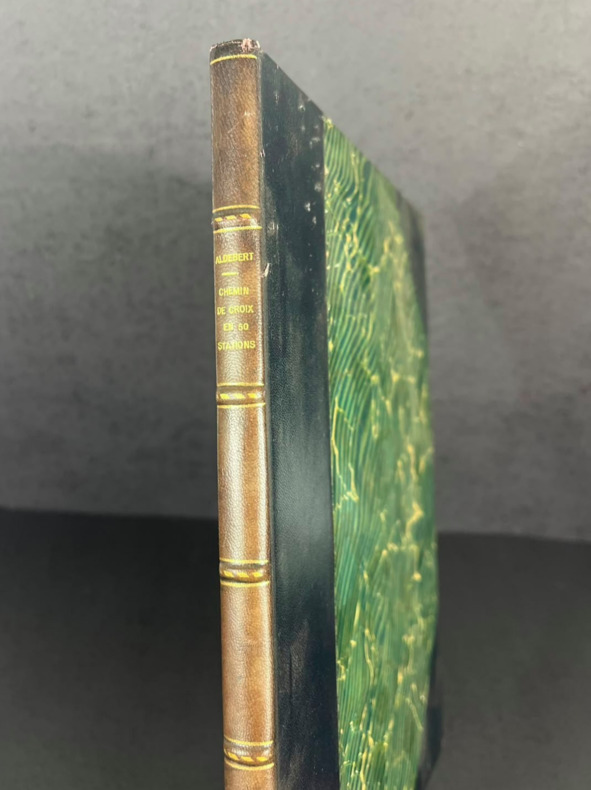
1946réf. 563Paris, Arthème Fayard, 1946. Édition originale. Grand album de 22 x 28 cm, 112 (2) pp. Relié demi-cuir noir à coins, dos à 5 nerfs ornés de pointillés et traits dorés, nom d'auteur et titre en doré. Plats marbrés. Couverture originale conservée. Tranchefile. Ouvrage illustré d'une cinquantaine de dessins en noir et blanc de l'auteur. Cet ouvrage est un puissant récit autobiographique illustré de l'artiste français Jean Bernard-Aldebert (connu sous le nom de Bernard-Aldebert, 1909-1974), relatant sa captivité dans cinq camps de concentration nazis différents entre 1944 et 1945. Après avoir bâti une carrière d'illustrateur, de caricaturiste et de satiriste, l'artiste voit son destin basculer tragiquement en novembre 1943. Pour avoir caricaturé Hitler sous les traits d'un chimpanzé dans le numéro du 1er août de l'hebdomadaire humoristique français *Ric et Rac*, Bernard-Aldebert est arrêté par la Gestapo. Il est ensuite transféré en janvier 1944 au camp d'internement de Royallieu-Compiègne, puis successivement à Buchenwald, Mauthausen, Gusen I et enfin Gusen II, où il demeure jusqu'à sa libération le 5 mai 1945. Le texte et les illustrations de l'auteur dévoilent les horreurs subies par les prisonniers dans ces camps : travaux forcés brutaux, famine, tortures sadiques et violences diverses. Si Bernard-Aldebert était surtout connu pour des caricatures au style léger et de charme, les images présentées ici versent dans un tout autre registre. Elles rappellent son style habituel, mais se révèlent bien plus dépouillées, sombres et austères, comme un reflet des émotions des personnages qui y apparaissent. Le texte est accompagné, presque systématiquement sur la page en regard, d'une reproduction en noir et blanc d'un dessin original de l'artiste, pour un total de 50 images. Celles-ci sont issues d'une série de croquis dessinés par Bernard-Aldebert peu après sa libération ; ils offrent, encore aujourd'hui, un témoignage visuel et émotionnel inestimable.
réf. 21134° (27 x 21,5 cm). 112 (1) Seiten mit 50 ganzseitigen Illustrationen, die den Leidensweg der Häftlinge in den verschiedenen Konzentrationslagern eindrucksvoll zeigen. Schöner Handeinband der Zeit in rotem Saffianleder mit Marmorpapierüberzug. Halbfranzband auf 5 echten Bünden mit handvergoldetem Rückentitel. Die farbig illustrierte Originalbroschur mit eingebunden. Sehr gut erhaltenes Exemplar. Einige Seiten etwas fleckig und mit geringfügigen Knickspuren. Der Einband von tadelloser Erhaltung. Seltenes, frühes Zeitzeugnis in einem unikalen Handeinband, der in einem auffälligen Spannungsverhältnis zum Inhalt steht.
1946Original Wraps. 4to. 112, [1] pages. 28 cm. First edition. In French. Includes 50 original color illustrations throughout of Compiegne Gusen 2, Buchenwald, Mauthausen, & Gusen 1. Illustrated narrative by the artist and survivor Bernard Aldebert. Jean Bernard-Aldebert (1909-1974) was born in Saint-Etienne, and began his career as an illustrator for Le Pêle-Mêle in 1928. He was arrested and deported to the Gusan extermination camp in early 1944, after publishing a satirical drawing in Ric et Rac. His deportation was via Compiegne, KZ Buchenwald, KZ Mauthausen, KZ Gusen I to KZ Gusen II (Bergkristall-Esche II underground plant) . One of the very few survivors of Gusen, he captured his experiences during this ordeal in the album 'Chemin de Croix en 50 Stations', published by the Arthème Fayard group in 1946 (Lambiek Comicopedia, 2014) . Subjects: Guerre mondiale (1939-1945) - Camps de concentration - Récits personnels français. Déportés français - 1939-1945 - Récits personnels français. Gusen (Concentration camp) - Pictorial works. Gusen (Concentration camp) . Pictorial works. OCLC lists 19 copies. Clean and fresh. Very good condition. (HOLO2-118-31) xx
199516x24 cm. 312 pages. Hardcover in dust jacket. In good condition.
1995Very Good Condition; Small 8vo; 409 pages. (HOLO2-111-5)
1979Hardcover, 348 pages, 8vo, 23 cm. SUBJECT (S) : Holocaust, Jewish (1939-1945) -- Psychological aspects. Children of Holocaust survivors -- Psychology. Holocaust. Overlevenden. Includes bibliographical references. Fading to cover. In dust jacket. Good condition. (Holo2-19-10)
1994Paperback. 8vo. X, 306 pages. 24 cm. Second edition. With fourteen black and whites illustrations. From evidence gathered in France, Germany, and England, John F. Sweets has produced an insightful reappraisal of French life during the war at Clermont-Ferrand, the largest town near the occupational capital of Vichy [ ] Having thoroughly examined town archives, records, and manuscripts, the author reconstructs occupational commerce, education, media, and attitudes, maintaining that, contrary to popular opinion, the vast majority of French were far from collaborationist. Choices in Vichy France details the effects upon society of war, oppression, internment, rationing, aryanization, and propaganda, painting a portrait of the wartime French that lies somewhere between the extremes of outright resistance and enthusiastic collaborationism. With illustrative examples of what day-to-day life was like in the region for the German, the Jew, the Communist, and the fascist, as well as the French masses, this provocative book opens a remarkably clear window onto an era of history often fraught with misunderstanding and suspicion. (Publishers description) . Subjects: World War, 1939-1945 - France - Clermont-Ferrand - Case studies. France - History - German occupation, 1940-1945. World War, 1939-1945 - France - Clermont-Ferrand. World War, 1939-1945 - France - Auvergne. Vichy-bewind. Guerre mondiale, 1939-1945 - France - Clermont-Ferrand. Guerre mondiale, 1939-1945 - France - Auvergne. Very good condition, like new. (HOLO2-100-12)
2015réf. 34546ABWetzlar, Arbeitsgemeinschaft Christen für Israel e.V., 2015. 8°, 218 S. mit zahlr. Farb- und s/w-Abb., illustr. original Kartonage (Paperback), Vorderdeckel unten mit zartem Eckknickchen, sonst ein schönes, sauberes Exemplar (re04)
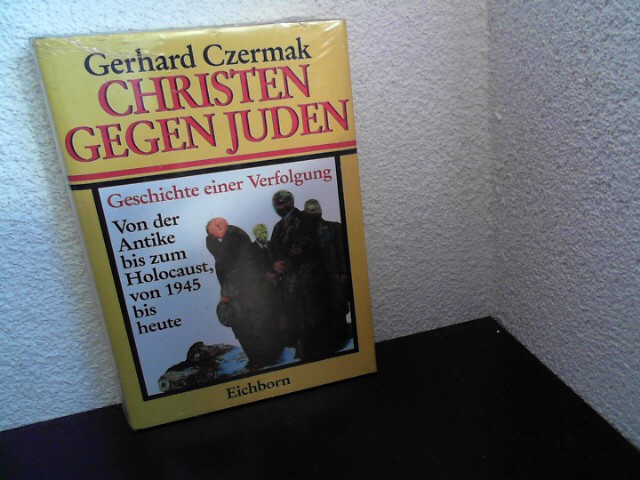
1991réf. 2938Frankfurt am Main : Eichborn 1991. 441 S. ; 24 cm Originalverschweißt, Top Zustand, gebundene Ausgabe, neuwertig noch in Folie eingeschweißt
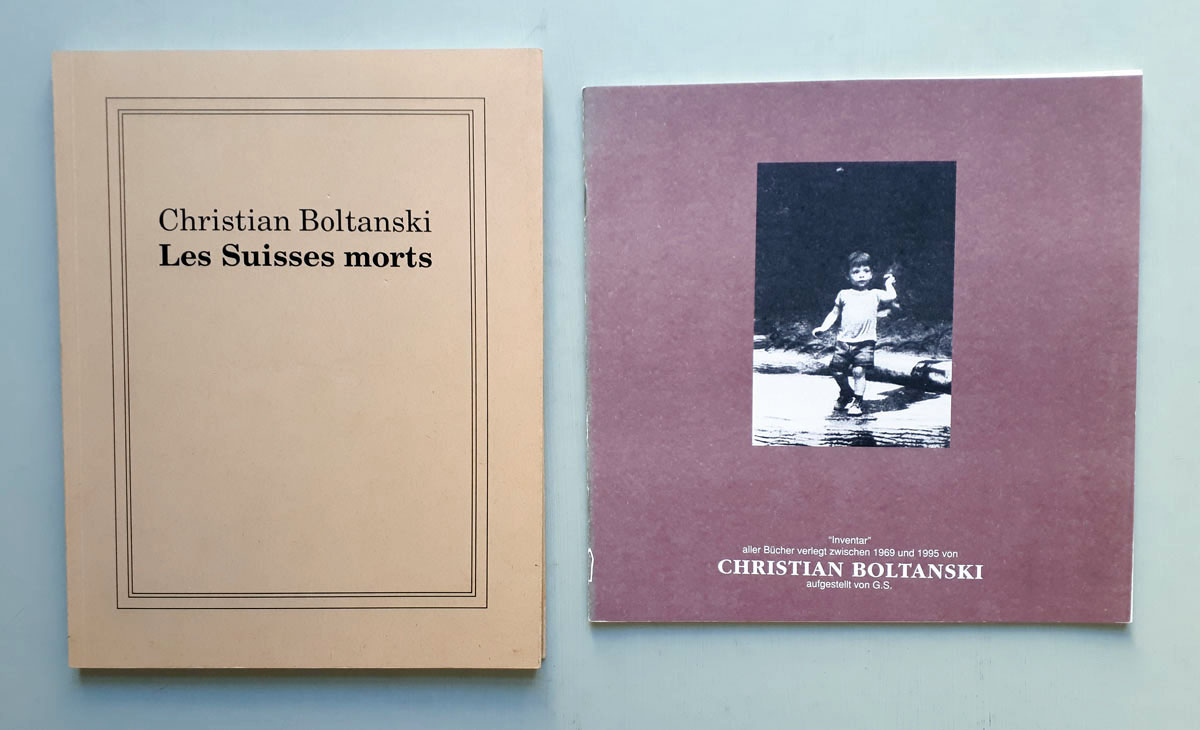
réf. q16b2619Neues Museum Weserburg / Museum für Moderne Kunst / Süddeutsche Zeitung. 1. Inventar - aller Bücher verlegt zwischen 1969 und 1995 von Christian Boltanski aufgestellt von G.S. - Neues Museum Weserburg, Bremen 1996. Text: Guy Schraenen. 23 S., 21x21 cm. Sehr gutes, sauberes Exemplar. 2. Christian Boltanski - Les Suisses morts. Memento mori und Schattenspiel - Memento mori and Shadow-Play. Schriften zur Sammlung des Museums für Moderne Kunst Frankfurt 1991. Museum für Moderne Kunst 1991. 99. S., 18,4x24 cm mit zahlreichen s/w Abbildungen. Broschiert, sehr gutes, sauberes Exemplar. 3. Christian Boltanski - Süddeutsche Zeitung Magazin - No. 46, 14.11.1997 - Verloren in München - Ein Porträt der Stadt München, anhand der Dinge, die die Menschen im Städtischen Fundbüro abgaben - Süddeutsche Zeitung 1997. Das Magazin als Kunstwerk - Ein Porträt der Stadt München, anhand der Dinge, die die Menschen dort in letzter Zeit verloren haben, dies ist das Konzept, das sich der große französische Künstler Christian Boltanski für diese Ausgabe des SZ-Magazins ausgedacht hat. Ab 14. November wurden die Gegenstände im Haus der Kunst in München ausgestellt. Christian Kämmerling: Ein Werkstattgespräch mit Christian Boltanski. 94 S., 23x30 cm. Sehr gutes, sauberes Exemplar. 4° [6 Warenabbildungen] Broschiert
2000réf. 007986Boulder, Westview Press, 2000. xx, 438 S. Orig.-Broschur. Mit Exlibris, sonst gut erhaltenes Exemplar mit nur leichten Gebrauchsspuren.
1943Softcover, 16 pages, 12mo. Holocaust-era plea to Christians to see what Christianity owes to Judaism, by one of the leading Philosemitic American Protestant pastors of the day. OCLC lists 3 copies worldwide (Lib of Congress, Univ of Penn, National Lib of Israel) . Small stain on front cover. Light wear. Very good condition. (Holo2-19-67)
197521.5x15 cm. 359 pages. Hardcover with dust jacket. Cover and spine slightly curved. Else in good condition.
1969IN HEBREW. 25x17.5 cm. 14+315 pages. Gilt hardcover with dust jacket. In good condition.
1967Publishers cloth. 8vo. 320 pages. 22 cm. First American edition. Hans Habe was one of the most important publicists in West Germany after World War II. During his life he wrote more than twenty books, some of them translated into English, and around ten thousand newspaper articles. Christopher and his Father; A novel of the Conflict of Generations in Germany Today concerns the relationship between Veit Harlan, the director of the anti-Semitic film Jud Suess during the Nazi period, and his son Thomas Harlan. Subjects: Fathers and sons - Germany - Fiction. Atonement - Fiction. German fiction - 20th century - Translations into English. Germany - History - 20th century - Fiction. With very good dustjacket. Near fine condition. (HOLO2-95-6)
1957Revised Edition. Cloth, Large 8vo, viii, 470 pages. In German. Includes numerous illustrations. 25 cm. Includes index. Author, an Austrian Catholic priest, was imprisoned for 5 years at Dachau. Includes signed letter (fundraising to rebuild a cathedral destroyed in the war) from Lenz laid in. Lenz has also signed the book on the front endpaper. SUBJECT(S): Clergy -- Germany -- Biography. World War, 1939-1945 -- Religious aspects. World War, 1939-1945 -- Personal narratives, German. Dachau (Concentration camp) Catholic Church -- Germany -- Clergy -- Biography. Catholic Church -- Germany -- History -- 1933-1945. Very Good Condition. (H-40-15)
197324.5x18cm. XIV+521 pages. Gilt hardcover with dust jacket. Spine slightly curved. Text block edges slightly age-stained. Else in good condition.
1996SIGNED BY AUTHOR. 225x140mm. 189 pages. Softcover. Cover slightly stained and slightly yellowing. Pages slightly yellowing. Else in good condition.
1979réf. 21303Wien, Europaverlag, (1979). 228 S. OLn.
19518vo. 468 pages. With 70 pages of photographs. In Yiddish with forward in English. SUBJECT (S) : Jews persecutions Lithuania; Holocaust, Jewish (1939-1945) Lithuania personal narratives; Oshry, Efriom, b. 1915; Lithuania ethnic relations. A scarce Yizkor title, very well illustrated.Very Good condition. (YIZ-1-1A) xx
19518vo. 468 pages. With 70 pages of photographs. In Yiddish with forward in English. SUBJECT (S) : Jews persecutions Lithuania; Holocaust, Jewish (1939-1945) Lithuania personal narratives; Oshry, Efriom, b. 1915; Lithuania ethnic relations. A scarce Yizkor title, very well illustrated.Very Good condition in Good+ Jacket. Nice copy. (YIZ-1-1)
19518vo. 468 pages. With 70 pages of photographs. In Yiddish with forward in English. SUBJECT (S) : Jews persecutions Lithuania; Holocaust, Jewish (1939-1945) Lithuania personal narratives; Oshry, Efriom, b. 1915; Lithuania ethnic relations. A scarce Yizkor title, very well illustrated.Very Good condition. (YIZ-1-1A) xx
19478vo; 1st edition. Original illustrated red boards, 8vo, 342 pages. In Yiddish. Title translates as, "The destruction of Vilna." Kaczerginski (19081954) was a Yiddish writer and cultural activist. Born in Vilna to a poor family and educated at that citys Talmud Torah, Shmerke (Pol., Szmerke) Kaczerginski lost both his parents during World War I. As a youth, he was involved with outlawed Communist groups and was arrested several times, serving a lengthy prison term. In the 1930s, two of his revolutionary poems became popular in Poland. He wrote short stories with a radical bent and was a correspondent and reporter for literary publications, including the semilegal leftist press in Poland and the New York Communist daily Morgn-frayhayt. Kaczerginski played a key role in shaping the writers and artists group Yung-Vilne; he organized its evening events and was the de facto publisher of its three miscellanies between 1934 and 1936. During the period of Soviet control over Lithuania in 19401941, he was even more active in the field of Yiddish culture, but at the same time experienced his first disappointments with the attitude of the Soviet regime toward Jewish culture. During the first period of Nazi occupation, Kaczerginski wandered through villages and towns posing as a deaf mute; after many difficulties, he ended up in the Vilna ghetto. Kaczerginski was very involved in the ghettos cultural activities. As a leader of its youth club, he wrote its Yugnt-himen (Youth Hymn), a song that immediately became popular. In 1943, he wrote the song Shtiler, shtiler in memory of the mass murders committed at Ponar. Set to music that Aleksander Volkoviski (later known as Aleksander Tamir) had submitted to a contest organized by the ghetto, the song was first heard at an evening performance there and over the years became one of the best-known songs of the Holocaust. With Avrom Sutzkever and others, Kaczerginski became part of a group of forced laborers whom the Germans designated to sort Jewish cultural treasures at YIVO and other locations. Known as the Papir-brigade (Paper Brigade), the groups members risked their lives to hide the most significant items, smuggling them back into the ghetto or entrusting them to non-Jewish acquaintances. Kaczerginski was a member of the Fareynikte Partizaner Organizatsye (United Partisans Organization; FPO), and, since YIVOs building was located outside the ghetto walls, he took part in smuggling weapons into the ghetto. In September 1943, Kaczerginski, along with Avrom and Freydke Sutzkever and other members of the FPO, escaped from the Vilna ghetto as part of an organized group of fighters just before its liquidation. They joined a Soviet partisan unit in the Naroch Forests, where Kaczerginski fought as a partisan until liberation in July 1944. Kaczerginskis books describe the destruction of Vilna, the partisan struggle, and his own experiences during the Holocaust period: Khurbn Vilne (The Destruction of Vilna; 1947), Partizaner geyen (Partisans on the Move; 1947), and Ikh bin geven a partizan (I Was a Partisan; 1952) (YIVO, 2010). Ex-library, spine sunned, otherwise very Good Condition. (HOLO2-89-3A)
2018réf. 2-1695143868Independently published 2018. Paperback. New. 146 pages. 11.00x8.50x0.35 inches. Independently published paperback