Forotivsky, LeontiMareMagnum

7.092 Ergebnisse
1952Original Wrappers. 12mo. 78 pages. 19 cm. Illustrated. First Edition. In Ukrainian. Black and white photogtaphs of Kiev throughout the wartime period. Alternate title in Spanish, “Kiev Bajo Las Ocupaciones Enemigas. "Written by Leonti Forostivsky, after his emigration to Argentina in 1943. Forostivsky, a historian interested in the Nazi occupation of Kiev, served as Head of the Kiev city council from February, 1942 until November , 1943. In this description of the city under Soviet and Nazi occupation he reports the destruction of Khreschatyk area of Kiev was destroyed by Soviet mines placed during the Red Army retreat from the city in 1941. The remote detonation of the Soviet mines preceded the notorious Babi Yar massacre, which was described by the Nazi occupiers as reprisal for guerilla attacks against them. Subjects: Kiev (Ukraine) -- History. OCLC lists 18 copies worldwide. Some edge wear and age toning. Light soiling to wrappers. Very good condition. (UKR-1-43)
1947Original Wrappers. 8vo. 77 pages. 21 cm. First Edition. "One of the first (and most detailed) studies of the works of famous Ukrainian writer, born in the city Trostianets. [Trahediya] Khvylovy (1893-1933) was written in exile, in a camp for internally displaced people (1947) by literary critic Paul I. Petrenko (1903-1982) , under the pseudonym O. Hahn." (Sumy News) Khvylovy was a prominent Ukrainian Bolshevik author who, after the arrest of a close friend, renounced Stalin and committed suicide. Subjects: Authors, Ukrainian -- Biography. Political activists -- Ukraine -- Biography. OCLC lists 24 copies worldwide. Light age toning and shelf wear. Writing in ink in center of front cover. Previous owner inscription on title page. Good condition. (UKR-1-39)
1952Good Solid condition.; 8vo; 387 pages; In Yiddish. Not in Robinson & Friedman nor Wolff. Jewish partisan's memoirs of resistance against the Nazis in Poland. Illustrated with many photographs throughout. Inscribed by Kaczerginski in year of publication. Kaczerginski (19081954) was a Yiddish writer and cultural activist. Born in Vilna to a poor family and educated at that citys Talmud Torah, Shmerke (Pol., Szmerke) Kaczerginski lost both his parents during World War I. As a youth, he was involved with outlawed Communist groups and was arrested several times, serving a lengthy prison term. In the 1930s, two of his revolutionary poems became popular in Poland. He wrote short stories with a radical bent and was a correspondent and reporter for literary publications, including the semilegal leftist press in Poland and the New York Communist daily Morgn-frayhayt. Kaczerginski played a key role in shaping the writers and artists group Yung-Vilne; he organized its evening events and was the de facto publisher of its three miscellanies between 1934 and 1936. During the period of Soviet control over Lithuania in 19401941, he was even more active in the field of Yiddish culture, but at the same time experienced his first disappointments with the attitude of the Soviet regime toward Jewish culture. During the first period of Nazi occupation, Kaczerginski wandered through villages and towns posing as a deaf mute; after many difficulties, he ended up in the Vilna ghetto. Kaczerginski was very involved in the ghettos cultural activities. As a leader of its youth club, he wrote its Yugnt-himen (Youth Hymn), a song that immediately became popular. In 1943, he wrote the song Shtiler, shtiler in memory of the mass murders committed at Ponar. Set to music that Aleksander Volkoviski (later known as Aleksander Tamir) had submitted to a contest organized by the ghetto, the song was first heard at an evening performance there and over the years became one of the best-known songs of the Holocaust. With Avrom Sutzkever and others, Kaczerginski became part of a group of forced laborers whom the Germans designated to sort Jewish cultural treasures at YIVO and other locations. Known as the Papir-brigade (Paper Brigade), the groups members risked their lives to hide the most significant items, smuggling them back into the ghetto or entrusting them to non-Jewish acquaintances. Kaczerginski was a member of the Fareynikte Partizaner Organizatsye (United Partisans Organization; FPO), and, since YIVOs building was located outside the ghetto walls, he took part in smuggling weapons into the ghetto. In September 1943, Kaczerginski, along with Avrom and Freydke Sutzkever and other members of the FPO, escaped from the Vilna ghetto as part of an organized group of fighters just before its liquidation. They joined a Soviet partisan unit in the Naroch Forests, where Kaczerginski fought as a partisan until liberation in July 1944. Kaczerginskis books describe the destruction of Vilna, the partisan struggle, and his own experiences during the Holocaust period: Khurbn Vilne (The Destruction of Vilna; 1947), Partizaner geyen (Partisans on the Move; 1947), and Ikh bin geven a partizan (I Was a Partisan; 1952) (YIVO, 2010). Wear to cover and edges, very good condition. (HOLO2-87-3A)
1997Original Wraps. 8vo. 122 pages. 23 cm. First edition. In Serbo-Croatian and English. Author of the exhibition and catalogue, Mladenko Kumovic. Catalogue of an exhibition held at Museum of Voivodina, Novi Sad, Museum of the Victims of Genocide, Belgrade. Profusely illustrated on every page, some in color. Exhibition on the Ustasha (Crotian Fascist) Jasenovac Concentration Camp, comprising Brocice, Krapje, Jasenovac and Stara Gradika Camps, several camp farms in the surrounding forcibly evicted villages, and many execution sites on both banks of the River Sava. From August 1941 to April 1945, hundreds of thousands of Serbs, Jews, and Romas, as well as anti-fascists of many nationalities, were murdered at the death camp known as Jasenovac. Estimates of the total numbers of men, women and children killed there range from 300, 000 to 700, 000. And yet, despite the scale of the crimes committed there, most of the world has never heard of Jasenovac. -Jasenovac.org. Subjects: World War, 1939-1945 - Atrocities - Croatia - Exhibitions. Atrocities. Jasenovac (Concentration camp) - Exhibitions. Jasenovac (Concentration camp) World War (1939-1945) Exhibition catalogs. 1939 1945. OCLC lists 3 copies (USHMM, Queensborough, Museum of Jewish Heritage) , none outside of NYC/DC. Wraps worn and lightly soiled, internally fresh and clean. Good + condition. (HOLO2-115-48)
Best.-Nr. 122725Imprimerie Artistique en couleurs, Lyon - 1946 - In-folio, chemise broché avec papier cristal, couverture illustrée, feuillets détachés, dans une chemise cartonnée, dans un emboitage gris neutre - 78 planches illustrées hors-texte en N&B - Exemplaire numéroté sur Vélin pur fil Lafuma, Ex N°274/1200.
19638vo; Complete in 2 volumes. Warszawa: Wydawn. Ministerstwa Obrony Narodowej & Wojskowy Instytut Historyczny. 25 cm. xix, 755 pages (text), plus accompanying clamshell portfolio volume of 80 folding maps (all indexed), many in color. Massive work, a must for the study of the Nazi invasion of Poland, an its eventual liberation. (Holo2-83-18)
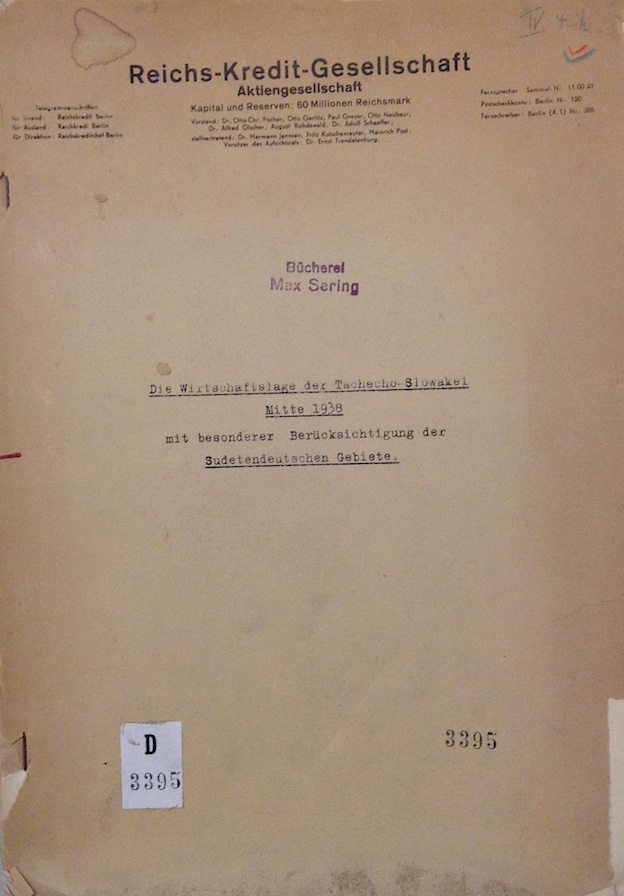
1938Best.-Nr. 614348Berlin, (1938). 120 num. Bl. Mit 2 Karten. Klammergeheftet, vom Umschlag nur noch der lose u. eingerissene Vorderdeckel erhalten. [2 Warenabbildungen]
1928Hardcover, 8vo. , 480- pages. In German. Printed in black letter type. Volume One of Three [Allgemeiner Teil], but stands on its own. Race in the Humanities: Studies on the History of Racial Thought Schemann was known for translating the works of French racial theorist Gobineau, but changing the ideas to support Germany as the superior race, and Jews inferior and a racial enemy. He was later awarded by the third Reich for his work. SUBJECT (S) : Race. Ethnology. With publishers advertisements laid in. Light wear to covers. Good + condition. (HOLO2-34-5)
1947Original Paper Wrappers with paper label as issued, 12mo, 208 pages, 17 cm. In Hebrew. Early post-war re-issue of this Nazi-era imprint, originally published by the Judischer Verlag in Berlin in 1935. Title translates as Songs of Israel: Maccabi Union of Germany on behalf of the Pioneer Association in Germany. In Hebrew. Lyrics (romanized) --also printed as vocalized text in Hebrew script. Anthology of 230 zionist songs. Includes unacc. Melodies. Published by the Yudisher Ferlag of Berlin, under the auspices of Hechalutz and Maccabi World Union. Jakob Schönberg was born in Fürth, Bavaria on September 8, 1900. His father, David Schönberg, was chazzan (cantor) at the Claus-synagoge in Fürth. ... Schönberg apparently earned his living during Germany's Weimar Republic (1919-1933) as a pianist, music critic, conductor and composer. He wrote articles for the Nürnberger Zeitung and served as a musical consultant for Bavarian Radio in Munich. Bavarian Radio performed some of his orchestral compositions. He also worked in films as a "musical conductor and illustrator" and some of his film music was published by Schott's Söhne, Mainz, and Hawkes and Son, London. Schönberg was interested in composing instrumental music especially orchestral. His first orchestral work, Prelude Symphonique, premiered in 1923. ... His style of composition took a decidedly Jewish turn after the Nazis took power in 1933, and Jewish musicians could no longer be employed by Germany's state-supported cultural institutions. In 1934 Schönberg transcribed the folk songs and dance tunes of several halutzim (pioneers) visiting Germany from Palestine. The following year he published Shire Erets Yisrael (Songs of the Land of Israel) , an anthology containing 230 Hebrew songs (Berlin: Jüdischer Verlag, 1935) . From this time until, at least, when he left Germany, these Israeli melodies would figure prominently in Schönberg's work. He set several of them for voice with piano and voice with flute and viola. His Suite für Orchester, 3 Sätze utilizes a Horra melody from the anthology. Schönberg's orchestral Horras appear to have been extremely popular in Nazi Germany, and were performed numerous times by the Jüdischer Kulturbünde between 1936 and 1938, in both Berlin and Frankfurt-am-Main (Jakob Schonberg Collection; JTSA) . Subjects: Zionism - Songs and music. Songs, Hebrew - Palestine. Jews - Palestine - Music.. Lyrics (romanized) also printed as vocalized text in Hebrew script. Includes unaccompanied melodies. Light wear, Good Condition (Holo2-68-20A)
1933Best.-Nr. wa644Vaterländischer Verlag Weller Cartonné avec jaquette 1933 In-4 (23 x 29,3 cm), cartonné avec jaquette, 262 pages, texte en allemand, Julius Streicher est un éditeur antisémite allemand, cadre du NSDAP, qui fut exécuté en 1946 à l'issue du procès de Nuremberg ; traces sur les plats de la jaquettes, incidents et petits manques sur les bords de la jaquette, rousseurs aux gardes, par ailleurs assez bon état général. Livraison a domicile (La Poste) ou en Mondial Relay sur simple demande.
1934Best.-Nr. qi2036Vaterländischer Verlag Weller Cartonné avec jaquette 1934 In-4 (23 x 29,5 cm), toile d'éditeur bleue, 410 pages, texte en allemand, photographies en noir in et hors-texte, illustration en noir en frontispice Julius Streicher est un éditeur antisémite allemand, cadre du NSDAP, qui fut exécuté en 1946 à l'issue du procès de Nuremberg ; mors supérieur fendu dans sa totalité, dos insolé, coiffes et coins frottés, quelques taches d'usage aux plats, légères rousseurs aux gardes, état correct. Livraison a domicile (La Poste) ou en Mondial Relay sur simple demande.
1945Original Illustrated Wrappers. 16mo. [36] pages. 18 cm. Illustrated with over 36 Anti-Nazi cartoons. First edition. De Jong #623. Written by Anne Cornelis Veth and Illustrated by Karel Leendert Links. Published anonymously and clandestinely during the Nazi occupation of the Netherlands. Illustrated throughout the text with anti-Nazi caricatures. Colophon on final page roughly translates as, On 1 April 1945 (Easter) came this work as the second piece of Ondergrondsche Knock-Out-Press. Offset printed on wood-free paper. The drawings and calligraphy from the same hand. The proceeds will benefit the victims of the current tyranny, whose end is in sight, as the hordes of oppressors meet their destruction on our home soil by the masterly strategy of the English, Americans and Russians. Subjects: World War, 1939-1945 -- Netherlands -- Poetry. Caricatures and cartoons. Humor. German occupation, 1940-1945. OCLC lists 4 copies worldwide. (British Libr. , UC Berkely, Northwestern, Bibliotheque Nationale de France. ) Light shelf wear, with minimal staining and light rubbing. Text block clean and fresh. Very good + condition. (HOLO2-110-17) xxxxx
1933Best.-Nr. 87713Altona Bahrenfeld Cigaretten- Bilderdienst 1933 In-4. Cartonnage éditeur pleine toile brune, report du titre or sur le dos et le premier plat, profil de SA or sur le premier plat, 150 pp., 225 vignettes la plupart en couleurs contrecollées. 1 vignette altérée, autrement bon exemplaire. - Photographies de Heinrich Hoffmann
1934Best.-Nr. 87716Stuttgat - Berlin, Friedrich Bohnenberger-Verlag 1934 Photographies de Heinrich Hoffmann
LEGATURA IN BROSSURA EDITORIALE, TESTO IN LINGUA FRANCESE numero pagine: 685 formato: 22.7X14.5 stato conservazione: BUONO, COPERTINA CON TRACCE D'USO CON MINIMO ANGOLO MANCANTE E TAGLI AI MARGINI traduttore: J. GAUDEFROY - DEMOMBYNES ET A. CALMETTES
Best.-Nr. 12104Zeitchrift der Sturmabteilungen der NSDAP. DIE SA. In 4 broché, 24 pages, texte sur 2 colonnes .illustrations photo , München. Organisation para militaire dont et issue la SS. Les SA ,Jouèrent un rôle important dans l’accès au pouvoir d’Hitler au parlement, en 1933. Rare réunion de 10 numéros : .n°21-22 du 21 juin 1940 (il manque le deuxième plat de couverture- n°26 19 juillet 1940. N°27 du 26 juillet- n° 28 du 2 Août- n°30 16 août-n° 31 du 23 août- n°34 du 13 septembre- n° 35 du 20 septembre- n°36 du 27 septembre 1940. L’ensemble des numéros
1938Best.-Nr. wq852Essener Verlaganstalt Relié 1938 "Rare volume relié en toile (17 x 25cm) 732 pages numérotées, puis 4 pages non paginées de table des matières, suivie d'une carte dépliable de l'Europe de l'Est ; ouvrage abordant la ""question juive"", l'Allemagne nazie et les persécutions raciales et antisémites en Europe de l'Est à cette époque, illustrations, cartes et photos en noir et blanc ; reliure légèrement frottée et pliée au dos, quelques taches de rousseur, bon état général. Livraison a domicile (La Poste) ou en Mondial Relay sur simple demande."
19332 voll. bross. edit. ill., lievi rotture alle cop., timbri ed etichette di biblioteca estinta, lievissime mancanze ai margini sup. delle ultime pp. del primo volume, sigle segnate a penna alle quarte di cop.
1967Opera monumentale in 6 volumi. Edizione italiana del 1967, tradotta dall'edizione originale inglese da Antonio Ghinelli, Eleonora Heger, Lydia Magliano. Copertine in mezza legatura in pelle rossa, con titoli e fregi dorati e piatti in tela. Tagli anch'essi ingialliti e con qualche segno di polvere; pagine in ottimo stato.
1936Best.-Nr. GITc775Berlin Han Eugen Hummel 1936. Grand in-8 6 feuillets non chiffrés 13-398pp. Reliure éditeur percaline noire bradel, titre argenté sur le dos et le 1er plat, celui-ci décoré d'un grand aigle germanique argenté et d'un drapeau rouge nazi, sous emboîtage cartonné gris à bandes noires. Portrait de Hitler en frontispice et 200 illustrations d'après des documents et des photographies, réunies par Arnold Schlen. Bel exemplaire frais. Impression gothique.
192112mo; 1st edition. Original green cloth, 12mo, 255 pages. 20 cm. Singerman 0118: This set is "The most well-known American contribution to the literature of anti-Semitism." Henry Ford, a noted anti-semite, had a close association with Dearborn, MI. Ford did not write the articles. He expressed his opinions verbally to his executive secretary, Ernest Liebold, and to William J. Cameron. Cameron had the main responsibility for expanding these opinions into article form. Liebold was responsible for collecting more material to support the articles. The Dearborn Independent, also known as The Ford International Weekly, was a weekly newspaper established in 1901, and published by Henry Ford from 1919 through 1927. The paper reached a circulation of 900,000 by 1925, second only to the New York Daily News, largely due to a quota system for promotion imposed on Ford dealers. Lawsuits regarding antisemitic material published in the paper caused Ford to close it, and the last issue was published in December 1927. The publication's title was derived from the Detroit suburb of Dearborn, Michigan. Derived largely from information found posted on line: Convinced that "bankers" and "the Jews" were responsible for a whole range of things he didn't like, from the world war to short skirts to jazz music, Henry Ford used his newspaper, the Dearborn Independent, to carry on an active anti-Semitic campaign. Between 1920 and 1922 a series of articles denounced all things Jewish. While officially apologizing for the articles in 1927, Ford's anti-Jewish sentiments ran deep. In January 1919, Henry Ford began publication of the Dearborn Independent, a small community weekly he had purchased the previous year. Carrying the subtitle, The Chronicler of the Neglected Truth, the paper primarily served as a forum for Henry Ford's views. Each issue of the Independent carried "Mr. Ford's Own Page," an editorial expressing his opinions, written by William J. Cameron. The Ford Motor Company pressured car dealers to buy multiple subscriptions and hand out copies to customers. The newspaper was popular, and circulation reached 900,000 in 1926. The Dearborn Independent would, most likely, have remained a sidebar in Ford's biography were it not for a controversial series that began on May 22, 1920 and lasted for several years. Appearing on the front page every week, "The International Jew: The World's Problem" examined a purported conspiracy launched by Jewish groups to achieve world domination. The basis for the articles was a notorious forgery, The Protocols of the Elders of Zion, an anti-Semitic hoax, first published in Russia in 1903. Many have accused Ford's personal secretary, Ernest Liebold, of being the source of the campaign, and Liebold's anti-Semitic views are well documented. William Cameron, editor of the Independent, was an enthusiastic supporter of the publication of the anti-Semitic diatribes. However, Ford's own attitudes towards Jews were the major reason for the publication of "The International Jew." His anti-Semitic beliefs formed along several strands from his upbringing, attitudes, and personal beliefs. A common stereotype at the time led some people to assume that Jews controlled the international banking system; that belief may have fed his anti-Jewish feelings. The publication of "The International Jew" caused an uproar. In some quarters, such as anti-immigrant and nativist groups, the series confirmed their own beliefs. Others were appalled by the series, published demands for a retraction, removed the paper from public libraries, and promoted a boycott of Ford automobiles. Some Ford dealers refused to carry the paper. Responding to this pressure, Ford halted publication of the anti-Jewish series in January 1922, only to start it up again less than a year later. Small spine label, library bookplate, pocket on rear blank pastedown, light wear to cloth, Text pages all very clean, no other markings, Gery Good- Condition. (HOLO2-63-21G)
19221st edition. Original green paper wrappers, 12mo 246 pages. Singerman 0132. This is the final separately issued volume of the International Jew set, which is "The most well-known American contribution to the literature of anti-Semitism." These articles were originally published in the Dearborn Independent. Light wear and stains to cover, closed tear to one page, Nice, Good+ Condition. (Holo2-63-21D)
1936Original Wrappers. 12mo. 16 pages. 1st edition. Full title: The Yiddish Scientific Institute YIVO: devoted to research and training in the domain of Jewish scholarship. An early Nazi-era publication of the American Branch of YIVO in New York, this publication describes the aims, organization, achievements, prospects, and future needs of the YIVO institute in Vilna, which would be overrun by Hitlers armies 4 years later. A very interesting early publication from the American Branch of YIVO in New York; in four years time from this published brochure the city to become the final location of the YIVO institute. On the first page lists the Honorary Board of Trustees: Simon Dubnow, Albert Einstein, Sigmund Freud, Moses Gaster, Edward Sapir, Chaim Zhitlowsky. Subjects: Yivo Institute for Jewish Research. OCLC lists only one copy (Spertus Institute) . An important document linking 2 of the greatest thinkers of the early 20th Century to each other and to Jewishness. Very lightly soiled, with lightly bumped edges. Very good condition. (HOLO2-95-16)
1943Original wraps. 8vo. 19 pages. 23 cm. First Spanish edition. Abridged. Published simultaneously in English as Post-War Migrations: Proposals for an international agency (54 pages in length) , the Spanish edition title translates as Suggestions for the Regularization of Post-War Migrations. No citation of translators name. Published under the auspices of the Research Institute on Peace and Post-War Problems of the American Jewish Committee. Introduction by Paul Van Zeeland; this 1943 report intended to situate the reality of massive displacement and post-war migration of refugees and attempts to unite interested parties on a global field to begin preparations for post-war assistance. Settlement of refugees in Latin America would be an important part of the reconstruction of Jewish life after the war, but, ironically, it became the home of many Nazis fleeing post-war Europe as well. Max Gottschalk (18891976) , Belgian social scientist and Jewish leader. [ ] He directed the Research Institute for Peace and Postwar Problems of the American Jewish Committee (194049) and from 1959 the Centre National des Hautes Etudes Juives, financed by the Belgian government. As president of the Belgian Committee for Refugees from Nazi Germany (193340) , he was instrumental in the rescue of the passengers from the ship St. Louis, which was sent back from Cuba and finally permitted to land in Antwerp (July 1939) . (EJ 2007) Paul Guillaume van Zeeland (11 November 1893 22 September 1973) was a Belgian lawyer, economist, Catholic politician and statesman born in Soignies. In 1939, Van Zeeland became president of the Committee on Refugees, established in London, and was made High Commissioner for the repatriation of displaced Belgians in 1944. In 1946, he was one of the founders of the European League for Economic Cooperation. Subjects: Emigration and immigration. Migration, Internal - Europe. World War, 1939-1945 - Refugees. No listings on OCLC. Near fine condition. Rare. (HOLO2-104-13)
Best.-Nr. DADAX0231185626New unknown