903 résultats
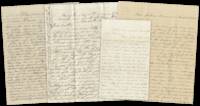
1865réf. BK0020Mississippi Louisiana Virginia Massachusetts and Maine 1865. Nine letters totaling 33 pages. One repaired with archival tape the remainder in excellent condition; overall very good to excellent. See inventory for detailed condition information. A collection of nine Civil War letters mainly written by Almon Libbey Varney to his cousin Cyrus Bede Varney then at Bowdoin College; with one from his sister Elma Ladora Varney and one from "Dan" likely also a relative. After attending Bowdoin College Almon Varney 1839-1922 was appointed Lieutenant with the 13th Maine Regiment and served in the lower seaboard theater of the Civil War. He was promoted to captain in 1862 and was a career military officer retiring as a colonel in 1904. Varney first writes from Ship Island Mississippi where he is on guard duty at the prison; prisoners include those who broke parole "political offenders" a few judges whom he deems "swarthy Lotharios" and even several women who are "regular Amazons". The latter includes Eugenia Levy Phillips wife of former Alabama Representative Philip Phillips. The island was occupied by General Butler's expedition in 1861. It was a strategic point for operations in the theater and became a Confederate prisoner of war camp and a base for the Louisiana Native Guards an African American unit with which Varney takes particular issue-in an 1863 letter from Fort Jackson he complains at length about the idea "that a negro could be made my superior or even equal by virtue of legislation and commission alone" and that African Americans could command "the intelligent sons of New England." From Fort Jackson Varney complains of the tediousness of his war experience having "seen nothing of the privations of long tedious marches and hard fighting" which he would have chosen over "this inglorious idleness". At other points he compares his experiences with those of his brother Edward 1842-1863 who fought at Antietam. Edward was imprisoned at Belle Isle and then Libby Prison and Elma's letter copies a letter from an anonymous fellow prisoner reporting on Edward's illness and death at Libby. Overall the letters document in great detail both life in the Union Army outside of combat and the attitudes of many elite Northern army men towards the Confederacy and towards their African American fellow soldiers. 1. August 1862 Letter from Ship Island Describing Confederate Prisoners and the Civilians Fleeing from Impressment in the Confederate Army. Four page letter measuring 8 ½ x 10 ½ inches with envelope postmarked New Orleans and addressed to "Cyrus B. Varney Windham Maine". Dated August 21 1862. Excellent. Varney writes from guard duty at the prison on Ship Island off the coast of Mississippi describing the prisoners held there: "about twenty prisoners; and among them three women - regular Amazons". The men include "6 men taken at fort Jackson who violated their Parole d'honneur - 4 judges regular 'swarthy Lotharios' and some other political offenders" and the women include "a Mrs La Rue sent here for wearing a secesh flag in the streets of New Orleans" and Eugenia Phillips: "Mrs Phillips wife of senator sic Phillips who made such a stir and was imprisoned in Washington last Summer is one of our female prisoners. Her husband is here visiting her. I've been out to sail with him to day. He is a very sensible man and favorably disposed toward the union; but his wife is a regular tyro. She thinks pretty well of me though I guess - she has given me a book to remember 'my prisoner' by. I use her as well as I can without 'overstepping' my orders of course." Eugenia Phillips had first been detained under house arrest-for Confederate sympathizing and suspected spying-in Washington D.C. and fled with her family to New Orleans after her release. When she was accused of mocking a deceased Union soldier General Butler had her imprisoned on Ship Island from which her Unionist husband Philip Phillips was able to secure her release after several months. Varney describes the reinforcements being sent in from the North for the war effort around New Orleans and the effects of Union control of the region: "The rascals are very busy down here and we have to look out for them on all sides. They are forcing everybody into the service native and foreign. There is a great deal of distress in Miss. and Alabama on account of scarcity of food. It is sublimely absurd for them to say our blockade is ineffective. Great numbers of refugees are daily arriving from the Main land to excape sic starvation and impressment into the service. Six men came today from Mobile. They the people who are left in the city are cursing the 'Yankees' that they don't take the place and relieve them from the oppression of their rulers and give them something to eat." He predicts that if the "rebels . are not eminently successful" in the fall that "they are done forever" especially given the Union's numbers "But the way how the new regiments come on I guess 'Old Abe' is going to 'give it to em curious'. Six hundred thousand more men! What an army!" and cautions Edward Varney against joining. 2. November 1862 Letter from "Brooks Station" Virginia Discussing Insufficient Provisions for Union Men and a Death from Exposure. Three page letter measuring 7 ¾ x 9 ½ inches from Almon Varney headed "Dear Brother" i.e. Edward Varney. Dated November 29 1862. Excellent to Near Fine. Varney writes to his brother following a journey to get winter clothing to his regiment a mission which "two had tried before & failed". He describes the death of a soldier from lack of sufficient clothing: "One of our Regt. is just being buried and his Company are firing volleys three in number over his grave. He was a great stout rugged man when he entered the service and had his health discharged by exposure resulting from the want of necessary clothing. He was anxious to do his duty & marched many a day with bare feet or in his stocking feet. I tried hard to get him a pair of shoes but could not find a pair in the brigade large enough." He comments on the state of railroads in the area and the dwindling size of Union forces: "Everything here connected with the railroad was burned last summer or otherwise destroyed. The country about here is filled with men. But the regiments are most all small. Do not say to yourself there is five thousand men in a brigade where you read five Regts. We could carry into action not over four hundred & fifty men. What has become of the rest I cannot tell. 3. December 1862 Letter from Ship Island Comparing His Experience There with Edward Varney's Experiences at Antietam and Expressing a Rising Pessimism about the War. Four page letter measuring 5 x 8 inches from Almon Varney to "cousin" likely to Cyrus Varney. Dated December 2 1862. Excellent to Near Fine. Back on Ship Island Varney complains of the boredom of garrison life comparing his war experiences with those had by his brother Edward at Antietam: "I shouldn't be surprised if we were kept here till the end of the war if it ends during our natural lives. We've been here already nearly a year and part of us have never heard a rebel shot. None of us have ever felt them. I am very uneasy and impatient. I want to have a finger in the pie. . Ed. is seeing some of the realities of war. He gave me a description of the field at Antietam. It was horrible. . For us - we have a little amusement occasionally watching the maneuvers of the fleet in harbor. Two or three nights since our ears were startled by the report of a 130 pound cannon and the whizzing of a shot directly over our barracks. I rushed out and saw the gun boat Pinola under full steam making for a strange looking steamer also under a pressure of steam - with lights out - sailing along directly under the Miss shore. The Pinola kept on in silence till she found the unknown was gaining on her and then she blazed away. If your imagination is big enough to comprehend it you can tell what kind of noise 15 or 20 130 pound cannons would make. It sounded something like war I can tell you. I have heard nothing like it since the bombardment of fort Jackson." Compared to earlier letters Varney seems to feel pessimistic about the war; though he vows that he will "never consent to making peace with these infernal rebels till they are thrashed or we are ruined" he states that "We don't begin to show the energy and determination that they do. They fight with little or no food not sufficient clothing and yet our well fed troops can't cope with them." The Confederate Army had just raised its maximum age limit to 45 years old and was ruthless in its conscription; Varney compares this with what he sees as the subpar efforts of the Union Army: "There is 'a leak' somewhere. A man escaped from Biloxi the other day who gave me an order from a Capt. and enrolling officer ordering him to report to Camp Mays on Wolf river in Miss within 8 days or be considered a deserter. He was also ordered to take with him his blanket and three days rations. That is a little different from the way our troops are raised - with 2 or 3 hundred dollars bounty. We can't whip them without we put forth more energy." 4. March 1863 Letter from Fort Jackson Louisiana Explaining at Length a Conflict Involving Varney Refusing to Fight Alongside African American Troops. Six page letter measuring 8 x 9 ½ inches from Almon Varney to "cousin". Dated March 24 1862. Some pages repaired with archival tape; very good. An indignant Varney describes his side of "certain 'commotions' 'uprisings' 'insubordinations' 'disgraceful conduct' &c &c" on his part that had been reported home in various news sources. The conflict involved Varney's refusal to fight alongside the Louisiana Native Guard an African American regiment. Varney writes: "As you know I suppose my Co. and Co. F. of this Regt. Capt C.R. March have garrisoned at Ship Island for the past year under command of our col. Henry Rust. When Banks came we tried to get a position in the ban - and finally it was promised. But the promise was never fulfilled The order was once issued for us to concentrate at Baton Rouge but it was immediately countermanded and Col. Rust was ordered to take command of these two forks on the Miss. and 7 Cos. of a Negro Regt under Col. Nathan W. Daniels were sent to reinforce us at Ship island. And in passing allow me to correct one statement of the press. Col. Daniels is neither a 'French officer' nor a 'gentleman' as was alleged. Nor is he wealthy. . He is a low-born vile besotted gambler. . When Col. Rust found he must leave No lions in Daniel's den us he went to Col. D. and told him it be folly to attempt 'to compel New England soldiers to obey Negroes for officers' and still more foolish to 'attempt to compel an accomplished and educated officer of our army' to do so. Col. D promised in bona fides that the duties at the Pot should be as separate as they always had been and that the white soldiers should not be mingled with the Black. But he was false as H-ll. He never intended to fulfill his agreement. Col. Rust had not left the harbor before I received a written order for the consolidation of my Co. with that Negro robber. I protested in writing . I knew it would spoil my Co. I have a fine Co. and I am proud of it; and you may be sure the thought was humiliating and revolting in the extreme that these men should be demoralized and spoiled by such associations. I did not care what they did with the n-rs I am willing they should make soldiers or anything else of them - But I was unwilling to admit that a negro could be made my superior or even equal by virtue of legislation and commission alone. Negro officers are well enough in their places perhaps - but let them command Negroes not the intelligent sons of New England. It has been said that these Colored officers are refined and educated. They are as much so and more than one could possibly expect of a race so down trodden and oppressed as the African - especially here in Louisiana". Varney "positively refused to obey any such orders" and after two days of "wrangling" and "calling him a coward" he "prevailed upon Capt. March to endorse" his written refusal. Varney and his fellow officers "were all arrested . Charges were prepared against us and sent to Gen. Banks for approval." Banks "didn't approve them" but instead the men were sent to Fort Jackson "where we are at present and may be for a considerable time to come." In an aside within his tirade Varney comments on the state of African Americans in Louisiana where "slavery can be seen in its worst and most malignant form": "The bloodhounds we read of in Uncle Tom's Cabin are by no means beasts of fable; and slaves scarred by their teeth are by no means a rarity." 5. June 1863 Letter from Fort Jackson Expressing the Boredom of Garrison Life and Loathing for Louisiana. Four page letter measuring 8 x 12 ¼ inches from Almon Varney to "cousin". Dated June 12 1863. Excellent. Varney describes the monotony of life at Fort Jackson: "My lot though has been comparatively easy - I have seen nothing of long tedious marches and hard fighting yet I would choose it rather than live in this inglorious idleness. I am forgetting all I ever knew - there is hardly excitement enough to keep my mind from dwindling into nothingness. . The routine of garrison life is dull enough. In the morning 'reveille' and roll-call - breakfast - then perhaps attend to drawing rations for my men or issue a little clothing or something of the sort - then dinner - policing quarters - maneuvering our guns - dress parade - supper - - go to bed and in the morning get up and go through with the same again." The most excitement he experiences is when the occasional "ship passes and our ears are stunned by the noise of the signal" at which point men "scramble" to the artillery; but "When everything is found to be all right the retreat is beaten . the men retire to their quarters to wait for a new excitement". After describing the insects-especially mosquitoes-and alligators Varney comments: "This part of the Southern Confed. is a pestiferous place indeed - if it's all like this I would respectfully recommend Uncle Abe to give it up to the indigenous race. If they are not like the Pontic Monarch of old who fed on poison they will die. I do not wonder these Southern chivalrous gentlemen are so full of venom They imbibe it with the air they breathe." 6. September 1863 Letter from "Dan" in Arlington Heights Virginia Reporting on the State of the War There. Three page letter measuring 5 x 8 inches from "Dan" to his "cousin" possibly also Cyrus Varney. Dated September 16 1863. Excellent to Near Fine. A letter from "Dan" possibly a relative of the Varney family in Arlington Heights Virginia. Dan provides his "cousin" with updates on his activities including digging trenches guard duty and "a temperance meeting at the Chaplain's tent tonight" which he is skipping in order to write. He remarks: "I think this war is all a speculation and most of the boys are sick of the 'show' we have a chance to see something of it although not much don't know but I have enjoyed myself here as well as I should at home". When he gets home Dan writes his first order of business will be to go to a Shaker meeting and then get to haying. 7. February 1864 Letter from the US Arsenal in Watertown Massachusetts Discussing Lincoln's "spiteful" Ten Percent Plan. Four page letter measuring 5 x 8 inches from Almon Varney to "cousin". Dated February 23 1864. Excellent to Near Fine. From the US Arsenal in Watertown Varney writes to his cousin about the conflict between Lincoln and Congress likely over Lincoln's Proclamation of Amnesty and Reconstruction also known as the Ten Percent Plan: "You know of course of the wrangle between Congress & the Pres. The President now seems inclined to issue a proclamation that the Country is in a state of peace despite the opinions of Congress. If he does that the nature of those acts in-creasing the Army in 1863 makes them null and void - and I and scores of other appointments are cut adrift. It is a piece of 'bull-headed-ness' on the part of the Pres. - just a spiteful blow levelled at Congress. I dont feel much concerned about it - I guess I can find something to do though it will seem rather awkward after having been in the army so long. But I shall be rid of one inconvenience which is really serious - I shall not be ordered about from one place to another at the pleasure of other people. . One disadvantage of this 'butt-headed-ness' of the president is that I intended to be married in May - If he shows me out it will slightly disarrange my plans". 8. May 1864 Letter from Elma Varney Reporting on the Death of Edward Varney at Libbey Prison. Three page letter measuring 5 x 8 inches from Elma Varney in Brunswick Maine to "cousin". Dated May 3 1864. Excellent to Near Fine. A letter from Almon and Edward's sister Elma in which she copies a letter sent to their mother by an unknown man who was imprisoned with Edward at the infamous Belle Isle military prison in Richmond Virginia. The man writes: "He was taken sick the first of Dec of Chronic Diarhea and failed very fast. When we carried from the Island poor fellow he was nothing but a mere shadow and so weak that we had to carry him in a blanket. . He had no medical attendance at all while on the Island. He slept in the same tent with me it was an old tent all full of holes and when it rained we were wet all the time. Our bed was the bare ground with one blanket over us. The box of provisions you sent to him never came. It was confiscated by the rebels. He wrote considerable more but I will not dwell any longer on the subject. Last Tuesday we read his name in the paper in the list of names of those who had died in a hospital attached to Libby prison. It is a rebel account and we hope to hear it contradicted." 9. December 1865 Postwar Letter Reporting His Marriage Plans. Two page letter measuring 5 x 8 inches from Almon Varney in Watertown Massachusetts to his cousin Cyrus Varney in Waverly New York. With stamped envelope postmarked Watertown MA. Excellent. In the final letter in the collection Varney reports to his cousin on his Thanksgiving activities back home and on his plans for marriage. . unknown books
1864réf. 25614The second in a series of four racist political cartoons published in 1864 by Bromley & Company which was closely affiliated with the Copperhead New York World newspaper. These prints sought to undermine Abraham Lincoln's chances for reelection by branding him as a "miscegenationist" and playing on white fears of "race-mixing." The cartoon scene pictures several interracial couples enjoying a day at the park eating ice cream discussing wedding plans and a woman's upcoming lecture. Two African American families have white employees a carriage driver and footmen and a babysitter. The only other example traced at auction brought $7800 in 2010. ABRAHAM LINCOLN. RACISM.Print. "Miscegenation or the Millennium of Abolitionism." Political Cartoon. New York: Bromley & Co. 1864. 1 p. 20¾ x 13â… in. American politics had long played on fears of sexual relationships between races. A powerful new word for "race-mixing" was coined in an anonymous December 1863 pamphlet entitled Miscegenation: The Theory of the Blending of the Races Applied to the American White Man and Negro published in New York. Purporting to advocate the virtues of the "blending of the white and black races on this continent" it was a literary forgery prepared by The World managing editor David Goodman Croly and reporter George Wakeman. The authors were unsuccessful in their attempt to trick President Lincoln into endorsing the work. At the far left of the image Abraham Lincoln declares "I shall be proud to number among my intimate friends any member of the Squash family especially the little Squashes." The African American woman to whom he is speaking replies "I'se 'quainted wid Missus Linkum I is washed far her 'fore de hebenly Miscegenation times was cum. Dont do nuffin now but gallevant 'round wid de white gem'men! he-ah! he-ah! he-ah!" Senator Charles Sumner says "Mr. President! Allow me the honor of introducing my very dear friend Miss Dinah Arabella Aramintha Squash." A white carriage driver complains in the background "Gla-a-ang there 240t! White driver white footmen niggers inside my heys! I wanted a situation when I took this one" while a black man in the carriage tells his companion "Phillis de_ah dars Sumner. We must not cut him if he is walking." A black woman at a table tells a white man with her "Ah! Horace its-its-its-bully 'specially de cream" and he replies "Ah! my dear Miss Snowball we have at last reached our political and social Paradise. Isn't it extatic" To the right are two couples embracing each a white woman and an African American man. The first white women tells her partner "Oh! You dear creature. I am so agitated! Go and ask Pa" to which he replies "Lubly Julia Anna name de day when Brodder Beecher shall make us one!" The second white woman says "Adolphus now you'll be sure to come to my lecture to morrow night won't you" to which he answers "I'll be there Honey on de front seat sure!" In the background are various immigrant minorities viewing the scene. One exclaims "Most hextwadinary! Aw neva witnessed the like in all me life if I did dem me!" and another adds "Mine Got vat a guntry vat a beebles!" An Irish girl complains "And is it to drag nagur babies that I left old Ireland Bad luck to me." Manton Marble the editor of The World collaborated with printmaker Bromley & Company to issue a series of four anti-Lincoln "Political Caricatures." The present example was the No. 2 in that series. No. 1 was "The Grave of the Union or Major Jack Downing's Dream"; No. 3 "The Abolition Catastrophe Or the November Smash-up"; and No. 4 "The Miscegenation Ball." Republicans responded by trying to turn the "miscegenation" charge against the Democrats. A Republican print "The Political "Siamese" Twins: The Offspring of Chicago Miscegenation" pictures McClellan and Pendleton joined together despite their very different ideas on ending the war. Although Abraham Lincoln won New York states' electoral votes in 1860 Stephen Douglas had carried New York City and its environs. Financial elites fearing that civil war would ruin business and recent immigrants fearing competition with free black labor supported Douglas. Lincoln's unpopularity in New York City during the Civil War was a factor in the deadly 1863 Draft Riots. In 1864 Lincoln again won the states' electoral votes while New York City favored his Democratic opponent McClellan. In fact Lincoln's majority dropped from 50136 votes in 1860 to only 7373 votes in 1864 with approximately 50000 more total votes cast than in 1860. Bromley and Company continued to sell the caricatures after the election as this January 1865 advertisement from an Ohio newspaper makes clear. Another advertisement assured purchasers that the set of four prints available for $1 were "sent on wooden rollers to insure safe carriage." The World 1860-1931 a daily independent newspaper was published in New York City. Alexander Cummings founded it as a religious Republican outlet in 1860. August Belmont and others purchased it in 1862 changing the editorial focus. With editor Manton Marble 1834-1917 The World soon became the country's leading Democratic newspaper. In 1864 Union authorities shut down The Worldand another paper for three days after they published forged documents purportedly written by Lincoln that were really part of a hoax to manipulate the price of gold. The paper actively supported George B. McClellan against Lincoln in 1864. Condition Fine for exhibit despite flaws. Cropped with loss of "Political Caricature No. 2" from top edge and part of printed pricing information from bottom edge publisher's name rubbed out from the copyright statement lacking ½" from lower left corners a few short tape repairs by the edges a 2" closed tear through the second dialogue bubble along the top edge and a 3" closed tear parallel to the right edge. Mount remnants on verso.
1864réf. 25614The second in a series of four racist political cartoons published in 1864 by Bromley & Company which was closely affiliated with the Copperhead New York World newspaper. These prints sought to undermine Abraham Lincoln's chances for reelection by branding him as a "miscegenationist" and playing on white fears of "race-mixing." The cartoon scene pictures several interracial couples enjoying a day at the park eating ice cream discussing wedding plans and a woman's upcoming lecture. Two African American families have white employees a carriage driver and footmen and a babysitter. The only other example traced at auction brought $7800 in 2010. ABRAHAM LINCOLN. RACISM.Print. "Miscegenation or the Millennium of Abolitionism." Political Cartoon. New York: Bromley & Co. 1864. 1 p. 20¾ x 13â… in. American politics had long played on fears of sexual relationships between races. A powerful new word for "race-mixing" was coined in an anonymous December 1863 pamphlet entitled Miscegenation: The Theory of the Blending of the Races Applied to the American White Man and Negro published in New York. Purporting to advocate the virtues of the "blending of the white and black races on this continent" it was a literary forgery prepared by The World managing editor David Goodman Croly and reporter George Wakeman. The authors were unsuccessful in their attempt to trick President Lincoln into endorsing the work. At the far left of the image Abraham Lincoln declares "I shall be proud to number among my intimate friends any member of the Squash family especially the little Squashes." The African American woman to whom he is speaking replies "I'se 'quainted wid Missus Linkum I is washed far her 'fore de hebenly Miscegenation times was cum. Dont do nuffin now but gallevant 'round wid de white gem'men! he-ah! he-ah! he-ah!" Senator Charles Sumner says "Mr. President! Allow me the honor of introducing my very dear friend Miss Dinah Arabella Aramintha Squash." A white carriage driver complains in the background "Gla-a-ang there 240t! White driver white footmen niggers inside my heys! I wanted a situation when I took this one" while a black man in the carriage tells his companion "Phillis de_ah dars Sumner. We must not cut him if he is walking." A black woman at a table tells a white man with her "Ah! Horace its-its-its-bully 'specially de cream" and he replies "Ah! my dear Miss Snowball we have at last reached our political and social Paradise. Isn't it extatic" To the right are two couples embracing each a white woman and an African American man. The first white women tells her partner "Oh! You dear creature. I am so agitated! Go and ask Pa" to which he replies "Lubly Julia Anna name de day when Brodder Beecher shall make us one!" The second white woman says "Adolphus now you'll be sure to come to my lecture to morrow night won't you" to which he answers "I'll be there Honey on de front seat sure!" In the background are various immigrant minorities viewing the scene. One exclaims "Most hextwadinary! Aw neva witnessed the like in all me life if I did dem me!" and another adds "Mine Got vat a guntry vat a beebles!" An Irish girl complains "And is it to drag nagur babies that I left old Ireland Bad luck to me." Manton Marble the editor of The World collaborated with printmaker Bromley & Company to issue a series of four anti-Lincoln "Political Caricatures." The present example was the No. 2 in that series. No. 1 was "The Grave of the Union or Major Jack Downing's Dream"; No. 3 "The Abolition Catastrophe Or the November Smash-up"; and No. 4 "The Miscegenation Ball." Republicans responded by trying to turn the "miscegenation" charge against the Democrats. A Republican print "The Political "Siamese" Twins: The Offspring of Chicago Miscegenation" pictures McClellan and Pendleton joined together despite their very different ideas on ending the war. Although Abraham Lincoln won New York states' electoral votes in 1860 Stephen Douglas had carried New York City and its environs. Financial elites fearing that civil war would ruin business and recent immigrants fearing competition with free black labor supported Douglas. Lincoln's unpopularity in New York City during the Civil War was a factor in the deadly 1863 Draft Riots. In 1864 Lincoln again won the states' electoral votes while New York City favored his Democratic opponent McClellan. In fact Lincoln's majority dropped from 50136 votes in 1860 to only 7373 votes in 1864 with approximately 50000 more total votes cast than in 1860. Bromley and Company continued to sell the caricatures after the election as this January 1865 advertisement from an Ohio newspaper makes clear. Another advertisement assured purchasers that the set of four prints available for $1 were "sent on wooden rollers to insure safe carriage." The World 1860-1931 a daily independent newspaper was published in New York City. Alexander Cummings founded it as a religious Republican outlet in 1860. August Belmont and others purchased it in 1862 changing the editorial focus. With editor Manton Marble 1834-1917 The World soon became the country's leading Democratic newspaper. In 1864 Union authorities shut down The Worldand another paper for three days after they published forged documents purportedly written by Lincoln that were really part of a hoax to manipulate the price of gold. The paper actively supported George B. McClellan against Lincoln in 1864. Condition Fine for exhibit despite flaws. Cropped with loss of "Political Caricature No. 2" from top edge and part of printed pricing information from bottom edge publisher's name rubbed out from the copyright statement lacking ½" from lower left corners a few short tape repairs by the edges a 2" closed tear through the second dialogue bubble along the top edge and a 3" closed tear parallel to the right edge. Mount remnants on verso. books
