Macias, Eugenia et alBiblio.com

3.043 resultados
2015ref. 017123Universidad Nacional Autónoma de México 2015. This is a fine softcover copy with no wear at all. Completely clean. Text in SPANISH. DVD is present in envelope inside rear cover. Illustrated throughout in black & white and some color reproductions of Enrique Bostelmann's photographs. 9" square 214 pages. This catalog will be securely wrapped and shipped with tracking. First Edition. Soft Cover. Fine. Universidad Nacional Autónoma de México Paperback
ref. 6203468851.Gpaperback. Good. Access codes and supplements are not guaranteed with used items. May be an ex-library book. paperback
ref. 3639554213.Gpaperback. Good. Access codes and supplements are not guaranteed with used items. May be an ex-library book. paperback
2023ref. x-1032310758Routledge 2023. Hardcover. New. 424 pages. 8.50x5.44x1.23 inches. Routledge hardcover
2023ref. x-1032311444Routledge 2023. Paperback. New. 424 pages. 8.50x5.44x1.04 inches. Routledge paperback
2023ref. 28069Albuquerque NM: Tamarind Institute. Fine with no dust jacket. 2023. First Edition. Hardcover. Small 4to 9" - 11" tall; 68 pages . Tamarind Institute hardcover
1999ref. 61442Paris: Bibliotheque Nationale de France 1999. Paperback. Very good. Paperback. 142pp index. Very good in publisher's French fold wraps. Text in French. Bibliotheque Nationale de France paperback books
ref. 57594, New Guinea, South Pacific, Art, 1982 Original publishers paper-covered boards, 35 pages ill.
1982ref. 153856Los Angeles: UCLA 1982. Softcover. Very clean tight interior but with light general wear to covers and a small wrinkle to top right corner of front cover and pages. Silver-grey stapled wraps with color image and blue lettering. 35 pp. with bw frontis and 38 bw illustrations including 1 map. Catalogue from the exhibition of December 1982 to February 1983 at the Museum of Cultural History Gallery UCLA. The catalogue is No. 18 in the Monograph Series. Includes a bw map of the Papuan Gulf region of New Guinea an introductory essay text on The Elema Socio-Economic System essay on The Hevehe Cycle a summary and notes and a bibliography. Includes some fabulous masks! UCLA paperback
1982ref. 153856Los Angeles: UCLA 1982. Softcover. Very clean tight interior but with light general wear to covers and a small wrinkle to top right corner of front cover and pages. Silver-grey stapled wraps with color image and blue lettering. 35 pp. with bw frontis and 38 bw illustrations including 1 map. Catalogue from the exhibition of December 1982 to February 1983 at the Museum of Cultural History Gallery UCLA. The catalogue is No. 18 in the Monograph Series. Includes a bw map of the Papuan Gulf region of New Guinea an introductory essay text on The Elema Socio-Economic System essay on The Hevehe Cycle a summary and notes and a bibliography. Includes some fabulous masks! UCLA paperback books
2019ref. 2-6200015686Editorial Académica Española 2019. Paperback. New. 292 pages. Spanish language. 8.66x5.91x0.66 inches. Editorial Académica Española paperback
ref. 3846560901.Gpaperback. Good. Access codes and supplements are not guaranteed with used items. May be an ex-library book. paperback
ref. 8499884113.Gpaperback. Good. Access codes and supplements are not guaranteed with used items. May be an ex-library book. paperback
ref. LDM0054812We ship worldwide. 100% guarentee. BRAND NEW unknown
2007ref. Q-8472456218Editorial Kairos 2007-11-01. Paperback. New. New. In shrink wrap. Looks like an interesting title! Editorial Kairos paperback
ref. 8472456218.Gpaperback. Good. Access codes and supplements are not guaranteed with used items. May be an ex-library book. paperback
1935335p. 8vo. Original full cloth binding. EROS5
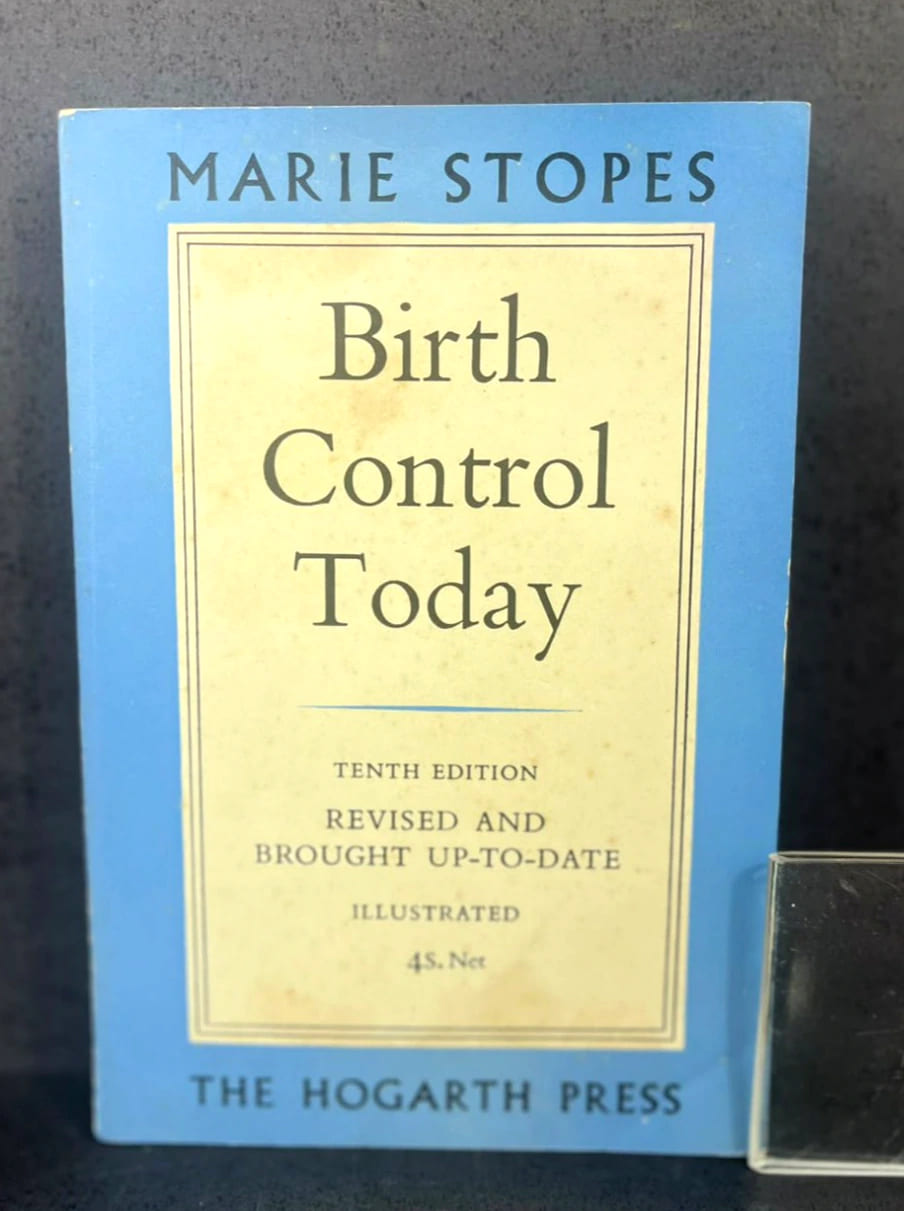
1954ref. QZI-40London: The Hogarth Press, 1954. Tenth edition, revised and brought up to date. Illustrated. 12.5 × 19 cm. [iii] leaves, 178 pp., [7] pp. An especially interesting signed presentation copy of Marie Stopes's influential handbook on contraception and family planning, personally inscribed by the author in blue ink: “To Antonio B. Martins Abranches, with the best wishes of the author, Marie C. Stopes. July 1956.” Accompanied by a printed “With Compliments” card from the C.B.C. and The Mother's Clinic, naming Marie C. Stopes as president and giving the organisation's address at 108 Whitfield Street, London, W.1. Also preserved is a fragment of the original envelope associated with the dedicatee. The combination of the personal inscription, the institutional compliments card, and the accompanying postal material provides a particularly appealing association with Stopes's own circle and with the organisation through which she disseminated her ideas. Marie Stopes occupies a complex and controversial position in the history of twentieth-century reproductive politics. A pioneering campaigner for access to contraceptive information and the founder of one of Britain's earliest birth-control clinics, she was instrumental in bringing subjects previously regarded as private, improper, or taboo into public and medical discussion. Her work helped establish contraception as an increasingly mainstream subject of scientific, social, and public-health debate. Yet her advocacy was also deeply intertwined with the eugenics movement. Stopes supported selective reproduction and established the Society for Constructive Birth Control and Racial Progress in 1921, linking reproductive control to contemporary theories of hereditary improvement and social reform. Rather than representing a straightforward abandonment of eugenics in favour of modern family planning, her career illustrates the considerable ideological overlap between these movements during the first half of the twentieth century. Indeed, the title page of this 1954 edition still identifies her as founder and president of the Society C.B.C. and Racial Progress. First published in 1934, Birth Control To-day was conceived as a practical guide for general readers. Its chapters discuss reproductive anatomy, domestic and clinical contraceptive methods, male contraception, ineffective or dangerous practices, comparative costs, and the role of specialist clinics and public authorities. The text is supplemented by anatomical illustrations and diagrams. The book also documents the gradual transition of birth control from a controversial social cause into a more widely accepted component of reproductive healthcare, while retaining traces of the eugenic assumptions that shaped part of its early institutional development. A notable association copy, signed only two years before Stopes's death in 1958, and accompanied by printed ephemera directly connected with her London clinic and birth-control organisation. Condition: Original blue printed wrappers, with some age-related spotting, light soiling, and minor edge wear. Interior generally clean and well preserved, with occasional signs of handling. Manuscript inscription clearly legible. The accompanying compliments card is preserved separately, together with the envelope fragment.
1992ref. 3831180243GLN-11, Departamento de Servicios Editoriales 1992
1927ref. QZI-35Bruxelles, Falk Fils et Georges Campenhout, 1927. Tome I seulement (sur deux). Édition originale. Un fort in-8, presque in-4, de 16,5 x 24,5 cm pour 513 pp. Relié demi-tissu mauve foncé, dos à 4 nerfs avec nom d'auteur et titre en caractères d'imprimerie dorés nettement poussés. Tampon de la Casa Garraux (première librairie française de São Paulo) sur la page de faux-titre. Ce livre fait un vaste tour d'horizon de la mouvance eugénique de son temps. On pourrait presque dire qu'il en est un annuaire ou un who's who. L'auteure nous mène parmi les associations d'éducation sexuelle, de birth-control (comme on disait alors), les congrès de médecins et "personnalités éminentes", avec de nombreux noms et dates. Si on retrouve certains noms connus du mouvement, comme ceux de Galton ou de Leonard Darwin, on croise aussi ceux de H. G. Wells ou de Keynes, de féministes premières vagues comme Margaret Sanger ou Marie Stopes, ainsi que d'une foule de docteurs et d'essayistes dont les livres et articles dorment sans doute dans bien des tiroirs. L'auteure s'attarde particulièrement sur la réduction des naissances en général et sur l'amélioration des conditions de vie dans les foyers, en particulier par la planification des naissances, dans un contexte où avoir 5 à 6 par femme demeurait normal. L'hérédité est admise, sans occuper, en Angleterre et en France, la place centrale que l'on pourrait imaginer. Nombreux tableaux, listes et statistiques.
1939ref. GIT20Paris Mercure de France 1939. In-8 broché 326pp. Orné d'un frontispice et 20 figures dont de nombreuses cartes à pleine page. Dos recollé avec manques de papier.
ref. Juanpebooks030058WE ship worldwide. Brand new 100%guarentee unknown
ref. Juanpebooks115600WE ship worldwide. Brand new 100%guarentee unknown
ref. Juanpebooks092392WE ship worldwide. Brand new 100%guarentee unknown
ref. Juanpebooks053374WE ship worldwide. Brand new 100%guarentee unknown