Herman H. RubinLivre Rare Book

3 résultats
1938réf. 588(English description below.) New York, Pioneer Publishing, 1938. Petit in-8 de 13 x 20 cm, (xiv) 574 pp. Reliure plein tissu percaliné d'un rouge pastel foncé, titre embossé au plat de couverture, titre et nom d'auteur en caractères d'argent au dos, filets doubles argentés en coiffe et queue. Reliures à la Bradel, très mince tranchefile. Préface du chirurgien-urologue Winfield S. Pugh. En 10 chapitres, richement illustrés de dessins en noir et blanc. En dépit de son titre, Eugenics and Sex Harmony insiste en fait sur l'éducation sexuelle, les rencontres hommes-femmes, la compatibilité des partenaires, les MST, la nutrition, les fameuses migraines... Le ton général est nettement plus enjoué que celui du reste de notre catalogue Eugénisme. En filigrane, une division claire entre littérature de spécialiste, technique, et livres destinés à un lectorat plus large. Le terme d'"eugénique" mêlait alors l'acquis, les conditions sociales ou matérielles d'une "bonne naissance" favorable à la santé de l'enfant et de sa mère, à l'hérédité, sans acrimonie particulière ou tabou autour de la question dite "nature versus nurture". Eugenics and Sex Harmony sera réédité plusieurs fois et reste presque courant sur le marché américain. ****** New York, Pioneer Publishing, 1938. New edition. Small octavo (13 x 20 cm), (xiv) 574 pp. Bound in full dark pastel-red percaline cloth; title embossed on the front cover; title and author's name in silver lettering on the spine; double silver fillets at the head and tail of the spine. Bradel-style binding; very thin headbands. Preface by urological surgeon Winfield S. Pugh. The book comprises 10 chapters, richly illustrated with black-and-white drawings. Despite its title, the book actually focuses primarily on sex education, male-female encounters, partner compatibility, STDs, nutrition, and common ailments like migraines—incorporating numerous cultural and historical elements that clearly mark it as a work of popularization and advice. The general tone is more lighthearted than that of the rest of our "Eugenics" catalog, reflecting a clear distinction between specialized technical literature and books aimed at a broader audience. It illustrates how the term "eugenics" at the time conflated acquired factors—such as the social or material conditions conducive to a "good birth" and the health of both child and mother—with heredity, all without the acrimony or taboos often associated with the "nature versus nurture" debate. *Eugenics and Sex Harmony* was reprinted several times and remains relatively common on the American market.
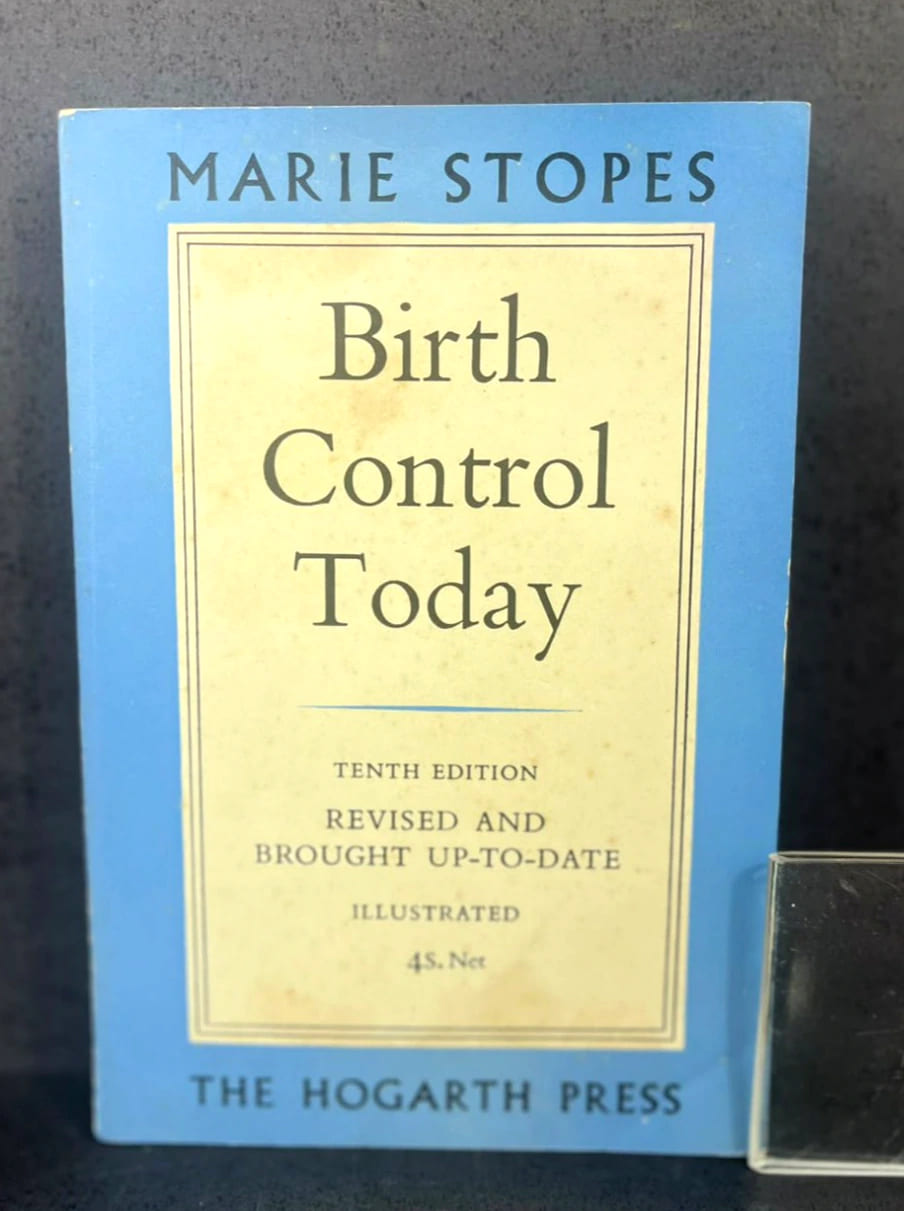
1954réf. QZI-40London: The Hogarth Press, 1954. Tenth edition, revised and brought up to date. Illustrated. 12.5 × 19 cm. [iii] leaves, 178 pp., [7] pp. An especially interesting signed presentation copy of Marie Stopes's influential handbook on contraception and family planning, personally inscribed by the author in blue ink: “To Antonio B. Martins Abranches, with the best wishes of the author, Marie C. Stopes. July 1956.” Accompanied by a printed “With Compliments” card from the C.B.C. and The Mother's Clinic, naming Marie C. Stopes as president and giving the organisation's address at 108 Whitfield Street, London, W.1. Also preserved is a fragment of the original envelope associated with the dedicatee. The combination of the personal inscription, the institutional compliments card, and the accompanying postal material provides a particularly appealing association with Stopes's own circle and with the organisation through which she disseminated her ideas. Marie Stopes occupies a complex and controversial position in the history of twentieth-century reproductive politics. A pioneering campaigner for access to contraceptive information and the founder of one of Britain's earliest birth-control clinics, she was instrumental in bringing subjects previously regarded as private, improper, or taboo into public and medical discussion. Her work helped establish contraception as an increasingly mainstream subject of scientific, social, and public-health debate. Yet her advocacy was also deeply intertwined with the eugenics movement. Stopes supported selective reproduction and established the Society for Constructive Birth Control and Racial Progress in 1921, linking reproductive control to contemporary theories of hereditary improvement and social reform. Rather than representing a straightforward abandonment of eugenics in favour of modern family planning, her career illustrates the considerable ideological overlap between these movements during the first half of the twentieth century. Indeed, the title page of this 1954 edition still identifies her as founder and president of the Society C.B.C. and Racial Progress. First published in 1934, Birth Control To-day was conceived as a practical guide for general readers. Its chapters discuss reproductive anatomy, domestic and clinical contraceptive methods, male contraception, ineffective or dangerous practices, comparative costs, and the role of specialist clinics and public authorities. The text is supplemented by anatomical illustrations and diagrams. The book also documents the gradual transition of birth control from a controversial social cause into a more widely accepted component of reproductive healthcare, while retaining traces of the eugenic assumptions that shaped part of its early institutional development. A notable association copy, signed only two years before Stopes's death in 1958, and accompanied by printed ephemera directly connected with her London clinic and birth-control organisation. Condition: Original blue printed wrappers, with some age-related spotting, light soiling, and minor edge wear. Interior generally clean and well preserved, with occasional signs of handling. Manuscript inscription clearly legible. The accompanying compliments card is preserved separately, together with the envelope fragment.
1911réf. QZI-34New York, Henry Holt & co., 1911. First edition. Octavo, 14 x 21.5 cm (5.5" x 8.3"), (xi) 298 pp. Hardbound, black grained half-leather, spine with four nerves, two red title pieces with the author's name and book title stamped in gold, three gilt fleurons. Colored enpapers. Two plates, one showing eye colors at the frontispiece and the other being an unfolding graph between pp. 218-9. 174 in-text figures, mostly genealogical trees with a few black and white pictures. Chapters: I. Eugenics: Its Nature, Importance and Aims; II. The Methods of Eugenics; III. The Inheritance of Family Traits; IV. The Geographic Distribution of Inheritable Traits; V. Migrations and their Eugenic Significance; VI. The Influence of the Individual on the Race; VII. The Study of American Families; VIII. Eugenics and Euthenics; IX. The Organisation of Applied Eugenics. "The human babies born each year constitute the world's most valuable crop." (p.2) A pioneering geneticist, Charles Davenport (1866-1944) taught at Chicago and Harvard University. He became one of the leading voices of the American eugenist movement and authored a number of articles and books on the topic. Heredity in Relation to Eugenics was his first monography and remained a textbook for years with at least one subsequent edition. This copy is first edition.