120 résultats
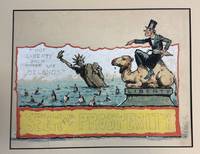
1933réf. 41184n.p. 1933. 8" x 12". Original color painting on Abacco illustration board matted and framed behind glass. Vibrant colors with some pencil sketch lines showing through. Unsigned and uninitialed. Corners chipped a closed crack in lower left corner. On verso of board is the name of the type of board and available dimensions "Paints Brush and Color Corporation" with distributors listed as E.H. & A.C. Friedrichs Co. of New York The Hirshberg Company of Baltimore and Henry M. Taws of Philadelphia. Very Good. Ours is the only copy located after diligent investigation. The camel which Thomas Nast chose as the symbol of the Prohibition Party has replaced the Statue of Liberty on the pedestal. Camels don't drink very often; when they do they only drink water. This item was likely painted between 1931 and 1933. The official Beer for Prosperity Campaign was organized May 1931 in New York City. Edward H. Schulze was director of the organization and announced that he would support all political candidates in favor of legalizing beer. The slogan spread over the next year and a half. Posters for this campaign in 1932 advertised that legalizing beer would bring two trillion dollars in new revenue in four years because "millions of dollars made from bootleg Beer now finances all kinds of crimes kidnappings etc." Another campaign poster advertised purchases of "Beer for Prosperity" Stamps to "Help Elect to Congress Men Who Will Vote 'Yes.'" Beer for Prosperity Campaign. n.d. In John J. Raskob papers. Manuscripts and Archives Hagley Museum and Library #m473_20100624_005; "Beer For Prosperity Campaign Inc. Will Back Pierce's Congressional Candidacy" The Rutland Daily Herald 23 August 1932 p.7. We do not know who painted this imaginative item. E.H. & A.C. Friedrichs Company was founded in 1868 and is still in business today under the modern name of Fredrix. The Hirshberg Company originated in 1845 as Hirshberg Hollander & Company and remained in business under a few different Hirshberg names until approximately the early 1960s. Henry B. Taws opened in Philadelphia around 1897 and remained in business until at least 1931. unknown books
1933réf. 41184n.p. 1933. 8" x 12". Original color painting on Abacco illustration board matted and framed behind glass. Vibrant colors with some pencil sketch lines showing through. Unsigned and uninitialed. Corners chipped a closed crack in lower left corner. On verso of board is the name of the type of board and available dimensions "Paints Brush and Color Corporation" with distributors listed as E.H. & A.C. Friedrichs Co. of New York The Hirshberg Company of Baltimore and Henry M. Taws of Philadelphia. Very Good. Ours is the only copy located after diligent investigation. The camel which Thomas Nast chose as the symbol of the Prohibition Party has replaced the Statue of Liberty on the pedestal. Camels don't drink very often; when they do they only drink water. This item was likely painted between 1931 and 1933. The official Beer for Prosperity Campaign was organized May 1931 in New York City. Edward H. Schulze was director of the organization and announced that he would support all political candidates in favor of legalizing beer. The slogan spread over the next year and a half. Posters for this campaign in 1932 advertised that legalizing beer would bring two trillion dollars in new revenue in four years because "millions of dollars made from bootleg Beer now finances all kinds of crimes kidnappings etc." Another campaign poster advertised purchases of "Beer for Prosperity" Stamps to "Help Elect to Congress Men Who Will Vote 'Yes.'" Beer for Prosperity Campaign. n.d. In John J. Raskob papers. Manuscripts and Archives Hagley Museum and Library #m473_20100624_005; "Beer For Prosperity Campaign Inc. Will Back Pierce's Congressional Candidacy" The Rutland Daily Herald 23 August 1932 p.7. We do not know who painted this imaginative item. E.H. & A.C. Friedrichs Company was founded in 1868 and is still in business today under the modern name of Fredrix. The Hirshberg Company originated in 1845 as Hirshberg Hollander & Company and remained in business under a few different Hirshberg names until approximately the early 1960s. Henry B. Taws opened in Philadelphia around 1897 and remained in business until at least 1931. unknown
1934réf. 59731934. St. Paul Pioneer Press. May 10 1934 issue documents the federal prosecution of St. Paul bootlegger Leon Gleckman and the government's effort to connect Minnesota's illicit liquor economy with Al Capone's Chicago organization supporting research into Prohibition enforcement organized crime tax prosecutions and regional newspaper coverage of interstate criminal networks. Published during Gleckman's federal trial for attempting to evade income taxes for 1929 through 1931 the issue places a locally prominent defendant within the wider history of federal authorities using financial records and tax law against figures whose illegal enterprises were difficult to prosecute directly. Court records confirm that Gleckman's case concerned substantial unreported income and that his first trial began in April 1934. St. Paul Pioneer Press. St. Paul Minnesota. Thursday May 10 1934. Number of pages and measurements not stated. Front page carries the headline "AL CAPONE NAMED IN GLECKMAN TRIAL" with the subheading "Government Seeks to Show St. Paulite Sold Chicago Rum Baron Alcohol." The article reports the prosecution's attempt to establish that Gleckman supplied alcohol to Capone presenting the trial as evidence of commercial ties between St. Paul and Chicago during the final phase of national Prohibition enforcement. The headline's pairing of Capone's nationally recognized name with a St. Paul defendant also shows how the local press framed Gleckman's financial prosecution through the more publicly legible language of bootlegging and organized crime. The issue appeared five months after repeal of national Prohibition while federal authorities continued prosecuting income generated during the illegal liquor trade. Gleckman was subsequently convicted on two counts of tax evasion after a second trial and the resulting appellate decision preserved extensive evidence concerning unexplained bank deposits and his claimed interest in a distillery. Left-edge binding holes; otherwise clean with no additional defects reported; overall near fine. A sharply focused contemporary account of the federal effort to reconstruct the financial and commercial connections linking St. Paul bootlegging to the better-known Chicago underworld. unknown books
1934réf. 59731934. St. Paul Pioneer Press. May 10 1934 issue documents the federal prosecution of St. Paul bootlegger Leon Gleckman and the government's effort to connect Minnesota's illicit liquor economy with Al Capone's Chicago organization supporting research into Prohibition enforcement organized crime tax prosecutions and regional newspaper coverage of interstate criminal networks. Published during Gleckman's federal trial for attempting to evade income taxes for 1929 through 1931 the issue places a locally prominent defendant within the wider history of federal authorities using financial records and tax law against figures whose illegal enterprises were difficult to prosecute directly. Court records confirm that Gleckman's case concerned substantial unreported income and that his first trial began in April 1934. St. Paul Pioneer Press. St. Paul Minnesota. Thursday May 10 1934. Number of pages and measurements not stated. Front page carries the headline "AL CAPONE NAMED IN GLECKMAN TRIAL" with the subheading "Government Seeks to Show St. Paulite Sold Chicago Rum Baron Alcohol." The article reports the prosecution's attempt to establish that Gleckman supplied alcohol to Capone presenting the trial as evidence of commercial ties between St. Paul and Chicago during the final phase of national Prohibition enforcement. The headline's pairing of Capone's nationally recognized name with a St. Paul defendant also shows how the local press framed Gleckman's financial prosecution through the more publicly legible language of bootlegging and organized crime. The issue appeared five months after repeal of national Prohibition while federal authorities continued prosecuting income generated during the illegal liquor trade. Gleckman was subsequently convicted on two counts of tax evasion after a second trial and the resulting appellate decision preserved extensive evidence concerning unexplained bank deposits and his claimed interest in a distillery. Left-edge binding holes; otherwise clean with no additional defects reported; overall near fine. A sharply focused contemporary account of the federal effort to reconstruct the financial and commercial connections linking St. Paul bootlegging to the better-known Chicago underworld. unknown
réf. 23092171-nnew. unknown
réf. 23092171like new. unknown
réf. SONG9462650438T.M.C. Asser Press 2014-12-18. 3rd ed. 2015. hardcover. Used: Good. 6.80x1.90x9.60. Buy with confidence. Excellent Customer Service & Return policy. T.M.C. Asser Press hardcover
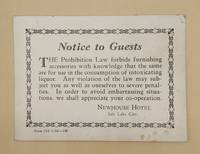
réf. 64183Ephemera. Very Good. Printed notice on thin card paper 11.5 cm x 8.5 cm. A notice from the former landmark hotel that was a staple in downtown Salt Lake City for 71 years. A June 24th 1983 "Deseret News" editorial referred to the hotel as "a monument to the early boom-and-bust days of mining in Utah a story of sudden wealth lavish spending and a lifestyle that has vanished from the American scene." Utah adopted statewide alcohol restrictions on August 1 1917 becoming the 24th state to do so. unknown books
1940réf. 128149Self published 1940s. Circa late 1930s-40s. Vintage ink blotters featuring advertisements for the National Woman's Christian Temperance Union IL one of the largest and most influential groups of the late 19th century focusing primarily on Prohibition by 1900s. These blotters represent the Union's attitude towards all alcohol and cigarets but ultimately feel like cursed fortune cookie messages. Blotters were useful during the heyday of fountain pens device that tended to bleed ink to be placed behind the parchment to absorb the excess ink and keep safe any surfaces beneath. Other blotters featuring the Union's temperance ads include loyalty patriotism auto accidents drinking and driving and many are duplicated messages on different colors of stock. About 3 x 6 inches card stock printed on rectos plain verso. Very Good overall light foxing rubbing toning a few light bumps and small creases. Self published unknown
1991PLEASE NOTE: This copy is *not* signed, despite what you may read elswhere in this description. 551 pages including index, bibliography, references and black and white photographs. Tells us of the Prohibition years - how Sam and his brothers kept one step ahead of the law - and paints an entertaining portrait of the romantic era of bootlegging. Sam emerges himself as a larger-than-life character: irascible, authoritarian, volcanic, iron-willed - as well as a loving father and loving husband. A seductive portrayal of a Canadian legend. Wonderful unmarked copy with only faint signs of handling. Several drops of light-beige staining to top edge. Book
1924308 p. + Frontis. 12mo. XLib. Original blue full cloth binding. George Wharton Pepper (1867-1961) was an influential American lawyer, law professor, Christian activist, and Republican politician from Philadelphia, PA. He represented Pennsylvania in the United States Senate. PA 18
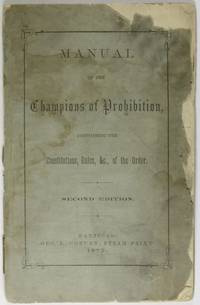
1872réf. 0000895Hartford Conn.: Geo. L. Coburn Steam Print. 1872. 24 33 pages. Original printed wraps. 17 x 11 cm. Chipping to wraps title and corners of a few other leaves not affecting text and a number of short marginal tears. Spine has mostly perished but gatherings are held by the original stitching. Wraps heavily stained not affecting legibility. Light marginal damp stains throughout; marginal soiling in a few places. A poor but complete copy. SECOND EDITION so stated on the front wrap expanded. The first edition of the previous year contained only the first part of this work the 24-page manual. The second edition includes a new section "Ritual" the second grouping of 33 pages. It contains a diagram of a lodge room and descriptions of ceremonies for opening meetings initiations recognizing visitors installing officers and instituting new lodges. At the end is a cipher being a number code for the alphabet and the common vocabulary used by the organization. In addition to the contents alluded to in the title the manual includes the lyrics to seven odes. Several ads are printed with the text all promoting Thomas H.L. Tallcott's diverse professional and business interests in Glastonbury and Hartford. One ad announces his services as a notary and justice of the peace and another his land surveying firm. He also advertises patent medicines Dickinson's Alternative Balsam and Discutient Ointment and a washing machine the Niagra Washer both of which he distributed. At the end of the manual is an ad for the New England Female Medical College Boston and the free dispensary offered by Dr. Samuel Gregory. Thomas Hyde Lord Tallcott 1829-1907 of Glastonbury was active in the temperance movement in Connecticut from his early adulthood belonged to several national prohibition organizations and was one of the founders of the Prohibition Party in Connecticut 1869. He was also an attorney justice of the peace Congregationalist minister and a prominent figure in the Templars. In 1849 he presented a petition to the Connecticut senate to prohibit alcohol. He was a leader in the Hartford County Temperance Society at least as early as 1852 when he issued a circular for the organization. In 1867 and 1868 he went to the Carolinas to organize lodges for the Templars. He established over a dozen lodges most of which were for African Americans. He founded the Champions of Prohibition in 1870 and served as the first president and secretary of the organization. Ref. Austin "Prohibition Leaders of America" 1895 p. 35. Obituary Hartford "Daily Courant" Sept. 30 1907 p. 2. Fahey "Temperance & Racism" pp. 61-62. Rare. OCLC locates only the Virginia Tech copy of this second edition; not in NUC. Of the first edition OCLC finds only two copies NYP and Harvard; NUC adds the LC copy. Geo. L. Coburn Steam Print. paperback
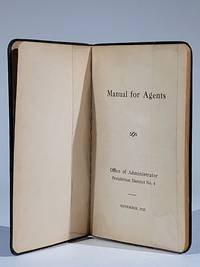
1925réf. 965Pittsburgh: Office of Administrator Prohibition District No. 4 1925. Cloth over flexible boards. Sixteenmo. ii 53 pages. Near fine. Bound in black cloth over flexible boards with no exterior titles. A few faint spots to lower board. Binding sound. A rare manual issued by Prohibition District No. 4 Pittsburgh as a pocket guide to help its Revenue and Prohibition agents build strong cases as they enforced the Volstead Act in the field. The contents are distilled ha from Treasury Department Regulations 12 and 60 and aimed at avoiding procedural mistakes during investigations sting operations and arrests. Think Eliot Ness making sure his "i"s are dotted and "t"s are crossed so the bootleggers don't walk on a technicality. Office of Administrator, Prohibition District No. 4 unknown
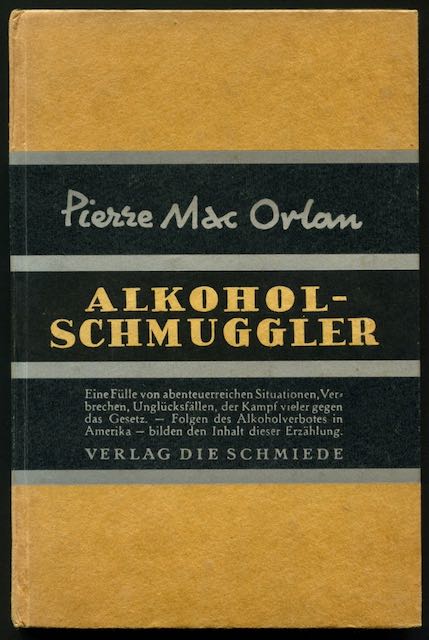
1927réf. 82999Bln.: Vlg. Die Schmiede (c 1927). 70 Ss., 1 Bl. 8°. Ockerfarb. Pp. mit grau-ockerfarb. Deckeltitel auf schwarz-grau-gestreiftem Grund, Kopfgrauschnitt (Kapitale min. bestoßen, Schnitt etw. stockfleckig).
1980réf. 11555Presses de la Cité 1980 191 pages in8. 1980. Broché. 191 pages. Les Pirates du Texas relate la poursuite d'un policier Ted Brown aux trousses de trafiquants d'alcool pendant la prohibition. L'histoire suit Brown jusqu'à Paris à la recherche de Bob Cummins le roi des bootleggers puis lors d'un déchargement d'alcool sur les côtes du Texas où il est blessé et soigné dans un ranch
réf. 38785Paris : Edition Simon Kra, 1925 - un volume in-12 (12,2x19,8 cm) broché, 146 pages - premier tirage sur papier courant (janvier 1925) - bon état -
1925réf. 98167P., Editions du Sagittaire, chez Simon Kra, 1925, in-12, 147 pp, imprimé sur papier de belle qualité, broché, bon état. Edition originale sur papier d'édition
1976Ed. Atlanta 1976, In-8 relioure éditeur trés décorée. 248 pages. Trés bon état.
1886réf. 56938Olympia W.T.: Thomas H. Cavanaugh Public Printer 1886. 8vo. 555 5 xxvii 1 xv 1 ix 1 pp. Contemporary full calf red black & gilt morocco spine labels minor uniform toning some edgewear minor bumping to corners still VG copy from the library of Bates & Burnett law firm with William Charles Bates 1885-1973 and Milton L. Burnett 1887-1972 who operated for decades in Vancouver WA from before World War I and moved their firm into the Charles Brown historic house in 1945 beginning a local trend of using older homes for professional buildings and George W. Yocum 1827-1890 longtime Portland attorney. First edition of this rare Washington Territory lawbook including the January 29 1886 Alien Land Ownership law which was the only anti-Chinese measure to pass the legislature as well as two laws related to Prohibition advocated by newly empowered women’s suffrage voters. The Alien Land laws emerged out of the anti-Chinese riots in Tacoma WA in November 1885 when labor organizations such as the Knights of Labor with the aid of the Pierce County Sheriff succeeded in forcing all of the Chinese residents out of town as well as torching their homes. Building on the 1882 Federal Chinese Exclusion Acts the Territorial Legislature specifically excluded any “Alien” who were “incapable of becoming citizens of the United States” could neither own land or convey title of properties to heirs. Unfortunately for the Chinese in Seattle this failed to placate socialist firebrands suffragettes & Knights of Labor advocates Laura Hall Peters and Mary Kenworthy or the equally charismatic Knights of Labor organizer Daniel Cronin. In February 1886 hundreds of working-class white men and women on the pretense of enforcing local health regulations condemned buildings in Seattle’s Chinatown and herded over 350 Chinese residents down to the Seattle docks and demanded they ship out. About 200 Chinese embarked for San Francisco and another had to wait six days for another ship setting off a riot and declaration by Washington Territory Governor Squire and President Grover Cleveland. The “Local Option” law passed by the Territorial Legislature in 1886 garnered huge opposition from saloon owners and cases brought resulted in the 1888 ruling against “Local Option” by the Territorial Supreme Court returning the power back to city councils and county commissioners. See: John Putnam Racism and Temperance: The Politics of Class and Gender in Late 19th-Century Seattle The Pacific Northwest Quarterly Vol. 95 No. 2 Spring 2004 pp. 70-81; Mark Lazarus III An Historical Analysis of Alien Land Law: Washington Territory & State 1853-1889 University of Puget Sound Law Review Vol. XII 1989 pp. 197-246. Thomas H. Cavanaugh, Public Printer, unknown
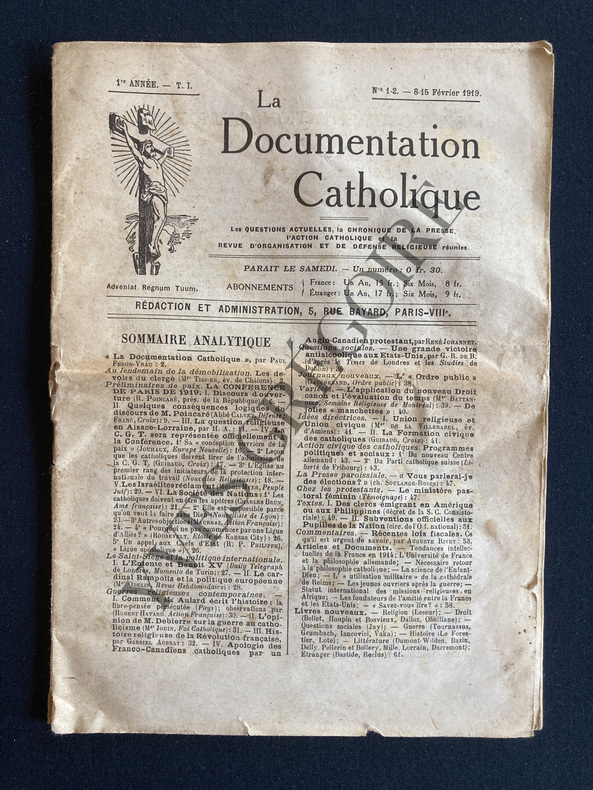
1919réf. ABE-1119542831364 PAGES FORMAT 18 CM X 25,5 CM-LA TRANSFORMATION SOCIALE ET LES DEVOIRS DU CLERGE AU LENDEMAIN DE LA DEMOBILISATION-PRELIMINAIRES DE PAIX LA CONFERENCE DE PARIS DE 1919,DISCOURS D'OUVERTURE PAR M.POINCARE-LA QUESTION RELIGIEUSE EN ALSACE-LORRAINE DEPUIS L'ARMISTICE DU 11 NOVEMBRE 1918-LA CGT SERA REPRESENTEE OFFICIELLEMENT A LA CONFERENCE DE PARIS-LES ISRAELITES RECLAMENT LA "RESTITUTION" DE LA PALESTINE-QUELQUES EXPOSES DIVERGENTS SUR LA SOCIETE DES NATIONS-LA PAPAUTE ET LA POLITIQUE INTERNATIONALE,BENOIT XV-GUERRES RELIGIEUSES CONTEMPORAINES,AULARD-UNE GRANDE VICTOIRE ANTIALCOOLIQUE,PROHIBITION POUR TOUS LES ETATS-UNIS D'AMERIQUE-UNION RELIGIEUSE ET UNION CIVIQUE
réf. 21374Paris, José Corti, 1934. In-4, LVIX-282 pp., broché, couverture originale imprimée (minuscules déchirures et taches à la couverture, papier jauni).
1984139 pages. Signed and inscribed by authors inside front cover. Numerous reproductions of black and white archival photos in text. Deals almost entirely with the trade from Saint Pierre. Binding tight. Somewhat above-average wear. A sound reference copy. Book
1937pp. xliii, 447. Numerous photo illustrations. Small folio. Original Purple cloth binding, lettered in white. Includes a yellow gold decorated cloth pin for the 59th Annual Convention, 1933. PA 10x2
1861réf. 46401811Paris, Havard, 1861 ; petit in-12, demi-basane fauve, fil. dor., non rogné, couverture beige imprimée conservée. (Reliure moderne). 93 pp.Ce livre semble extrêmement rare, nous n’avons trouvé que trois exemplaires dans les bibliothèques françaises, tous à la date de 1861. Histoire du tabac depuis sa découverte par les Espagnols en 1520 chez les habitants de Tabasco, province du Yucatan, introduction en France, Jean Nicot, en Italie, en Orient, en Angleterre, usage du tabac en Amérique avant 1520, calumet de paix, sauvages de Virginie. Nombreuses guérisons opérées par le tabac ; les Chinois et le tabac, introduction en Hollande, pipes. Persécutions : en Angleterre par Jacques Ier, supplice de Rawlegh ; en Perse, Schah-Abbas ; en Tuquie, Amurat IV ; bulle d’Urbain VIII... Opinions des médecins du XVIIe siècle, conseils de Néander aux jeunes gens ; Simon Paulli et sa haine contre le tabac et le thé. Une thèse de 1699 intitulée “le tabac abrège t’il la vie ?” ; impôts sous Richelieu, Colbert, premier bail du tabac. Sous Louis XIV, Louis XV, et Louis XVI, les turgotines, la Révolution, la régie. Smith n°15.
1938[4], 5-254, [2], 8 [ads], pages. This portion of Carr's life story begins after his experience as a submariner in WWI. He serves as an officer of the Mercantile Marine and experiences incredible adventures and hardships before deciding to move his young family from England to New Brunswick. Times are tough in his new land. He describes the local poverty and exposes the awful social problems of rural New Brunswick, as well as his dramatic adventures at work, with a local trapper and as a member of the C.P.R. police. In short, Carr was a man's man and this book is full of manly adventures. Later in life, Carr [1895-1959] became very concerned about what he viewed as plans for world government and wrote Pawns in the Game and Red Fog Over America, books which sold by the hundreds of thousand. The present work is vital in understanding the background and motivations of this fascinating man. Above-average wear to publisher's black cloth. Binding intact. Gift greetings upon front free endpaper. Spine leaning. Dust jacket not included. Not pretty but a worthy reading copy. Book