Crang, Mike (Ed)Biblio.com
122.795 risultati
2000rif. 2924981Routledge 2000. This is an ex-library book and may have the usual library/used-book markings inside.This book has hardback covers. In good all round condition. No dust jacket. Please note the Image in this listing is a stock photo and may not match the covers of the actual item700grams ISBN:0415160154 Routledge hardcover
2004rif. 88259Las Vegas: Bechtel Nevada Geothechnical Sciences Group 2004. Version 1.0. CD in a plastic box. Very good. This CD is not meant to be a rigorous discussion of geologic methods a lengthy discussion of the role of geology in the containment of nuclear explosions or an in-depth treatise on the geology of the NTS. However through the use of the information presented in conjunction with the materials cited a geologist should find sufficient information to enable interaction with the other disciplines involved to support the successful execution of an underground nuclear test. GEOLOGY: THE PRACTICE PHYSICAL GEOLOGY OF THE TEST AREAS The ultimate goal of any nuclear test is to obtain desired data safely with no release of radiation to the atmosphere. This section describes what geologists do to help assure that these goals are met. Geologists provide essential input to the safe conduct of underground nuclear explosions in support of site selection test-bed construction and in furthering the understanding of the role of geology in successful containment. GEOLOGY AND CONTAINMENT This section presents a summary of the history of nuclear testing with emphasis on events that led to the advent of underground testing a description of the phenomenology of an underground nuclear explosion and a discussion of containment evaluation. These subjects are presented to describe how the testing community came to realize that it was necessary to understand the geologic setting of each underground test location and are not meant to be a primer on containment. This Compact Disc CD has been designed to familiarize the user with the arts and sciences of Geology as performed at the Nevada Test Site NTS and to provide an overview of the physical geology found at the historic nuclear testing areas. This was prepared for the U.S. Department of Energy National Nuclear Security Administration Nevada Site Office. It is understood that the contents no longer meet the criteria for Official Use Only. As part of its efforts to demonstrate transparency about its work in late November 2023 the U.S. Department of Energy's National Nuclear Security Administration NNSA welcomed 13 non-governmental experts on arms control and nonproliferation to its Nevada facilities including parts of the Nevada National Security Site NNSS outside Las Vegas. NNSS hosts a variety of nonproliferation projects in large part focused on the ability to detect low-yield nuclear explosions around the world. The visitors saw P Tunnel the site of an October 2023 nonproliferation experiment using chemical non-nuclear explosives and radiotracers as well as other sites supporting nonproliferation efforts. The group visited the Principal Underground Laboratory for Subcritical Experimentation PULSE formerly called the U1a Complex. PULSE is where U.S. subcritical experiments are conducted. The visitors also saw locations involved with the Stockpile Stewardship Program which the United States started in 1992 when it ended nuclear explosive testing. Due to the program's success in Nevada and at NNSA's national laboratories the United States has no identified technical need to conduct additional nuclear explosive tests and no plans to do so. Instead of nuclear explosive testing the program relies on specialized facilities supercomputers subcritical experiments and technical experts to ensure the safety security reliability and effectiveness of the U.S. nuclear stockpile. During an NNSA-led visit of non-governmental experts on arms control and nonproliferation to the Nevada National Security Site they stopped by the Big Explosives Experimental Facility. The NGO group also visited the Icecap site at NNSS. Icecap was constructed for a nuclear explosive test set for 1993 but never carried out after the U.S. testing moratorium. The United States hasn't tested since 1992 and has no plans to do so. Before visiting the site NNSA hosted discussions related to NNSA operations specifically Stockpile Stewardship and nonproliferation projects along with U.S. support for the Preparatory Commission for the Comprehensive Nuclear-Test-Ban Treaty Organization CTBTO PrepCom. The United States has a long history of transparency as the NNSA Administrator highlighted in her June 2023 keynote remarks at the CTBT Science and Technology 2023 Conference. At NNSS the experts were immersed in the history of U.S. nuclear explosive testing and shown sites where atmospheric and underground nuclear explosions took place. They also visited the Principal Underground Laboratory for Subcritical Experimentation PULSE formerly known as the U1a Complex site of U.S. subcritical experiments a key effort to maintain the safety security and effectiveness of the stockpile without nuclear explosive testing. Some also visited the Atomic Museum in Las Vegas which preserves and fosters public accessibility to the history associated with the former Nevada Test Site and the nation's nuclear weapons program. The transparency visit included representatives from the Arms Control Association Carnegie Endowment for International Peace Center for Arms Control and Non-Proliferation Center for Strategic & International Studies Federation of American Scientists Harvard Kennedy School Middlebury Institute of International Studies National Academy of Sciences Nuclear Threat Initiative Open Nuclear Network and Ploughshares Fund. It followed a similar April 2023 transparency visit to NNSS by CTBTO PrepCom Executive Secretary Dr. Robert Floyd. Bechtel Nevada Geothechnical Sciences Group unknown
1996rif. 88096Washington DC: National Academy Press 1996. Presumed First Edition First printing. Wraps. Good. The format is approximately 8.25 inches by 10.75 inches. xii 75 1 pages. Illustrated front cover. Some red ink marks noted. Figures. Tables. References. This is one of the National Academies Compass Series. Astronauts who venture beyond the protection of Earth's atmosphere and magnetosphere risk exposure to levels of radiation far exceeding those on Earth. Of all the risks this one is probably the most straightforward to control—by providing adequate shielding. However because shielding adds weight cost and complexity to space vehicles it is very important for designers to have a good quantitative understanding of the risk and its degree of certainty. This report assesses our understanding of radiation hazards in space. It also considers the additional research needed to reduce the areas of uncertainty research that must be completed prior to undertaking the detailed design of a vehicle carrying crew members into space for periods of extended exposure. The report finds that it will take more than a decade of research to answer even the narrowest set of key questions. The nation has backed away from a specific timetable for human exploration of the moon and Mars. Yet it seems plausible that such expeditions will be mounted sometime in the first quarter of the 21st century especially given the recent resurgence of interest in possible life on Mars from the study of meteorites. It becomes clear when the lengthy time scale of the research is also taken into account that the present report is indeed timely and should receive prompt consideration by NASA planners. NASA's long-range plans include possible human exploratory missions to the moon and Mars within the next quarter century. Such missions beyond low Earth orbit will expose crews to transient radiation from solar particle events as well as continuous high-energy galactic cosmic rays ranging from energetic protons with low mean linear energy transfer LET to nuclei with high atomic numbers high energies and high LET. Because the radiation levels in space are high and the missions long adequate shielding is needed to minimize the deleterious health effects of exposure to radiation. The knowledge base needed to design shielding involves two sets of factors each with quantitative uncertainty—the radiation spectra and doses present behind different types of shielding and the effects of the doses on relevant biological systems. It is only prudent to design shielding that will protect the crew of spacecraft exposed to predicted high but uncertain levels of radiation and biological effects. Because of the uncertainties regarding the degree and type of radiation protection needed a requirement for shielding to protect against large deleterious but uncertain biological effects may be imposed which in turn could result in an unacceptable cost to a mission. It therefore is of interest to reduce these uncertainties in biological effects and shielding requirements for reasons of mission feasibility safety and cost. National Academy Press paperback
1963rif. 85741Washington DC: National Academy of Sciences National Research Council 1963. Presumed First Edition First printing. Wraps. Good. vi 93 1 pages. Tables. Formulae. Appendixes. References. Index. This is Publication 1078. Cover has some wear and soiling and a small blacked over portion on the top right of the front cover. The contents includes discussions of the Subcommittee's approach effects of external ionizing radiation on farm animals Effects from ingestion of fission products internal exposure to Gamma and Bata Rays. effects of contact with radioactive materials animals and poultry as sources of food exposure of marine life sterility sexual genetic and embryologic effects protective considerations form husbandmen and research needs along with several appendixes. This publication is a condensed review of the available literature concerning the effects of radioactive fallout upon animals under varying situations. Its main purpose is the estimation of the usability of animal tissue for human consumption in a time of disaster due to a nuclear attack. Material is presented in a clear concise manner with no literary embellishment. The reader need not be an atomic scientist to fully comprehend the facts as stated although there are adequate formulas and calculations given to interest readers knowledgeable in physical science. The text progresses step by step through several species of animals and the effects of gamma and beta radiation upon their systems. Clinical and post-mortem findings are clearly outlined. The main fission by-products such as Iodine-131 and Strontium-90 and their toxic effects are discussed. Sterility along with other considerations of reproduction is considered because of the need for replacement stock particularly after a nuclear disaster. Therapy feeding practices and protective considerations for the husbandmen are reviewed. The final chapter is most worthy of the research communities' consideration. It deals with research needed to fill out the complete picture of nuclear fallout and its effects on animals. Urgently needed information in both the physical and biological areas is listed. Four appendixes are added which enlarge and explain in greater detail methods for computing fallout and its uptake by different tissues. Eighteen pages of references offer the reader a wide area for library exploration in addition to making the report a valuable reference. This book can be recommended to both scientist and layman and especially to anyone dealing with research animals or those produced for consumption as food. From a review in American Journal of Public Health 54 no. 1 January 1964 by Clifford H. Eby. National Academy of Sciences, National Research Council paperback
rif. 3700181817.Gpaperback. Good. Access codes and supplements are not guaranteed with used items. May be an ex-library book. paperback
2005rif. 83994Washington DC: The National Academies Press 2005. Presumed First Edition First printing. Wraps. Very good. xii 134 pages. Illustrations some in color. Letter from the Study Director to a Department of Energy official providing copies laid in. Table of Contents includes: Front Matter; Summary; 1 Introduction; 2 Hard and Deeply Buried Targets; 3 Earth-Penetrator Weapons; 4 Effectiveness of Nuclear Weapons Against Hard and Deeply Buried Targets; 5 Fallout and Tools for Calculating Effects of Release of Hazardous Materials; 6 Human and Environmental Effects; 7 Conventional Weapons; 8 Uncertainty in Estimates of Effects; 9 Conclusions; Appendix A: Committee and Staff; Appendix B: Agendas; Appendix C: Equivalent Yield Factors for Energy Coupling; and Appendix D: Acronyms and Abbreviations. An earth-penetrating weapon EPW is the nuclear equivalent of the conventional bunker buster. The non-nuclear component of the weapon is designed to penetrate soil rock or concrete to deliver a nuclear warhead to an underground target. These weapons would be used to destroy hardened underground military bunkers or other below-ground facilities. An underground explosion releases a larger fraction of its energy into the ground compared to a surface burst or air burst explosion at or above the surface and so can destroy an underground target using a lower explosive yield. This in turn could lead to a reduced amount of radioactive fallout. However it is unlikely that the explosion would be completely contained underground. As a result significant amounts of rock and soil would be rendered radioactive and lofted as dust or vapor into the atmosphere generating significant fallout. Underground facilities are used extensively by many nations to conceal and protect strategic military functions and weapons' stockpiles. Because of their depth and hardened status however many of these strategic hard and deeply buried targets could only be put at risk by conventional or nuclear earth penetrating weapons EPW. Recently an engineering feasibility study the robust nuclear earth penetrator program was started by DOE and DOD to determine if a more effective EPW could be designed using major components of existing nuclear weapons. This activity has created some controversy about among other things the level of collateral damage that would ensue if such a weapon were used. To help clarify this issue the Congress in P.L. 107-314 directed the Secretary of Defense to request from the NRC a study of the anticipated health and environmental effects of nuclear earth-penetrators and other weapons and the effect of both conventional and nuclear weapons against the storage of biological and chemical weapons. This report provides the results of those analyses. Based on detailed numerical calculations the report presents a series of findings comparing the effectiveness and expected collateral damage of nuclear EPW and surface nuclear weapons under a variety of conditions. The National Academies Press paperback
1985rif. 81567Washington DC: National Academies Press 1985. Presumed first edition/first printing. Trade paperback. Good. ix 1 . 193 1 p. References. Diagrams. Maps. Illustrations. Index. Cover has some wear and soiling. Signed by Colin S. Gray on front cover! Colin S. Gray December 29 1943 - February 27 2020 was a British-American writer on geopolitics and professor of International Relations and Strategic Studies at the University of Reading where he was the director of the Centre for Strategic Studies. In addition he was a Senior Associate to the National Institute for Public Policy. Gray was educated at the University of Manchester and the University of Oxford. He worked at the International Institute for Strategic Studies and the Hudson Institute before founding the National Institute for Public Policy in Washington D.C. He also served as a defence adviser both to the British and U.S. governments. Gray served from 1982 until 1987 in the Reagan Administration's General Advisory Committee on Arms Control and Disarmament. He taught at the University of Hull the University of Lancaster York University the University of Toronto and the University of British Columbia. Gray published 30 books on military history and strategic studies as well as numerous articles. Most of the earth's population would survive the immediate horrors of a nuclear holocaust but what long-term climatological changes would affect their ability to secure food and shelter This sobering book considers the effects of fine dust from ground-level detonations of smoke from widespread fires and of chemicals released into the atmosphere. The authors use mathematical models of atmospheric processes and data from natural situations-e.g. volcanic eruptions and arctic haze-to draw their conclusions. This is the most detailed and comprehensive probe of the scientific evidence published to date. National Academies Press paperback
2013rif. 80287Bethesda Maryland: Uniformed Services University of the Health Sciences F. Edward Hebert School of Medicine Department of Military and Emergency Medicine 2013. Revised Edition presumed first printing thus. Spiral bound. Very good. ix 1 219 1 pages plus covers. Illustrations. Includes chapters on Tactical Leadership Checklists Radio Communications; Establishing a Battalion Aid Station; Medical Platoon Operational Procedures; Battle Drills/Attack Scenarios; Evacuation; Medical Stability Operations; Health Service Support; and Appendices Glossary and Notes. Also includes Precombat Checklists Troop Leading Procedures Force Protection Levels Individual PCI Checklist Leader PCI Checklist Personnel Status Communications Convoy PCI Convoy Mission Briefing Preventive Medicine Radio Communications Establishing a Battalion Aid Station Mass Casualty Plans Medical Platoon Operational Procedures Battle Drills/Attack Scenarios Evacuation Medical Stability Operations Healthy Service Support Appendices including Glossary. OPERATION BUSHMASTER is a field training exercise FTX conducted at Fort Indiatown Gap Pennsylvania. During this exercise senior USU medical students Graduate Nursing students and international military medical officers are formally evaluated on their medical knowledge and leadership abilities in a simulated resource constrained far forward tactical field setting. Students assume leadership positions in a joint battalion aid station where they are presented with operationally current reality based missions and operational problems for which they must plan and execute while simultaneously managing the medical care of simulated Disease and Non-Battle Injury DNBI patients combat stress casualties and combat trauma casualties. Before "Operation Bushmaster" students go through a two-week military contingency medicine course during which they are presented operational problems and receive pre-deployment training just as they would prior to a real deployment. This classroom phase includes lectures and is focused on team building. The students become a cohesive unit as they prepare to deploy to a fictional country facing challenges from rebel forces. Divided into two groups the students were sent sequentially to spend four days at this large National Guard base nestled in the mountains just north of Hershey Pennsylvania. They were assigned to one of four platoons - all undergoing identical scenarios planning and executing missions while simultaneously caring for a variety of casualties ranging in severity from fatigue to gunshot wounds. The exercise featured nearly 1000 encounters with simulated patients. While patient care is a large part of their training leadership communication skills and logistics are just as important. Students were assigned various roles during the exercise such as patient administrator triage officer medical logistics or litter bearers transporting patients. They frequently rotated positions allowing every student to practice each role. The students also were graded on how well they performed key positions including platoon leader ambulance team leader surgeon and combat stress control officer. They were graded on a number of factors such as communication and leadership skills as they were observed by more than 60 faculty members from Uniformed Services University as well as from across the country. Uniformed Services University of the Health Sciences, F. Edward Hebert School of Medicine, Department of Military and Emergency unknown
2009rif. 81013Germantown Maryland: U.S. Department of Energy Office of Science 2009. Presumed First Edition First printing. Wraps. Very good. Oversized book measuring 8-1/2 inches by 11 inches. 6 184 1 pages. Illustrations. References. Appendices A-E. Topics covered include Executive Summary Use of Existing Facilities to Study Energy-Related HEDLP Science; Exploiting NIF to Study Energy-Related Ignition Science and Transition to an Energy Science and Technology Development Program: Remaining Science and Technology Issues. The Fusion Energy Sciences Advisory Committee FESAC has been Chartered pursuant to Section 14a2A of the Federal Advisory Committee Act Public Law 92-463 and Section 101-6.1015 title 41 Code of Federal Regulations. The committee provides independent advice to the Director of the Office of Science on complex scientific and technological issues that arise in the planning implementation and management of the fusion energy sciences program. The Director of the Office of Science charges the committee to provide advice and recommendations on various issues of concern to the Fusion Energy Sciences program. The Committee conducts its business in public meetings and submits reports containing its advice and recommendations to the Director of the Office of Science. High energy density plasmas that can be produced within state-of-the-art laboratory facilities are among the most scientifically interesting states of matter. Their densities and pressures can exceed those of the solar core and their temperatures and flows can be high enough that relativistic effects become important. Particle acceleration by nonlinear waves radiation-dominated plasmas large self-generated magnetic fields degenerate states of matter strongly coupled plasmas relativistic flows and the interaction of intense particle and laser beams with matter are only some of the many fascinating and exciting physical phenomena that can be studied with present or soon to be completed high energy density facilities. Understanding such states of matter will greatly extend the limits of knowledge in plasma physics and related areas. U.S. Department of Energy, Office of Science paperback
1991rif. 81246Washington DC: National Academy Press 1991. Presumed First Edition First printing. Trade paperback. Very good. xvi 2 181 1 pages. Tables. Figures some in color. References. Appendices. Index. Slight cover wear. The Committee on Astronomy and Astrophysics CAA provides an independent authoritative forum for identifying and discussing issues in astronomy and astrophysics with the research community the federal government and the interested public. The committee supports scientific progress in astronomy and astrophysics by providing advice to the federal government on the implementation of decadal survey recommendations. The CAA will issue reports that will provide guidance to federal agencies that support astronomy and astrophysics research. The CAA's scope spans the full range of astronomy and astrophysics research including space- and ground-based observations. The Committee's domain encompasses stellar galactic and extragalactic astronomy particle astrophysics cosmology the search for extra-solar planets and aspects of fundamental physics relating to astronomical objects. The CAA's scope also includes appropriate cross-disciplinary areas and consideration of budget and programmatic aspects of the implementation of the decadal survey. Astronomers and astrophysicists are making revolutionary advances in our understanding of planets stars galaxies and even the structure of the universe itself. The Decade of Discovery presents a survey of this exciting field of science and offers a prioritized agenda for space- and ground-based research into the twenty-first century. The book presents specific recommendations programs and expenditure levels to meet the needs of the astronomy and astrophysics communities. Accessible to the interested lay reader the book explores: The technological investments needed for instruments that will be built in the next century. The importance of the computer revolution to all aspects of astronomical research. The potential usefulness of the moon as an observatory site. Policy issues relevant to the funding of astronomy and the execution of astronomical projects. The Decade of Discovery will prove valuable to science policymakers research administrators scientists and students in the physical sciences and interested lay readers. Alternate Selection Astronomy Book Club. National Academy Press paperback
2013rif. 81285Washington DC: The National Academies Press 2013. Prepublication copy--subject to further editorial correction. Wraps. Good. 8 16 56 54 24 65 pages. Footnotes. Illustrations Tables and Figures. Rear cover creased. The potential for using fusion energy to produce commercial electric power was first explored in the 1950s. Harnessing fusion energy offers the prospect of a nearly carbon-free energy source with a virtually unlimited supply of fuel. Unlike nuclear fission plants appropriately designed fusion power plants would not produce the large amounts of high-level nuclear waste that requires long-term disposal. Due to these prospects many nations have initiated research and development R&D programs aimed at developing fusion as an energy source. Two R&D approaches are being explored: magnetic fusion energy MFE and inertial fusion energy IFE. An Assessment of the Prospects for Inertial Fusion Energy describes and assesses the current status of IFE research in the United States; compares the various technical approaches to IFE; and identifies the scientific and engineering challenges associated with developing inertial confinement fusion ICF in particular as an energy source. It also provides guidance on an R&D roadmap at the conceptual level for a national program focusing on the design and construction of an inertial fusion energy demonstration plant. The committee's final report represents the consensus of the committee after six meetings see Appendix C for the meeting agendas. The first four meetings were concerned mainly with information gathering through presentations while the final two meetings focused on carrying out a detailed analysis of the many important topics needed to complete the committee's assessment. This report describes and assesses the current status of inertial fusion energy research in the United States identifies the scientific and engineering challenges associated with developing inertial confinement fusion as an energy source compares the various technical approaches and finally provides guidance on an R&D roadmap at the conceptual level for a national program aimed at the design and construction of an inertial fusion energy demonstration plant including approximate estimates where possible of the funding required at each stage. At the outset of the study the committee decided that the fusion-fission hybrid concept was outside the scope of the study. While they are certainly interesting subjects of study comparisons of inertial fusion energy to magnetic fusion energy or any other potential or available energy technologies such as wind or nuclear fission were also outside the committee's purview. Although the committee carried out its work in an unclassified environment it was recognized that some of the research relevant to the prospects for inertial fusion energy was conducted under the auspices of the nation's nuclear weapons program and has been classified. Therefore the NRC established the separate Panel on the Assessment of Inertial Confinement Fusion ICF Targets to explore the extent to which past and ongoing classified research affects the prospects for practical inertial fusion energy systems. The panel was also tasked with analyzing the nuclear proliferation risks associated with IFE; although that analysis was not available for inclusion in the interim report the committee reviewed the panel's principal conclusions and recommendations on proliferation and these are included in this final report of the committee. The target physics panel exchanged unclassified information informally with the committee in the course of the study process and the committee was aware of the panel's conclusions and recommendations as they evolved. The panel produced both a classified and an unclassified report; the latter was timed so as to be available to inform this committee's final report; the Summary of the panel's unclassified report prepublication version is included as Appendix H. The National Academies Press paperback
2001rif. 81522Washington DC: National Academy Press 2001. Presumed First Edition First printing. Hardcover. Very good. xii 198 2 pages. Illustrations Tables Figures some with color. Formulae. Appendixes. Glossary. References. Biosketches. The Committee on Dosimetry for the Radiation Effects Research Foundation RERF was set up more than a decade before this publication at the request of the U.S. Department of Energy. It was charged with monitoring work and experimental results related to the Dosimetry System 1986 DS86 used by RERF to reconstruct the radiation doses to the survivors in Hiroshima and Nagasaki. At the time it was established DS86 was believed to be the best available dosimetric system for RERF but questions have persisted about some features especially the estimates of neutrons resulting from the Hiroshima bomb. This book describes the current situation the gamma-ray dosimetry and such dosimetry issues as thermal-neutron discrepancies between measurement and calculation at various distances in Hiroshima and Nagasaki. It recommends approaches to bring those issues to closure and sets the stage for the recently convened U.S. and Japan Working Groups that will develop a new dosimetry for RERF. The book outlines the changes relating to DS86 in the past 15 years such as improved numbers that go into and are part of more sophisticated calculations for determining the radiations from bombs that reach certain distances in air and encourages incorporation of the changes into a revised dosimetry system. The Radiation Effects Research Foundation RERF is a joint U.S.-Japan research organization responsible for studying the medical effects of radiation and associated diseases in humans for the welfare of the survivors and all humankind. The organization is located in Hiroshima Japan. The studies have been going on for 70 years which makes RERF the only institution that has been conducting epidemiological studies on a population of more than 120000 individuals for this long. RERF continues to conduct research until this day because the effects of A-bomb radiation on human health have not been fully elucidated. RERF conducts research in multiple fields of science including epidemiology clinical medicine genetics and immunology. Findings from RERF's studies have been used not only for the medical care and welfare of the A-bomb survivors but also for the establishment of international radiation protection standards. The preceding organization to RERF was the Atomic Bomb Casualty Commission which was established in 1948 by the U.S National Academy of Sciences. It was established to determine how over long-term exposure to radiation affected the health of A-bomb survivors. An extensive interview survey was conducted in the 1950s based on which records were compiled for each A-bomb survivor. These records concerned location and structure of the building the survivor may have been at the time of the bombing. Based on these records radiation doses were calculated for most A-bomb survivors. RERF was established on April 1 1975 as a nonprofit foundation under the jurisdiction of the Japan Ministry of Foreign Affairs and Ministry of Health and Welfare. On April 1 2012 RERF transitioned to a public interest incorporated foundation upon authorization by Japan's Prime Minister. National Academy Press hardcover
2012rif. 79972Washington DC: The National Academies Press 2012. Presumed First Edition First printing. Trade paperback. Very good. xi 1 131 1 pages. Footnotes. Formulae. Figures some with color. Boxes some with color. References. In recognition of the increasing importance of computational simulation and the increasing need to assess uncertainties in computational results the National Research Council NRC was asked to study the mathematical foundations of VVUQ and to recommend steps that will ultimately lead to improved processes. The specific tasking to the Committee on Mathematical Foundations of Verification Validation and Uncertainty Quantification is as follows: • A committee of the National Research Council will examine practices for VVUQ of large-scale computational simulations in several research communities. • The committee will identify common concepts terms approaches tools and best practices of VVUQ. • The committee will identify mathematical sciences research needed to establish a foundation for building a science of verification and validation V&V and for improving the practice of VVUQ. • The committee will recommend educational changes needed in the mathematical sciences community and mathematical sciences education needed by other scientific communities to most effectively use VVUQ. Advances in computing hardware and algorithms have dramatically improved the ability to simulate complex processes computationally. Today's simulation capabilities offer the prospect of addressing questions that in the past could be addressed only by resource-intensive experimentation if at all. Assessing the Reliability of Complex Models recognizes the ubiquity of uncertainty in computational estimates of reality and the necessity for its quantification. As computational science and engineering have matured the process of quantifying or bounding uncertainties in a computational estimate of a physical quality of interest has evolved into a small set of interdependent tasks: verification validation and uncertainty of quantification VVUQ. In recognition of the increasing importance of computational simulation and the increasing need to assess uncertainties in computational results the National Research Council was asked to study the mathematical foundations of VVUQ and to recommend steps that will ultimately lead to improved processes. Assessing the Reliability of Complex Models discusses changes in education of professionals and dissemination of information that should enhance the ability of future VVUQ practitioners to improve and properly apply VVUQ methodologies to difficult problems enhance the ability of VVUQ customers to understand VVUQ results and use them to make informed decisions and enhance the ability of all VVUQ stakeholders to communicate with each other. This report is an essential resource for all decision and policy makers in the field students stakeholders UQ experts and VVUQ educators and practitioners. The National Academies Press paperback
2005rif. 77127Washington DC: The National Academies Press 2005. Presumed First Edition First printing. Trade paperback. Very good. xii 72 pages. Illustrations. References. Appendices includes Biographical Sketches of Committee Members and Acronyms. To manage the massive cleanup of sites involved in the production of nuclear weapons materials throughout the Manhattan Project and the Cold War the Department of Energy DOE established in 1989 its Office of Environmental Remediation and Waste Management renamed the Office of Environmental Management EM in 1994. Because of the complexity of cleaning up this legacy of waste and contamination limited experience and changing requirements identifying actual costs and time required to complete the cleanup was a challenge from the beginning. In June 1998 EM issued its first comprehensive plan Paths to Closure DOE 1998a for accelerating the cleanup and reducing costs. Currently according to EM's plan for accelerated cleanup the total life cycle cost is estimated to be about $142 billion with completion in 2035. EM is considering how the schedule and costs might be reduced further without compromising its commitments to health and safety. EM commissioned this study by the National Academies' Board on Radioactive Waste Management BRWM to provide technical advice for EM's accelerated cleanup program specifically by identifying opportunities for EM to improve its capabilities for characterizing and treating the legacy wastes and contamination that are within the scope of the accelerated cleanup program. While acknowledging that site cleanup is a multifaceted challenge including establishing cleanup goals legal and regulatory compliance and public confidence the committee confined its study to the technical issues set forth in its Study Prospectus and Statement of Task . EM's technical capability to manage its wastes and environmental contamination is essential for accomplishing the cleanup regardless of how non-technical issues surrounding site cleanup may change over the time. The National Academies Press paperback
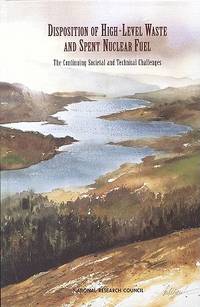
2001rif. 75748Washington DC: National Academy Press 2001. Presumed First Edition First printing. Hardcover. Very good. William Matthews. xv 1 198 2 pages. Footnotes. Boxes. Illustrations. References. Acronyms Used in this Report. There has been for decades a worldwide consensus in the nuclear technical community for disposal through geological isolation of high-level waste HLW including spent nuclear fuel SNF.1 However none of the national programs established to implement geological disposal has yet succeeded in establishing a geological repository and emplacing HLW in it. The large and growing HLW inventory from civilian and military reactor use over nearly 60 years remains in surface facilities intended only for interim storage. The societal and technical challenges of geological disposal and more broadly of ongoing management of HLW have turned out to be substantially greater than anticipated when the United States and other nations established programs for HLW disposal starting some decades ago. The project that produced this report was initiated by the Board on Radioactive Waste Management the part of the National Research Council responsible for studies on nuclear waste in response to its observation that many nations including the United States were encountering significant difficulties and delays in their plans for geological disposal of HLW. The study committee includes scientists from several nations as well as a variety of disciplinary backgrounds and the study has addressed both the societal and the technical aspects of HLW management. In particular the study addresses the questions of whether and when to implement disposal of HLW through geological isolation rather than focusing exclusively on how to implement geological disposal. This report is intended to provide elected officials and policymakers interested parties among the public and those professionally involved with HLW with an informative overview and with specific insights to aid planning and decision making. National Academy Press hardcover
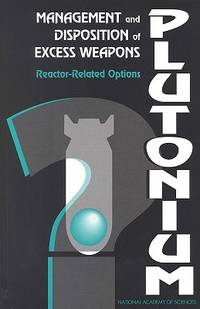
1995rif. 75031Washington DC: National Academy Press 1995. Presumed First Edition First printing. Trade paperback. Very good. xi 3 418 4 pages. Wraps Footnotes References. Boxes. Tables. Institutional stamp and ink notation on verso page ii. Within the next decade many thousands of U.S. and Russian nuclear weapons are slated to be retired as a result of nuclear arms reduction treaties and unilateral pledges. Hundreds of tons of plutonium and highly enriched uranium will no longer be needed for weapons purposes and will pose urgent challenges to international security. This is the supporting volume to a study by the Committee on International Security and Arms Control which dealt with all phases of the management and disposition of these materials. This technical study concentrates on the option for the disposition of plutonium looking in detail at the different types of reactors in which weapons plutonium could be burned and at the vitrification of plutonium and comparing them using economic security and environmental criteria. This is the supporting volume to a study by the Committee on International Security and Arms Control which dealt with all phases of the management and disposition of these materials. This technical study concentrates on the option for the disposition of plutonium looking in detail at the different types of reactors in which weapons plutonium could be burned and at the vitrification of plutonium and comparing them using economic security and environmental criteria. Within the next decade many thousands of U.S. and Russian nuclear weapons are slated to be retired as a result of nuclear arms reduction treaties and unilateral pledges. Hundreds of tons of plutonium and highly enriched uranium will no longer be needed for weapons purposes and will pose urgent challenges to international security. This is the supporting volume to a study by the Committee on International Security and Arms Control which dealt with all phases of the management and disposition of these materials. National Academy Press paperback
1997rif. 75336Washington DC: National Academy of Sciences 1997. presumed First Edition First printing. Trade paperback. Very good. viii 110 2 pages. Boxes. Notes. Appendixes. Cover has slight wear and soiling. The Committee on International Security and Arms Control CISAC is a standing committee of the National Academy of Sciences. CISAC was created in 1980 to bring the Academy's scientific and technical talent to bear on crucial problems of peace and security. This report was based on an exhaustive reexamination of the issues addressed tin the Committee's 1991 report on The Future of the U.S.-Soviet Nuclear Relationship. It describes the state to which U.S. and Russian nuclear forces and policies have evolved since the Cold War ended the reasons why further evolution is desirable and the shape of a regime of progressive constraints responses to these reasons. It concludes with a discussion of the conditions and means under which in the longer term it could becomes desirable and feasible to prohibit the possession of nuclear weapons altogether. National Academy of Sciences paperback
2013rif. 75357Washington DC: The National Academies Press 2013. Presumed First Edition First printing. Trade paperback. Very good. xiv 103 1 pages. References. Illustrations. Footnotes. Appendices. Acronyms. Pencil erasure residue on title page. Format is approximately 7 inches by 10 inches. In the fall of 2010 the Office of the U.S. Department of Energy's DOE's Secretary for Science asked for a National Research Council NRC committee to investigate the prospects for generating power using inertial confinement fusion ICF concepts acknowledging that a key test of viability for this concept-ignition -could be demonstrated at the National Ignition Facility NIF at Lawrence Livermore National Laboratory in the relatively near term. The committee was asked to provide an unclassified report. However DOE indicated that to fully assess this topic the committee's deliberations would have to be informed by the results of some classified experiments and information particularly in the area of ICF targets and nonproliferation. Thus the Panel on the Assessment of Inertial Confinement Fusion Targets was assembled composed of experts able to access the information. The panel was charged with advising the Committee on the Prospects for Inertial Confinement Fusion Energy Systems on these issues both by internal discussion and by this unclassified report. A Panel on Fusion Target Physics "the panel" will serve as a technical resource to the Committee on Inertial Confinement Energy Systems "the Committee" and will prepare a report that describes the R&D challenges to providing suitable targets on the basis of parameters established and provided to the Panel by the Committee. The Panel on Fusion Target Physics will prepare a report that will assess the current performance of fusion targets associated with various ICF concepts in order to understand: 1. The spectrum output; 2. The illumination geometry; 3. The high-gain geometry; and 4. The robustness of the target design. The panel addressed the potential impacts of the use and development of current concepts for Inertial Fusion Energy on the proliferation of nuclear weapons information and technology as appropriate. The Panel examined technology options but did not provide recommendations. The National Academies Press paperback
1990rif. 74457Washington DC: National Research Council 1990. Presumed First paperback Edition First printing. Trade paperback. Good. xiii 1 421 1 pages. Illustrations. References. Glossary. Index. Ex-library with usual markings. Some markings blacked out. Cover has some wear and soiling and front corner creased. The Committee was asked to conduct a comprehensive review of the biological effects of ionizing radiation focusing on information that had been reported since the conclusion of the BEIR III study and to the extent that available information permitted provide new estimates of the risks of genetic and somatic effects in humans due to low-level exposures of ionizing radiation. These risk estimates were to address both internal and external sources of radiation and the procedures by which these risk estimates were derived was to be documented. The Committee on the Biological Effects of Ionizing Radiation BEIR is a committee of the American National Research Council. It publishes reports on the effects of ionizing radiation. This book reevaluates the health risks of ionizing radiation in light of data that have become available since the 1980 report on this subject was published. The data include new much more reliable dose estimates for the A-bomb survivors the results of an additional 14 years of follow-up of the survivors for cancer mortality recent results of follow-up studies of persons irradiated for medical purposes and results of relevant experiments with laboratory animals and cultured cells. It analyzes the data in terms of risk estimates for specific organs in relation to dose and time after exposure and compares radiation effects between Japanese and Western populations. National Research Council paperback
2005rif. 73692Washington DC: The National Academies Press 2005. Presumed First Edition First printing. Wraps. Very good. xvi 122 pages. Illustrations Figures Tables Boxes and Charts. Acronyms. Footnotes. References. Cover has slight wear and soiling. The global spread of expertise in science and technology and commercial access to advanced technologies with possible military applications could undermine the technological superiority on which U.S. military strength is based. To address this possibility the U.S. intelligence community must provide adequate effective warnings of the evolution of critical technologies. The Technology Warning Division of the Defense Intelligence Agency asked the National Academies to undertake a study of technology warning issues. This report the first part of that study provides an assessment of critical evolving technologies; postulates ways potential adversaries could disrupt their development; and identifies warning signs that disruptive methods are under development. The intention of this report is to establish the foundation for a long-term relationship between the National Academies and the technology warning community to support ongoing studies of technology warning issues. U.S. military strength is built on a foundation of technological superiority that grew from a position of global leadership in relevant technologies and innovative capabilities. That leadership position is no longer assured. The synergistic forces of globalization and commercialization of science and technology are providing current and future adversaries with access to advanced technologies as well as the expertise needed to exploit those technologies. The Defense Intelligence Agency DIA requested that the National Research Council NRC establish the Committee on Defense Intelligence Agency Technology Forecasts and Reviews to conduct meetings with the intelligence community IC in order to develop study topics relating to technology warning. The committee was asked to produce a report based on its discussions with the intelligence community that discusses capabilities upon which U.S. warfighters are dependent and to identify the potential for adversaries to threaten those capabilities through the exploitation of evolving technologies. It is the intent of both the DIA Technology Warning Division as sponsor and the National Research Council that this report which is limited in scope will establish the foundation for a long-term collaborative relationship to support the examination of technology warning issues. It is expected that such examination will be useful not only for the DIA but also for other members of the intelligence community who might need such analyses. It is intended that the current ad hoc committee be disbanded subsequent to the publication of this report and that a standing committee be formed to work with the IC to keep abreast of issues relating to technology warning and to develop specific statements of task for independent ad hoc committees of the NRC to perform. The National Academies Press paperback
2013rif. 73662Washington DC: National Research Council of the National Academies 2013. Presumed First Edition First printing thus. Trade paperback. Very good. xiii 1 95 1 pages. Illustrations some with color. Footnotes. Acronyms. Glossary. References. Cover has slight wear and soiling. Thomas Schelling and Roger Hagengruber were members of the Committee. The Global Nuclear Detection Architecture GNDA is described as a worldwide network of sensors telecommunications and personnel with the supporting information exchanges programs and protocols that serve to detect analyze and report on nuclear and radiological materials that are out of regulatory control. The Domestic Nuclear Detection Office DNDO an office within the Department of Homeland Security DHS coordinates the development of the GNDA with its federal partners. Performance Metrics for the Global Nuclear Detection Architecture considers how to develop performance measures and quantitative metrics that can be used to evaluate the overall effectiveness and report on progress toward meeting the goals of the GNDA. According to this report two critical components are needed to evaluate the effectiveness of the GNDA: a new strategic plan with outcome-based metrics and an analysis framework to enable assessment of outcome-based metrics. The GNDA is a complex system of systems meant to deter and detect attempts to unlawfully transport radiological or nuclear material. The recommendations of Performance Metrics for the Performance Metrics for the Global Nuclear Detection Architecture may be used to improve the GNDA strategic plan and the reporting of progress toward meeting its goals during subsequent review cycles. Derived from an institutional website: Society is facing an array of complex policy questions. The National Academies of Sciences Engineering and Medicine are distinctively qualified to provide nonpartisan objective guidance for decision makers on pressing issues. As we have done since our founding in 1863 we marshal the energy and intellect of the nation's critical thinkers to respond to policy challenges with science engineering and medicine at their core. Through a meticulous process of information collection evidence analysis and deliberation our studies provide blueprints for progress. By shining a spotlight on subjects and facilitating dialogue across disciplines our work advances understanding of critical issues. The needs of the nation-and therefore the topics we study- change over time but our commitment to putting sound advice to work for the public good does not. The work of the National Academies spurs progress by connecting understandings of science engineering and medicine to advising national policies and practice. Our studies have lasting impacts from guiding NASA's agenda for space exploration to charting the course for improving the quality of health care to proposing effective strategies to guard against cyberattacks. When faced with a complex question we bring together experts from across disciplines to look at the evidence with fresh eyes and openness to insights from other fields. These study committees survey the landscape of relevant research hold public meetings to gather information and deliberate to reach consensus which results in a shared understanding of what the evidence reveals and the best path forward. We shield committee deliberations and conclusions from influence by sponsors and special interests and make certain each report undergoes rigorous peer review to ensure that our advice is grounded in the best available evidence. This provides policy makers assurance that the results reflect the facts and the combined expertise of the science engineering and medical communities. The National Academies also convene workshops symposia and other events that bring together experts and practitioners to consider issues related to science engineering and medicine and their implications for policy and practice. In a space free from partisan pressures and preset agendas participants share their own research and perspectives and also look beyond them-making connections within and across disciplines sharpening questions sparking new ideas and exploring possible solutions. Some workshops focus on specialized areas while others tackle big questions. When necessary we can swiftly gather the nation's top minds to address matters of urgent importance such as how to combat an emerging virus or respond to a natural disaster. When there is a need for ongoing dialogue our roundtables and forums-which are organized around a topic-offer stakeholders an opportunity to build relationships and unravel complicated issues over time. Regardless of the format these gatherings go beyond bringing people together. They advance conversation catalyze movement around an issue and generate bold ideas. National Research Council of the National Academies paperback
1980rif. 73715Reading MA: TASC 1980. Presumed First Edition First printing this. Spiral bound. Good. Unpaginated. Cover has some wear and soiling. Some wear to tabs. Spiral binder has large dent in it. RARE. Typically these reports do not survive to reach the history of technology and rare book marketplace. This document is a reference manual of Western-manufactured inertial navigation and guidance components and systems. The material herein was obtained from various open-literature sources specific product data sheets and interviews with personnel from certain hardward manufacturers. This manual represents a compendium of all pertinent inertial system ahnd component data gathered during the contract period. Where possible the distinction is made between components and systems manufactured under license from U. S> firms and those developed and manufatcured solely by foreign firms. The material in this manual is presented in the form of annotated briefing charts. TASC Inc. formerly known as The Analytic Sciences Corporation Inc. is a private defense contractor based outside Washington D.C. in Chantilly Virginia. Northrop Grumman owned TASC from 2001 to 2009 when it sold the unit to comply with new government conflict of interest rules. The firm describes itself as "a leading provider of enterprise systems engineering mission-enabling architectures and value-based solutions for the national security and public safety markets." TASC merged with Engility in late 2014 bringing expertise in enterprise systems engineering mission-enabling architectures and value-based solutions for the national security and public safety markets. Engility was launched in 2012 as an independent company made up of leading businesses within L-3's Government Services segments: including MPRI Command & Control Systems and Software C2S2 Global Security & Engineering Solutions GS&ES Linguist Operations & Technical Support LOTS and Engility Corporation and International Resources Group IRG. Engility's core businesses are renowned for providing critical services and support to the U.S. Department of Defense Federal civilian agencies and allied foreign governments with work spanning several decades. We are very proud of our collective histories and we've combined our capabilities under one brand to expand our market-leading positions to address the current market opportunities and enhance value for our customers. The following are some of the leading businesses and services that form who we are today. TASC unknown
2010rif. 73685Washington DC: The National Academies Press 2010. Presumed First Edition First printing. Marked "Official Use Only" and "Limited Distribution". Wraps. Very good. xii 94 pages. Illustrations. Boxed text. Footnotes. References. Acronyms. Dissenting statement by W. Earl Boebert. Roger Hagengruber was a Committee member. Stiff card cover in cloth spine. Ink notation on front. An abbreviated version of about 30 pages was published in 2011. The mission of the National Academies of Sciences Engineering and Medicine is to improve government decision making and public policy increase public understanding and promote the acquisition and dissemination of knowledge in matters involving science engineering technology and health. Our reports and other scientific activities inform policies and actions that can improve the lives of people in the U.S. and around the world. Our major programs conduct studies facilitate workshops and undertake other activities: Behavioral and Social Sciences and Education; Earth and Life Studies; Engineering and Physical Sciences; Health and Medicine; Policy and Global Affairs; Transportation Research Board; and the Gulf Research Program. The Council's rules and regulations govern this work. It is understood that the distribution limitation has expired with the passage of time and publication of the abbreviated version. A nuclear weapon or a significant quantity of special nuclear material SNM would be of great value to a terrorist or other adversary. It might have particular value if acquired from a U.S. facility-in addition to acquiring a highly destructive tool the adversary would demonstrate an inability of the United States to protect its nuclear assets. The United States expends considerable resources toward maintaining effective security at facilities that house its nuclear assets. However particularly in a budget-constrained environment it is essential that these assets are also secured efficiently meaning at reasonable cost and imposing minimal burdens on the primary missions of the organizations that operate U.S. nuclear facilities. It is in this context that the U.S. Congress directed the National Nuclear Security Administration NNSA-a semi-autonomous agency in the U.S. Department of Energy DOE responsible for securing nuclear weapons and significant quantities of SNM-to ask the National Academies for advice on augmenting its security approach particularly on the applicability of quantitative and other risk-based approaches for securing its facilities. In carrying out its charge the committee has focused on what actions NNSA could take to make its security approach more effective and efficient. The committee concluded that the solution to balancing cost security and operations at facilities in the nuclear weapons complex is not to assess security risks more quantitatively or more precisely. This is primarily because there is no comprehensive analytical basis for defining the attack strategies that a malicious creative and deliberate adversary might employ or the probabilities associated with them. However using structured thinking processes and techniques to characterize security risk could improve NNSA's understanding of security vulnerabilities and guide more effective resource allocation. Over the course of the study the committee identified three key shortcomings in NNSA's current security approach: 1 the interactions and dependencies among security countermeasures; 2 the interactions between DOE/NNSA and other organizations responsible in part for preparing for or responding to an attack on NNSA facilities; and 3 the adequacy of attack scenarios used to design update and test the security systems to consider all possible attack scenarios. As a first step in addressing these shortcomings the committee recommends that NNSA adopt what the committee termed a "total systems approach" to characterize the interactions and dependencies of security countermeasures at its facilities. Such an approach is commonly used as an initial step in assessing the risks associated with a complex technological system. However performing such an analysis is not sufficient for implementing highly effective security. Coordination communication and joint exercises that include all relevant security organizations are also necessary. In addition it is essential to understand the adversary. This involves understanding adversary objectives goals and in particular how adversaries view the security system. The committee's approach could help DOE to better understand a range of potentially unexpected vulnerabilities and attack scenarios. The National Academies Press paperback
2005rif. 73665Washington DC: The National Academies Press 2005. Presumed First Edition First printing. Trade paperback. Very good. xv 1 250 pages. Footnotes. Illustrations figures tables and boxes. Acronyms. Biographical Sketches of Committee Members. Cover has slight wear and soiling. Among the members were: John Steinbruner Susan Eisenhower Richard Garwin Rose Gottemoeller Spurgeon Keeney Albert Narath and Wolfgang Panofsky. In the United States and many other countries policy-makers are working to minimize the proliferation of nuclear weapons prevent terrorists from acquiring them and reduce the risks posed by existing nuclear arsenals. A new report from the National Academy of Sciences addresses the technical and institutional approaches and capabilities in transparency and monitoring that could be applied to any or all of these goals. The report does not analyze or make recommendations about the choices in U.S. nuclear weapon and nonproliferation policies or priorities that will continue to shape the context within which such approaches and capabilities might be applied. Save Cancel Bottom of Form 1 dressed not only nuclear issues but also those connected with chemical and biological weapons space weaponry and national missile defense and conventional forces and the arms trade. The year 2005 marked the 25th anniversary of the creation of the Committee on International Security and Arms CISAC by the National Academy of Sciences NAS. CISAC was formed at a time when the risks to the world from nuclear weapons seemed to be increasing. During a time of extraordinary tensions in U.S.-Soviet relations CISAC provided a nongovernmental channel of communication between Soviet and American scientists as a vehicle for exploring ways to reduce nuclear dangers. For several years the private off-the-record dialogue between CISAC and its Soviet counterpart group was one of the few links through which well-informed policy-connected individuals on the two sides could interact to pursue solutions to key technical problems related to nuclear arms control. Even after formal U.S.-Soviet arms control negotiations resumed the CISAC-initiated dialogues continued to be invaluable offering a vehicle for "back channel" discussions that were both less constrained and more analytical than those being pursued officially. In the 25 years since it was founded CISAC has broadened its efforts to include: bilateral dialogues and related workshops with similarly constituted groups in China and India; bilateral and multilateral meetings with European academies; the conduct of major studies of security and arms control problems and policies; the instigation of additional studies by specially constituted panels within the National Academies; and the organization of symposia and workshops to inform Academy members the wider technical community and the public at large about key issues at the intersection of science and technology with international security. The National Academies Press paperback
1997rif. 73931W: National Academy Press 1997. Presumed First Edition First printing. Wraps. Very good. viii 55 1 pages. Footnotes. Illustrations. Acronyms and Abbreviations. Text pasted inside front cover addressed a temporary difficulty DOE had in being able to use this report. Inertial confinement fusion ICF is a type of fusion energy research that attempts to initiate nuclear fusion reactions by heating and compressing a fuel target typically in the form of a pellet that most often contains a mixture of deuterium and tritium. To compress and heat the fuel energy is delivered to the outer layer of the target using high-energy beams of laser light electrons or ions. The heated outer layer explodes outward producing a reaction force against the remainder of the target accelerating it inwards compressing the target. A sufficiently powerful set of shock waves can compress and heat the fuel at the center so much that fusion reactions occur. The energy released by these reactions will then heat the surrounding fuel and if the heating is strong enough this could also begin to undergo fusion. The aim of ICF is to produce a condition known as ignition where this heating process causes a chain reaction that burns a significant portion of the fuel. When it was first proposed in the early 1970s ICF appeared to be a practical approach to fusion power production and the field flourished. Experiments during the 1970s and '80s demonstrated that reaching ignition would not be easy. Throughout the 1980s and '90s many experiments were conducted in order to understand the complex interaction of high-intensity laser light and plasma. These led to the design of newer machines much larger that would finally reach ignition energies. The Committee for the Review of the Department of Energy's Inertial Confinement Fusion Program was formed in response to a request from the Department of Energy's DOE's Assistant Secretary for Defense Programs Victor H. Reis that the National Research Council NRC review the DOE's Inertial Confinement Fusion ICF program. The recent declaration of Science Based Stockpile Stewardship SBSS as national policy within the broader Stockpile Stewardship and Management Program implies changes in the nuclear weapons program and resulted in a DOE decision that the ICF program a component of SBSS should undergo regular evaluation to ensure its continuing quality and its capacity to contribute both to SBSS and to other national needs. The committee includes members with expertise in theoretical and experimental plasma physics theoretical and applied hydrodynamics and fluid dynamics high-energy physics nuclear physics laser physics optics and optical engineering laser-plasma interactions and computing and computer science. In addition the membership includes individuals experienced in designing building and managing large experimental facilities. One member has experience in nuclear weapons design and another is a long-time leader of a nongovernmental organization concerned with national nuclear energy and weapons policy. All committee members are recognized as leaders in their respective fields of expertise. Several have served on previous committees that have examined ICF and several have consulted for Lawrence Livermore National Laboratory in various areas. The charge to the committee was as follows: Conduct an initial review to: 1 determine the scientific and technological readiness of the NIF project 2 assess the entire ICF program including program scope balance and priorities; facility operation; experimentation; theory; etc. and make recommendations to facilitate the achievement of the scientific goal which is ignition and 3 evaluate the capabilities of the ICF program in conjunction with NIF to support SBSS. This charge to the committee does not request reassessment of the desirability of the Comprehensive Test Ban Treaty the necessity for SBSS or the nonproliferation aspects of ICF. Nor does it ask for recommendations about whether or not to construct the proposed NIF a decision that involves considerations beyond the scientific and technical issues considered here. National Academy Press paperback