126,316 results
1925ref. 2280517Cambridge University Press 1925. This is an ex-library book and may have the usual library/used-book markings inside.This book has hardback covers. In fair condition suitable as a study copy. No dust jacket. Re-bound by library. Please note the Image in this listing is a stock photo and may not match the covers of the actual item1150grams ISBN: Cambridge University Press hardcover
1921ref. 4940025Clarendon Press 1921. This is an ex-library book and may have the usual library/used-book markings inside.This book has hardback covers. In poor condition suitable as a reading copy. No dust jacket. Bindings damaged. Interior good. Please note the Image in this listing is a stock photo and may not match the covers of the actual item4850grams ISBN: Clarendon Press hardcover
1920ref. 4940023Technological Museum New South Wales 1920. This is an ex-library book and may have the usual library/used-book markings inside.This book has hardback covers. In poor condition suitable as a reading copy. Majority of backstrip missing. Heavy exterior wear. Interior good. Please note the Image in this listing is a stock photo and may not match the covers of the actual item2650grams ISBN: Technological Museum, New South Wales hardcover
ref. 0331258080.Ghardcover. Good. Access codes and supplements are not guaranteed with used items. May be an ex-library book. hardcover
ref. 0331306174.Ghardcover. Good. Access codes and supplements are not guaranteed with used items. May be an ex-library book. hardcover
ref. 0282530711.Gpaperback. Good. Access codes and supplements are not guaranteed with used items. May be an ex-library book. paperback
ref. 6660474Edition: reprint . Good Condition. No Hassle 30 Day Returns Ships Daily Underlining/Highlighting: NONE Writing: NONE Publisher: National Academies Press Pub Date: 1/1/2016 Binding: paperback Pages: 141 paperback
ref. 6662801Edition: reprint . Good Condition. No Hassle 30 Day Returns Ships Daily Underlining/Highlighting: NONE Writing: NONE Publisher: National Academies Press Pub Date: 1/1/1997 Binding: paperback Pages: 88 paperback
ref. 0266063225.Gpaperback. Good. Access codes and supplements are not guaranteed with used items. May be an ex-library book. paperback
ref. 0260118311.Gpaperback. Good. Access codes and supplements are not guaranteed with used items. May be an ex-library book. paperback
ref. 0309683955.Gpaperback. Good. Access codes and supplements are not guaranteed with used items. May be an ex-library book. paperback
ref. 0309679540.Gpaperback. Good. Access codes and supplements are not guaranteed with used items. May be an ex-library book. paperback
ref. 0309681146.Gpaperback. Good. Access codes and supplements are not guaranteed with used items. May be an ex-library book. paperback
1987ref. 20085Graham & Trotman 1987. 1st edition. Fine/No Jacket. Publisher’s green cloth gilt titles Owner’s signature otherwise scarcely used. Graham & Trotman hardcover
1859ref. 16084William White London 1859. 1st edition. Good/No Jacket. Publisher’s cloth Edge wear to cover; bookplate and owner’s signatures. 575 pp. William White, London hardcover
1898ref. 15876Carlisle: W. Meals & Co. 1898. 1st edition. V.g./No Jacket. Publisher’s cloth Hint of foxing on fore-edge; no inscriptions. xxxvi 398 pp. Carlisle: W. Meals & Co. hardcover
1998ref. 065674Geological Society of Amer 1998. Book. Fine. Hardcover. First Edition. 4to - over 9¾ - 12" tall. 245pp. Oversized in mylar-protected dust jacket. . Geological Society of Amer hardcover
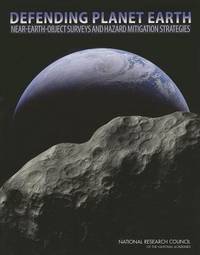
2010ref. 91089Washington DC: The National Academies Press 2010. Presumed First Edition First printing. Wraps. Very good. xvii 1 134 pages. Footnotes. Illustrations Tables Figures Photographs some with color. References. Bibliography. Appendixes. Glossary and Selected Acronyms. The United States spends approximately $4 million each year searching for near-Earth objects NEOs. The objective is to detect those that may collide with Earth. The majority of this funding supports the operation of several observatories that scan the sky searching for NEOs. This however is insufficient in detecting the majority of NEOs that may present a tangible threat to humanity. A significantly smaller amount of funding supports ways to protect the Earth from such a potential collision or “mitigation.” In 2005 a Congressional mandate called for NASA to detect 90 percent of NEOs with diameters of 140 meters or greater by 2020. Defending Planet Earth: Near-Earth Object Surveys and Hazard Mitigation Strategies identifies the need for detection of objects as small as 30 to 50 meters as these can be highly destructive. The book explores four main types of mitigation including civil defense “slow push” or “pull” methods kinetic impactors and nuclear explosions. It also asserts that responding effectively to hazards posed by NEOs requires national and international cooperation. Defending Planet Earth: Near-Earth Object Surveys and Hazard Mitigation Strategies is a useful guide for scientists astronomers policy makers and engineers. The Table of Contents: Front Matter; Summary; 1 Introduction; 2 Risk Analysis; 3 Survey and Detection of Near-Earth Objects; 4 Characterization; 5 Mitigation; 6 Research; 7 National and International Coordination and Collaboration; 8 Optimal Approaches; Appendixes: Appendix A: Independent Cost Assessment; Appendix B: Letter of Request; Appendix C: Committee Panel and Staff Biographical Information; Appendix D: Minority Opinion - Mark Boslough Mitigation Panel Member; Appendix E: Glossary and Selected Acronyms. Planetary defense is the organized global effort to detect track and mitigate potential asteroid or comet impacts on Earth. Coordinated by agencies like NASA's Planetary Defense Coordination Office PDCO it involves surveying for Near-Earth Objects NEOs to prevent catastrophic natural disasters. Strategies include detection characterization and deflection techniques like kinetic impactors. Key Components of Planetary Defense: Detection & Tracking: Astronomers use telescopes to find and monitor NEOs forecasting their paths to identify risks; and Characterization: Scientists analyze the size shape composition and spin rate of hazardous objects. Mitigation/Deflection: Kinetic Impactors: Crashing a spacecraft into an asteroid to alter its path e.g. NASA's DART mission; Nuclear Explosions: An option for large threats or short warning times; "Slow Push/Pull" Methods: Utilizing gravity tractors or laser ablation to gently change an object's orbit. Organizations and Partnerships: NASA & PDCO: Leads US efforts and coordinates with international partners including the International Asteroid Warning Network IAWN and Space Mission Planning Advisory Group SMPAG. Johns Hopkins Applied Physics Laboratory APL: Involved in developing mission technologies: The Planetary Society: Supports research and advocacy for planetary defense. Key Takeaways: Asteroid impacts are rare but potentially devastating. It is considered the only natural disaster humanity could potentially avoid. The goal is to detect threats early to allow for smaller manageable deflections. The National Academies Press paperback
ref. 1024011348.Gpaperback. Good. Access codes and supplements are not guaranteed with used items. May be an ex-library book. paperback
ref. 1024030679.Gpaperback. Good. Access codes and supplements are not guaranteed with used items. May be an ex-library book. paperback
ref. 1024028151.Ghardcover. Good. Access codes and supplements are not guaranteed with used items. May be an ex-library book. hardcover
ref. 1024006697.Ghardcover. Good. Access codes and supplements are not guaranteed with used items. May be an ex-library book. hardcover
ref. 030947695X.Gpaperback. Good. Access codes and supplements are not guaranteed with used items. May be an ex-library book. paperback
2008ref. 2-0309118549National Academies Press 2008. Hardcover. New. illustrated edition. 164 pages. 11.30x8.70x0.70 inches. National Academies Press hardcover
ref. 0309064139.Ghardcover. Good. Access codes and supplements are not guaranteed with used items. May be an ex-library book. hardcover