69 résultats
réf. 22776Bielefeld und Leipzig, Von Belhagen und Klasing, 1910 Gebunden, Leinen illustriert, 130 x 200mm., 272S., illustriert.
19348vo., First Edition, with a frontispiece and 3 plates, free endpapers lightly browned, catalogue leaf annotated neatly by previous owner; original brown cloth, upper board ruled in white and lettered in black, pictorial backstrip blocked and lettered in white and black, a very good, clean copy. This classic tale was reissued in 1949 and 1957.
2010New English Paperback. Pbo. 4to. (30 x 24 cm). In Turkish. 148 p., color ills. Ottoman charm seals from the Haluk Perk Collection. Osmanli tilsim mühürleri. Halûk Perk Koleksiyonu. OTTOMANIA Turkish and Islamic arts Talisman Ottoman culture Seal Collection Islamic culture health History of medicine Turkish folklore.
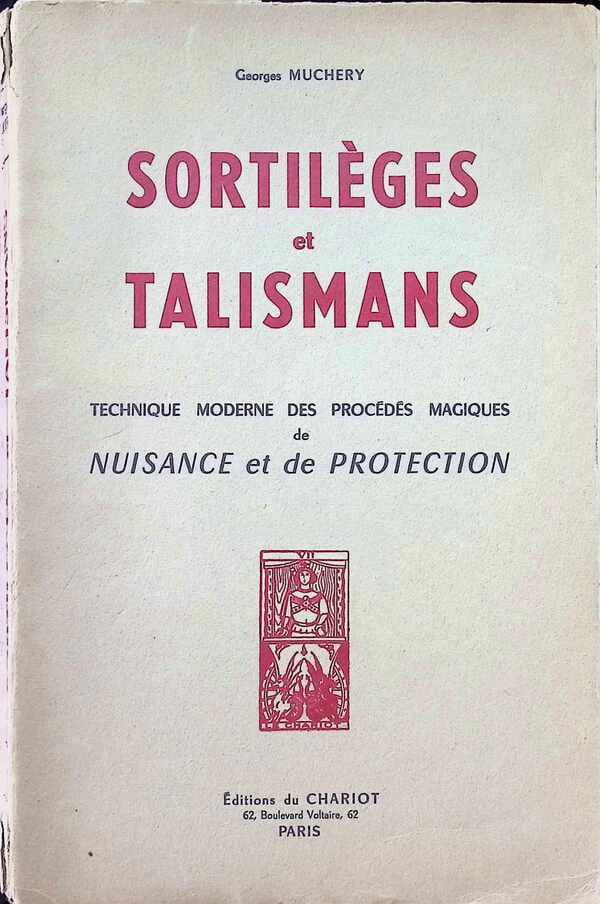
1955réf. 030878Chartres 1955 Editions du Chariot Soft cover
1979réf. ETHIOPIEEE93170825Paris, Seuil, 1979, 20,5 x 28, 122 pages sous couverture souple illustrée. Iconographie noir & blanc et couleurs.
1972Covers show light wear only, text/interior is clean and free of marking of any kind. 357 pages, translated from the Persian to English by George Morrison. This is a prose translation of the epic poem by Gurgani, and is one of the earlies of its kind in Persian literature. Looks like a pretty action-packed tale involving a sorceress who casts a spell of impotency; escapes, a wild boar, a brawl, a marriage ensue. Jacket is quite shelf-worn with several open tears, edge/corner wear but intact.
1966réf. 40701München, Callwey, 1966. 1. Aufl. 270 S. mit zahlr. Ill. (z.T. farb.) 29 x 26 cm, Leinen mit OSchU
195218,6x11,8 cm; 104, (8) pp. Bella brossura editoriale esoterica con titolo in nero e immagine in azzurro. Numero 13 parte della collana "L'Occultisme Simplifiè". Rara edizione esoterica che tratta i poteri occulti dei colori e la loro possibile applicazione nella Cromoterapia, ai talismani, nell'astrologia. L'opera tratta anche delle gemme. Opera in parte intonsa ed in ottime condizioni di conservazione. Poinsot fu autore di numerosi tetsi di occultismo.
1966réf. 70715München, Verlag George D.W.Callwey, 1966. Original-Leiennband mit Schutzumschlag, 4°, 270 Seiten.
2026réf. LRB27061006Paris: Editions Recreasoft 2026 Langue : Français. Environ 506 pages. Français : Réimpression à la demande. Édition originale : 1888. Ouvrage en français. Ouvrage scientifique majeur relatant les expéditions océanographiques des navires français Travailleur et Talisman entre 1880 et 1883. Dirigé par Alphonse Milne-Edwards puis Edmond Perrier ce volume fait partie d'une série documentant la faune marine recueillie lors de ces missions. Il couvre divers groupes d'organismes marins incluant des études sur les cirripèdes némertiens opistobranches holothuries et autres espèces. Une référence essentielle pour les chercheurs en biologie marine et en histoire des sciences. Images du livre non contractuelles English: Print-on-demand reprint. Original edition : 1888. Text in French. Major scientific work documenting the oceanographic expeditions of the French ships Travailleur and Talisman between 1880 and 1883. Directed by Alphonse Milne-Edwards and later Edmond Perrier this volume is part of a series detailing the marine fauna collected during these missions. It covers various marine organism groups including studies on barnacles nemerteans sea slugs sea cucumbers and other species. An essential reference for marine biologists and historians of science. Book images are non-contractual. Editions Recreasoft. Softcover. New. Editions Recreasoft paperback
2014New English Original bdg. Dust wrapper. 4to. (32 x 25 cm). English Edition. 241, [1] p., color ills. The arms of the sultans. The arms collection of Topkapi Palace. Translated by Alev (Kerimoglu) Bulut. "Weapon is a device that was developed by the mankind in the ancient ages for protection against the events of nature and enemies. The arms that were used for the functions of drilling, cutting, defense, and the firing function to be acquired later, were accepted as works of art owing to the mastery and craftsmanship skills that they display. The present work title The arms of the sultans. The arms collection of Topkapi Palace was prepared for the purpose of presenting to the readers The Arms of Collection of the Topkapi Palace Museum, where some of the rarest examples of these works of art are on display, as a whole along with an analysis of its fundamental attributes". Covering 1,300 years and consisting of 52,000 weapons of Arab, Umayyad, Abbasid, Mamluk, Persian, Turkish, Crimean Tartar, Indian, European, and Japanese origin, the Topkapi Palace Museum's weaponry collection is also among the world's premier weapons collections. The collection is made up in part of weapons transferred from the cebehâne and those used by the palace guards; however, the collection's most noteworthy section consists of those weapons ordered by the sultan personally or specially made as gifts for him, which weapons are a part of the palace's private collection. This collection includes weaponry owned by such sultans as Mehmed II, Bayezid II, Selim the Grim, Suleiman the Magnificent, Selim II, Mehmed II, and Ahmed I, as well as the weapons of such high-level dignitaries as grand viziers, pashas, and palace chamberlains; all of these weapons are eye-catching with their fine craftsmanship and decorations. An additional factor that contributed to the diversification of the collection's highly artistic weaponry was the tradition of bringing to the palace the weapons of important figures that were obtained through plunder.
réf. 0282542272.Gpaperback. Good. Access codes and supplements are not guaranteed with used items. May be an ex-library book. paperback
1985réf. 19298Cracow, Jagiellonian University Press, 1985. 1. Edition. 93 pages, 1 n.n., XXIV plates with 144 figures.
réf. 103692534X.Ghardcover. Good. Access codes and supplements are not guaranteed with used items. May be an ex-library book. hardcover
réf. 117962176X.Gpaperback. Good. Access codes and supplements are not guaranteed with used items. May be an ex-library book. paperback
1952réf. 508Paris, Desclée de Brouwer, 1952, in-8, broché, 244 pages (dont index).
1920réf. 1120Paris, P. Brenet, sans date (circa 1920-1930), in-8, broché ; (2) feuillets, 262 pages, (1) page de table, 11 gravures h.t. tirées en bistre.
réf. 9786557123386BEST SELLER. new. Os astros como voc� nunca viu: escrito por Maria Talism� a astr��loga da pǭgina Astroloucamente � maior pǭgina brasileira de astrologia no Instagram com mais de 45 milh��es de seguidores � Deu a louca nos signos Ǹ um guia informativo descontra�do e revelador do zod�aco. Voc� pode n�o acreditar em astrologia e ��s vezes atǸ n�o entender muito bem do assunto mas que Ǹ divertido adivinhar o signo das pessoas e conversar sobre os clich�s de cada integrante do zod�aco isso Ǹ inegǭvel. � nesse esp�rito que Deu a louca nos signos aborda o tema: com a descontra��o e a simplicidade de um papo entre amigos mas ao mesmo tempo com a profundidade necessǭria para que voc� d� sua opini�o com propriedade. Neste guia Maria Talism� a astr��loga da pǭgina Astroloucamente � a maior pǭgina brasileira de astrologia no Instagram com mais de 45 milh��es de seguidores � tra��a um perfil mais que completo do zod�aco com o humor que Ǹ marca registrada do perfil. Em Deu a louca nos astros voc� vai encontrar: dados tǸcnicos como elemento polaridade modalidade decanatos posi����es no mapa astral c�spides e mais BEST SELLER unknown
2015New New Turkish Original bdg. Dust wrapper. 4to. (28 x 21 cm). In Turkish. 574 p., color ills. Study on the objects used in daily life in the Ottoman Empire. Osmanli'da günlük yasam nesneleri. Second Edition.
réf. 13981451Milan: Editions 5 continents, 2019 in-4 (24,5 x 34 cm), 192 pages, 148 illustrations en couleurs. Reliure d'éd., comme neuf. Les tablettes coraniques appelées allo kafii gida, conservées par l'ethnie des hausa qui peuplent le nord du Nigeria, sont marquées du sceau du secret. Les hausa ont peur de révéler à des étrangers les formules de bon augure qui ornent ces objets. Et ils refusent aussi de prendre le risque d'exposer des représentations d'êtres humains et d'animaux dans un contexte islamique iconoclaste. Aujourd'hui encore, l'islam radical punit sévèrement la possession d'allo kafii gida par des sanctions pouvant aller jusqu'à l'exécution capitale. Si elles n'avaient pas été sauvées au fil du temps, toutes les tablettes de ce livre auraient été vouées à la destruction par les fondamentalistes musulmans. Les auteurs des décorations qui ornent les tablettes coraniques ne sont pas de simples illustrateurs, ce sont de véritables conteurs : ils ont peint sur ces planches de bois les récits qui reflètent la vision cosmique de leur société. A travers la création artistique, ils ont incorporé des idées étrangères et lointaines dans le système de pensée des hausa, faisant de ces allo kafii gida de véritables capsules cosmologiques sur bois. Dans ce contexte difficile, on peut qualifier les propriétaires de ces oeuvres d'art de "conservateurs ", car ces tablettes secrètes, bien que liées à la religion musulmane, témoignent de la cosmologie hausa. Les objets dont les photographies illustrent cet ouvrage, uniques dans le domaine des arts extraeuropéens, appartiennent à une collection privée fruit de plus de vingt années de recherches
1958réf. FB8152 /L19Paperback. Green cover with black title. We provide an in-depth photographic presentation of this item to stimulate your feeling and touch. More traditional book descriptions are immediately available Warning: This book was part of the erotic library gathered by the famous Cambridge Don computer scientist food and wine connoisseur Jack Arnold LANG along with medical friends and family involved in Freudian research. Sexual instincts or drives have deeply hidden roots in the unconscious mind. Instincts act by giving vitality and enthusiasm to the mind through meaning and purpose. The range of instincts is in great numbers. Freud expressed them in two categories. One is Eros the self-preserving life instinct containing all erotic pleasures. While Eros is used for basic survival the living instinct alone cannot explain all behavior according to Freud. In contrast Thanatos is the death instinct. It is full of self-destruction of sexual energy and our unconscious desire to die. The main part of human behavior and actions is tied back to sexual drives. Since birth the existence of sexual drives can be recognized as one of the most important incentives of life. The enclosed book was part of this research. A photograph is enclosed should you seek further details please contact Martin Frost on martin.frost@gmail.com Foremost amongst erotic books collected by Jack Arnold Lang are those published in France by the Olympia Press. The Olympia Press was a Paris-based publisher launched in 1953 by Maurice Girodias as a rebranded version of the Obelisk Press he inherited from his father Jack Kahane. It published a mix of erotic fiction and avant-garde literary fiction and is best known for issuing the first printed edition of Vladimir Nabokov's Lolita. In its heyday during the mid-fifties Olympia Press specialized in books which could not be published without legal action in the English-speaking world. Early on Girodias relied on the permissive attitudes of the French to publish sexually explicit books in both French and English. In the late 1950sthe French authorities began to ban and seize the press's books. A total of 94 Olympia Press publications were promoted and packaged as "Traveller's Companion" books usually with simple text-only covers and each edition in the series was numbered. The "Ophelia Press" line of erotica was far larger using the same design but pink covers instead of green. Olympia Press was the first publisher willing to print William S. Burroughs's avant-garde sexually explicit Naked Lunch which soon became famous. Other notable works included J. P. Donleavy's The Ginger Man ; Samuel Beckett's French trilogy Molloy Malone Dies and The Unnamable ; Henry Miller's trilogy The Rosy Crucifixion consisting of Sexus Nexus and Plexus; A Tale of Satisfied Desire by Georges Bataille; Story of O by Pauline Réage; Terry Southern and Mason Hoffenberg's Candy ; Alex Austin's The Blue Guitar and Eleanore ; and a critical book on Scientology Inside Scientology/Dianetics by Robert Kaufman. The South African poet Sinclair Beiles was an editor at the publisher. Other authors included Alexander Trocchi Iris Owens Harriet Daimler and John Stevenson Marcus Van Heller. Girodias had troubled dealings with his authors including copyright issues. Nabokov was dissatisfied with the copyediting assignment of copyright and the press's literary reputation. The press engaged in a long-running dispute over the rights to The Ginger Man ended with Donleavy's wife Mary buying out Girodias at what was intended to be a closed auction. Forced to leave France in 1963 Girodias briefly reestablished Olympia Press in New York in the 1960s and in London in the early 1970s. Grove Press in the U.S. would later print The Olympia Reader a best-selling anthology containing material from some of Olympia's most popular works including material by Burroughs Miller Trocchi and others. Another well-known collection was The Best of Olympia first published by the Olympia Press in 1963 and reprinted by New English Library in 1966. Other incarnations of the company some with Girodias' support emerged in Germany Italy and the United Kingdom. Olympia Press has been re-established and is currently operating out of Washington London and Frankfurt. Paris: The Olympia Press.1958. Small format 8vo. original green card covers ruled and lettered in black and white; pp. vi 7-259 v; title page with border in green; a very good to near fine copy. First issue. No. 63 in the Traveller's Companion series. An Olympia Press catalogue issued c.1958 lists no. 63 in this series as being a novel by Henry Crannach Marilyn Meeskeentitled 'Porridge Tasters'. The book was never written and Talsman's offering filled the gap.Somewhat of a lost novel in the history of gay literature The Gaudy Image follows the protagonist Titania Thomas Schwartz as he navigates a cast of characters in New Orleans in search of the perfect lover. Review: Talsma's book tells the story of Thomas Schwartz Madame Titania's alter ego who moves to 1950s New Orleans in search of the perfect man synthesized in the "Gaudy Image". Through the city's bars clubs and back streets you follow the lives of a variety of characters. Sometimes the novel seems a bit confusing sometimes it's not simple to follow the story. But right away you have a very articulate split of what gay life was like in those years. So many characters who call themselves using adjectives and feminine pronouns a world where true identities don't matter replaced by nicknames. In which the police seem to tolerate. And in which the Gay and partly lesbian world seems organized into precise castes each with its role. Yet the desire to love many of the figures in the novel Tit in the lead already tells of a desire for normality that will be late in arriving. Note: Originally published in France in the 50s to avoid prosecution for obscenity The Gaudy Image is one of the most important `lost' gay novels. A classic of gay fiction. The Olympia Press. paperback
réf. 1207A181317Good. ND C.1890 Boston:DeWolfe Fiske embossed floral decor. red HC Good/No DJ. 3 illus. Intro. July 1832. 508pp with another 5pp index. Includes CASTLE DANGEROUSindex in one vol. hardcover
1933réf. 15428Paris, Librairie Orientale et Américaine Maisonneuve, 1933 ; fort in-8, broché ; pp.317-792 et (1) f. de corrections, 2 cartes dépliantes.
1998réf. Q-0910155372Bartleby Press 1998-10-01. Paperback. New. In shrink wrap. Looks like an interesting title! Bartleby Press paperback
2014New English Original bdg. Dust wrapper. 4to. (32 x 25 cm). English Edition. 241, [1] p., color ills. The arms of the sultans. The arms collection of Topkapi Palace. Translated by Alev (Kerimoglu) Bulut. "Weapon is a device that was developed by the mankind in the ancient ages for protection against the events of nature and enemies. The arms that were used for the functions of drilling, cutting, defense, and the firing function to be acquired later, were accepted as works of art owing to the mastery and craftsmanship skills that they display. The present work title The arms of the sultans. The arms collection of Topkapi Palace was prepared for the purpose of presenting to the readers The Arms of Collection of the Topkapi Palace Museum, where some of the rarest examples of these works of art are on display, as a whole along with an analysis of its fundamental attributes". Covering 1,300 years and consisting of 52,000 weapons of Arab, Umayyad, Abbasid, Mamluk, Persian, Turkish, Crimean Tartar, Indian, European, and Japanese origin, the Topkapi Palace Museum's weaponry collection is also among the world's premier weapons collections. The collection is made up in part of weapons transferred from the cebehâne and those used by the palace guards; however, the collection's most noteworthy section consists of those weapons ordered by the sultan personally or specially made as gifts for him, which weapons are a part of the palace's private collection. This collection includes weaponry owned by such sultans as Mehmed II, Bayezid II, Selim the Grim, Suleiman the Magnificent, Selim II, Mehmed II, and Ahmed I, as well as the weapons of such high-level dignitaries as grand viziers, pashas, and palace chamberlains; all of these weapons are eye-catching with their fine craftsmanship and decorations. An additional factor that contributed to the diversification of the collection's highly artistic weaponry was the tradition of bringing to the palace the weapons of important figures that were obtained through plunder.