Livre Rare Book
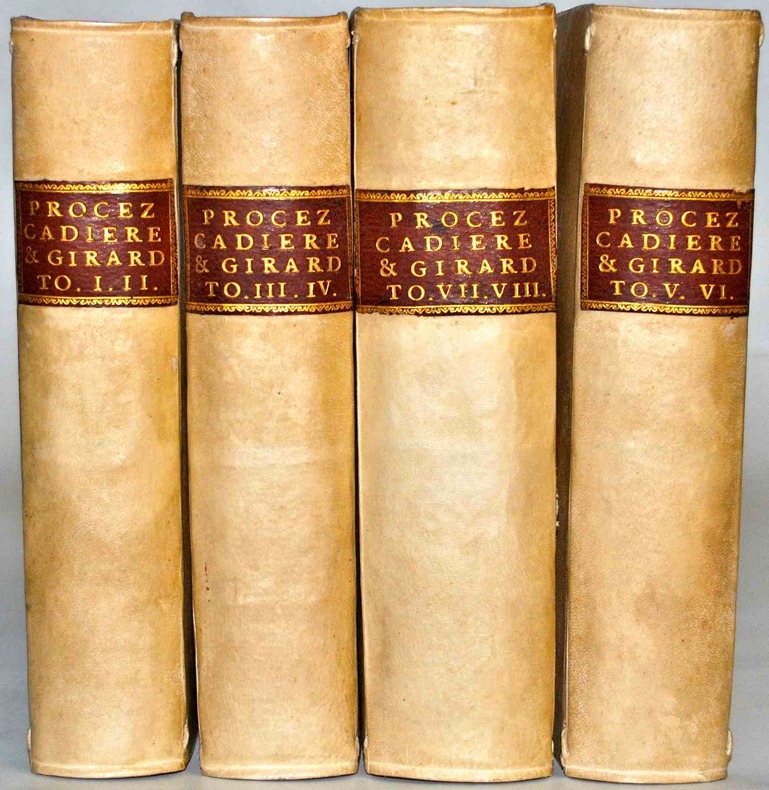
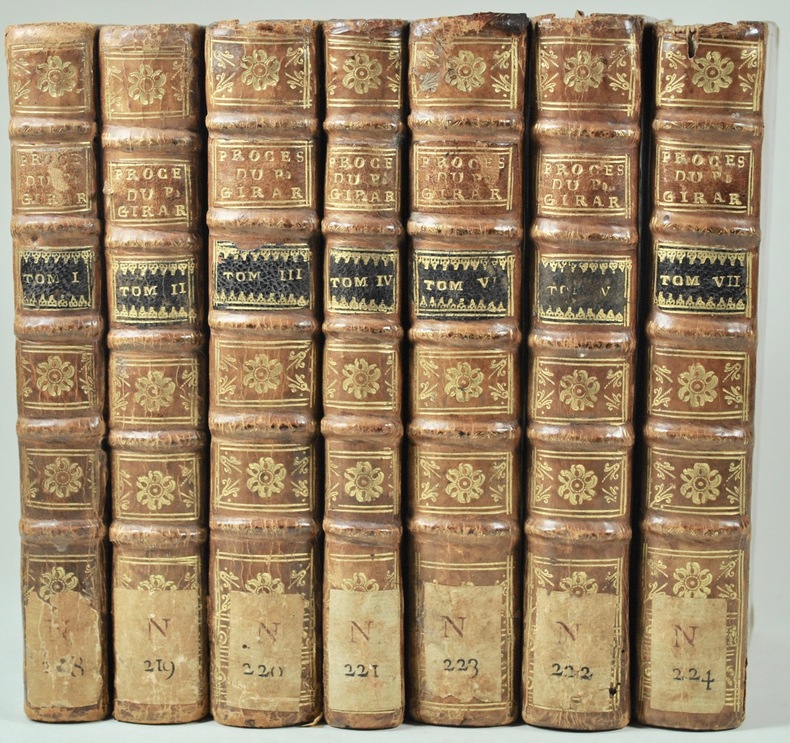
1731ref. 5499A La Haye, Chez Swart, 1731. 8 tomes en 4 vol. in-12 de (4)-30-(4)-172-16-36-38-(2)-8 pp. ; (4)-144-147 pp. ; (4)-191-131 pp. ; (4)-144-28-128 pp. ; (4)-168-51-108 pp. ; (4)-160-92-15-55 pp. ; (4)-203-104 pp. ; (4)-133-106-132-33-11-36 pp., vélin dur à petits rabats, tranches jaspées, pièces de titre en maroquin rouge (reliure de l'époque).
1731ref. 14798A La Haye, Chez Swart, 1731. 8 tomes en 8 vol. in-12, veau brun, dos ornés à nerfs, tranches rouges, pièces de titre et de tomaison en maroquin rouge (reliure de l'époque).
1731ref. 276501731 Aix : impr. de D. David, 1731; etc- 1 fort vol. in-folio, précédées d'un feuillet de titre général et d'un feuillet de table, veau brun trés abimé, dos orné à nerfs en partie manquant,plats trés usés ; tranches rouges (reliure de l'époque). contenant 28 des pièces en premier tirage (liste sur demande). total = 881 pp.,paginations separées - titre identique à l'exemplaire de la BNF du premier factum seul (58p.).- + copie manuscrite époque in fine: les lettres au Chancelier: magistrat à M. le président de Maliverny, la réponse de ce juge, et celles des autres messieurs qui ont été de son opinion (11 octobre-23 novembre 1732). 22 pp.; bon état,reglé - Sorcellerie et possession à Aix en Provence; Ollioules ; la Cadière.- Trés rare, rèstaurable.-
ref. 20449Anvers, Hevdrick Connix, 1584. In-4, [12]-653-[23] pp. (*4, **2, a-z4, A-Z4, Aa-Zz4, Aaa-Qqq4; Qq4 est 1 f. bl.), parchemin souple ivoire, dos long, titre manuscrit au dos, traces de liens (liens manquants, restaurations, taches, importantes mouillures sans dommage pour la lecture, taches).
1977ref. 4669E. J. Brill. Near Fine with no dust jacket. First Edition. Hardcover. All volumes are in Near Fine or better condition. Volume 2 has rubbing to small portion of spine.; 6 Volume Set. Études Préliminaires Aux Religions Orientales Dans L'Empire Romain; 1-6 . 1977. E. J. Brill hardcover
1744ref. GEJ-3Rome but Lille, Imprimerie de Blocquel, 1744 but probably 1830. Hardcover. In-12. Colation complete: 112 pp. and avertissement pp. Quarter leather binding, brown leather backstrip over marbled paper boards. Gilt titling on leather spine label, raised bands, gilt rules and decorations to spine. Marbled endpapers and page edges. Exlibris on the first endpaper: "Libraire Papeterie G.Cazaux".Frontispiece, full page plates, sigils and devices in text. Bright and clean inside. Little foxing interior. Rare 1744 edition of French Grimoire refers to an edition of Henri Corneille Agrippa famous grimoire, translated into French by Pierre d Aban, which includes occult secrets such as the ritual of the Queen of the Hairy Flies. Although dated 1744, the edition may be fanciful. Probably early XIX c. edition. This type of Bibliotheque Blue publication, although sometimes fanciful in its dating, was common at the time and refers to writings already circulating on occult and alchemical practices. Bibliography: Caillet, 97, Y. Plessis, 34.
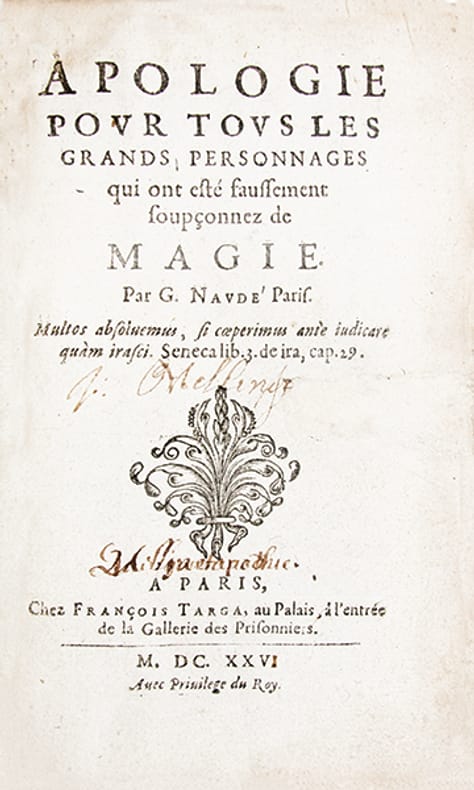
ref. 39293Paris, François Targa, 1625. In-8° (170 x 110 mm), vélin souple, dos lisse titré à la plume, (24), 615 (i.e. 650), (23) pages.
1977ref. 18545E. J. Brill. Very Good with no dust jacket. First Edition. Hardcover. All volumes are in VG or better condition. Leather bindings with slipcases. Spines sunned and discolored.; V1: 1987 xxxvii 349 pp 199 pl; V2: 1982 xxxi 278 pp 219 pl; V3: 1977 xxviii 198 pp 302 pl; V4: 1978 xxiii 142 pp 111 pl; V5: 1986 xxiv 226 pp 168 pl; V6: 1989 xxix 224 pp 146 pl; V7: 1977 xv 67 pp 115 pl.; 7 Volume Set. COMPLETE. Études Préliminaires Aux Religions Orientales Dans L'Empire Romain; 1-7 . 1977. E. J. Brill hardcover
In Fiorenza, nella Stamperia di Zanobi Pignoni, 1643, volume unico, in-4, legatura settecentesca che riutilizza due pergamene più antiche (probabilmente smontate da rilegature di libri di formato inferiore), con dorso rinforzato in carta decorata antica e titolo calligrafato su tassello in carta, pp. 610, [2]. Frontespizio stampato in rosso e nero con stemma mediceo, 23 incisioni xilografiche nel testo (fra cui forme geometriche, la pianta di un passaggio segreto, mobili a doppio fondo, teschi e ossa umane) e una tavola allegorica in rame fuori testo (che quasi mai si trova) raffigurante un liuto senza una corda su cui si poggia una cicala e con motto latino "Ut suppleat" - simbologie per la stonatura delle perversioni del genere umano, sostenuta però dall'intelletto personificato dall'apollinea cicala -. Rara opera seicentesca sul diritto criminale scritta da Antonio Maria Cospi, giudice in varie sedi dello Stato toscano fra la fine del Cinquecento e l'inizio del Seicento, ed edita postuma dal nipote Ottaviano. Si tratta di un testo di pratica giudiziaria che tenta di organizzare i ricordi e le conoscenze professionali dell'autore. Si spazia infatti dalla trattazione scientifica alla spicciola quotidianità del criminalista, passando per la superstizione e l'aneddotica. Il Cospi si sofferma nella prima parte sulla deontologia del giudice, indicando la lussuria e quindi - in una visione fortemente antifemminile - la donna come "ianua diabuli". Nella seconda parte tratta gli ambiti della criminalità, soprattutto quelli fra reato e peccato, quali la magia, la divinazione, l'eresia, la stregoneria. Nella terza, oltre che su negromanzia, avvelenamenti, stupri, aborti, ladri, zingari e bari (alle carte o ai dadi), si sofferma a lungo sull'importanza della ricognizione del cadavere e del luogo del suo ritrovamento. Ci troviamo di fronte a un quasi manuale per "la scena del crimine", con tanto di descrizioni dettagliate e illustrazioni. L'autore sostiene proprio che il giudice necessiti di conoscenze scientifiche, anatomiche, chimiche e di disegno, oltre a quelle prettamente giuridiche e morali, per poter analizzare al meglio e mettere a verbale ogni caso in modo critico. Altro concetto innovativo e fondamentale è quello della testimonianza, intesa come interrogatorio al fine di trarre indizi dall'esame del reo e vista come unica via laddove la scienza non può arrivare. Dalle bibliografie a nostra disposizione (Piantanida/Diotallevi/Livraghi 1948, Michel 1970 e la rivista "Le Carte e la Storia" edita da Il Mulino 2002) questa del 1643 risulterebbe come prima edizione, anche se, probabilmente in tempi successivi, ne sarebbe stato censito un unico esemplare, alla Biblioteca Nazionale di Firenze, datato invece 1638. Più probabilmente però, secondo la nostra interpretazione, si tratterebbe di un errore tipografico sulla data di quest'ultimo esemplare: MDCXXXVIII (1638) invece di MDCXXXXIII (1643). La carta Oo presenta uno strappo con perdita di qualche carattere; minuto camminamento di tarlo alle 6 carte da Vv3 a Xx4, solamente marginale; alcuni fascicoli leggermente bruniti per la fattura della carta. Comunque un bell'esemplare.
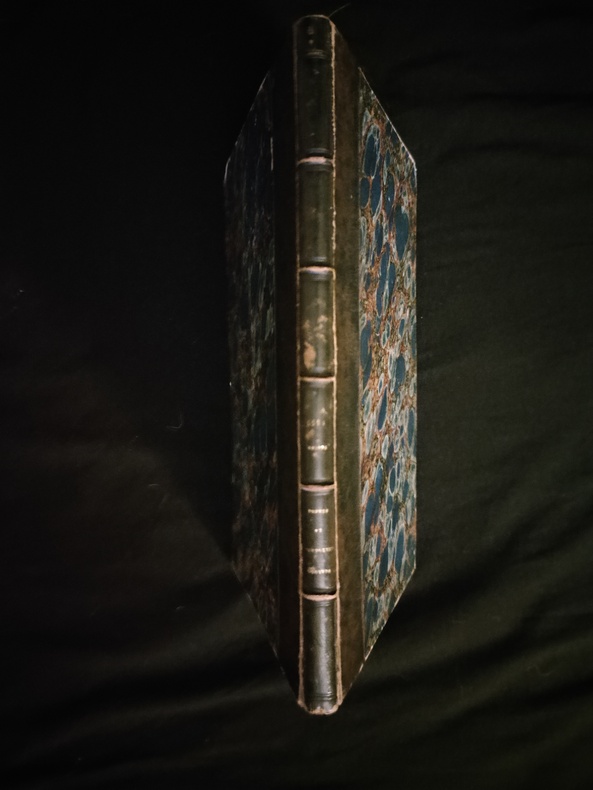
1866ref. 40275Paris, Pincebourde, 1866. In-12 de 38 pp. frontispice, maroquin rouge, titre doré en long sur le dos, septuple filet doré en encadrement sur les plats, dentelle intérieure, non rogné, tranches dorées (reliure de l'époque).
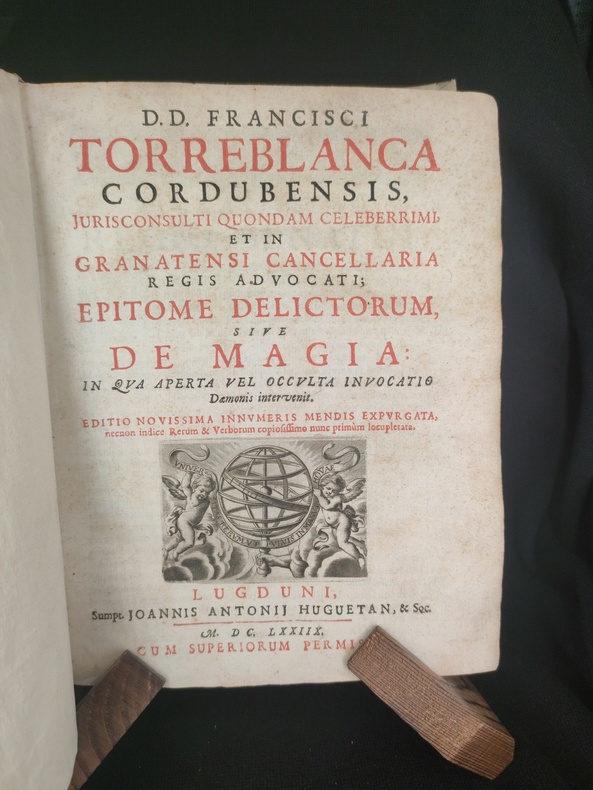
1678ref. GEJ-9Lugduni (Lyon), sumpt. J. A. Huguetan, 1678. Book in Latin. In-4. Collation: [8], 576, [104]. Original full vellum, ink title on the spine. Title in red & black. Armorial bookplate of the Prince of Lichtenstein on the front pastedown. First and last blank endpapers intact. Some wear and soiling to vellum. Foxing. Overall Very good. Complete. 3rd edition of Summary of Crimes, or On Magic: In which open or hidden invocation of the demon intervenes, is a comprehensive legal guide on defining, identifying, and prosecuting acts of magic, witchcraft, and sorcery, heavily influenced by the Spanish Inquisition and demonological theory. The work categorizes different types of magic—distinguishing between "open" (explicit pacts) and "hidden" (implicit/superstitious) invocation of demons. It was a standard reference for canon law and criminal issues related to magic in the 17th century, including its use in Spanish and Portuguese colonial contexts. Book is devided into 4 parts + "Defensa". Pages 514-76 contain the author's "Defensa de los Libros Católicos de la Magia". Bibliography: Caillet 10764; Cornell Witchcraft Collection 53; Graesse (Magica) 53; Palau 334.827; Thorndike VII, 326-30; USTC No. 6080367; Coumont T.33.3; Goldsmith T-444; Crowe 551; OCLC: 11407716; Robbins 1026. "The work is divided into four books devoted to divining magic, operative magic, and its punishment in the forum exterior and juridical, and in the interior tribunal of the soul and confessional. Magic is defined after Proclus and Psellus as an exacter knowledge of secret things in which, by observing the course and influence of the stars and the sympathies and antipathies of particular things, they are applied to one another at the proper time and place and in the proper manner, so that marvels are worked. Torreblanca turns to diabolical magic and the extent of the powers of the devil to make it possible. Torreblanca has jumbled together natural and diabolical magic almost inextricably, but his remaining chapters are on witchcraft, with the two last on natural and divine remedies against it." (Thorndike VII, A History of Magic and Experimental Science). Provenance: Old Ex libris - (library ?) Lichtensteinianis (Armorial bookplate of the Prince of Lichtenstein?).
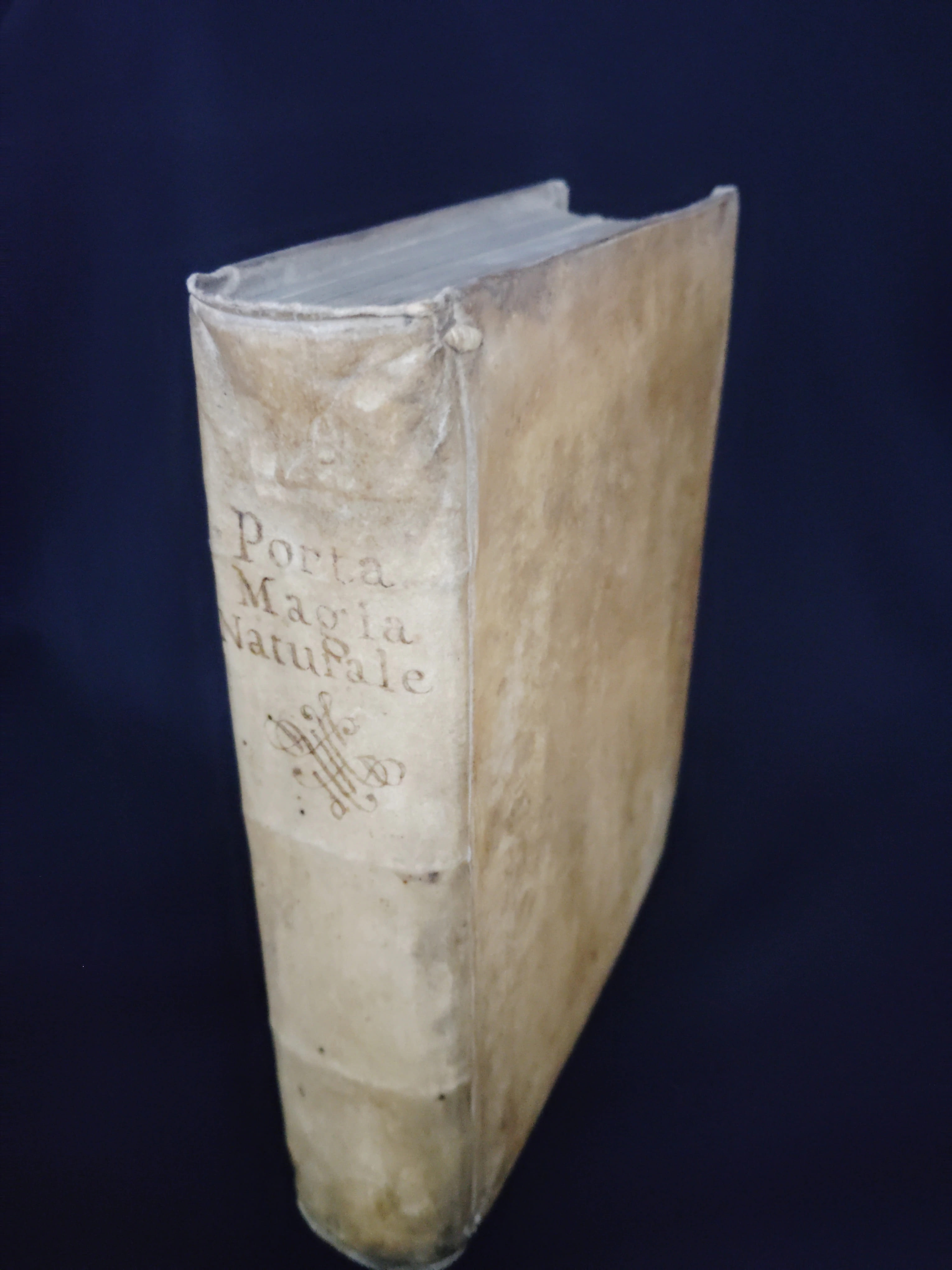
1611ref. GEJ-12Napoli, appresso Giovanni Giacomo Carlino, 1611, pp. [8] 725 [1]. In-4. Book in Italian. Original full vellum, ink title on the spine. Title in black. Small restoration on the title page. Old but later endpapers. Clean with a little foxing. Overall Very good. Complete. This rare 1611 Italian 1st expanded twenty-book version of Giambattista della Porta’s magnum opus, Della magia naturale (Natural Magic). Originally published as a shorter four-book treatise in 1558, della Porta spent decades expanding his observations into this monumental encyclopedia of Renaissance science, secrets, and experimental philosophy. Della Porta’s work serves as a fascinating intellectual bridge between medieval alchemy and the Scientific Revolution. To the author, natural magic did not mean sorcery, but rather the understanding and manipulation of the hidden laws of nature through rigorous observation and experimentation. Across its twenty books, this comprehensive volume covers an astonishingly diverse range of subjects. It includes early descriptions of the camera obscura and foundational concepts in optics that later influenced the invention of the telescope. It also delves into metallurgy, cryptography, agriculture, and botany, alongside practical recipes for cosmetics, perfumes, pyrotechnics, and early chemical warfare. As the founder of the Academy of the Secrets of Nature, della Porta was one of Europe’s foremost polymaths, and his writings heavily influenced contemporary titans of science like Galileo Galilei and Johannes Kepler. Capturing the very peak of late-Renaissance intellectual curiosity, this 1611 edition stands as a highly desirable and significant artifact for any collector of early science, occult philosophy, and the history of ideas. Bibliography: USTC No. 4025330; EDIT16; Riccardi II, 307; Caillet 8851; Duveen (Bibliotheca Alchemica et Chemica) p. 481; OPAC SBN Numer BVEE002361; Graesse V; Dorbon-Aîné 3710-20; STCN 833455907; Ferguson, II, p. 216.
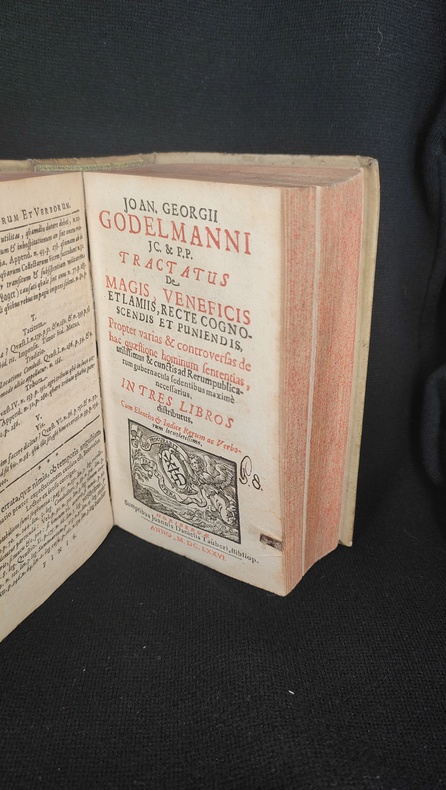
1676ref. GEJ-5Nuremberg: Johann Daniel Tauber, 1676. Book in Latin and German. In-8. [12], 162; 102; 256, [73] pages, including errata leaf at end. Contemporary vellum, ink title on the spine, occasional light foxing. Title in red & black. Later edition of this work on magic and witchcraft by J.G. Godelmann (1559-1611), German diplomat and professor of law at Rostock University. Book contains 3 parts. The 1st and 2nd part contains information on magic, sorcerers, and witches, the 3rd part dedicates to legal procedures in witchcraft cases. The book was placed on the Index of prohibited books in 1601. Bibliography: Ref. VD-17 1:0629512, Caillet 4226, Coumont G 43.5., Thorndike VI, 535-37. USTC 2589027. Not in BL London. Coumont G 43.5. - "Godelmann's greatest achievement lies in his, for this time, exceptionally decisive stance against the belief in witches". Provenance: From the library of André Lambert, with ex-libris. Ownership sticker: Oskar Gershel, Buchhandlung Stuttgart, Kronprinzstrasse 32. bound with Law book by MEVIUS (David) titled: Considerationes juridicae super Sex diversis punctis, indeque resultantibus Quaestionibus, in Causis Proprietariorum Pensionariorum subinde occurrentibus. Hall. Saxon.[Halle-sur-Saale], Sumptibus Simon. Joh. Hubneri, 1675.
1837ref. 156383London: John Russell Smith 1837-38. Arraignment Tryall Confession and Condemnation First edition thus part of the publisher's "Library of Old Authors". Smith issued numerous reprints of early tracts such as Puritan discipline works the ballads of Captain Cox and reports of 15th-century battles. This collection was followed in 1862 by a volume on the witch trials of New England. The tracts were printed separately and have separate title pages but were published as a single edition with a collected contents page. Octavo 209 x 129 mm. Portrait frontispiece. Contemporary black half calf brown morocco spine label marbled boards brown endpapers edges speckled red binder's ticket of W. Isacke London on front pastedown. Contemporary shelf label on front pastedown; a handful of neat annotations to contents. Binding rubbed front inner hinge cracked contents lightly foxed and browned: a very good copy. hardcover
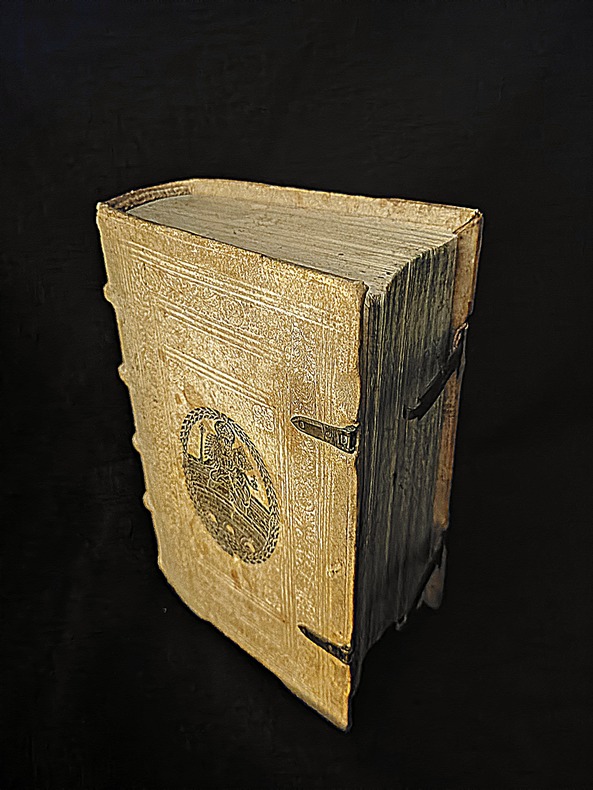
1581ref. GEJ-8Ingolstadt, apud Davidem Sartorium, 1581. pp. [80] 542 p. Book in Latin. In-8. Beautifull ornamented white blind stamped calf. Additionally black engreved to front cover. Two original clasps. Fist and last blank leaf missing. Title page in black. 80 unnumbered and 542 numbered pages. Blue paper edges. Clean endpapers with small pencil annotation on the first back cover. Nice ornameting, wide margins and initial letters. Very clean and bright interior. Franziskaner Kloster Dettelbach stamp and hand-written anotations on the title page. Complete. Very good condition. 2nd rare edition (First, 1580) of interesting and influential work on heresy. Very uncommon issue on the market. Rare in any edition. "Hammer of Heretics" is a Catholic counter-reformation text by Georg Eder, published in Ingolstadt, that defends Catholicism against Protestant doctrines, particularly Lutheranism and Anabaptism. It is distinct from the 1487 Malleus Maleficarum (witch-hunting manual), focusing instead on combating heresy through theological argumentation. Eder was a lawyer and Catholic theologian (1523 - 1587), Imperial Court Councillor and advisor to Emperors Ferdinand I, Maximilian II, and Rudolf II. Best known for his theological polemical writings. "His oratorical and literary talent, the decidedly Catholic orientation from his Bavarian homeland, which deepened in Cologne and, in Vienna, where he immediately sought contact with the Jesuits, manifested itself in tireless activity, making Eder a champion of Catholicism struggling for its existence in Austria" (NDB IV, 311 f.). "Eder's writings from this period all deal with the question of church confession with regard to the differing and opposing positions of the Protestants" (ADB V, 318). Bibliography: USTC No. 674751, VD16 E 541, Stalla 1413, Adams E 64. Provenance: Franziskaner Kloster Dettelbach.
1731ref. 42632S.l.n.d., , (1731 circa). Manuscrit in-8 calligraphié de (24) ff., texte encadré, maroquin rouge, dos lisse orné, titre doré en long sur le dos : Chansons manuscrites du Père Girard, filets d’encadrement dorés sur les plats, frise intérieure (Purgold).
1674ref. GEJ-2Basel, Getrukt bey Johann Heinrich Meyer, 1674. In-8. Latin & German text. 1 volume complete itself. 1107 p. Colation complete. First edition of kind of warning against sorcery by the XVII c. Swiss Protestant pastor Bartholomäus Anhorn. Contains chapters on dreams, palmistry, duelling, witches, alchemy, and charming. Very rare book including an introductory eulogy by Johannes Tonjola. Internal condition: original gold ornamented brown calf binding. Rubbed, bumped, with minor defects on the spine with missing the closure ribbons. Title page and engraved title printed in black. Slightly browned due to paper, dampstained in places and few corners bent with XIX c. unknown bookplate on the endpaper. Red paper edges. Rare first edition. Bibliography: VD17 3:600284P. Graesse, BMP, 51. Goedeke III, 241, 22. Por. Faber du Faur 1265 and Jantz 378. Hayn-Gotendorf III, 172. USTC 6144407. Faber du Faur 1265: "Anhorn believed in devils and witchery, but advocated caution as regards such phenomena as the bleeding of corpses in the presence of their murderers, and thought that no one should be imprisoned and questioned under torture on such kind of evidence alone". Jantz 378: "A partially critical survey of occult phenomena and popular superstitions". Provenance: Unknown, probably XIX c. coat of arms bookplate on the first endpaper.
1597ref. 16014Eisleben, Henningus Grosius, 1597. Petit in-4 (14 x 19 cm) de 8 ff. 478 pp. 1 f.bl. 14 ff. d'index 2 ff.bl. veau brun, dos orné à nerfs, armes sur les plats dans un encadrement de double filet doré (reliure de l'époque).
1626ref. 42497Paris, Jean Libert, 1626. In-12 de (28)-476-(56) pp., maroquin vert, dos lisse orné, frise et roulette dorées d'encadrement sur les plats (reliure du XVIIIe siècle).
ref. 13464La philosophie Occulte.Divisée en trois livres et traduite du latin. Deux tomes en deux volumes in 8 (185x110mm) plein cuir fauve glacé d’époque, à nerfs, titre, roulette, tomaison, filets,caissons, palmettes dorés, roulette dorée sur les coupes. Tome premier : titre avec figure gravée, XX, 427 pages. Tome deuxième titre avec figure gravée, 317 pages, tranches rouges Nombreux tableaux et figures cabalistiques gravés, dans le texte et 12 planches gravées hors texte certaines dépliantes, nombreux bandeaux et fleurons gravés. Première édition de la traduction française par A.A Levasseur. A Lahaye chez R.Ch Alberts 1727. Très bon état. Fort rare. Caillet 95. « capital pour l’étude de la science occulte » DORBIN
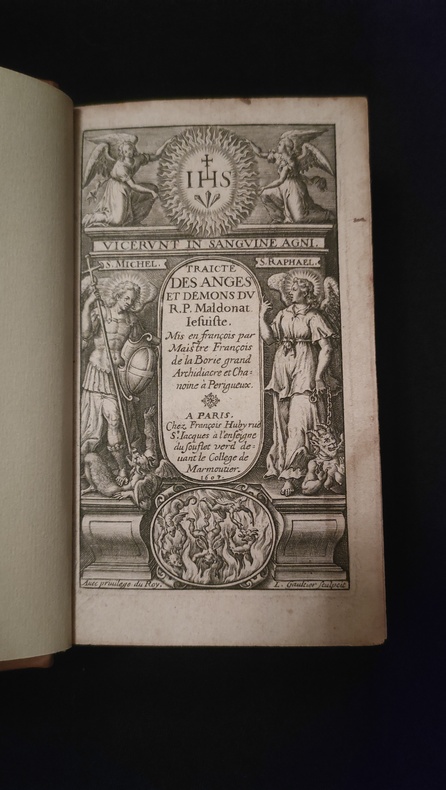
1607ref. GEJ-7A Paris: chez Francois Huby, 1607. Book in French. In-12. Engreved title page in black, 7 sheets unnumbered and 242 numbered sheets. Later XIX c. full brown blind stamped calf. Gold lettering and ornamenting spine, red lables. Red paper edges. Clean ecrue endpapers. Nice ornameting and lettering, initial letters, some light browning and few water stains inside. Otherwise very clean without any anotations, marks or stamps. Complete. 2nd rare edition (First, 1605) of interesting and influential work on demonology and angelology. Very uncommon issue on the market. Rare in any edition. Tratise deals with the angels' names, their immortality, movement and the power by Spanish Jesuit theologian Juan de Maldonado (1533-1583). Juan Maldonado was a scholar and demonologist known for his profound knowledge of ancient languages. "Traicté des anges et demons" is a translation of some lectures of Maldonado, collected and translated by Canon Fr. Arnault de La Borie (1525?-1607) in 1605 and published in the same year in French. Bibliography: Coumont M:11.8., Wellcome I:3996., Not in Caillet (other ed. 7042), USTC No. 6024485. Provenance: No markings (?).
1575ref. GEJ-14Romae (Rome), In Aedibus Populi Romani, 1575. [24], 262, [2] pp. In-4°. Book in Latin. The work is adorned with a woodcut printer’s device on the title page, fine ornamental initials, and an extensive, enlarged index preceding the main text. Old handwriten title letering to spine. Full original vellum binding and endpapers. XXth century bookplate with the initials J.B to front pastedown. Some early shelf-mark on first blank leaf and annotaions on the last pastedown. Foxing, worholes and some discolorations. Otherwise good and complete copy. This volume represents the important and rare second edition of De strigimagarum, daemonumque mirandis (“On the Marvels of Witch-Magicians and Demons”), a landmark early modern treatise on witchcraft, demonology, and inquisitorial procedure. First published in Rome in 1521 by Antonio Blado, the text was reissued in this substantially revised edition more than fifty years later. As noted on the title page, this 1575 printing was meticulously corrected and purged of the countless typographical errors that plagued the earlier publication. The author, Silvestro Mazzolini da Prierio (ca. 1456–1527), known as Prierias, was a distinguished Dominican theologian, inquisitor, and Master of the Sacred Palace under Pope Leo X. Famously remembered as one of the earliest Catholic theologians to publicly challenge Martin Luther, Prierias skillfully combined scholastic theology, canon law, and his extensive personal inquisitorial experience to address the contemporary socio-religious crisis of witchcraft. The treatise is organized into three distinct books. The first explores the theoretical, theological, and philosophical foundations of demonology, examining the nature of the soul, angels, and demons, alongside the limits of their influence on the physical world. The second book focuses directly on the witches themselves (strigimagae), providing a detailed contemporary account of diabolical pacts, harmful magic (maleficium), nocturnal flight, and the reality of the witches' Sabbath. Historically, Prierias's work is of paramount importance due to its radical reinterpretation of the medieval Canon Episcopi. While that traditional authority dismissed the nocturnal journeys of women as mere demonic illusions, Prierias argued that early modern witchcraft had evolved into a far more dangerous threat. In his view, the witch was not merely suffering from delusions, but was actively guilty of heresy, superstition, apostasy, and deliberate maleficium. This pivotal intellectual shift effectively bridged older canon-law precedents with the increasingly aggressive sixteenth-century prosecution of witchcraft. The third book shifts entirely to a juridical framework, treating witchcraft strictly as a form of heresy. It serves as a practical manual for magistrates and inquisitors, offering concrete guidance on investigating accusations, evaluating evidence, conducting formal trials, and determining punishments. This pragmatic approach is explicitly signaled in the title: una cum praxi exactissima, et ratione formandi processus contra ipsas (“together with a most exact practice and method for conducting proceedings against them”). While developing its arguments within a strict Dominican and Thomistic framework, the work belongs to the same influential tradition of judicial demonology as the Malleus Maleficarum. Ultimately, De strigimagarum stands as a crucial transition point in European history, mapping the evolution from late-medieval theological theory to the highly systemic, institutionalized judicial demonology that fueled the great witch trials of the sixteenth and seventeenth centuries. This 1575 edition remains an indispensable primary source for the study of Renaissance demonology and early modern jurisprudence. Bibliography: USTC 841748; OCLC 79459438; Folger Shakespeare Library, BF1520 .M2; Robbins Collection, University of California, Berkeley, BX1713 .M39 1575; Caillet, Caillet 8974; Graesse V, p. 442; Bibliotheca Magica 833; Michael Tavuzzi, Prierias: The Life and Works of Silvestro Mazzolini da Prierio, 1456–1527, Durham & London, 1997. Provenance: Old Ex libris with initials J.B. - (library ?) or Private Collection (?).
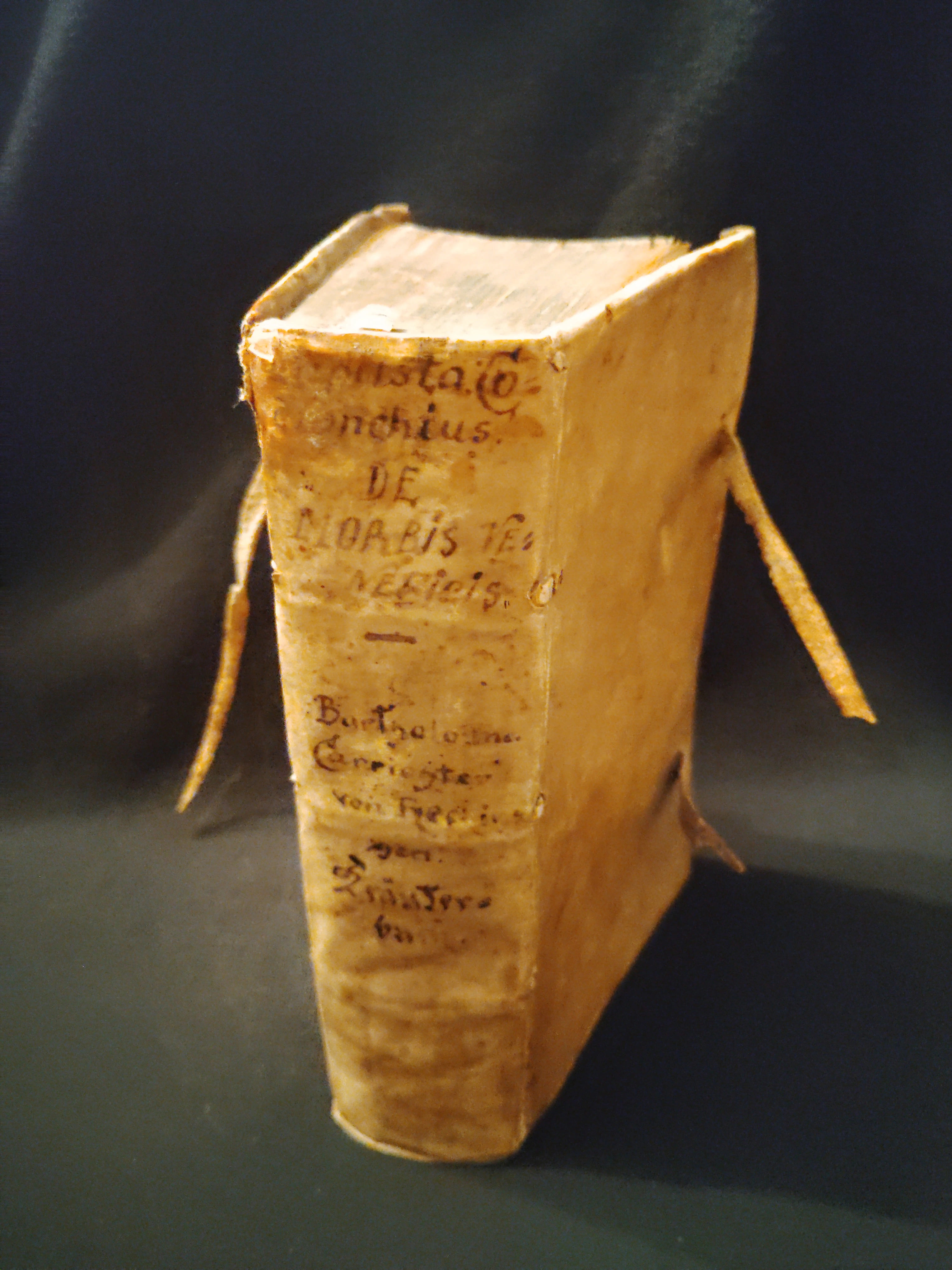
1595ref. GEJ-15Venezia, apud Francesco De Franceschi, 1595. In-8, pp. [8] 199 [13]. Small octavo (16 x 10 cm). 8 leaves, 199 (paginated) leaves, 25 unnumbered pages (index), 1 leaf (Errate sic corrige). Complete. Contemporary overlapping vellum with handwritten spine titles and 4 leather-band straps, but only 1 full lenght functionally. Interior minimally rubbed and bumped, slightly stained and dusty. 1st edition, Very Rare!!! Ex-libris on the first bookplate belonging to Georg Christoph Petri von Hartenfels, who was a 17 century notable physician and polymath, professor, and later the Rector of the University of Erfurt. The treatise under title De morbis veneficis ac veneficiis (On Poisoning Witches and Spells), published in 1595 in Venice by the physician Giovan Battista Codronchi (1547–1628), is a significant, is rare 16th-century work focusing on the intersection of medicine and demonology. Codronchi wrote the treatise to analyze "diabolical illnesses" (specifically regarding his daughter) and to define the roles of physicians versus exorcists in cases of presumed poisoning or witchcraft. (Akademia.edu) Author has an extensive account of the present work is given by Thorndike who deals with its role in the history of witchcraft. Codronchi (1547-1628) was a physician from Imola, whose works according to Hirsch all show deep knowledge and originality. Bibliographie: USTC No.823353; Caillet, 2435, Dorbon (Bibliotheca Esoterica), 829; Yvesa Plessis, 224; Graesse (Bibliotheca Magica et Pneumatica), Chapter VIII: "Von den Zauberkrankheiten" (On diseases caused by witchcraft); Garrison & Morton, A Medical Bibliography, 1718; Cornell University Library Witchcraft Collection, 114, Thorndike, VI; Hansen, "Quellen und Untersuchungen zur Geschichte des Hexenwahns; Bibliotheca Osleriana, 2343; OCLC: 165994812. "Plessis, like Caillet, appreciates Codronchi for his attempt to systematize medical knowledge in the forensic service (recognizing whether a given case is a natural disease or the effect of "maleficia".(Plessis) "Grässe appreciated this work as one of the first systematic treatises in which a physician attempted to provide scientific (for that time) criteria for distinguishing natural diseases from the effects of "magical poisons".(Graesse) "Garrison and Morton mention De morbis veneficis... They indicate that it was this work on poisons and witchcraft, published two years earlier, that prepared the ground for the later treatise on forensic medicine". (Garrison and Morton). Provenance: Ex-libris on the first bookplate belonging to Georg Christoph Petri von Hartenfels, who was a 17 century notable physician and polymath, professor, and later the Rector of the University of Erfurt. Book is bound with: Bartholomäus Carrichter: Kräuterbuch. Darinnen begriffen, under welchen zeichen Zodiaci, auch in welchem Gradu ein jedes Kraut stehe, wie sie in Leib unnd zu allen Schäden zu bereyten, und zu welcher zeit sie zu colligieren sein. Anton Bertram 1589. Kl.-8° (16 x 10 cm). 8 Bll., 223(1) S., 8.
1555ref. GEJ-11Pescia: Lorenzo Torrentino, 1555, 4to, [13] 18-126 [1] of colophon 1 blank. Book in Italian. 1st Italian Edition (2nd overall) of this rare demonology tratise. Later (18/19 .century) later half morocco with gold lettered spine and blank pages. Marbled endpapers. Architectural woodcut border on title-page with a small view of Florence and with Medici coat of arms. Woodcut initials, woodcut vignette on verso of A4. Colophon leaf at end. Very ginuine interior, clean, without marks, annotations, stamps and ex libris. No foxing and stains. Complete. First Italian edition and the first translation from the 1523 Latin original by Turino Turini, marking the earliest book on witchcraft printed in the Italian vernacular. While the dialogue format reinforces the grim theological framework of the Malleus Maleficarum and contemporary inquisitorial manuals regarding sabbaths and demonic pacts, it stands apart for its erudition. By sophisticatedly weaving classical and pagan citations into medieval scholastic precepts, Pico della Mirandola effectively pioneered the "humanistic literature of witchcraft," bridging Renaissance intellectualism and counter-reformation demonology. The work embodies the Renaissance approach to demonology, demonstrating how a humanist could substantiate the reality of witchcraft, transvection, and the sabbath using classical sources alongside scripture and inquisitorial manuals. Ultimately, the early modern obsession with demonology is presented not as an irrational residue of a rational age, but as a foundational conceptual nexus essential to understanding sixteenth-century philosophy. Bibliography: Censimento 16 CNCE 34704; Riccardi II, 281; Moreni, Annali della tipografia di Lorenzo Torrentino, s. 394; Sander 5688; Graesse V, 283; USTC No. 848435; Caillet 8654; Encyclopaedia of Witchcraft 2006.
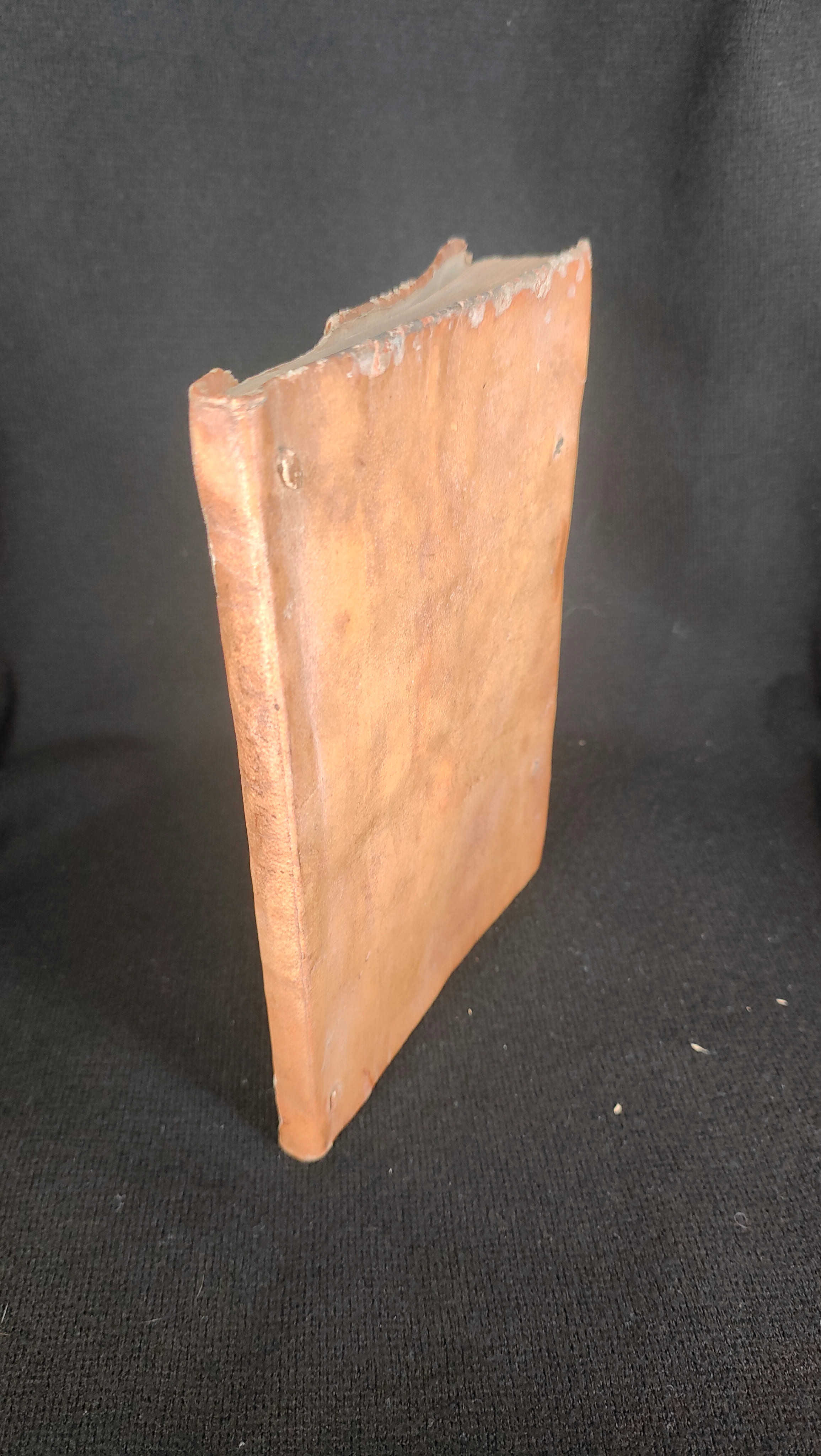
1615ref. GEJ-13Paris, Jean Millot, 1615. In-12 : 109pp, (1). Full original vellum binding and endpapers with blank pages. Parchment with defects on the cover, few stains at the end of book. Shorter page 103/104 due to handmade paper inperfections. Some worm holes. Bright and complete copy. Two old ink different anotations on the first endpaper. This exceptionally rare 1615 Parisian first edition, published by Jean Millot, represents a foundational cornerstone in early modern demonological literature and the history of psychiatry. Written by the French physician Jean de Nynauld, De la lycanthropie, transformation et extase des sorciers is widely celebrated by historians Evans and Bartholomew as "the most extensive and detailed description of ointments in relation to both witchcraft and lycanthropy." Across four meticulous chapters dedicated entirely to the salves of sorcerers, Nynauld documents the grim contemporary lore surrounding these unguents, including the notorious belief that they utilized the fat of sacrificed children. However, rather than validating these horrors as supernatural reality, Nynauld applies a brilliant, early medical rationalism to the phenomenon. He boldly declares the numerous reports of murderous, cannibalistic shapeshifters and sabbat flights to be powerful hallucinations brought on by diabolical chemistry—specifically, the pharmacological effects of psychoactive herbs. Defying the harsh inquisitorial consensus of his era, he firmly regards those who claim they metamorphose into animals not as literal monsters or heretics, but as sufferers of severe mental disorders and clinical delusion. Consequently, this prized editio princeps stands as a crucial historical milestone, marking the transition from superstitious witch-hunting to a rational understanding of early pharmacology and mental health. Bibliography: "One of the "classic" works on Witchcraft and nevertheless one of the rarest." (Caillet 8124), The Encyclopedia of Extraordinary Social Behavior 333-39; Guaita, Bibliothèque occulte 774; Coumont, Demonology and Witchcraft: An Annotated Bibliography N38.3; Laehr, Die Literatur der Psychiatrie, Neurologie und Psychologie I: 159; Cioranescu 51435; Yve-Plessis, 975; USTC No. 6013581. Keywords : Keywords : Grimoire, Magie, Occultisme, Charmes, Sorcellerie, Diables