Ulrich MolitorLivre Rare Book

1561ref. GEJ-10Paris, apud Gilles Corrozet, 1561, [1], 40, [1] pp, 8°. Book in Latin. RARE AND UNCOMMON ON THE MARKET FIRST PARISIAN PRINTING! 17/18 century full calf binding, gold lettered spine, marbled endpapers, owner's ex libris of Emeric Bigot (?) on title page. Good antiquarian condition, woodcut printers device to title, woodcut initials. Few stains and discolorations. Complete. Published in Paris by Gilles Corrozet in 1561, this rare edition of Ulrich Molitor’s Tractatus de lamiis et pythonicis stands as a definitive cornerstone of early occult literature and a fascinating, skeptical counterpoint to fanatical witch-hunting manuals like the Malleus Maleficarum. Written by a prominent German jurist, the treatise is historically significant for its early skepticism, as Molitor boldly argued that supernatural acts like shape-shifting or flying to sabbaths were merely illusions and dreams induced by the Devil rather than physical realities. This text is equally famous for containing the earliest printed depictions of witches, establishing the modern iconography of the occult through striking woodcut imagery that includes scenes of witches brewing storms in cauldrons, a wizard riding a wolf, and the Devil corrupting a woman. Composed as a direct response to Europe's rising witchcraft hysteria, this treatise introduces cold legal logic and canonical jurisprudence into a debate previously dominated by religious fanaticism. Moving away from dry academic lecturing, the text adopts the dynamic structure of a scholarly dialogue between three real historical figures: Archduke Sigismund of Austria, the ruler of Tyrol, who acts as the voice of skepticism by raising logical doubts and challenging the validity of witch trials; Conrad Schatz, the magistrate of Constance, who champions the strict, traditional view by defending the physical reality of witchcraft and demanding harsh punishments; and Ulrich Molitor himself, the author, who serves as the impartial arbiter utilizing Roman and Canon law to systematically resolve the disagreements between his interlocutors. Ulrich Molitor (c. 1442–1507) was a pioneering German jurist, humanist, and diplomat who shaped early modern legal thought. After studying humanities in Basel, he earned a prestigious doctorate in civil and canon law from the University of Pavia, positioning him at the forefront of Renaissance jurisprudence. He spent the pinnacle of his career as a trusted legal advisor to Archduke Sigismund of Austria in Innsbruck and later served as chancellor to the Bishop of Worms. Molitor’s enduring legacy is his 1489 masterpiece, Tractatus de lamiis et pythonicis, which stands as one of history's earliest legal critiques of witch-hunt fanaticism. By utilizing rigorous Roman and Canon law to argue that witchcraft was largely a demonic illusion, he became a vehement opponent of judicial torture, forever marking his place as a trailblazer of European rationalism. Provenance: Emeric Bigot (?) - Ex Libris: Emeric Bigot (1626–1689) was a prominent French humanist, bibliophile, and a central figure in the 17th-century European intellectual network known as the Respublica Literaria (Republic of Letters). Born and based in Rouen, he used his substantial wealth to amass one of the most legendary private libraries in Europe, renowned for its rare Greek and Latin manuscripts and early printed books. Though he published little under his own name—focusing primarily on editing early Christian texts—Bigot served as an indispensable international scholarly coordinator. He maintained a vast correspondence with major thinkers like John Milton and Nicolas Heinsius, utilizing his unparalleled bibliographic expertise to source texts, verify translations, and generously assist scholars across the continent in preparing their own monumental works for print. Bibliography: Herbert M. Adams, M 1573; USTC, 153205; Pettegree i Walsby, 153205, only found in one US institution (Yale University, Beinecke Library), Not in VD 16, Yve-Plessis, Dorbon-Aîné and Bibliotheca Esoterica; Caillet, II, 7641; Grässe, p. 55; Bibliotheca Daemonologica (Robbins).
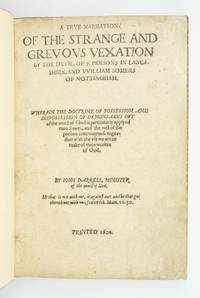
1600ref. ST21089England: Printed by the English secret press 1600. FIRST EDITION. 187 x 128 mm. 7 3/8 x 5". 4 p.l. 24 106 2 pp. Very pleasing early 20th century grained calf gilt covers with French fillet border and rosette cornerpieces raised bands spine panels with small daisy centerpiece gilt lettering densely gilt turn-ins marbled endpapers all edges gilt. STC 6288; ESTC S109297. See also Freeman "Demons Deviance and Defiance: John Darrell and the Politics of Exorcism in Late Elizabethan England" in Conformity and Orthodoxy in the English Church c. 1560-1660 ed. P. Lake and M. Questier Boydell Press 2000 pp. 34-63. Short faint scratch to front board extremities lightly rubbed text washed and pressed title and final two leaves somewhat grayed and grubby margins trimmed a bit close occasionally grazing headlines or shoulder notes but a perfectly readable copy in an attractive binding. This scarce clandestine imprint is a central publication in of one of the strangest religio-political controversies of the turn of the 17th century involving demonic possession witchcraft accusations and an anti-Puritan crusade by a Church of England bishop. Our author Puritan exorcist John Darrell ca. 1562 - ca. 1607 was educated at Cambridge and briefly dabbled in law and farming before establishing himself as a preacher and spiritual healer. In 1586 he began conducting exorcisms resulting in a level of local fame partly because some of them resulted in the convictions of witches. In the following decade he achieved national notoriety. First in March of 1597 he exorcised a group of seven demoniacs in the household of Lancashire landowner Nicholas Starkey. Then in November of the same year he conducted a dramatic public exorcism of Nottingham apprentice musician William Somers whose claim of having been magically possessed led to the arrest of 13 people on witchcraft charges. One of these individuals was the sister of a city alderman who immediately took action to protect his kinswoman. The resulting legal tangle--which included the arrest of Somers on charges of witchcraft later changed to fraud and an investigative commission led by the Archbishop of York--attracted widespread attention to Darrell's activities by both supporters and detractors. The Church of England was highly concerned about Puritan exorcisms: in the words of historian Thomas S. Freeman "exorcism magnified those aspects of Puritan worship which the ecclesiastical authorities most feared--its anti-hierarchical tendencies its strong sense of communal solidarity and its potential as a vehicle for protest." No doubt with an understanding of this threat Bishop of London Richard Bancroft and his chaplain Samuel Harsnett led a vicious campaign against Darrell publishing multiple works smearing his character and theology stripping Durrell of his license to preach and imprisoning him for more than a year. Darrell did not go quietly. Over the next four years he and his supporters penned multiple defenses of his actions and of Puritan exorcism more generally published either abroad or illegally by secret English presses. The present work is significant not only for its detailed retelling of Darrell's final two exorcisms in his own words but also because it includes Darrell's detailed "doctrine of possession" which discusses the difference between his exorcisms and those of the apostolic age an important theological clarification in the debate. STC indicates that our book was one of the works published clandestinely in England; this is backed up by the October 29 1600 Stationers' Company order to burn all copies of "mr Darrell's book lately printed concerning the casting out of Devilles" which Freeman asserts refers to the present publication. This order to be burned on top of the clandestine publication could explain the present scarcity of the work which appears on the market very infrequently. We have been able to trace just a single copy at auction this century and only five since 1964 several lacking the final errata leaf which does appear here. Printed [by the English secret press?] unknown
1600ref. ST21089England: Printed by the English secret press 1600. FIRST EDITION. 187 x 128 mm. 7 3/8 x 5". 4 p.l. 24 106 2 pp. Very pleasing early 20th century grained calf gilt covers with French fillet border and rosette cornerpieces raised bands spine panels with small daisy centerpiece gilt lettering densely gilt turn-ins marbled endpapers all edges gilt. STC 6288; ESTC S109297. See also Freeman "Demons Deviance and Defiance: John Darrell and the Politics of Exorcism in Late Elizabethan England" in Conformity and Orthodoxy in the English Church c. 1560-1660 ed. P. Lake and M. Questier Boydell Press 2000 pp. 34-63. Short faint scratch to front board extremities lightly rubbed text washed and pressed title and final two leaves somewhat grayed and grubby margins trimmed a bit close occasionally grazing headlines or shoulder notes but a perfectly readable copy in an attractive binding. This scarce clandestine imprint is a central publication in of one of the strangest religio-political controversies of the turn of the 17th century involving demonic possession witchcraft accusations and an anti-Puritan crusade by a Church of England bishop. Our author Puritan exorcist John Darrell ca. 1562 - ca. 1607 was educated at Cambridge and briefly dabbled in law and farming before establishing himself as a preacher and spiritual healer. In 1586 he began conducting exorcisms resulting in a level of local fame partly because some of them resulted in the convictions of witches. In the following decade he achieved national notoriety. First in March of 1597 he exorcised a group of seven demoniacs in the household of Lancashire landowner Nicholas Starkey. Then in November of the same year he conducted a dramatic public exorcism of Nottingham apprentice musician William Somers whose claim of having been magically possessed led to the arrest of 13 people on witchcraft charges. One of these individuals was the sister of a city alderman who immediately took action to protect his kinswoman. The resulting legal tangle--which included the arrest of Somers on charges of witchcraft later changed to fraud and an investigative commission led by the Archbishop of York--attracted widespread attention to Darrell's activities by both supporters and detractors. The Church of England was highly concerned about Puritan exorcisms: in the words of historian Thomas S. Freeman "exorcism magnified those aspects of Puritan worship which the ecclesiastical authorities most feared--its anti-hierarchical tendencies its strong sense of communal solidarity and its potential as a vehicle for protest." No doubt with an understanding of this threat Bishop of London Richard Bancroft and his chaplain Samuel Harsnett led a vicious campaign against Darrell publishing multiple works smearing his character and theology stripping Durrell of his license to preach and imprisoning him for more than a year. Darrell did not go quietly. Over the next four years he and his supporters penned multiple defenses of his actions and of Puritan exorcism more generally published either abroad or illegally by secret English presses. The present work is significant not only for its detailed retelling of Darrell's final two exorcisms in his own words but also because it includes Darrell's detailed "doctrine of possession" which discusses the difference between his exorcisms and those of the apostolic age an important theological clarification in the debate. STC indicates that our book was one of the works published clandestinely in England; this is backed up by the October 29 1600 Stationers' Company order to burn all copies of "mr Darrell's book lately printed concerning the casting out of Devilles" which Freeman asserts refers to the present publication. This order to be burned on top of the clandestine publication could explain the present scarcity of the work which appears on the market very infrequently. We have been able to trace just a single copy at auction this century and only five since 1964 several lacking the final errata leaf which does appear here. Printed [by the English secret press?] unknown books
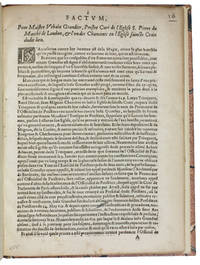
1634ref. ABC_48501France 1634. Modern marbled boards with a red morocco title-label lettered in gold on the spine. 4to ca. 18.5 x 24 cm. 2 works in 1 volume. With:2 WITCHCRAFT. Remarques et considerations servans a la justification du curé de Loudun autres que celles contenuës en son factum.France ca. 1634. Two exceedingly rare pamphlets about the "Loudon possessions" a case of mass hysteria surrounding the supposed demonic possession of Ursuline nuns that took place in the western French town of Loudun in 1634. The affair led to the trial of a local priest Urbain Grandier who was accused of witchcraft. Interestingly these two pamphlets are by an anonymous partisan of the accused priest. The possession cases began in 1632 when several nuns at the local Ursuline convent claimed to be possessed by demons. The nuns accused Grandier a charismatic and controversial figure in Loudun of casting spells on them and making them his witches. Grandier who had gained the enmity of the powerful Cardinal Richelieu was arrested and put on trial despite a lack of evidence against him. The trial was riddled with corruption and political intrigue and Grandier was ultimately found guilty and sentenced to death by burning at the stake. His execution took place on 18 August 1634.While 18th century accounts of the famous trial such as those by De La Menardaye were popular contemporary accounts are almost unobtainable. Neither pamphlet has appeared in auction records and there are very few institutional holdings.The spine and corners of the boards are rubbed the title label is slightly chipped. Numbers in the upper corners of the leaves indicate that these two works were likely removed from a sammelband containing multiple works. Internally slightly browned an older typed description has been mounted with tape to the recto of the first free flyleaf. Otherwise in good condition.l Ad 1: Caillet 4718; Coumont F7.1; WorldCat 467111589 705771905 7 copies; Yve-Plessis 1285; Ad 2: Coumont R31.1; WorldCat 1254612433 2 copies; Yve-Plessis 1286; cf. for more information about Grandier and the Loudun Nuns see: Robbins The Encyclopedia of Witchcraft and Demonology pp. 312-317; Both ads not in Barbier Dictionnaire des ouvrages anonymes; Rosenthal Bibliotheca Magica et Pneumatica; Thorndike Grandier and the Ursulines only mentioned once in general vol VIII p. 583; Ad 2 not in Caillet. hardcover