TYARD (Pontus de)Livre Rare Book
7.230 Ergebnisse
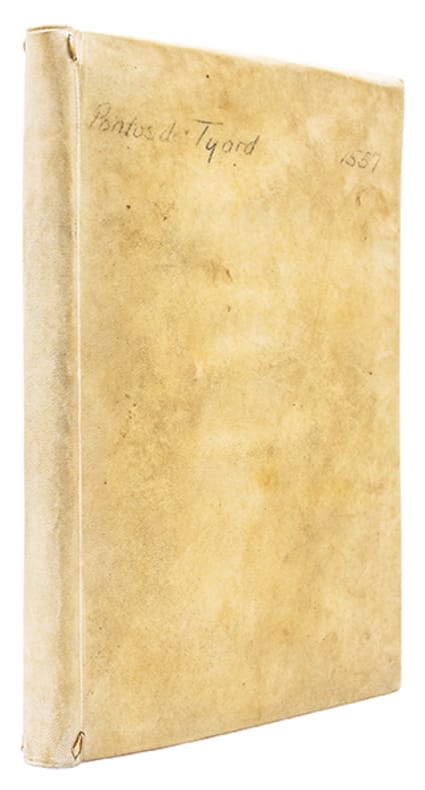
Best.-Nr. 38964In-4 (224 x 155 mm), vélin rigide à recouvrement (reliure moderne), 156, (14) pages. A Lion, par Ian de Tournes et Guil. Gazeau [Lyon, Jean de Tournes et Guillaume Gazeau], 1557.
1556In-8°; 1) cc. (104) e 2 tavole ripiegate; nel testo legni e tabelle. 2) pp. 269, (1) 1 cb., pp. (16), 229, (1), il testo è in latino e in greco. Legatura in piena pergamena con titolo in oro al dorso e tagli in azzurro. 1) Edizione originale, rara, della prima opera di Johannes Garcaeus/Gartze (1530-75) che testimonia in modo chiaro dell’influenza delle teorie copernicane nella letteratura del XVI secolo. Siamo nel pieno Cinquecento, quando il termine astrologia indica genericamente lo studio delle stelle. Garcaeus nella definizione dei cieli per gli oroscopi insiste particolarmente sulle basi matematiche e astronomiche per i calcoli delle posizioni dei pianeti. Nel testo vengono diffusamente citati Copernico e Tolomeo, e costantemente messe a confronto le tavole Pruteniche – copernicane, con quelle astronomiche dette Alfonsine redatte alla metà del Duecento sulla scorta dei calcoli di Tolomeo. Tra gli scienziati citati anche Schoener, Regiomontano e Alchabitius (astrologo arabo del X sec., la cui opera a stampa apparve con il commento di John of Saxony): una figura illustra lo schema del cielo secondo quest’ultimo. In fine anche il metodo per calcolare le eclissi di luna e di sole secondo le tavole Pruteniche. Sono evidenti in questa opera i debiti che Garcaeus deve agli insegnamenti di Melantone, che attorno agli anni 40 teneva lezioni proprio sul Tetrabiblos di Tolomeo all’Univeristà di Wittenberg. Gartze fu dottore in teologia all’Università di Wittenberg, astrologo allievo di Erasmus Reinholt (nel testo “mei praeceptoris… Astronomiae peritissimae artificis”) e di Caspar Peucer, menzionato nell’Epilogo, professore di matematica e astronomia all’Università di Wittenberg, epigono di Melantone, seguace della Riforma. Deve la sua fama alla più tarda Astrologiae methodus del 1576. L’opera è dedicata a Giovanni Federico di Pomerania. Robert S. Westman, the Copernican Question, 2011: Prognostication, Skepticism and Celestial Order, p. 166 e ss. “The need for a work that would show how to use the Prutenics for casting nativities must have been more urgent after Reinhold’s death in 1553. Peucer himself was busy writing astronomical textbooks and a work on divination. The task of adding the final link in the rebuilding of a reformed heavenly science fell to Johannes Garcaeus, a valued student of Peucer and Reinhold… The Brief and Useful Treatise illustrates the range of kinds af works that constituted the science of the stars. It is a handbook for calculating nativities… It apparead in 1556 from a major Wittenberg publishing house, the heirs of Georg Rhau, with a dedicatory poem from Caspar Peucer. The epilogue says that “the true foundations of astronomy” and “astrology, as it is now called”, lie the basis of this work… This little work took place in this pedagogical reformation of science of the stars. In the second half of the sixteenth century, these Wittenberg astronomical-astrological textbooks became the most influential models for instrucion in safe predictive knowledge based on natural causes”. 2) Prima edizione della traduzione dal greco di Melantone. Nella Lettera di dedica Melantone ricorda la traduzione del suo amico Joachim Camerarius (1500-74), ma solo dei primi due libri (1533), da lui rivista e ricorretta. Il Tetrabiblos, o Quadripartitum, è il libro delle predizioni astrologiche in cui Tolomeo nel II secolo getta le basi dell’astrologia classica e più in generale occidentale. E’ considerato la Bibbia dell’astrologia poiché rappresenta la tradizione astrologica antica. Affronta per la prima volta l’argomento dell’influenza dei movimenti degli astri sulla vita umana in maniera assolutamente scientifica, servendosi della geometria e dei calcoli numerici per studiare gli influssi dei pianeti in base alla loro posizione nello zodiaco. Herbst, già editore di Andrea Vesalio, propone in questa edizione tutti e quattro I libri: il testo originale in greco, la traduzione latina di Filippo Melantone e il Centiloquium nella traduzione di Gioviano Pontano. Melantone (Philip Schwarzerd 1497-1560), umanista, assai vicino a Martin Lutero fu la colonna portante del pensiero e della teologia della Riforma. Da teologo, non vedeva conflitti tra la religione e l’astrologia. Cantamessa, 6436. Robert S. Westman, The Copernican Question: Prognostication, Skepticism, and Celestial Order, California, 2011. In-8 °; 1) cc. (104) and 2 folded plates; in the text woodcuts and charts. 2) pp. 269, (1) 1 cb., Pp. (16), 229, (1), the text is in Latin and Greek. Full vellum binding with gilt title on the spine and blue edges. 1) Original edition, rare, of the first work by Johannes Garcaeus / Gartze (1530-75) which clearly testifies the influence of Copernican theories in the literature of the sixteenth century. We are in the middle of the sixteenth century, when the term astrology generically indicates the study of the stars. Garcaeus in defining the heavens for horoscopes particularly insists on the mathematical and astronomical basis for the calculations of the positions of the planets. In the text Copernicus and Ptolemy are widely cited, and the Prutenic - Copernican tables are constantly compared with the astronomical ones called Alfonsine drawn up in the mid-thirteenth century on the basis of Ptolemy's calculations. Among the scientists mentioned also Schoener, Regiomontano and Alchabitius (Arab astrologer of the 10th century, whose printed work appeared with the comment of John of Saxony): a figure illustrates the pattern of the sky according to the latter. Finally, also the method for calculating the eclipses of the moon and the sun according to the Prutenic tables. In this work, the debts that Garcaeus owes to the teachings of Melanchthon are evident, who around the 40s gave lectures precisely on Ptolemy's Tetrabiblos at the University of Wittenberg. Gartze was a doctor of Theology at the University of Wittenberg, an astrologer student of Erasmus Reinholt (in the text "mei praeceptoris ... Astronomiae peritissimae artificis") and Caspar Peucer, mentioned in the Epilogue, professor of Mathematics and Astronomy at the University of Wittenberg, epigone of Melanchthon, follower of the Reformation. It owes its fame to the later Astrologiae methodus of 1576. The work is dedicated to John Frederick of Pomerania. Robert S. Westman, the Copernican Question, 2011: Prognostication, Skepticism and Celestial Order, p. 166 e ss. “The need for a work that would show how to use the Prutenics for casting nativities must have been more urgent after Reinhold’s death in 1553. Peucer himself was busy writing astronomical textbooks and a work on divination. The task of adding the final link in the rebuilding of a reformed heavenly science fell to Johannes Garcaeus, a valued student of Peucer and Reinhold… The Brief and Useful Treatise illustrates the range of kinds af works that constituted the science of the stars. It is a handbook for calculating nativities… It apparead in 1556 from a major Wittenberg publishing house, the heirs of Georg Rhau, with a dedicatory poem from Caspar Peucer. The epilogue says that “the true foundations of astronomy” and “astrology, as it is now called”, lie the basis of this work… This little work took place in this pedagogical reformation of science of the stars. In the second half of the sixteenth century, these Wittenberg astrnomical-astrological textbooks became the most influential models for instrucion in safe predictive knowledge based on natural causes”. 2) First edition of the Latin translation from the Greek of Melanchthon. In the letter of dedication, Melanchthon recalls the translation of his friend Joachim Camerarius (1500-74), but only of the first two books (1533), which he revised and repeated. Tetrabiblos, or Quadripartitum, is the book of astrological predictions in which Ptolemy in the second century laid the foundations of classical and more generally Western astrology. It is considered the Bible of astrology since it represents the ancient astrological tradition. It tackles for the first time the topic of the influence of the movements of the stars on human life in an absolutely scientific way, using geometry and numerical calculations to study the influences of the planets based on their position in the zodiac. Herbst, former editor of Andrea Vesalio, proposes all four books in this edition: the original text in Greek, the Latin translation by Filippo Melanchthon and the Centiloquium in the translation by Gioviano Pontano. Melanchthon (Philip Schwarzerd 1497-1560), humanist, very close to Martin Luther was the pillar of the thought and theology of the Reformation. As a theologian, he saw no conflict between religion and astrology. Cantamessa, 6436. Robert S. Westman, The Copernican Question: Prognostication, Skepticism, and Celestial Order, California, 2011.
Best.-Nr. 49886Texte de F.de Mély,paru en 1922 à Paris,chez Ernest Leroux.In-folio broché de 11 pages accompagnant le très rare In-folio relié réunissant les 5 planches gravées de La Virga Aurea et du Calendarium naturale magicum, attribué à Jacques Bonaventure Hepburn d'Ecosse; l'un en 1616, l'autre en 1582.L'auteur du Calendarium serait Johann Baptist Grosschedel, dont le nom véritable serait Tycho Brahé. Les calculs du Calendarium auraient été faits par l'astronome danois Cazalas. La Virga Aurea de Jacques Bonaventure Hepburn,est à la gloire de la Vierge Marie, avec les alphabets mondiaux à l'époque du Pape Paul V.Ce sont 4 colonnes de 72 alphabets. Gravures allégoriques.Légendes tirées des Livres Saints. ( demi-reliure cartonnée au dos en velin fin XIXème.)
1540in-folio (305x205 mm), ff. 104 (A-Z4, AA-CC4), bella legatura del XVII secolo in marocchino granata, triplice filettatura in oro ai piatti con terminazioni angolari vegetali, dorso a sei nervi con titolo in lungo nei compartimenti riquadrati da filetti in oro. Precede l'opera dedica a Ercole d'Este, duca di Ferrara (p. III) e proemio esplicativo ai lettori (pp. IV-V). Titolo, ad opera di Francesco Salviati, inciso da Marco Dente, raffigurante un gruppo di uomini e donne intenti a discorrere e a consultare il libro del Marcolini nel "Giardino di pensieri"; Cervolini (Marcolini, p. 20) e Mauroner (Incisione di Tiziano, 42) attribuiscono però l'ideazione del disegno del frontespizio a Tiziano. Al verso del titolo ritratto dell'autore a piena pagina racchiuso entro cornice architettonica sorretta da due cariatidi (la stessa usata dal Marcolini nei volumi del Serlio e dell'Aretino, impressi qualche anno prima). Alle pp. VI-VII elenco dei 50 quesiti che si possono rivolgere al libro (suddivisi tra uomini, donne e per uomini e donne) e rimando alle 50 tavole relative. La prima sezione del libro contiene 50 silografie poste nella parte superiore del recto di ogni foglio raffiguranti immagini simboliche, vizi e virtù, accompagnate da 90 carte da gioco che circondano l'incisione e da altre 45 carte disposte nel verso della carta a fronte disposte a forma di croce. In base al responso delle carte il giocatore deve andare a consultare una delle cinquanta sezioni dei filosofi: nel margine superiore sinistro di ogni doppia pagina compere una silografia con un filosofo dell'antichità accompagnato da 31 risposte collocate sulla sinistra e da altre 24 sulla destra. Le risposte ai quesiti sono poste in forma di terzine scritte da Ludovico Dolce. Ogni terzina ha al fianco una coppia di carte da gioco; al verso dell'ultima carta impresa tipografica del Marcolini inserita in un elaborato cartiglio con volute, intorno al quale si intrecciano un ramo d'ulivo ed uno di quercia. Prima edizione in perfetto esemplare di uno dei più famosi giochi di fortuna del Cinquecento, realizzato su imitazione dei giochi di Lorenzo Spirito e Sigismondo Fanti. Rispetto alla precedente tradizione di genere il Marcolini imposta la doppia pagina di stampa su un registro parallelo, iconografico e verbale; la struttura tradizionale del libro è inoltre ripensata, sovvertendo la tradizionale recto verso di ogni carta e immaginando per la prima volta un intero volume da leggere a doppia pagina, tenuto insieme da un complicato sistema di rimandi interni che il giocatore apprende alle pagine iniziali. Gli strumenti del gioco diventano il libro stesso e un mazzo di carte, che dovrà gestire il giocatore a cui capita la carta più alta del mazzo. L'opera si configura come un inesauribile repertorio di modelli e situazioni figurative; è ipotizzabile che la l'impressione avvenisse in stadi diversi: stampando prima la cornice esterna quindi le immagini interne e per ultimo il testo, seguendo il modello consueto per la stampa di edizioni musicali (il Marcolini d'altronde si era formato presso il Petrucci, come incisore di testi musicali). Magnifico esempio di libro che diventa oggetto, da leggere, da vedere e da maneggiare.. Mortimer 279. Sander 4231. Brunet iii, 1407-1408, Suppl. I, 941. Essling II, 670. Cicognara 1701: "rarissimo a trovarsi di bella conservazione". Rosenthal, 1385. L. Nardin, Carte da gioco e letteratura fra Quattrocento e Ottocento, Lucca 1997. Cinti 54..
2002Best.-Nr. LFA00163Un ouvrage de 231 pages, format 155 x 240 mm, broché publié en 2002, Editions du Rocher, bon état (avec un envoi de l'auteur)

