MARCOLINI, Francesco.MareMagnum

7 454 résultats
1540in-folio (305x205 mm), ff. 104 (A-Z4, AA-CC4), bella legatura del XVII secolo in marocchino granata, triplice filettatura in oro ai piatti con terminazioni angolari vegetali, dorso a sei nervi con titolo in lungo nei compartimenti riquadrati da filetti in oro. Precede l'opera dedica a Ercole d'Este, duca di Ferrara (p. III) e proemio esplicativo ai lettori (pp. IV-V). Titolo, ad opera di Francesco Salviati, inciso da Marco Dente, raffigurante un gruppo di uomini e donne intenti a discorrere e a consultare il libro del Marcolini nel "Giardino di pensieri"; Cervolini (Marcolini, p. 20) e Mauroner (Incisione di Tiziano, 42) attribuiscono però l'ideazione del disegno del frontespizio a Tiziano. Al verso del titolo ritratto dell'autore a piena pagina racchiuso entro cornice architettonica sorretta da due cariatidi (la stessa usata dal Marcolini nei volumi del Serlio e dell'Aretino, impressi qualche anno prima). Alle pp. VI-VII elenco dei 50 quesiti che si possono rivolgere al libro (suddivisi tra uomini, donne e per uomini e donne) e rimando alle 50 tavole relative. La prima sezione del libro contiene 50 silografie poste nella parte superiore del recto di ogni foglio raffiguranti immagini simboliche, vizi e virtù, accompagnate da 90 carte da gioco che circondano l'incisione e da altre 45 carte disposte nel verso della carta a fronte disposte a forma di croce. In base al responso delle carte il giocatore deve andare a consultare una delle cinquanta sezioni dei filosofi: nel margine superiore sinistro di ogni doppia pagina compere una silografia con un filosofo dell'antichità accompagnato da 31 risposte collocate sulla sinistra e da altre 24 sulla destra. Le risposte ai quesiti sono poste in forma di terzine scritte da Ludovico Dolce. Ogni terzina ha al fianco una coppia di carte da gioco; al verso dell'ultima carta impresa tipografica del Marcolini inserita in un elaborato cartiglio con volute, intorno al quale si intrecciano un ramo d'ulivo ed uno di quercia. Prima edizione in perfetto esemplare di uno dei più famosi giochi di fortuna del Cinquecento, realizzato su imitazione dei giochi di Lorenzo Spirito e Sigismondo Fanti. Rispetto alla precedente tradizione di genere il Marcolini imposta la doppia pagina di stampa su un registro parallelo, iconografico e verbale; la struttura tradizionale del libro è inoltre ripensata, sovvertendo la tradizionale recto verso di ogni carta e immaginando per la prima volta un intero volume da leggere a doppia pagina, tenuto insieme da un complicato sistema di rimandi interni che il giocatore apprende alle pagine iniziali. Gli strumenti del gioco diventano il libro stesso e un mazzo di carte, che dovrà gestire il giocatore a cui capita la carta più alta del mazzo. L'opera si configura come un inesauribile repertorio di modelli e situazioni figurative; è ipotizzabile che la l'impressione avvenisse in stadi diversi: stampando prima la cornice esterna quindi le immagini interne e per ultimo il testo, seguendo il modello consueto per la stampa di edizioni musicali (il Marcolini d'altronde si era formato presso il Petrucci, come incisore di testi musicali). Magnifico esempio di libro che diventa oggetto, da leggere, da vedere e da maneggiare.. Mortimer 279. Sander 4231. Brunet iii, 1407-1408, Suppl. I, 941. Essling II, 670. Cicognara 1701: "rarissimo a trovarsi di bella conservazione". Rosenthal, 1385. L. Nardin, Carte da gioco e letteratura fra Quattrocento e Ottocento, Lucca 1997. Cinti 54..
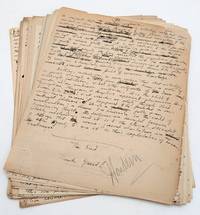
1926réf. 71978Providence RI: H. P. Lovecraft 1926. Manuscript. Very Good. Twenty-three letter-sized manuscript leaves approx. 8.5" x 11". Written in dark ink and hand-numbered by Lovecraft: page numbers 16 18 24 25 26 26b and 27-43. The manuscript pages feature heavy contemporary ink revisions cancellations interlinear additions and a data table. Lovecraft concludes on page 43 in ink: "The End / Thank Gawd!" and the manuscript is signed "Houdini" by Harry Houdini in pencil at the conclusion. The manuscript is written on the reverse sides of correspondence and constitutes a rich literary archive preserving original incoming letters to H.P. Lovecraft. Professional and personal correspondence typescript poetry submissions and editorial rejections sent to Lovecraft between 1922 and 1926 by associates editors and other contemporaries are represented here. Some horizontal folding creases sporadic edge wear and chipping age-toning. The Manuscript Rectos: A major autograph working draft of The Cancer of Superstition the ghostwritten treatise commissioned by Harry Houdini in 1926 to combat spiritualism and commercial fortune-telling. Writing entirely in his own hand Lovecraft systematically deconstructs astrology using modern astronomical scientific knowledge-citing the precession of the equinoxes light-speed delays and extragalactic nebulae-while refuting astrological claims through logic probability and history. Lovecraft mounts a rigorous scientific assault on astrology treating pseudoscience not merely as an intellectual failing but as a cosmic absurdity. On page 39 he constructs a detailed planetary data table tracking diameters solar distances and revolution periods arguing that when viewing these immense scales "we can no longer entertain the astrological illusion that our earth is a considerable object for whose benefit the rest of the universe is arranged." Turning his venom toward the commercial occult trade Lovecraft decries "how many dollars are snatched from the unwary by a device so ancient & so simple" warning that "many lives have been utterly wrecked through the random bombast & gibberish of some ignorant & unscrupulous soothsayer" page 26. Elsewhere he dismantles horoscopic predictions through celestial mechanics noting that zodiac signs "sprang partly from apparent conditions no longer existing" 35 and questions the clockwork of the planets reckoning with light-speed delays crossing vast distances of the cosmos: "If the planets rule the earth why are not the real times of their aspects calculated; instead of the apparent times as judged by their light as it reaches us" 38. Driving his argument to its climax Lovecraft brands astrology as "a legacy from primitive times; a sister of witchcraft fetichism . a shame & a nuisance in the world of broadening thought" and brings his draft to an exhausted close: "The End / Thank Gawd!" 43. The Correspondence Versos: Lovecraft reused the blank backs of incoming correspondence received between 1922 and 1926 to draft the text-a lifelong habit born of extreme poverty and his frequent inability to afford fresh writing paper. These versos contain letters poems and notes from key associates including W. Paul Cook James F. Morton Jr. Anne T. Renshaw Horace L. Lawson Leo Fritter Edward L. Sechrist and John Ravenor Bullen. Notably Leaf 26b preserves a typed rejection letter from Macfadden Publications Ghost Stories magazine dated September 13 1926 establishing the precise date of composition weeks prior to Houdini's death on October 31 1926. Beyond serving as draft paper these recycled letters capture vivid glimpses into Lovecraft's inner circle and literary network. James F. Morton Jr. bemoans his paid ghostwriting work lamenting "The more I work on this stuff the more I realize the hopeless inadequacy of the profanity division of the English language" while praising mutual associate Samuel Loveman as "a greater genius than both of us together" see letter on reverse of HPL's corresponding manuscript page 41. A remarkably interesting and macabre letter from entomologist Edward L. Sechrist is present. Inspired by Lovecraft's horror fiction Sechrist muses on having little "reverence for human meat than for any other kind of flesh and I believe I could contentedly pick a bone with the rest of a group of cannibals squatted beside a little fire. So I rather appreciate your Doctor's experiments. I have no shivers for anything." 28-29. Crucially anchoring the entire assembly is a formal rejection letter 26b from Macfadden Publications' Ghost Stories magazine "I regret that I am unable to use it" typed September 13 1926-providing the definitive date of this manuscript composition just weeks before Houdini's untimely death. Historical & Publication Context: Following their successful 1924 collaboration on "Imprisoned with the Pharaohs" Harry Houdini retained Lovecraft to spearhead a book-length crusade against spiritualism and pseudoscience. Lovecraft devised the work's master outline and drafted its core scientific arguments bringing in his Providence associate C. M. Eddy Jr. to expand prose chapters under his editorial direction. The project came to a sudden halt when Houdini unexpectedly died on Halloween 1926 prompting his widow Bess Houdini to discontinue the work. Long regarded as a legendary lost collaboration-represented in print for decades only by Lovecraft's outline in Arkham House's The Dark Brotherhood 1966 and a partial typescript discovery in 2016-the text remained unpublished for nearly a century until its debut release in March 2025 by 1878 Press Co. titled The Cancer of Superstition and credited to "Harry Houdini & C.M. Eddy Jr. Outline by H.P. Lovecraft." Here preserving twenty-three pages written entirely in Lovecraft's own hand this manuscript proves he penned far more than a mere outline for this famous lost work. H. P. Lovecraft unknown
1926réf. 71978Providence RI: H. P. Lovecraft 1926. Manuscript. Very Good. Twenty-three letter-sized manuscript leaves approx. 8.5" x 11". Written in dark ink and hand-numbered by Lovecraft: page numbers 16 18 24 25 26 26b and 27-43. The manuscript pages feature heavy contemporary ink revisions cancellations interlinear additions and a data table. Lovecraft concludes on page 43 in ink: "The End / Thank Gawd!" and the manuscript is signed "Houdini" by Harry Houdini in pencil at the conclusion. The manuscript is written on the reverse sides of correspondence and constitutes a rich literary archive preserving original incoming letters to H.P. Lovecraft. Professional and personal correspondence typescript poetry submissions and editorial rejections sent to Lovecraft between 1922 and 1926 by associates editors and other contemporaries are represented here. Some horizontal folding creases sporadic edge wear and chipping age-toning. The Manuscript Rectos: A major autograph working draft of The Cancer of Superstition the ghostwritten treatise commissioned by Harry Houdini in 1926 to combat spiritualism and commercial fortune-telling. Writing entirely in his own hand Lovecraft systematically deconstructs astrology using modern astronomical scientific knowledge-citing the precession of the equinoxes light-speed delays and extragalactic nebulae-while refuting astrological claims through logic probability and history. Lovecraft mounts a rigorous scientific assault on astrology treating pseudoscience not merely as an intellectual failing but as a cosmic absurdity. On page 39 he constructs a detailed planetary data table tracking diameters solar distances and revolution periods arguing that when viewing these immense scales "we can no longer entertain the astrological illusion that our earth is a considerable object for whose benefit the rest of the universe is arranged." Turning his venom toward the commercial occult trade Lovecraft decries "how many dollars are snatched from the unwary by a device so ancient & so simple" warning that "many lives have been utterly wrecked through the random bombast & gibberish of some ignorant & unscrupulous soothsayer" page 26. Elsewhere he dismantles horoscopic predictions through celestial mechanics noting that zodiac signs "sprang partly from apparent conditions no longer existing" 35 and questions the clockwork of the planets reckoning with light-speed delays crossing vast distances of the cosmos: "If the planets rule the earth why are not the real times of their aspects calculated; instead of the apparent times as judged by their light as it reaches us" 38. Driving his argument to its climax Lovecraft brands astrology as "a legacy from primitive times; a sister of witchcraft fetichism . a shame & a nuisance in the world of broadening thought" and brings his draft to an exhausted close: "The End / Thank Gawd!" 43. The Correspondence Versos: Lovecraft reused the blank backs of incoming correspondence received between 1922 and 1926 to draft the text-a lifelong habit born of extreme poverty and his frequent inability to afford fresh writing paper. These versos contain letters poems and notes from key associates including W. Paul Cook James F. Morton Jr. Anne T. Renshaw Horace L. Lawson Leo Fritter Edward L. Sechrist and John Ravenor Bullen. Notably Leaf 26b preserves a typed rejection letter from Macfadden Publications Ghost Stories magazine dated September 13 1926 establishing the precise date of composition weeks prior to Houdini's death on October 31 1926. Beyond serving as draft paper these recycled letters capture vivid glimpses into Lovecraft's inner circle and literary network. James F. Morton Jr. bemoans his paid ghostwriting work lamenting "The more I work on this stuff the more I realize the hopeless inadequacy of the profanity division of the English language" while praising mutual associate Samuel Loveman as "a greater genius than both of us together" see letter on reverse of HPL's corresponding manuscript page 41. A remarkably interesting and macabre letter from entomologist Edward L. Sechrist is present. Inspired by Lovecraft's horror fiction Sechrist muses on having little "reverence for human meat than for any other kind of flesh and I believe I could contentedly pick a bone with the rest of a group of cannibals squatted beside a little fire. So I rather appreciate your Doctor's experiments. I have no shivers for anything." 28-29. Crucially anchoring the entire assembly is a formal rejection letter 26b from Macfadden Publications' Ghost Stories magazine "I regret that I am unable to use it" typed September 13 1926-providing the definitive date of this manuscript composition just weeks before Houdini's untimely death. Historical & Publication Context: Following their successful 1924 collaboration on "Imprisoned with the Pharaohs" Harry Houdini retained Lovecraft to spearhead a book-length crusade against spiritualism and pseudoscience. Lovecraft devised the work's master outline and drafted its core scientific arguments bringing in his Providence associate C. M. Eddy Jr. to expand prose chapters under his editorial direction. The project came to a sudden halt when Houdini unexpectedly died on Halloween 1926 prompting his widow Bess Houdini to discontinue the work. Long regarded as a legendary lost collaboration-represented in print for decades only by Lovecraft's outline in Arkham House's The Dark Brotherhood 1966 and a partial typescript discovery in 2016-the text remained unpublished for nearly a century until its debut release in March 2025 by 1878 Press Co. titled The Cancer of Superstition and credited to "Harry Houdini & C.M. Eddy Jr. Outline by H.P. Lovecraft." Here preserving twenty-three pages written entirely in Lovecraft's own hand this manuscript proves he penned far more than a mere outline for this famous lost work. H. P. Lovecraft unknown books
2002réf. LFA00163Un ouvrage de 231 pages, format 155 x 240 mm, broché publié en 2002, Editions du Rocher, bon état (avec un envoi de l'auteur)