BUDOVINO, Niccolò.MareMagnum

6 555 résultats
Grande miniatura su pergamena (mm. 227x313) firmata in maiuscolo dall'artista nell'angolo inf. destro "Nicolaus Balduinus F.". Stupendo foglio miniato di grandi dimensioni e firmato, rarissimo. L'episodio della Vita del Cristo è animato da apostoli e soldati che passano sotto un arco. In primo piano la Vergine. Sullo sfondo raffinata veduta di Gerusalemme. Le opere note di questo pittore miniaturista veneziano del ‘500 sono assai poche e la presente è apparentemente unica ed inedita.. Thieme-Becker V, 186. D'Ancona-Aeschliman p. 39. Favaro, l'arte dei pittori in Venezia e i suoi statuti, p. 141..
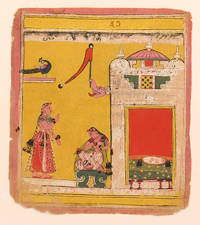
réf. 112940India Malwa circa 1630 AD. . Single leaf ink & gouache painting on paper image double-ruled and framed within red borders total leaf 200 x 175 mm; lightly faded with some chipping of paint with slight loss of pigmentation outer edges a little worn contemporary ink inscription to reverse in Sanskrit tipper-into card mount. Keshav Das d. 1601 was a renowned Indian court poet best known for the Rasikapriya which is considered a pioneering work of Hindu literature dealing with the classification of idealised types of male and female lovers nayakas and nayikas and their emotions and interactions. The work was compiled around the 1590s probably in Bundelkhand to the east of Malwa and the present painting is from a near-contemporary series of illustrations depicting scenes from the poems. Three leaves from the same series are housed in the Ashmolean Museum's collections these all dated c. 1630 also described as Malwa accession nos. EA2012.200 EA2012.202 EA2012.201. India, Malwa, circa 1630 AD. unknown
1820réf. 12635London Newton & Son 1820-1830. Newton's new & improved terrestrial and celestial globes The diameter of the globes is 2.75 inches 7 cm. The total height including the stands is 6.75 inches 15 cm. A beautiful pair of miniature desk globes with 12 hand-colored engraved gores on plaster spheres mounted to nineteenth-century calibrated brass meridian rings and carved wooden stands. The Terrestrial and celestial globes are made of carved wood and are in fine condition. The Newton family was among the foremost English globe makers of the early 19th century producing globes of many sizes under various names. The origins of the firm began in the previous century in fact back to Nathaniel Hill for it was he who taught the art of globe making to Thomas Bateman fl.1754-1781 who in turn trained John Newton 1759-1844 who was the patriarch of the Newton firm. John began his firm in 1780 publishing a reissue of a Nathaniel Hill pocket globe in partnership with William Palmer. At the beginning of the 19th century John Newton had located his business at 97 Chancery Lane in London and was quickly joined by his second son William 1786-1861 under the name J.& W. Newton. For the decade between 1831 and 1841 Miles Berry a civil engineer became a member of the firm known then as Newton Son & Berry. After 1841 ownership passed to William Newtons eldest son William Edward Alfred Vincent 1821-1900 who became associated with the firm which continued in operation through future generations until the early years of the 20th century. London, Newton & Son unknown
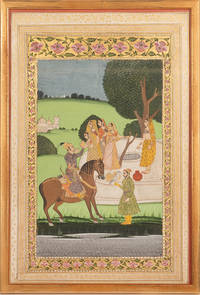
réf. 119661Mughal India possibly Murshidabad mid- to late-18th century. . Single miniature painting on card opaque pigments with gold depicting a scene with a Prince on horseback accepting a drink from a gold vessel from a village maiden miniature 282 x 179 mm full album page 394 x 255 mm; painting framed within multiple gilt rulings innermost frame painted with delicate pink and white flowers on a spiralling green vine set against a richly gilt background some very minor surface soiling overall in exceptionally bright and attractive condition floating in modern cream mount. Scenes painted around imagined amorous encounters between the 'prince and village girl' were popular among artists during the late Mughal period in centres such as Delhi Lucknow and Murshidabad. The concept of 'love at first sight' was similarly echoed in the tradition of the courtly poets of the pan-European middle ages and can be seen echoed through their visual arts. The inspiration behind the theme in this painting was likely rooted in Persian literary sources the Nayrang'i Eshq The Charm of Love by Mughal Sufi poet Ghanimat Kunjahi d. 1695 AD being one such example. Written during a period of considerable Muslim-Hindu cultural interaction the poem was later absorbed into Sanskrit works and grew further in popularity. One notable section of the poem stanza 40.7 describes how in pursuit of a stag Shahid comes upon a village where he is struck by the sight of village girls at a well and is particularly struck by the beauty of Wafa the daughter of the village headsman see C. Shackle Persian Poetry and Q dir Sufism in Later Mughal India: Ghan mat Kunj h and his Mathnaw -yi Nayrang-i 'ishq in The Heritage of Sufism: Volume 3 Late Classical Persianate Sufism Boston 1999. In this painting a beautiful maiden leans across to offer the handsome stranger a drink from the well. Neither appears abashed and their eyes fix upon each other as if a spell has been cast. Of note is the way their hands come together around the vessel of water though they do not touch. The mono green background gives a prominence to this encounter watched by the other village girls. There are subtle details that give context to the scene the stranger's courtly attire and jewelled ruby dagger. His companion's falcon hints at their noble status. By contrast the village girl's sari is tied in the style of a working women as she draws water from the well. For notable examples see Indian Painting 16001870 Oliver Forge & Brendon Lynch New York 2012 and Painting 91 in Domains of Wonder B.N Goswamy & C. Smith 2006. Mughal India, possibly Murshidabad, mid- to late-18th century. unknown
ff. 172 (su 174), legatura inizio '500 in marocchino bruno decorato da bande trasversali alternate a secco e in oro; in testa ad entrambi i piatti impressione a secco "+S+ Emilia". Al primo f. grande iniziale "B" miniata su fondo oro, istoriata all'interno con una finissima figura di Davide in preghiera; la decorazione si estende su 3 margini. In assenza del calendario, l'esame della scrittura, dell'ornamentazione e del testo (litanie ed innario), conducono all'ambiente lombardo e più in particolare ad un ambiente femminile domenicano della regione bresciana. Di notevole interesse la legatura: un ferro assai simile, seppur altrimenti utilizzato, si ritrova su due legature che rivestono edizioni aldine (De Marinis I, 439 e 441, tavv. LXXVIII e LXXVII). Il manoscritto si compone di 17 quaderni di 10 ff. + uno di 4 ff., con richiami. Mancano due fogli tra le attuali carte 12/13 e 16/17. La miniatura misura mm 43x50; nel testo 9 capilettera (mm 40x40) dipinti in blu o rosso su fondo di elaborati e finissimi fregi calligrafici in rosso, verde e seppia. Scrittura semigotica in nero e rosso; notazione musicale quadrata. Il codice, nello stato attuale, non contiene il calendario, né sembra l'attuale legatura averlo potuto contenere, essendo piuutosto stretta e non mostrando segni di asportazione. Di grande interesse è la decorazione della rilegatura. Lo stile della lunga doppia banda verticale (in blu ed oro) che si estende lungo il margine sinistro del primo f. è assai simile a quello dei fogli miniati del Messale romano di scuola lombarda (Brescia, Queriniana, ms. C II 3). Il testo del codice pare avvicinarsi molto a quello del Salterio domenicano commissionato per il monastero domenicano femminile di Santa Caterina di Brescia (Bergamo, Bibl. A.Mai, MA 418). Mentre lo stile della pittura dell'iniziale del f. 1 ricorda parecchio le miniature del Salterio e Innario di scuola lombarda (Brescia, Queriniana, ms. A II 5).. .