2 273 résultats
réf. 16-5820Dhrol Kathiawar India: 1937. Oblong folio album 530 x 420 mm depicting the installation festivities for the Thakore of Dhrol held on August 30 1937. Contemporary padded red morocco stamped and titled "Installation Festivities Dhrol Kathiawar" in gilt. Binding heavily rubbed with partial erasure of gilt lettering from upper cover contents somewhat loose boards heavily chipping and separating.Photographs depict all aspects of the society and community: Family notables servants military vernacular and royal architecture vehicles animals residents.Installation Festivities Kathiawar. Dhrol.Photograph album containing 128 black and white photos mounted on board leaves most 220 x 150 mm some 300 x 240 mm.A presentation album with the name of the recipient erased from the cover in celebration of the installation of H.H Thakore Saheb Shri Jorawarsinhji Dipsinhji Jadeja of Dhrol in August 1937. Shri Jorawarsinhji Dipsinhji Jadeja held the title of Thakore of Dhrol State—a British protectorate—for just two years until his death in 1939. His successor would be the last to hold the title which became extinct with the Union of India in February 1948.Before the arrival of Jadejas in Saurashtra the town of Dhrol was known as Dhamalpur. Dhamalpur was ruled by Chavda King founded & named after Dhamal Chavda who then reigned at Dhamalpur Dhrol obstructed the Jam Hardholji in their conquests and in order to remove this obstruction Jam Hardholji marched against Dhamal Chavda. Dhamal Chavda's army was made of different warrior clans such as Chavda Rathod Chauhan Jadav Jhala Gohil Varsur Makwana Dabhi Khimsurya and Solanki. These clans were not as united as Jadejas. Consequently they were defeated and King Dhamal Chavda was killed by Jadejas in 1539.Dhrol State became a British protectorate in 1807. During the British rule of India Dhrol State was a princely state of India ruled by the Jadeja dynasty having an area of 732 sqkm and 71 villages under its rule. It was accorded 9-gun salute status and a privy purse of 110000/-.The last ruler HH Thakore Saheb Shri Chandrasinhji Dipsinhji Jadeja acceded to the Union of India on 15 February 1948. Dhrol, Kathiawar, India: 1937 hardcover
1960réf. 480941960s. 22 loose sheets. 21 of which measure 250 x 370 mm and one 410 x 330 mm on brown paper stock. . Set and costume designs in watercolour and gouache most with pencilled annotations. A large collection of original designs for 'The Merchant of Venice'.The collection consists of a highly striking gouache of a masked scene at night on a large sheet of brown paper 410 x 330 mm a further scene marked 'Belmont' various costume studies for groups of actors 4 sheets and the majority 16 sheets are costume studies for single characters as follows: - 'Antonio of Belmont' unnamed female study verso- 'Portia as the Doctor of Law'- 'Portia at End' - 'Jessica' 'Taffeta dress painted stripes black pearls' 2 versions 2nd unnamed- 'Bassanio at Belmont'- 'Arragon'- 'Jessica at End' with rudimentary pencil sketch verso- 'Count dignitary' on thick card- 'Gratiano Venice' rudimentary pencil sketch verso- 'Gratiano at End'- 'Morocco' 'wine and gelatine crown.' with sketch verso- 'Figure at Carnival' sketch verso- 'Old bobbo'- 'Venetian Gadler' sketch verso- One unnamed in green and black design sketch verso.These works closely resemble designs by Motley. They were likely created for the 1967 production of The Merchant of Venice at the Theatre Royal Haymarket London. unknown
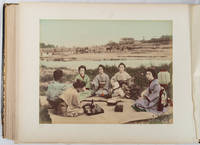
1890réf. 215089Japan. Circa1890s. 50 hand-tinted albumen prints 30 captioned with studio stock references mounted on thick gilt-edged card leaves19.5 x 25 cm in an album 27.5 x 35 cms; elaborately lacquered boards scuffed and chipped inlaid with mother of pearl with loss over quarter calf renewed bevelled edges gilt dentelles endpapers gilt-flecked some fading and spotting to the images and toning to the margins of the card leaves but a very good handsomely bound collection. Beautiful studio album containing a collection of 50 hand coloured photos of Japan with a splendid lacquered and decorated cover. The photos were commercially produced images which were sold to foreign visitors who had the studio place photographs in an album of their choice. This album is unusually interesting because unlike many where photographs were more randomly placed the images have been selected and arranged geographically beginning in Tokyo and moving southwards: Nikko Yokohama Miyanoshita & Hakone Lake Mount Fuji Kyoto Osaka Kobe and Nagasaki. There are fine images and portraits of geisha including an uncaptioned image of geisha seated possibly by the Kamo River in Kyoto entertaining a male guest. A lute is placed on the rice mat together with a tray of beer. One of the geisha is looking straight to camera a striking composition. Another uncaptioned in the Kyoto group is likely to be in Arashiyama shows a sandalled figure on a mountain path overlooking the leisure boating below. There are also images of pagoda fishing rice planting street vendors and markets. More than half the photographs appear to be from the studio of the Yokohama based photographer Tamamura Kozaburo c.1856-192 who at his height was described as "the best photographer in Yokohama". As Terry Bennett has attested Tamamura's business strategy of selling souvenir albums of views and costumes to foreigners became a "winning formula". see Terry Bennett "Early Japanese Images" Tuttle 1996 and "Photography in Japan 1853-1912" Tuttle 2006 . hardcover
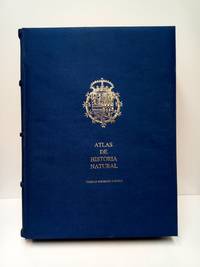
1990réf. 47341EDICION FACSIMIL.- Valencia: Vicente García Editores S. A. Imp. en Artes Gráficas Vicent S. A. 1990.- 2 VOLS. El códice consta de 7 h. en blanco 218 láminas a todo color 8 h. en blanco 2 h. con el colofón y el DOY FE de la edición con firma y sello notariales y el estudio tiene 138 p; Gan Folio 347 x 245 cm; El facsímil totalmente compuesto por láminas a todo color e impreso sobre magnífico papel en imitación similar al del original y el estudio bilingüe en español e inglés sobre excelente papel offset satinado de fuerte textura; El facsímil encuadernado exactamente como el original en Plena Piel Pergamino con el lomo dorado con grecas y florones y con ambas tapas plenamente doradas y el estudio encuadernado en Media Piel Pergamino.- Esta edición se compone únicamente de: tres mil ejemplares numerados correlativamente del 1 al 3.000 ambos inclusive siendo este el n.º 613; un ejemplar con destino a S. M. el Rey Don Juan Carlos I; y además sin fines comerciales cincuenta ejemplares que se identificarán con números romanos y otros treinta ejemplares que se identificarán con las letras del abecedario de la A a la Z incluyendo dobles y compuestas. Sigue la autentificación notarial con su firma y sello. Excelentísimo estado de conservación por no decir como nuevo. Este códice pictórico que se conserva en la Biblioteca de la Universidad de Valencia -nos dice el Prof. D. José María López Piñero- es un volumen de de 335 x 23 cm encuadernado en pergamino con adornos dorados. En una de las cubiertas lleva la leyenda "Jardín de Cámara" y el la otra "Retrato de Naturaleza". Tradicionalmente ha venido llamándose sin embargo "Atlas de Historia Natural" denominación con la que fue incluido en el Catálogo de manuscritos existentes en la Biblioteca Universitaria de Valencia publicado en 1913 por Marcelino Gutiérrez del Caño. Consta de 234 hojas de papel del siglo XV como puede verse por sus marcas estando en blanco las seis primeras y las diez últimas. Las restantes 218 contienen dibujos en colores a la acuarela de plantas y animales pintados por una sola cara con la excepción de una que lleva figuras en ambas que corresponde a las páginas numeradas 51-52. En casi todas las hojas hay un solo dibujo; solamente en cinco se incluyen dos o tres. Sesenta dibujos corresponden a animales y los demás a plantas. HISTORIA DEL SIGLO DE ORO ESPAÑOL Libro en español Vicente García Editores, S. A. hardcover
réf. 98101501Canton 1860-80's Cheungqua. A group of 7 pith or Tongcao color paintings usual minimal issues mostly clean & solid sold "as is" as a collection with the typical chips & a few fox spots else very good clean examples. A RARE GROUP ! . . . . A SUITE OF 7 FINE CHINESE COLOR PITH PAINTINGS . . . SHOWING BEAUTIFULLY DRESSED CHINESE WOMEN . . . PLAYING MUSICAL INSTRUMENTS . . . EXECUTED IN STUNNING & BRILLIANT COLORS . . . AKA: CHINESE EXPORT WATERCOLOURS . A group of typical "trade paintings" executed by Chinese native artists for foreign traders visiting Canton or Macao during the early to mid-19th century. . A SUPERB SUITE OF FABULOUS COLOR PITH PAINTINGS: A stunningly beautiful group of hand-painted color pith paintings depicting a woman playing a musical instrument. . "GOLDEN LOTUS" or "LOTUS FEET" BOUND FEET Chanzu: This like most illustrations of the period show the women with bound feet. Chanzu bound feet was an erotic obsession and fetish in ancient China. The erotic ramifications are outlined in the references below. . The paintings illustrate Chinese women in a domestic scene with furniture playing musical instruments. Subjects are: . a. Yue1in Ruan Moon Guitar Moon Zither 4 stringed . b. Yanqin Chinese Dulcimer . c. Sanxian three-stringed Chinese lute . d. Drumming on the back of a Chinese ceramic bowl . e. Dizi Chinese bamboo flute . f. Huqin Chinese violin . g. Tong Luo Chinese Brass Gong . DESCRIPTION OF THE PAINTING ART WORK AND CONDITION: . Each painting is in brilliant vivid and stunning colors. Each is skillfully painted with a fine hand delicate fine-point brush with great detail incredible reality texture and appeal. . As usual the set paintings were tipped to a contemporary backing period Each painting is backed with a contemporary stiff paper or a more current back card. . Items "a" & "b" are matted see cover.jpg & title.jpg photos posted to our website. . Each painting is approximately 21 x 34 cm. most have a blue silk ribbon border partial border or border lacking chipped and the like on has restorations on the verso in the margin only. . Each painting has some chips parts missing on the edges or with small holes here and there 'e' by and large the images are complete but some may have usual and often typical age-related cracks or splits a touch of fox spots on "c." . Suitable for framing & display. Please review photographs posted to our website for details. . "RICE PAPER" PAINTINGS: Several authors refer to this name rather than the proper name "Pith" paper paintings also can be called "Tung Tsao." . THE CANTON ARTIST OR 'SCHOOL' OF CHEUNG QUA: Cheung Qua was an export watercolor painter in Canton. He and followers of his school produced various single and albums of these paintings which were sold from his studio. . Often his in-house artists began painting on their own thus replicating the techniques subjects and essence of their masters. Because these paintings were rarely signed the one and only identification ever found was occasionally on the album cover or spine with the studio name. . Often these paintings were sold in various shops in Macao the main resting and gathering place of foreigners during part of the year. . REFERENCE: . CLUNAS Craig.: CHINESE EXPORT WATERCOLOURS. This entire book is devoted to Pith or Rice paper paintings. For musical instruments see color plates on pp.50-53 especially plates on pp.66-67 plates 39 & 40 are particularly similar to our examples that is to say by the same or an artist who was in the same house of Cheungqua or that school. CHU Arthur. et al.: ORIENTAL ANTIQUES AND COLLECTIBLES: A GUIDE pp.62-66. THE CHINESE PITH PAINTING COLLECTION AT THE NATIONAL LIBRARY OF AUSTRALIA: An Annotated Guide. Crossman Carl L. The decorative arts of the China trade : paintings furnishings and exotic curiosities. LEVY Howard S.: CHINESE FOOT BINDING: The History of a Curious Erotic Custom. . --. THE LOTUS LOVERS: The Complete History of the Curious Erotic Custom of Foot binding in China. JACKSON Beverly.: SPLENDID SLIPPERS: A THOUSAND YEARS OF AN EROTIC TRADITION. . . unknown
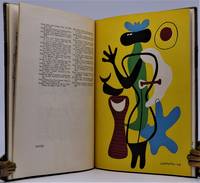
1949réf. 009041Santiago De Chile: Cuadernos del Pacifico 1949. Book. Near Fine. Cloth. Limited Edition. 4to - over 9¾" - 12" tall. One of the 100 copies that contain a sheet hand-colored by the artist this copy additionally has the frontispiece illustration also hand-colored by the artist. Handsomely bound in contemporary green cloth over boards with decorative black morocco strip lettered in gilt at front cover and spine ribbon marker bound without the original wrappers. Typeface by Mauricio Amster. Near Fine light soiling to boards slight wear to morocco at board edge small bookseller's plate front end page. Mario Carreno 1913-1999 was a Cuban-born Chilean painter known for his Cubist abstraction and surrealism with techniques seen in Mexican muralist paintings. A unique copy with the additional hand-colored illustration and in contemporary fine binding. Cuadernos del Pacifico Hardcover
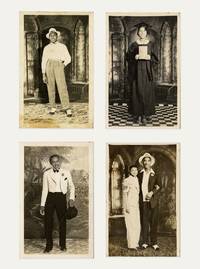
1920réf. COL-4131920. Silver prints 24. Collection of real photo postcard studio-portraits of the African American community of Miami Florida in the 1920s-40s. Eighteen of the photographs are from the "Nu Way Photo Shoppe" a commercial studio located at 939 N.W. 2nd Avenue in the Overtown neighborhood of Miami.The firm was opened by David Jenkins in the early 1940s and catered to a Black clientele. A 1942 issue of "The Crisis" advertises Jenkins' work in Overtown and notes that many of the photographs illustrating the issue were shot by his firm. Included in the collection are portraits of two young women posed proudly in her graduation uniform an identified soldier alongside his sister dapper men in pinstripe suits two-tone shoes and panama hats and equally sharp-dressed women. There are six other photographs from other Miami-area studios. One of a woman seated has an embossed stamp for "Hicks Studio." Run by proprietor James E. Hicks the Hicks Studio was also located in Overtown at 225 N.W. 8th Street and is mentioned in the same issue of "The Crisis." Also included are a fun pair of photos showing a coolly-posed man in an all white suit and a second image showing him with a woman elegantly-clad in all white as well. There are also two photographs in front of the same tropical-backdrop one of a man dressed in a suit with tails holding a cane and bowler and the other of a man and woman. One of the last two photos show a woman in lavish evening wear and the other shows a couple in more conservative attire. The second-oldest continuously inhabited Miami-area neighborhood after Coconut Grove Overtown is located just northwest of downtown. The area was originally settled in the late 19th-century by African American laborers who worked on the construction of the Florida East Coast Railway. Originally known as "Colored Town" it was one of the few places in Miami where black residents were allowed to live. During the early 20th-century Overtown became a thriving cultural center for Miami's black community with numerous businesses restaurants and nightclubs built primarily along Northwest 2nd Avenue where the Nu-Way Photo Shoppe was located. Its thriving Jazz scene earned Overtown the nickname "Little Harlem." In the 1960s Overtown was largely demolished to make way for the construction of Interstate 95 which cut through the heart of the neighborhood. Many homes and businesses were destroyed and the highway effectively cut Overtown off from downtown Miami and the rest of the city. Today revitalization efforts are in place including the restoration of the neighborhood's historic Lyric Theatre. Each 5 1/2 x 3 1/2 inches ; Some with "Nu Way Photo Shoppe" stamp verso one with Hicks Photo Studio embossed credit stamp some with subject identification recto or verso. ;. unknown
2006réf. SBBIH-3LPSTNFVFN3YMap Studio 2006. paperback. Acceptable. Please see the condition note after this for details if this is missing please consider Acceptable to mean poor quality that could include major staining water damage writing missing dustjacket etc etc. Our books are dispatched from a Yorkshire former cotton mill. We list via barcode/ISBN so please note that the images are stock images and may not be the exact copy you receive furthermore the details about edition and year might not be accurate as many publishers reuse the same ISBN for multiple editions and as we simply scan a barcode or enter an ISBN we do not check the validity of the edition data when listing. If you're looking for an exact edition please don't order at least not without checking with us first although we don't always have time to check. We aim to dispatch prompty the service used will depend on order value and book size. We can ship to most countries see our shipping policies. Payment is via Abe only. Map Studio paperback
1980réf. SBBI-mon0000020441Map Studio 1980. unknown_binding. Good. Our good condition books are generally good for reading but not for gifting or collecting. They could have imperfections such as creasing fanning inscriptions margin notes yellowing staining on edge or cover or pages bumps scuffs etc etc sometimes multiple of these. It's a wide category that encompasses anything that isn't almost-new down to anything that is slightly better than poor. We would NOT recommend gifting Good books - these should be considered reading copies. Our books are dispatched from a Yorkshire former cotton mill. We list via barcode/ISBN so please note that the images are stock images and may not be the exact copy you receive furthermore the details about edition and year might not be accurate as many publishers reuse the same ISBN for multiple editions and as we simply scan a barcode or enter an ISBN we do not check the validity of the edition data when listing. If you're looking for an exact edition please don't order at least not without checking with us first although we don't always have time to check. We aim to dispatch prompty the service used will depend on order value and book size. We can ship to most countries see our shipping policies. Payment is via Abe only. Map Studio unknown
1991réf. 2091202133212933Mainichishinbunsha 1991. Soft Cover. Fine. Number of books: 2 in total Mainichishinbunsha paperback
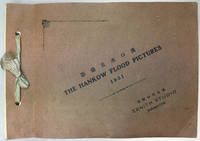
1931réf. ABE-163333276393130 original photos. Album size: 21.915.4 cm; Image size: 14.89.3 cm. 15 card leaves each with 2 mounted black and white photographs 148mm93mm with printed captions very good condition in card covers. More photos available upon request. Hankow: Zenith Studio, 1931 paperback
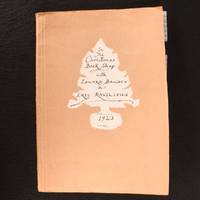
1923réf. 957Z15London: The Studio Limited 1923 . First edition. Paperback. Very Good Indeed. 11.5" by 8.5". Eric Ravilious; Edward Bawden. The vanishingly scarce first collaboration between the celebrated artists Eric Ravilious and Edward Bawden. One of the earliest examples of their impressive artwork being an advertisement for Christmas gift books from 'The Studio'. The first edition. A vanishingly scarce piece of art history being the first ever collaboration between Eric Ravilious and Edward Bawden. Not held by any institutional library. Illustrated with their dual tone wood engraving to the title page and six pages of dual tone wood engraved vignettes. Collated complete. An advertisement insert for the December issue for 'The Studio' advertising a number of Christmas gift books published by 'The Studio' and other notable publishers. 'The Studio' was an illustrated art magazine and publisher of art and design works. This advertisement is one of the earliest known published works for the noted artists Eric Ravilious and Edward Bawden and is the first collaboration between the two made while the two were still studying at the 'Royal College of Art'. Both Bawden and Ravilious are notable artists from the first half of the twentieth century being renowned for their work as war artists during WWII. The two collaborated many times on murals and other projects. In the publisher's original paper covers. In the publisher's original paper covers. Externally excellent with only minimal creasing. Bookseller's label to the verso of the rear cover. Internally firmly bound with light spotting. Very Good Indeed The Studio Limited paperback
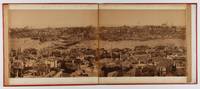
1890réf. 54541Constantinople: Sebah & Joaillier 1890. First edition. Hardcover. vg- to vg. Oblong small folio. 12 1/4 x 14 1/4". Red pebbled cloth boards with decorative gilt ruling tooling and lettering on the covers. Rebacked maroon leather spine. Gilt-stamped crescent moon and star motif the national emblem of Turkey on the back cover. Taken from the Galata Tower in what is now the Karaköy neighborhood of Istanbul this magnificent panorama displays the skyline and cityscape of Constantinople as it appeared sometime in the late 1880s or early 1890s. The panorama is comprised of 10 original albumen photographs mounted on heavy card stock and bound together in accordion style leporello measuring a total of more then 11 feet when completely unfolded. Shot in a southwardly direction the viewer can see Galata Karaköy in the foreground and from left to right across the Bosporus to the Uskudar district on the Asian side and then across the harbor at the mouth of the Golden Horn the Galata Bridge and across to the Pérama neighborhood and the Faith district where many famous landmarks of the city can be seen including the New Mosque Topkapi Palace Hagia Sophia and many others. Each panel measures about 13" wide and 12" tall. The photography is credited to "Sebah & Joaillier" one of the most prominent and prolific photography studios of Ottoman Empire during the second half of 19th century. Originally founded sometime around 1857 in Instanbul by Syrian-Armenian photographer Pascal Sebah 1823-1886 the studio was one of the earliest in the city and all of Ottoman Turkey. By the 1870s Sebah had become among the most prominent Ottoman photographers having also opened a branch of the studio in Cairo. Upon Sebah's death in 1888 the firm was taken over by his 16 year-old son Jean Pascal Sebah who then partnered with photographer Policarpe Joaillier 1848-1904. The firm was renamed "Sebah & Joaillier". Therefore although this panorama is undated it could not have been issued earlier than 1888; most likely sometime shortly thereafter circa 1890. Spine of of the portfolio has been professionally re-backed. Plates with minor to light foxing although the images are still quite clean and vibrant. Binding in very good images in very good- to very good condition overall. A slightly later version of the panorama from Sebah & Joaillier simply titled "Constantinople" is comprised of 12 slightly smaller panels instead of 10 and measures around the same size in total. Bibliographic refences: Jacobson Ken. Odalisques & Arabesques: Orientalist Photography 1939-1925. Quaritch 2007; Özendes Engin. "Photography in the Ottoman Empire"; Öztuncay Bahattin. The Photographers of Constantinople. Aygaz 2003. Sebah & Joaillier hardcover
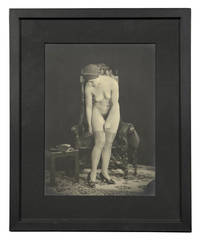
réf. 83369Paris c.1930s. . Six gelatin silver prints 22 x 16 cm. Very good condition and with very good tone. Framed. A series of six nude studies showing the same model posing in the photographer's studio. The style of the photographs which artistically combines high and low art allows to attribute the authorship to the Grundworth studio which is known to have been producing erotic postcards in Paris from the 1890s to the 1930s. Like most of the studios engaged in production of erotic photographs and postcards of the time little is known about it as despite the widespread circulation of these cards their production and distribution was illegal in France hence anonymity was essential. Given the time span and a number of different styles the name is unlikely to represent an individual photographer but more likely a group of photographers who were perhaps better known but wanted to hide their real identities. [Paris, c.1930s]. unknown
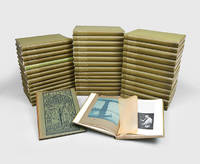
1893réf. 193928London: The Studio 1893-1907. The formation of modern art and design A substantial run of one of the most significant arts magazines of its time a major influence on the development of the Arts and Crafts and Art Nouveau movements. The set forms an uninterrupted run from the first to the forty-second volume from the magazine's foundation to December 1907 encompassing its heyday and the height of its influence. Its circulation dwindled during the First World War though the magazine continued until 1964. 42 vols large octavo. Illustrations throughout many in colour. Original green cloth spines lettered in gilt patterned endpapers. General light rubbing and uneven sunning to spines vol. XI supplied with variant spine lettering and much brighter cloth some volumes a little shaken a few hinges split some tissue guards loose a few leaves reinserted in vols. VII and XXIV. A very good set. hardcover
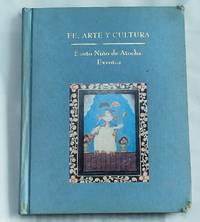
2000réf. 8Hermoso libro editado por el Consejo Nacional para la Cultura y las Artes y la casa Estudio Diego Rivera y Frida Khalo. Con hermosas fotografías el tema es visto desde varios puntos como es el lietrario artístico religioso etcetera. El libro esta lastimado en las puntas de las tapas pero las hojas estan en perfecto estado Tapa dura forrada en tela primera edición año 2000. Instituto Nacional de Bellas Artes hardcover
réf. 85063902Tokio 1901 Yamamoto. Oblong album color pictorial stiff wrs. purple silk ties mild/faint center fold a remarkably clean bright copy 58p. 40 large photos 26.5 x 20 cm. 21 smaller photos ca. 12.5 x 8.5 cm. album size 39 x 26.5 cm. . . . PHOTOGRAPHED BY THE EMINENT YAMAMOTO SANSHICHIRO . . . THE LEGENDARY AND OBSCURE PHOTO ALBUM OF . . . THE NORTH CHINA AFFAIR OR THE BOXER REBELLION . . . PRINTED IN A VERY SMALL FIRST & ONLY OBSCURE EDITION . . . WORLDCAT LOCATES ONLY 3 COPIES ! . THE BOXER UPRISING 1900 This work documents the results of the Boxer Uprising of 1899-1900 where in anti-foreign sentiments reached a boiling point. Several foreigners were killed mostly missionaries later when foreign embassies were besieged some diplomats were also killed. This resulted in the combined efforts of these foreign countries who teamed up to suppress this rebellion. This rebellion was mostly limited to North China where it began in Shandong province under German control and spread Westward across Northern China through Beijing. . This superb work contains a total of 114 b.w. photogravures. This work shows historic photographs of the foreign troops occupying Beijing Peking China. Good photographs of these troops in and around the Forbidden City namely those from Japan Russia France America and Germany. . What makes this graphic work important is that it shows a large part of the Palace and other Forbidden City buildings as they were before the troops actually damaged or pillaged these historic sights. Each country garrisoned their troops in a select group of old buildings hither to unseen by commoners and especially never by any foreigner. It is a superb look at the inner world of the Emperor of China. . THE PHOTOGRAPHER: YAMAMOTO Sanshichiro 1855-1943: . He was an eminent Meiji era photographer born in Okayama. From 1882 to about 1897 he had a photographic studio in Tokyo. Later when news of the Boxer Rebellion swept the world he quickly went to Peking to photograph the historic activities of foreign troops in the capitol including the Japanese living there. . After photographing the destruction & aftermath in Peking he finally settled down in Tianjin and opened his third photographic studio. . Color photos are posted to our website. . CONDITION: This work is truly an excellent copy externally and internally. There is a very tiny bit of edge wear at the lower right a tiny chip loss and upper left front corners. The purple silk ties are bright solid and very clean. There is a very slight hint of where this book was probably lightly folded in half but not hard and there is a mild hint remaining. From about the middle onwards there is not much evidence of this at all. By and large we feel this work is an excellent copy. There is NO damp or other condition issues with this item. Overall exceptionally clean and solid throughout. This is a very RARE book has seldom been found let alone in such lovely condition. A REMARKABLE COPY ! See photographs posted to our website from this copy. . RARITY: WorldCat only locates three copies in the world. This is indeed a very RARE book ! . See references below for more information. . BIBLIOGRAPHY: The author/photographer was noted for photographing and publishing two other superb photographic books on China: "Peking" published in 1906 and his stunning "View and Custom of North China" in 1909. . REFERENCE: Please see WorldCat: worldcat-org/title/views-of-the-north-china-affai r/oclc/25266060&referer=brief_results Yamamoto Sanshichiro is amazingly NOT FOUND in any of the 3 Terry BENNETT books: . History of Photography in China 1842-1860 vol. 1 2009 . History of Photography in China: Western Photographers 1861-1879 vol. 2 2010. . History of Photography in China: Chinese Photographers 1844-1879 vol. 3 2013. . . unknown
1931réf. 140941772Philadelphia: David McKay Publisher 1931. First Edition. Near Fine/Very Good. First edition. Unpaginated. Bound in illustrated paper-covered boards. Near Fine with wear along bottom edge and tips faint occasional thumbsoil and foxing in Very Good price-clipped dust jacket with a few short closed tears to edges sticker wear to bottom of front panel rectangular chip to top of back panel with associated closed tear and creasing a little foxing. Illustrated in color throughout. The very first book of Mickey Mouse published by Disney in its rare dust jacket. David McKay, Publisher unknown
1939réf. ZB445259Columbus etc.: Design Publishing Co. 1939. volumes 41-60 1939-1959 mostly bound with covers and ads retained ex library else texts clean & bindings tight. - If you are reading this this item is actually physically in our stock and ready for shipment once ordered. We are not bookjackers. Buyer is responsible for any additional duties taxes or fees required by recipient's country. Photos available upon request. Columbus, etc.: Design Publishing Co. unknown
réf. 02-0060London: The Studio. 1893-1910. A complete run of the first 17 years with 100 original graphic works. The preeminent art journal of the Arts and Crafts movement. All volumes with original graphics are present including the five lithographs by Whistler. The Studio commissioned original graphic works for inclusion in its periodical magazine as opposed to the Special Numbers.The artists include Whistler 5 original lithographs Pennell Nicholson Brangwyn and Riviére among others. 20.5 x 28.5 cm. Original cloth. Some front covers dampstained. A list of all the prints is available. London: The Studio. 1893-1910. hardcover
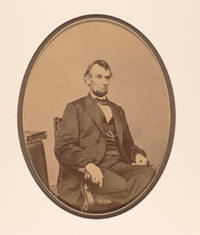
1864réf. 42820809Oval albumen print 8 x 6 in. original printed mount trimmed at bottom removing caption signed "BRADY & CO. PHOTOGRAPHERS." Browning and offsetting to mount light toning to image. Very good. Matted and framed. The classic Brady $5 bill photograph. This celebrated portrait the basis for the five-dollar bill engraving used for most of the 20th century is one of seven poses taken by Anthony Berger at Mathew Brady's Washington D. C. studio on February 9 1864. The most prolific photographer of Lincoln Brady himself did not actually operate his cameras during the war years instead training and employing men like Alexander Gardner and his successor Anthony Berger who took this picture to operate the camera. Lincoln's son Robert Todd Lincoln declared this famous portrait to be "the most satisfactory likeness" of Abraham Lincoln. Mathew Brady Gallery
réf. 146130N.p.: N.p. 1978. Archive of 14 iconic vintage photographs of Studio 54 celebrities and revelers by photographer William Coupon all from 1978. Ten of these are signed and dated by Coupon at the bottom right and one bears a tag on the verso noting "Two Dancers Studio 54 August 1978." Images of Andy Warhol Truman Capote Grace Jones Patti Smith and Divine are included in the collection along with a variety of other glamorous and fascinating visitors to the exclusive New York night club. Coupon's Studio 54 photographs were included in the International Center of Photography exhibition "Fleeting Gestures: Treasures of Dance Photography" in late 1978 his first major exhibition. The photographs in this collection were exhibited at Photo London 2019 and on display at Tenderbooks in London in conjunction with Rare Photo Gallery in Toronto. Coupon was born in New York City and after attending Syracuse University returned there in 1978. He began to photograph the disco/celebrity scene at Studio 54 and the punk/New Wave scene at the Mudd Clubb in lower Manhattan. During this time he also became a successful commercial photographer working for a variety of international magazines record companies and advertising agencies. In the 1980s and 1990s Coupon did several series on various subcultures and indigenous peoples that he called "Social Studies." In 1992 he was invited to photograph the world's tribal leaders during Earth Summit in Rio de Janeiro Brazil. The work at the request of the United Nations and the United States Congress was exhibited in 1994 in the United States Senate Rotunda as part of the UN's "Year of the Indigenous People." Coupon's vast catalog of portraits include world leaders noted writers artists and musicians as well as his highly regarded indigenous portraits. He has photographed covers for Newsweek Rolling Stone and the New York Times Sunday Magazine as well as assignments for Esquire The Washington Post The Los Angeles Times People and many more. He photographed 15 covers for Time magazine including the Bill Clinton and George W. Bush "Person of the Year" covers and has photographed all of the Presidents of the United States from Richard Nixon going forward. 8 x 10 inches archivally matted to 16 x 20 inches. Near Fine overall. N.p. unknown
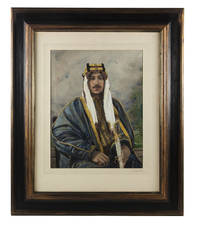
1930réf. I7D9LIPN5PS6London 1930. In a wooden frame ca. 53 x 64 cm under glass. Matt silver print ca. 28 x 36 cm watercolour pastel gouache and oil paint. Mounted on paper in a passe-partout. Signed "Lafayette" in pencil on the mount. Impressively coloured photographic portrait of the Saudi crown prince Saud 1902-1969 by the eminent London photographic studio Lafayette. Prince Saud the future King Saud of Saudi Arabia had been appointed crown prince in 1933 and fought in the 1934 war against Yemen. After the war his father encouraged him to travel abroad and over the next few years he visited Saudi-Arabia's neighbours Europe and the United States. While in London Prince Saud had his portrait taken by the Lafayette studio originally established in Dublin in 1880. It is no coincidence that Prince Saud chose a firm that had photographed numerous emperors kings sultans earls early movie stars etc. The firm would also provide hand coloured prints on request and the current photograph is an example of the very high quality they provided. The photograph of Prince Saud was coloured by painting over the photograph with watercolours and pastel. A subsequent treatment made it possible to use tiny drops of oil paint to highlight the gold trimming on his robe the jewels and pearls on his sword and the small lights in his eyes. In very good condition with only very minor craquelure. A colour portrait of the future King Saud of Arabia: a photograph enhanced by an expert painter from the leading British firm for the genre.l For Lafayette: Russell Harris Narrated in calm prose. unknown