3 215 résultats
1918réf. 53908Amsterdam: Goudstikker J. / Kunstzalen Van Pulchri Studio. As New. Paperback. FREE UPGRADE to Courier/Priority Shipping Upon Request – – IN STOCK AND IMMEDIATELY AVAILABLE FOR SHIPMENT - Text pristine & unmarked - Text in Dutch. 62 works catalogued and described; some illustrated in lovely black and white plates; artists' signatures reproduced next to descriptions of signed works. Among the artists represented: Hobbema Gerrit Lundens Ferdinand Bol and others. -- with a bonus offer-- . 1918. Goudstikker, J. / Kunstzalen Van Pulchri Studio paperback
1927réf. 38811London England: The Studio. As New. Paperback. FREE UPGRADE to Courier/Priority Shipping Upon Request – – IN STOCK AND IMMEDIATELY AVAILABLE FOR SHIPMENT - Eight color plates tipped-in; by artists including J. Pollard Alken and others. -- with a bonus offer--; T-Derbystu; Kendall George; The Studio Famous Sporting Events: III - The Derby . 1927. The Studio paperback
1998réf. 60524Museum. New. Paperback. FREE UPGRADE to Courier/Priority Shipping Upon Request – – IN STOCK AND IMMEDIATELY AVAILABLE FOR SHIPMENT - Flawless copy brand new pristine never opened -- 64 pp. With 36 ills. 25 col. . 25 x 21 cm. -- with a bonus offer-- . 1998. 0965811514 . Museum paperback
2022réf. 130790Art Books Publishing Ltd. New. Hardcover. FREE UPGRADE to Courier/Priority Shipping Upon Request - IN STOCK AND IMMEDIATELY AVAILABLE FOR SHIPMENT - Flawless copy brand new pristine never opened -- with a bonus offer-- . 2022. 1908970472 . Art Books Publishing Ltd hardcover
2009réf. 78769University of Washington Press Distribution . New. Paperback. FREE UPGRADE to Courier/Priority Shipping Upon Request - IN STOCK AND IMMEDIATELY AVAILABLE FOR SHIPMENT - Flawless copy brand new pristine never opened -- Text in English. 56 pp. With 33 ills. 23 col. . 26 x 21 cm. -- with a bonus offer--; This book documents a mammoth two-part installation and related drawings videos and sculpture by Annie Han and Daniel Mihalyo. Their work After transformed the Boise Art Museum's Sculpture Court and Garden into a construction / deconstruction zone. The terrain of the indoor work consisted of a gravel landscape and floating above it several fragments of a modern living room. Outside a flourescent-lit billboard advertising the promise of modern living perched atop a pile of construction debris. Annie Han and Daniel Mihalyo are professional architects and artists who utilize unconventional architectural systems and new media to explore issues of spatial perception. They are the principals and founders of the Seattle architectural and installation art firm Lead Pencil Studio and the 2008 recipients of the Prix de Rome in architecture. . 2009. 0295989343 . University of Washington Press (Distribution) paperback
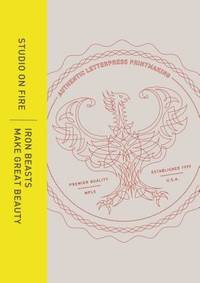
2011réf. 94163Gestalten. New. Hardcover. FREE UPGRADE to Courier/Priority Shipping Upon Request - IN STOCK AND IMMEDIATELY AVAILABLE FOR SHIPMENT - Flawless copy brand new pristine never opened -- 144 pages. Description: "Studio On Fire is at the forefront of the current letterpress movement—the rediscovery of old printing machines and techniques by young designers. The phenomenal detail and haptic sensuousness of their work have made this Minnesota-based company a seminal reference for how to effectively blend current and classical graphic design styles with production methods. " -- with a bonus offer--; Studio On Fire is at the forefront of the current rediscovery of old printing machines and techniques by young designers. Young designers and typographers are currently rediscovering traditional printing methods and using them to give their work a special handcrafted quality. Studio On Fire is a design studio workshop and printer all rolled into one. Founded and managed by Ben Levitz the Minnesota-based company not only belongs to the trailblazers of this movement but has also become a seminal representative of how to effectively blend current and classical graphic design styles and techniques. Studio On Fire is the logical consequence of Levitz's life-long passion for everything related to design printing and paper. Since his youth he has collected old printing presses and over the years learned to master the challenging design processes associated with labor-intensive techniques including letterpress screen printing hot foil stamping and blind embossing. Studio On Fire's designs and products are distinguished by a phenomenal richness and attention to detail. Today an impressive list of clients appreciates the haptic sensuousness of their work. This book is a collection of Studio On Fire's own work as well as projects commissioned by designers artists agencies private clients and brands. The designs are done in a wide range of formats such as placards posters books flyers folders business cards and wallpaper. From unique wedding invitations to printed art the examples included here show the inspiring results of seamlessly melding traditional techniques and handicraft with contemporary design. . 2011. 3899553810 . Gestalten hardcover
2000réf. 61200Studio Per Edizioni Scelte. New. Paperback. FREE UPGRADE to Courier/Priority Shipping Upon Request – – IN STOCK AND IMMEDIATELY AVAILABLE FOR SHIPMENT - Flawless copy brand new pristine never opened -- Text in Italian. 156 pp. With 152 ills. 146 col. . 29 x 24 cm. -- with a bonus offer-- . 2000. 8872422884 . Studio Per Edizioni Scelte paperback
2016réf. 120440Lannoo Publishers Acc. New. Hardcover. FREE UPGRADE to Courier/Priority Shipping Upon Request - IN STOCK AND IMMEDIATELY AVAILABLE FOR SHIPMENT - Flawless copy brand new pristine never opened. -- with a bonus offer-- . 2016. 9089896627 . Lannoo Publishers (Acc) hardcover
1932réf. 36411London England: The Studio Limited. As New. Hardcover Monograph. FREE UPGRADE to Courier/Priority Shipping Upon Request – – IN STOCK AND IMMEDIATELY AVAILABLE FOR SHIPMENT - Gift inscription FEP; else flawless - 12 1/4" x 9 3/4" - 12 tipped-in black and white plates by Peter Paul Rubens -- with a bonus offer--; T-Friestu; The Studio Limited; Freeman Martin introduction Peter Paul Rubens 1577 - 1640 Master Draughtsmen Number 3 . 1932. The Studio Limited hardcover
2002réf. 62335Distribution. New. Paperback. FREE UPGRADE to Courier/Priority Shipping Upon Request – – IN STOCK AND IMMEDIATELY AVAILABLE FOR SHIPMENT - Flawless copy brand new pristine never opened -- Text in English. 152 pp. With 146 col. Ills. 33 x 24 cm. -- with a bonus offer-- . 2002. 9056622617 . (Distribution) paperback
2012réf. 98827Loft Publications. New. Hardcover. FREE UPGRADE to Courier/Priority Shipping Upon Request - IN STOCK AND IMMEDIATELY AVAILABLE FOR SHIPMENT - Flawless copy brand new pristine never opened -- 256 pp. ; 275 illus. 248 in color. -- with a bonus offer--; PTang Studio is an architectural and interior design firm that seeks for the finest quality and innovation. With a fresh and unique style this studio gets back to basics while looking for comfort and understanding individual needs. Their aim is to develop projects that transcend boundaries and widen the horizon of design in the visionary future. PTStudio is one of China's most recognized interior design firms with projects like serenade with which the firm won several prizes last year. . 2012. 849936862X . Loft Publications hardcover
réf. 16-5820Dhrol Kathiawar India: 1937. Oblong folio album 530 x 420 mm depicting the installation festivities for the Thakore of Dhrol held on August 30 1937. Contemporary padded red morocco stamped and titled "Installation Festivities Dhrol Kathiawar" in gilt. Binding heavily rubbed with partial erasure of gilt lettering from upper cover contents somewhat loose boards heavily chipping and separating.Photographs depict all aspects of the society and community: Family notables servants military vernacular and royal architecture vehicles animals residents.Installation Festivities Kathiawar. Dhrol.Photograph album containing 128 black and white photos mounted on board leaves most 220 x 150 mm some 300 x 240 mm.A presentation album with the name of the recipient erased from the cover in celebration of the installation of H.H Thakore Saheb Shri Jorawarsinhji Dipsinhji Jadeja of Dhrol in August 1937. Shri Jorawarsinhji Dipsinhji Jadeja held the title of Thakore of Dhrol State—a British protectorate—for just two years until his death in 1939. His successor would be the last to hold the title which became extinct with the Union of India in February 1948.Before the arrival of Jadejas in Saurashtra the town of Dhrol was known as Dhamalpur. Dhamalpur was ruled by Chavda King founded & named after Dhamal Chavda who then reigned at Dhamalpur Dhrol obstructed the Jam Hardholji in their conquests and in order to remove this obstruction Jam Hardholji marched against Dhamal Chavda. Dhamal Chavda's army was made of different warrior clans such as Chavda Rathod Chauhan Jadav Jhala Gohil Varsur Makwana Dabhi Khimsurya and Solanki. These clans were not as united as Jadejas. Consequently they were defeated and King Dhamal Chavda was killed by Jadejas in 1539.Dhrol State became a British protectorate in 1807. During the British rule of India Dhrol State was a princely state of India ruled by the Jadeja dynasty having an area of 732 sqkm and 71 villages under its rule. It was accorded 9-gun salute status and a privy purse of 110000/-.The last ruler HH Thakore Saheb Shri Chandrasinhji Dipsinhji Jadeja acceded to the Union of India on 15 February 1948. Dhrol, Kathiawar, India: 1937 hardcover
Fra la 2a e la 3a opera è legato un manoscritto bifolio, scritto in chiara grafia a inchiostro nero (2 facciate) su carta vergellata, firmato e datato al verso: "Lod.° Ant.° Muratori" in cui l'erudito modenese, corrispondente degli arcadi Petracchi (Lettore di Filosofia Morale presso lo Studio cittadino), Formagliari (Cancelliere maggiore) e Bianconi (poligrafo ed insegnante di greco all'Archiginnasio), si pronuncia in merito alla controversia storiografica circa la legittimità del diploma teodosiano che avrebbe istituito come primario lo Studio di Bologna. Di grande interesse perché il manoscritto s'inserisce nella schermaglia erudita fra Petracchi e Formagliari. Le 5 opere e il manoscritto rilegati in un unico volume in bella legatura posteriore in mezza pelle ed angoli, dorso a 5 nervi con titolo e fregi oro negli scomparti, piatti marmorizzati. Mancanza ben reintegrata all'angolo inferiore esterno del frontespizio. Gora non deturpante che interessa la metà superiore di gran parte delle carte e in specie l'ultima opera, ma buone condizioni. La Congregazione dei Celestini di cui l'accademico Petracchi era membro, fondata da Pietro da Morrone divenuto papa col nome di Celestino V, aveva il controllo dell'Abbazia di S. Stefano dal sec. XV e la mantenne fino alle soppressioni del 1797.
1980réf. 4361Genève, Editions de la Galerie de l’Hôtel de Ville, 1980.
réf. 98101501Canton 1860-80's Cheungqua. A group of 7 pith or Tongcao color paintings usual minimal issues mostly clean & solid sold "as is" as a collection with the typical chips & a few fox spots else very good clean examples. A RARE GROUP ! . . . . A SUITE OF 7 FINE CHINESE COLOR PITH PAINTINGS . . . SHOWING BEAUTIFULLY DRESSED CHINESE WOMEN . . . PLAYING MUSICAL INSTRUMENTS . . . EXECUTED IN STUNNING & BRILLIANT COLORS . . . AKA: CHINESE EXPORT WATERCOLOURS . A group of typical "trade paintings" executed by Chinese native artists for foreign traders visiting Canton or Macao during the early to mid-19th century. . A SUPERB SUITE OF FABULOUS COLOR PITH PAINTINGS: A stunningly beautiful group of hand-painted color pith paintings depicting a woman playing a musical instrument. . "GOLDEN LOTUS" or "LOTUS FEET" BOUND FEET Chanzu: This like most illustrations of the period show the women with bound feet. Chanzu bound feet was an erotic obsession and fetish in ancient China. The erotic ramifications are outlined in the references below. . The paintings illustrate Chinese women in a domestic scene with furniture playing musical instruments. Subjects are: . a. Yue1in Ruan Moon Guitar Moon Zither 4 stringed . b. Yanqin Chinese Dulcimer . c. Sanxian three-stringed Chinese lute . d. Drumming on the back of a Chinese ceramic bowl . e. Dizi Chinese bamboo flute . f. Huqin Chinese violin . g. Tong Luo Chinese Brass Gong . DESCRIPTION OF THE PAINTING ART WORK AND CONDITION: . Each painting is in brilliant vivid and stunning colors. Each is skillfully painted with a fine hand delicate fine-point brush with great detail incredible reality texture and appeal. . As usual the set paintings were tipped to a contemporary backing period Each painting is backed with a contemporary stiff paper or a more current back card. . Items "a" & "b" are matted see cover.jpg & title.jpg photos posted to our website. . Each painting is approximately 21 x 34 cm. most have a blue silk ribbon border partial border or border lacking chipped and the like on has restorations on the verso in the margin only. . Each painting has some chips parts missing on the edges or with small holes here and there 'e' by and large the images are complete but some may have usual and often typical age-related cracks or splits a touch of fox spots on "c." . Suitable for framing & display. Please review photographs posted to our website for details. . "RICE PAPER" PAINTINGS: Several authors refer to this name rather than the proper name "Pith" paper paintings also can be called "Tung Tsao." . THE CANTON ARTIST OR 'SCHOOL' OF CHEUNG QUA: Cheung Qua was an export watercolor painter in Canton. He and followers of his school produced various single and albums of these paintings which were sold from his studio. . Often his in-house artists began painting on their own thus replicating the techniques subjects and essence of their masters. Because these paintings were rarely signed the one and only identification ever found was occasionally on the album cover or spine with the studio name. . Often these paintings were sold in various shops in Macao the main resting and gathering place of foreigners during part of the year. . REFERENCE: . CLUNAS Craig.: CHINESE EXPORT WATERCOLOURS. This entire book is devoted to Pith or Rice paper paintings. For musical instruments see color plates on pp.50-53 especially plates on pp.66-67 plates 39 & 40 are particularly similar to our examples that is to say by the same or an artist who was in the same house of Cheungqua or that school. CHU Arthur. et al.: ORIENTAL ANTIQUES AND COLLECTIBLES: A GUIDE pp.62-66. THE CHINESE PITH PAINTING COLLECTION AT THE NATIONAL LIBRARY OF AUSTRALIA: An Annotated Guide. Crossman Carl L. The decorative arts of the China trade : paintings furnishings and exotic curiosities. LEVY Howard S.: CHINESE FOOT BINDING: The History of a Curious Erotic Custom. . --. THE LOTUS LOVERS: The Complete History of the Curious Erotic Custom of Foot binding in China. JACKSON Beverly.: SPLENDID SLIPPERS: A THOUSAND YEARS OF AN EROTIC TRADITION. . . unknown
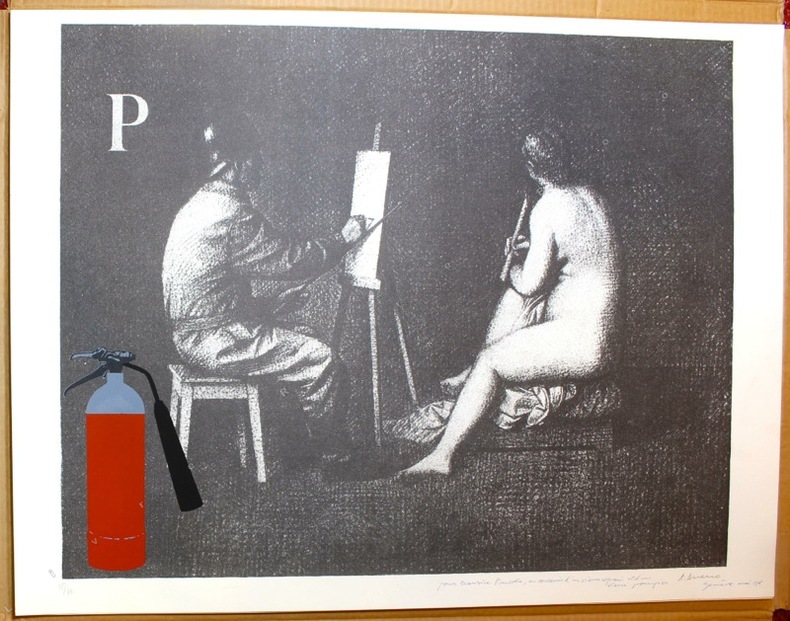
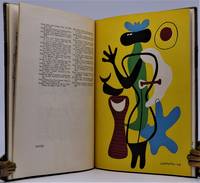
1949réf. 009041Santiago De Chile: Cuadernos del Pacifico 1949. Book. Near Fine. Cloth. Limited Edition. 4to - over 9¾" - 12" tall. One of the 100 copies that contain a sheet hand-colored by the artist this copy additionally has the frontispiece illustration also hand-colored by the artist. Handsomely bound in contemporary green cloth over boards with decorative black morocco strip lettered in gilt at front cover and spine ribbon marker bound without the original wrappers. Typeface by Mauricio Amster. Near Fine light soiling to boards slight wear to morocco at board edge small bookseller's plate front end page. Mario Carreno 1913-1999 was a Cuban-born Chilean painter known for his Cubist abstraction and surrealism with techniques seen in Mexican muralist paintings. A unique copy with the additional hand-colored illustration and in contemporary fine binding. Cuadernos del Pacifico Hardcover
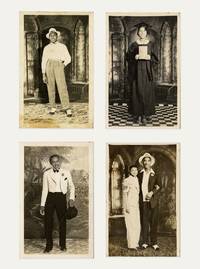
1920réf. COL-4131920. Silver prints 24. Collection of real photo postcard studio-portraits of the African American community of Miami Florida in the 1920s-40s. Eighteen of the photographs are from the "Nu Way Photo Shoppe" a commercial studio located at 939 N.W. 2nd Avenue in the Overtown neighborhood of Miami.The firm was opened by David Jenkins in the early 1940s and catered to a Black clientele. A 1942 issue of "The Crisis" advertises Jenkins' work in Overtown and notes that many of the photographs illustrating the issue were shot by his firm. Included in the collection are portraits of two young women posed proudly in her graduation uniform an identified soldier alongside his sister dapper men in pinstripe suits two-tone shoes and panama hats and equally sharp-dressed women. There are six other photographs from other Miami-area studios. One of a woman seated has an embossed stamp for "Hicks Studio." Run by proprietor James E. Hicks the Hicks Studio was also located in Overtown at 225 N.W. 8th Street and is mentioned in the same issue of "The Crisis." Also included are a fun pair of photos showing a coolly-posed man in an all white suit and a second image showing him with a woman elegantly-clad in all white as well. There are also two photographs in front of the same tropical-backdrop one of a man dressed in a suit with tails holding a cane and bowler and the other of a man and woman. One of the last two photos show a woman in lavish evening wear and the other shows a couple in more conservative attire. The second-oldest continuously inhabited Miami-area neighborhood after Coconut Grove Overtown is located just northwest of downtown. The area was originally settled in the late 19th-century by African American laborers who worked on the construction of the Florida East Coast Railway. Originally known as "Colored Town" it was one of the few places in Miami where black residents were allowed to live. During the early 20th-century Overtown became a thriving cultural center for Miami's black community with numerous businesses restaurants and nightclubs built primarily along Northwest 2nd Avenue where the Nu-Way Photo Shoppe was located. Its thriving Jazz scene earned Overtown the nickname "Little Harlem." In the 1960s Overtown was largely demolished to make way for the construction of Interstate 95 which cut through the heart of the neighborhood. Many homes and businesses were destroyed and the highway effectively cut Overtown off from downtown Miami and the rest of the city. Today revitalization efforts are in place including the restoration of the neighborhood's historic Lyric Theatre. Each 5 1/2 x 3 1/2 inches ; Some with "Nu Way Photo Shoppe" stamp verso one with Hicks Photo Studio embossed credit stamp some with subject identification recto or verso. ;. unknown
Pietra nera misure: mm 400 x 255 Pittore. Probabilmente entra giovanissimo nella bottega di Giambattista Piazzetta diventandone senza ombra di dubbio il migliore e il più longevo dei suoi allievi. Ne assimila così profondamente lo stile e la pennellata che ancora oggi diverse sono le opere che dividono la critica circa la loro attribuzione ad una o all’altra mano. Francesco è citato per la prima volta in un documento del 1744 della Fraglia dei Pittori veneziani, tuttavia è molto probabile che già da tempo fosse celebre in città. La sua prima opera documentata è un Immacolata Concezione per la chiesa parrocchiale di Cortona, oggi conservata presso l’oratorio della Villa Tommasi a Metelliano. Nel 1749, grazie all’interessamento del Conte Giacomo Carrara di Bergamo, gli fu commissionata la Pala dei Quattro Santi che adorano la Croce e i due laterali con Santa Lucia e Santa Apollonia per la chiesa di San Martino ad Alzano Lombardo. I dipinti ebbero un grande successo e valsero al pittore la protezione del Conte Carrara ma attirarono l’attenzione anche dei Conti Albani che divennero anch’essi suoi committenti invitando il pittore nel 1757 ad eseguire gli affreschi per casa Albani a Bergamo. Tali affreschi sono considerati dalla critica come il momento centrale dell’attività dell’artista. Pur accettando nel 1755, su segnalazione tra l’altro di Tiepolo e di Pittoni, la nomina a professore del Collegio dell’Accademia di Venezia, l’attività nella bergamasca si fa sempre più intensa. Nel 1762 Capella si trasferisce definitivamente a Bergamo dove apre anche una scuola di pittura particolarmente fiorente. Si tratta di uno studio preparatorio per l'importante pala nella Basilica di San Martino ad Alzano Lombardo, così come attestato anche dalla scritta a matita sul verso, e a giudicare dalle pieghe, fu probabilmente ripiegato e spedito a mo' di lettera. Questo insolito invio di disegni doveva essere una prerogativa dell’autore poiché si conosce un altro suo disegno, proveniente dalla collezione del Conte Carrara ed oggi presso l’Accademia Carrara (Inv. n, 14), che presenta le medesime caratteristiche. Nella metà inferiore del disegno si vede il gruppo di quattro Santi: Santo Stefano a sinistra, San Vincenzo Ferreri, San Francesco Saverio e San Nicola di Bari a destra ritratti in movimentate posture e intenti a rivolge le proprie preghiere verso la parte superiore della composizione dove vediamo due angioletti che sollevano in volo la Croce. Rispetto alla redazione finale su tela vi sono alcune differenze. Santo Stefano anziché avere il braccio sinistro alzato a indicare la Croce ha entrambe le braccia alzate con le mani congiunte in segno di preghiera. Il Santo in piedi risulta leggermente più spostato verso destra, ma la modifica più consistente riguarda gli ultimi due Santi che vengono ricollocati spostando più verso il centro la figura di San Nicola e allontanando sensibilmente verso destra l’ultima figura, a cui viene inoltre cambiato atteggiamento nascondendo le mani che nel dipinto sono invece ben visibili. Il disegno è un tipico esempio dello stile grafico di Capella, caratterizzato dai modi soffici e dal tocco leggero, oltre che dall’uso del gessetto nero. Anche il cielo è realizzato con il caratteristico tratteggio obliquo tipico dell’autore che sfrutta la fragile consistenza del gessetto per creare leggere e movimentate campiture chiaroscurali. Opera in ottimo stato di conservazione eccetto le pieghe descritte. Nonostante la tecnica impiegata, il disegno mantiene tutta la leggerezza e la sensibilità di tocco del maestro veneto. Bibliografia: R. Pallucchini, “Francesco Daggiù detto il Cappella”, in Riv. di Venezia, XI (1932); L. Vaccher, “Opere del periodo bergamasco del C.”, in Arte veneta, XXII (1968); F. Rossi, “I Grandi disegni italiani dell'Accademia Carrara in Bergamo”, Silvana editoriale, 1985.
réf. awd-106458 encres originales sur vélin au format 32/24 cm (dont 40 avec ajouts localisés aux crayons de couleur et 3 signées et datées 9-86) insérées dans un book en skaï gris texturé (35,5/29,2/3,8 cm).
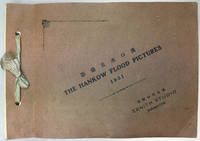
1931réf. ABE-1633332763931Hankow: Zenith Studio 1931 1931 30 original photos. Album size: 21.915.4cm; Image size: 14.89.3cm. 15 card leaves each with 2 mounted black and white photographs 148mm93mm with printed captions very good condition in card covers. 1st Edition. Soft cover. Very Good/No Jacket. More photos available upon request. Hankow: Zenith Studio, 1931 paperback
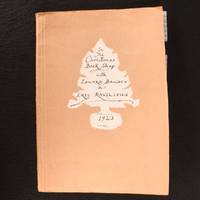
1923réf. 957Z15London: The Studio Limited 1923 . First edition. Paperback. Very Good Indeed. 11.5" by 8.5". Eric Ravilious; Edward Bawden. The vanishingly scarce first collaboration between the celebrated artists Eric Ravilious and Edward Bawden. One of the earliest examples of their impressive artwork being an advertisement for Christmas gift books from 'The Studio'. The first edition. A vanishingly scarce piece of art history being the first ever collaboration between Eric Ravilious and Edward Bawden. Not held by any institutional library. Illustrated with their dual tone wood engraving to the title page and six pages of dual tone wood engraved vignettes. Collated complete. An advertisement insert for the December issue for 'The Studio' advertising a number of Christmas gift books published by 'The Studio' and other notable publishers. 'The Studio' was an illustrated art magazine and publisher of art and design works. This advertisement is one of the earliest known published works for the noted artists Eric Ravilious and Edward Bawden and is the first collaboration between the two made while the two were still studying at the 'Royal College of Art'. Both Bawden and Ravilious are notable artists from the first half of the twentieth century being renowned for their work as war artists during WWII. The two collaborated many times on murals and other projects. In the publisher's original paper covers. In the publisher's original paper covers. Externally excellent with only minimal creasing. Bookseller's label to the verso of the rear cover. Internally firmly bound with light spotting. Very Good Indeed The Studio Limited paperback
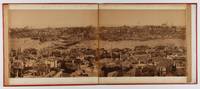
1890réf. 54541Constantinople: Sebah & Joaillier 1890. First edition. Hardcover. vg- to vg. Oblong small folio. 12 1/4 x 14 1/4". Red pebbled cloth boards with decorative gilt ruling tooling and lettering on the covers. Rebacked maroon leather spine. Gilt-stamped crescent moon and star motif the national emblem of Turkey on the back cover. Taken from the Galata Tower in what is now the Karaköy neighborhood of Istanbul this magnificent panorama displays the skyline and cityscape of Constantinople as it appeared sometime in the late 1880s or early 1890s. The panorama is comprised of 10 original albumen photographs mounted on heavy card stock and bound together in accordion style leporello measuring a total of more then 11 feet when completely unfolded. Shot in a southwardly direction the viewer can see Galata Karaköy in the foreground and from left to right across the Bosporus to the Uskudar district on the Asian side and then across the harbor at the mouth of the Golden Horn the Galata Bridge and across to the Pérama neighborhood and the Faith district where many famous landmarks of the city can be seen including the New Mosque Topkapi Palace Hagia Sophia and many others. Each panel measures about 13" wide and 12" tall. The photography is credited to "Sebah & Joaillier" one of the most prominent and prolific photography studios of Ottoman Empire during the second half of 19th century. Originally founded sometime around 1857 in Instanbul by Syrian-Armenian photographer Pascal Sebah 1823-1886 the studio was one of the earliest in the city and all of Ottoman Turkey. By the 1870s Sebah had become among the most prominent Ottoman photographers having also opened a branch of the studio in Cairo. Upon Sebah's death in 1888 the firm was taken over by his 16 year-old son Jean Pascal Sebah who then partnered with photographer Policarpe Joaillier 1848-1904. The firm was renamed "Sebah & Joaillier". Therefore although this panorama is undated it could not have been issued earlier than 1888; most likely sometime shortly thereafter circa 1890. Spine of of the portfolio has been professionally re-backed. Plates with minor to light foxing although the images are still quite clean and vibrant. Binding in very good images in very good- to very good condition overall. A slightly later version of the panorama from Sebah & Joaillier simply titled "Constantinople" is comprised of 12 slightly smaller panels instead of 10 and measures around the same size in total. Bibliographic refences: Jacobson Ken. Odalisques & Arabesques: Orientalist Photography 1939-1925. Quaritch 2007; Özendes Engin. "Photography in the Ottoman Empire"; Öztuncay Bahattin. The Photographers of Constantinople. Aygaz 2003. Sebah & Joaillier hardcover
In-folio. 7 carte, 144 pp., 3 cc. (tavola ripiegata con Plani Villae Adrianae), 145-263 pp., 5 cc. Antiporta incisa da Romeyn de Hooghe, ritratto in rame di papa Clemente X, 25 tavole in rame (di cui 15 ripiegate) e 20 incisioni n.t. Qualche fioritura sparsa; Piena pergamena coeva con medaglione centrale e impressioni a freddo sui piatti, decorazioni al dorso. Qualche leggero difetto alle cerniere. Bibliografia: Caillet II, 5777.
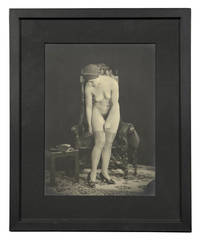
réf. 83369Paris c.1930s. . Six gelatin silver prints 22 x 16 cm. Very good condition and with very good tone. Framed. A series of six nude studies showing the same model posing in the photographer's studio. The style of the photographs which artistically combines high and low art allows to attribute the authorship to the Grundworth studio which is known to have been producing erotic postcards in Paris from the 1890s to the 1930s. Like most of the studios engaged in production of erotic photographs and postcards of the time little is known about it as despite the widespread circulation of these cards their production and distribution was illegal in France hence anonymity was essential. Given the time span and a number of different styles the name is unlikely to represent an individual photographer but more likely a group of photographers who were perhaps better known but wanted to hide their real identities. [Paris, c.1930s]. unknown
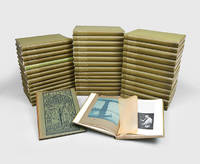
1893réf. 193928London: The Studio 1893-1907. The formation of modern art and design A substantial run of one of the most significant arts magazines of its time a major influence on the development of the Arts and Crafts and Art Nouveau movements. The set forms an uninterrupted run from the first to the forty-second volume from the magazine's foundation to December 1907 encompassing its heyday and the height of its influence. Its circulation dwindled during the First World War though the magazine continued until 1964. 42 vols large octavo. Illustrations throughout many in colour. Original green cloth spines lettered in gilt patterned endpapers. General light rubbing and uneven sunning to spines vol. XI supplied with variant spine lettering and much brighter cloth some volumes a little shaken a few hinges split some tissue guards loose a few leaves reinserted in vols. VII and XXIV. A very good set. hardcover