1927réf. D12058Milan 1927. Ephemera. Very Good. Broadside advertisements for the performance of "Piccolo Harem" at Teatro Manzoni 4 large printed in color; 7 handwritten letters by Costa 5 of them signed with content related to the drama; 78-pp. typescript of the play in French "Petit Harem" signed by Costa; and 7 contemporary newspapers containing reviews. Condition is VG or better. The broadsides are particularly striking -- some flattened creases from folding but boldly designed and colors remain bright would display nicely. unknown books
1885réf. 140511885. Neurdein Frères Paris Opera circa 1887 to 1890 documents the Palais Garnier and the concentrated carriage and pedestrian traffic surrounding one of the principal public buildings of late nineteenth century Paris. Completed in 1875 the opera house stood within the rebuilt urban landscape of the Second Empire and early Third Republic while the traffic visible before its façade records the everyday movement of people and horse drawn vehicles through the surrounding streets. Albumen print approximately 8 x 11 inches mounted on paper. The view centers on the elaborately ornamented façade of the Palais Garnier with numerous horse drawn carriages and pedestrians filling the foreground and the square before the building. The "X Phot." mark identifies the image with Neurdein Frères who used the mark from 1887. The firm produced extensive photographic views of Paris for circulation as tourist and architectural images including monuments civic buildings streets and other recognizable features of the capital. The combination of monumental architecture and active street traffic preserves both the appearance of the Palais Garnier and the transportation patterns of Paris before the widespread replacement of horse drawn vehicles by motor traffic. Excellent condition. A sharp late nineteenth century view combining architectural documentation of the Paris Opera with closely observed evidence of everyday movement through the surrounding urban space. unknown books
1988réf. 159709San Francisco: The Folcrom 1988. Vintage flyer announcing four performances of an opera entitled "Watt" adapted from the Samuel Beckett novel performed by The Tiny Dead Bodies Opera Company at The Folcrom San Francisco October 21 and 22 28 and 29 1988. Based on the 1953 novel by Samuel Beckett. The Folcrom was a non-profit installation and performance space located at 2150 Folsom Street San Francisco from 1987-1991. 8.5 x 14 inches on pale yellow paper. Very Good plus with pinholes to the corners and a small crease to the lower left corner. The Folcrom unknown books
1954réf. 231274New York.: Ballet Theatre Foundation. 1954. Stapled wrap. Very light soiling and light wear to covers otherwise a very good copy. 4to. Signed by Igor Youskevich Alicia Alonso John Kriza Melissa Hayden Roy Fitzell and Job Sanders on their respective photographs. Program for 1954 series at the San Francisco War Memorial Opera House laid in. Numerous photographs of the performers. Ballet Theatre Foundation. unknown
réf. 2309Beijing, Peoples Art Publishing House, 1957. Edited by the Research Studio of the Northeast Drama Institute. Designs reproduced by Xia Yang, Lu Hua and Ma Qiang. 1 grand volume ef, 73 pp., bound in illustrated silk cover with original slipcase, presenting 73 coloured plates of Chinese Opera Costume. Lavishly decorated and nicely presented. This grand volume is in very good condition. Description in Chinese.
1870In folio (39×58 cm). Croquis par Ciardi, Dessinè sur pierre pad A. Lebedeff. Una mano coeva ha scritto con matita rossa il nome di Leschetizky al margine basso della tavola. Bellissima caricatura del celebre pianista, compositore ed insegnante di piano nato a Lancut nel 1830 e morto a Dresda nel che fu insegnante del grande musicista e diplomatico polacco, Ignacy Jan Paderewski, Teodor Leszetycki trascritto anche come Theodor Leschetizky o Theodor Leschetitzky (Lancut, 22 giugno 1830 – Dresda, 4 novembre 1915). Leszetycki fin da bambino dimostrò grandi doti di musicista tanto da essere ritenuto un bambino prodigio. Studiò pianoforte a Vienna con Carl Czerny e Simon Sechter. Già a 14 anni divenne insegnante di pianoforte. A diciotto anni era già un noto virtuoso di pianoforte nei circoli musicali viennesi. All’attività di virtuoso nei teatri di Vienna e d’Europa affiancò ,in modo sempre più importante, quella di insegnante fino ad essere con Rubinstein, cofondatore del conservatorio di San Pietroburgo. Fra i suoi allievi più celebri Fanny Bloomfield Zeisler, Katharine Goodson, Ignaz Friedman, Paderewski, Artur Schnabel, Alexander Brailowsky, Ossip Gabrilowitsch, Mark Hambourg, Elly Ney, Severin Eisenberger, Mieczyslaw Horszowski e molti altri. Molti dei suoi allievi divennero noti insegnanti di pianoforte a loro volta, come Isabelle Vengerova, Anna Langenhan-Hirzel, Richard Buhlig and Czeslaw Marek. La caricatura è opera del celebre compositore, flautista e caricaturista fiorentino Cesare Ciardi (Firenze, 28 giugno 1818 – Strel’na, 13 giugno 1877). Dopo una grande carriera in Italia ed in Francia nel “…1853 Ciardi partì per l’estero: Parigi e poi Pietroburgo dove resterà per anni come flautista dello Zar, direttori dei Teatri Imperiali e successivamente docente di flauto al neonato Conservatorio di Pietroburgo creato da Anton Grigorevic Rubinštejn; lì, per due anni (come scrive Fabbri, 1999), Pëtr Il’ic Cajkovskij studia flauto con Ciardi diventandone sincero amico; anche il celebre clarinettista Ernesto Cavallini lavorava nella stessa città entrando spesso in contatto con Ciardi. L’ultimo rimpatrio di Ciardi è del 1867 documentato dal programma di un ‘Gran Concerto Vocale e Strumentale’ a Prato dove Ciardi si esibì trionfalmente”. Esemplare in buone-ottime condizioni di conservazione. Raro.
1914réf. 76891914 Paris librairie Fischbacher 1914-19 In12 relié demi basane bleue dos lisse 1 fleuron titre frappé 146 pages
1930réf. 64011930 éditions Kra collection poivre et sel 1930 In8 broché 142 pages
1933réf. 3319Couverture rigide 1ère Édition Editions centrales 1933 Lausanne 27x21 cm
réf. 100074Rivista trimestrale di musicologia poesia storia e cultura piemontese cucina curiosità locali. - Musicalbrandè - Arvista Piemonteisa - Raccolta dei primi 40 fascicoli pubblicati dall'anno I n. 1 Marzo 1959 all'anno X n. 40 Dicembre 1968. - Circa 1000 pagine complessive con illustrazioni. - Copertina rigida - Lingua italiana / Dialetto piemontese. - Condizioni molto buone. Legatura e sguardie rifatte. unknown
réf. Fromonot, FrançoiseIn near perfect condition. unknown
réf. 129638aafParis, Marcel Sautier, s. d., (vers 1945), gr. in-8vo, 192 p., avec dessin original au crayon de Mariano Andreü (’46), ill. par des lithographies originales de Mariano Andreü, Ex. sur vélin pur fil à la forme des Manufactures de Lana nº 281 sur 310, reliure en plein cuir (sans la pièce de titre au dos) dos légèrement insolé, tranche supérieure dorée.
réf. 11723Paris, Olivier Perrin 1951 - 1956 315x240mm, 1200pages, env., nombreuses illustrations n/b et couleurs, reliure cartonnage sous jaquette illustrée. Avec un supplément: Tableau des pièces créées à Paris de 1951 à 1956. Quelques pages glacées avec des traces de mouillures sans gravité. Quelques jaquettes défraichies, volume II: il manque 1,5 cm au dos supérieur.
1978cm. 17,5 x 25, tre voll. di xxviii-1638 pp. con 69 tavv. f.t. Storia dei teatri italiani 3495 gr. xxviii-1638 p.
réf. 2518810 January 1993 with address label of ‘ERIC CROZIER OBE / 4 THE TIMBERYARD / GREAT GLEMHAM / SAXMUNDHAM / SUFFOLK’. See his entry in the Oxford DNB. 1p foolscap 8vo. In fair condition lightly aged and creased. Folded twice for postage. The address is printed on a small golden label affixed at the top left corner. Addressed to ‘Dear Mr. Catry’ and signed ‘With all best wishes - and thank you for writing! / Sincerely / Eric Crozier.’ He asks him to forgive a typed letter as he is ‘convalescing from a heart-attack and still not very good at hand-writing. / The opera I must enjoyed producing was I suppose my very first - Smetana’s THE BARTERED BRIDE in 1943 in a new English version made by Joan Cross and myself which stayed in the repertoire at Sadler’s Wells and Covent Garden for twenty years.’ He recalls that it was first staged ‘during the black-out to audiences starved of colour and gaiety: our first audience included the Czech government in exile - President Benes Jan Masaryk and others - and on the second night they took the whole theatre for their fellow-countrymen to see what all Czechs regarded as their national opera’. The rest of the letter concerns his next production Britten’s ‘Peter Grimes’ ‘a world-wide event’ premiered at Sadler’s Wells in 1945 ‘and one year later I staged the American premiere with Leonard Bernstein as conductor at Tanglewood. I worked with Britten and Montagu Slater the librettist throughout the writing and composition of that great work which has had I would guess a greater international success than any other English opera all through the past fifty years. It is still being staged - Rostropovich will conduct performances of it at the Barbican this March.’ 10 January 1993, with address label of ‘ERIC CROZIER, OBE / 4 THE TIMBERYARD / GREAT GLEMHAM / SAXMUNDHAM / SUFFOLK’. unknown
réf. 2439115 July 1859. London. Meyerbeer is said to have been the most frequently performed opera composer during the nineteenth century. He encouraged and supported the young Wagner who turned on him viciously later in life. Lady Molesworth née Andalusia Carstairs d.1888 had herself been a professional singer. She was the widow of Sir William Molesworth 1810-55 founder of the London Review and owner under the editorship of John Stuart Mill of the Westminster Review. Regarding the present item Meyerbeer notes in his diary for Sunday 17 July ‘Big dinner and musical soiree at Lady Molesworth’s.’ Sir Charles Santley recalls in his reminiscences ‘singing for Meyerbeer at a party at Lady Molesworth’s house’ in order to reassure him that he was up to the part of Hoel in Chorley’s English version of ‘Dinorah’. 1p 12mo. On recto of first leaf of a bifolium. In fair condition lightly aged and folded four times for postage. Blot at top right-hand corner in same ink as note. Reads: ‘Meyerbeer présente ses respectueux hommages à Mylady Molesworth & se rendra avec autant d’empressement que de plaisir à l’aimable invitation de Mylady pour dimanche prochain / Londres 14 Juillet 59.’ See image. 15 July 1859. London. unknown
réf. 20494No place. Dated 1942. There has been a recent resurgence of interest in Mona Inglesby and her International Ballet 1942-1951. In 2008 Kay Hunter published a study of the troupe titled 'Ballet in the Blitz'; then in 2012 BBC Radio 4 aired a documentary about Mona Inglesby and International Ballet titled 'Black-Out Ballet: The Invisible Woman of British Ballet'. The writer of the documentary Ismene Brown gave the following explanation of her motives: 'In 2006 an elderly dancer died in Bexhill-on-Sea Sussex. She was 88 and had once been one of Britain's most recognised ballerinas. Why did she die in obscurity Why is the great ballet company that she ran now a forgotten name This was what I set out to explore in a BBC Radio 4 documentary which aired yesterday. Inglesby's story has the improbability of an epic. As a very young woman she defied wartime conditions to launch a major ballet company which introduced the British public en masse to grand ballet. She was also nothing less than the saviour of the most precious texts in all classical ballet. A mounting sense of injustice caused the last remaining dancers of her company now in their eighties and nineties to try to get some amends for Inglesby before they too were gone.' The scenery and costume designs of International Ballet are at Harvard. The present item is on one side of a 12mo piece of paper. It is in good condition lightly aged and spotted. Half way down the page slightly to the right of centre is the large firm signature in red ink of 'Mona Inglesby 1942.' Arranged above and below this in two loose columns and in a variety of different-oloured inks are the other 23 signatures: 'Thelma Fabian Anne Negus Joan Harris later ballet director for The Norwegian National Opera and Ballet and founder and first director of The Norwegian National Ballet School Anglela Bayley <Eileen> Ward. Harold Turner. Nina Tarakanova c.1911-1994; Russian see obituary Independent 16 June 1994 Joyce Graeme. 1918-1991; later director of the National Theatre Ballet in Australia and assistant director of the Ballet Rambert Claudie Léonard b.1924; later Claudie Algeranova; French Muriel Harding. Jean Beazley Moira Shearer. 1926-2006; later a celebrated film actress Patricia Lynne. Barbara Barrie Anna Marinova 1917-1982; English born Daphne Marie Tietgen <Peter Yard> Raymond Farrell Maria Balinska. Rex Reid 1921-2000; Australian dancer and teacher David Kerral <Harold Baring> Ronald <Bracie>'. No place. Dated 1942. unknown
1970réf. 25351970 Basse-Terre, Archives départementales, 1970-1974. Cinq volumes in-8 brochés, couverture ivoire, 527, 622, 369, 548 et 522 pages, réimpression de l'édition de 1890. Bel état.
1970réf. 119057Basse-Terre, Guadeloupe, Archives départementales 1970 5 volumes. In-4 25 x 16 cm. Brochés, couvertures ivoire, auteur et titre en sépia sur les dos et les premiers plats, 527-622-369-548-522 pp., table des matières à la fin de chaque volume. Exemplaires en bon état.
1925réf. 1761Paris Briant-Robert 1925 1 in-8 Illustrations de DIGNIMONT. Paris, Briant-Robert, 1925, in-8, en feuilles sous couverture lithographiée en couleurs.
réf. 23408Dated 1924 or 1925 according to docketing with the name and name of the Company. Eleven Signatures of members of the D'Oyly Carte Opera Company 7 signatures on 7 x 13 x 8cm paper laid down on detached album leaves good condition 18 x 14cm 4 2 each signatures on same album leaves all with tissue fronts. Signatures as follows usually with a brief greeting such as "Best wishes" or "Yours sincerely": singles Sydney Granville Eileen Sharp Bertha Lewis Sidney Pointer Aileen Davies Henry A. Lytton Leo Sheffield; doubles Charles Goulding/Darrell Fancourt Joseph F. Griffin/Winifred Lawson. All "best known" for their roles in Gilbert and Sullivan Savoy Operas. WITH: Signature of "R. D'Oyly Carte" on paper 11.5 x 4 clipped from Typed Letter Signed preserving only the typed words "Yours faithfully" and the signature. Dated 1924 or 1925 according to docketing, with the name and name of the Company. unknown
2018cm 25 x 32, 148 pp. Carus-Verlag GmbH - ISBN 9783899483130 The organ is the instrument on which the young Giacomo Puccini began his career as a musician. Through the rediscovery of a considerable number of hand-written pieces, which he composed after 1870 as part of his duties as organist in the churches of Lucca, several primary sources are now available. These give an insight into the beginnings of his musical activities which have only been known about from anecdotes from his first biographers until now. Puccini?s organ repertoire includes works which were typical for liturgical organ music at that time: sonatas for the main sections of the mass, versets which were substituted for Gregorian chant, marches, which were played after the mass (exceptionally even waltzes), and even a pastorale for Christmas time. This music was written with the sound of instruments made in Tuscany in mind. These have just one manual, a 8 foot Principale register and a small pedalboard always coupled to the manual. In addition there were several solo stops divided into "bass" and "soprano".Puccini contributed with originality to the renewal of Italian organ practice, which began in his day to discard its operatic style in favor of a style more suited to the liturgy. The organ is the instrument on which the young Giacomo Puccini began his career as a musician. Through the rediscovery of a considerable number of hand-written pieces, which he composed after 1870 as part of his duties as organist in the churches of Lucca, several primary sources are now available. These give an insight into the beginnings of his musical activities which have only been known about from anecdotes from his first biographers until now. Puccini?s organ repertoire includes works which were typical for liturgical organ music at that time: sonatas for the main sections of the mass, versets which were substituted for Gregorian chant, marches, which were played after the mass (exceptionally even waltzes), and even a pastorale for Christmas time. This music was written with the sound of instruments made in Tuscany in mind. These have just one manual, a 8 foot Principale register and a small pedalboard always coupled to the manual. In addition there were several solo stops divided into "bass" and "soprano".Puccini contributed with originality to the renewal of Italian organ practice, which began in his day to discard its operatic style in favor of a style more suited to the liturgy. Ed. Nat. OperePuccini 2.Instr. 2.1.Organ 782
1977Very Good Very Good English Paperback. Pbo. Folio. (40 x 29 cm). In English, French, German and Turkish. [4], [16] p., full page color ills. Mengü. Posters.= Affiches.= Afisler.= Plakate. Text by Alexandre Alexandre. After graduating from the Istanbul State Academy of Fine Arts, he began to design theatre posters with the support of Muhsin Ertugrul. He participated in international poster exhibitions and biennales 1966 and held his first personal exhibition in Istanbul in 1969. He has posters in Munich, Amsterdam and Warsaw. Ertel is the winner of various awards, including the Grand Prize at the International Paris Cinema Posters Competition, and the Achievement Award at the Graphics 83 Exhibition Ihap Hulusi Poster Competition in 1983. He, as a graphic artist, uses communicative features and original aesthetic values in his theatre and cinema posters. Following on from Ihap Hulusi, he created a new era in cinema and theatre posters which reflect his discipline and ambition. Extremely rare.
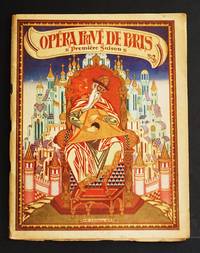
1929réf. 20354Paris: Opéra Privé de Paris 1929. Good/No Dust Jacket As Issued. RUSSIAN MODERNISM REBORN ON THE PARISIAN STAGE. A visually striking Première Saison program documenting the post-Diaghilev continuation of Russian operatic and theatrical culture in interwar Paris. Issued by the newly founded Opéra Privé de Paris in 1929 this richly illustrated production program for Rimsky-Korsakov's 'Tsar Saltan' preserves the artistic language of the Ballets Russes through tipped-in color costume and scenic designs after Ivan Bilibin and Alexandre Korovine. Founded immediately following the death of Sergei Diaghilev the Opéra Privé de Paris sought to sustain the creative energy of Russian émigré theater in Western Europe. This production united performers designers and musicians associated with the Russian diaspora transforming Pushkin's fairy-tale opera into a vivid expression of émigré modernism transplanted into the cultural life of Paris. PHYSICAL DESCRIPTION: Quarto format approximately 9.5 × 12.5 inches. Stapled illustrated wraps with full-color chromolithographic cover after Ivan Bilibin. Illustrated with six tipped-in color chromolithographs of costume designs after Bilibin executed from stage maquettes by Alexandre Korovine together with two additional tipped-in scenic plates and a tipped-in color portrait of Madame Maria Kousnezoff-Massenet by Nicolas Kousnezoff. Numerous illustrated period advertisements throughout including several full-page advertisements. CONDITION: One advertisement leaf detached but present. Plates remain vivid and visually strong with only light handling wear to the wraps. Staples sound. A well-preserved and unusually attractive example of interwar Parisian opera ephemera. Première Saison issue. Première Saison programs of the Opéra Privé de Paris survive in comparatively small numbers particularly examples retaining the full suite of tipped-in color plates after Ivan Bilibin. Comparable illustrated programs from this short-lived company appear only intermittently in the market especially in near-complete condition. HISTORICAL SIGNIFICANCE - The Opéra Privé de Paris was co-directed by the Russian soprano Maria Kousnezoff-Massenet and functioned as an important cultural bridge for displaced Russian artists after the Revolution. Though short-lived the company preserved important elements of Russian operatic staging and Ballets Russes visual identity during a transitional moment in European theater history. Ivan Bilibin's influence on Russian stage aesthetics remained profound well into the twentieth century and his designs for productions such as 'Tsar Saltan' helped define the visual mythology of Russian folklore on the international stage. This program captures a pivotal moment in the evolution of Russian theatrical modernism after the dissolution of the Ballets Russes. Following Diaghilev's death in 1929 Russian émigré artists in Paris sought new institutional forms through which to continue the aesthetic innovations that had transformed European stage culture during the previous two decades. The production of Rimsky-Korsakov's 'Tsar Saltan' adapted from Pushkin's fairy-tale poem provided an ideal vehicle for this visual and musical continuity. The decorative richness of Ivan Bilibin's folkloric imagery combined with the scenic interpretation of Alexandre Korovine preserves the highly ornamental stage language that became synonymous with Russian theatrical design in the early twentieth century. Beyond its theatrical importance the program also presents a vivid portrait of interwar Parisian cultural life. Its advertisements portraiture typography and chromolithographic inserts collectively illustrate the commercial and artistic environment surrounding Russian émigré performance culture in France between the wars. SUBJECTS: Ballets Russes Legacy Ivan Bilibin Stage Design Russian Émigré Art Paris Theater History Rimsky-Korsakov Tsar Saltan Interwar Opera Culture Russian Opera In Paris Chromolithographic Illustration Illustrated Performance Programs Opera Ephemera Theater History Russian Modernism Illustrated Programs. Opéra Privé de Paris unknown
réf. elala5277Toronto: March 31 1962. Toronto: March 31, 1962 unknown