Harrison, DavidMareMagnum

72 478 résultats
2009Appears unread. No marks or inscriptions. No creasing to covers or to spine. A very clean very tight copy with bright unmarked boards and no bumping to corners. 249pp. The first thorough study of medieval bridges which rewrites their history from early Anglo-Saxon England right up to the Industrial Revolution, providing new insights into many aspects of the subject.
1986No marks or inscriptions. A lovely clean very tight copy with bright unmarked boards and no bumping to corners. Dust jacket not price clipped or marked or torn or creased with minor traces of storage. 173pp. The evolution of the bridge over the centuries. With a wealth of examples and drawings and their associated social histories. The counties of Lancashire and Yorkshire are chosen because many of the country's most historic and attractive bridges are to be found there.
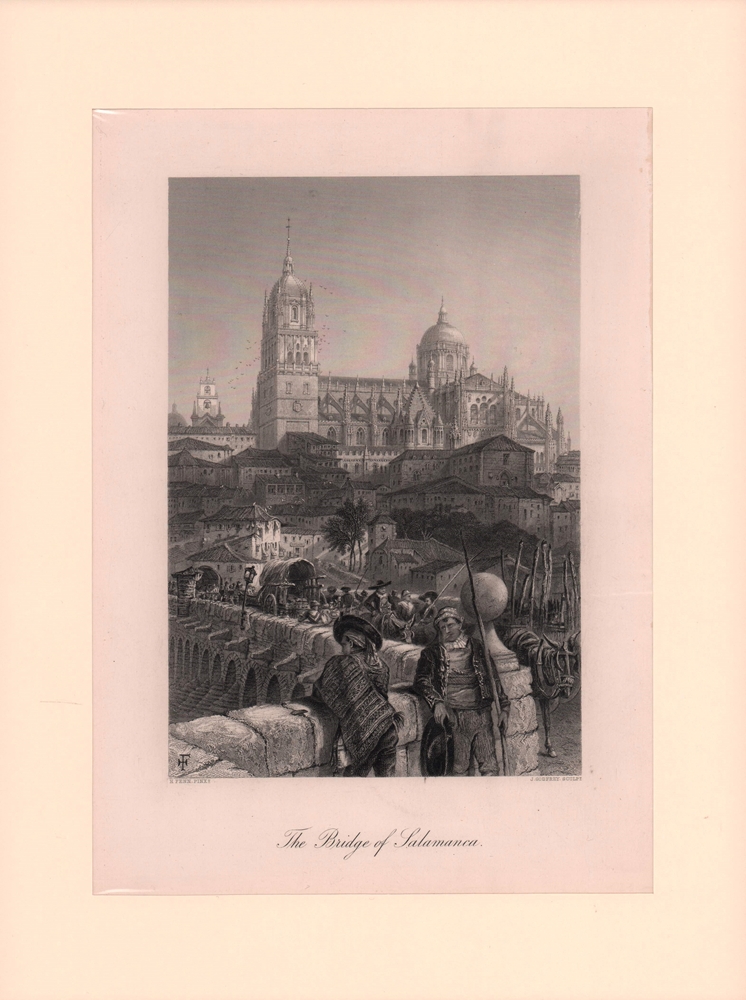
1870réf. 76897[ca. 1870]. Bildgröße 21 x 14,5 cm. Unter Feinkartonpassepartout.
1928réf. 011522-Opittsburg PA.: Cramer Printing & publishing 1928. Book. Illus. by Unknowen. Near Fine. Hardcover. 1st Edition. 1st. edition 1928 Black cloth hardcover with gilt letters on the front board 113 page book . Illustrated with black & white image of the bridges in the Pittsburgh area . A great research book on bridge architecture and history . A tipped on compliments card on the inside front board . Condition : Near Fine with edge rubs and small rip on first blank page tape repair . Size: 4to - over 9¾ - 12" tall. Cramer Printing & publishing Hardcover
1899réf. 16437Boston: Rogers & Manson. Good. 1899. First Edition. Hardcover. Bound in three-quarter leather and cloth. The front hinge has cracked but the intererior hinges are still firm. Bottom of the spine is chipped and the corners are rubbed. Contents "fine". ; Folio 13" - 23" tall; 258 pages . Rogers & Manson hardcover
1898réf. 16436Boston: Rogers & Manson. Very Good-. 1898. First Edition. Hardcover. Bound in three-quarter leather & cloth. The leather is rubbed at the corners & spine ends with cracking starting at the spine ends. Contents are "fine". ; Folio 13" - 23" tall; 261 pages . Rogers & Manson hardcover
1915réf. ARCH0333Boston: Rogers and Manson Co. Good with No dust jacket as issued. 1915. First Edition. Hardcover. Bound copy of most of the magazine's issues from 1915. Covers are worn spine and corners bumped some light dampstain. Some internal pages have small portions torn. Many pphotos and drawings. Included in this volume Volume XXIV : April 1915 Number 4 May 1915 Number 5 June 1915 Number 6 July1915 Number 7 August 1915 Number 8 September 1915 Number 9 October 1915 Number 10 November 1915 Number 11 December 1915 Number 12. The May issue has the first 8 pages missing the July issue has the first 7 pages missing. Very heavy oversize book. ; 4to 11" - 13" tall . Rogers and Manson Co. hardcover
1977192 pages including index. A unique how-to-build-it book full of imaginative ideas and practical projects in brick - from a beginner's barbecue to a summer house. Shows you how to mix mortar, build foundations, lay bricks, make walls, patios, pergolas, fireplaces, planters - exciting projects for indoors and out. Dust jacket in quite rough condition. Book
2002Large white quarto ; x, 257 p : illus, maps ; 29 cm Streets -- Design and construction -- Architecture --† Rues
1993Fine English Paperback. Pbo. Cr. 8vo. (20 x 14 cm). In English. [xvi], 182 p., b/w plts. The Bosphorus. Photos by Anthony E. Baker.
1894Issued by subscription. Twenty-three (of 25) original parts. [Lacks parts 1 & 25]. Folio. 310 x 415 mm. Forty pages in each part. Numerous photo illustrations. A very well preserved set. Books in parts are works which were published piecemeal (mainly in the 19th century) over a period of months or years. Each unit usually having a separate magazine-like cover. This method of publishing benefited the publisher as it was thought that the price of a weekly or monthly part at one shilling or a quarter was affordable to a wider readership than the price of pound sterling or $ 5.00 for a bound volume. Though this particular set was very costly at $ 1.00 for each part! Since they were meant to be bound by the purchaser, very few have survived into our present era. This set is extremely scarce in parts format. A wonderful artifact of the World's Columbian Exposition, Chicago: 1893. This edition apparently not in Arents (1957). RARE. **PRICE JUST REDUCED! PARTS 2
1925A clean, unmarked book with a tight binding. Edge wear to cover. Previous owner's name inside. Front hinge is a bit loose. Large format with many black and white photos and illustrations. A few color plates. Unpaginated. 10 3/4"w x 13 5/8"h.
1926Black quarto, green spine, 246 pages, b&w illustrations (some color), plans ; 25 cm. Architecture, Decoration and ornament -- Spain. || Scarce. || Architectural illus papers to inside of book.
1924Dark green folio, leather spine, unpaginated, approx. 150 p, chiefly b&w illustrations (some color) ; 35 cm. Architecture -- England -- History.
1923Dark green folio, leather spine, 150 p, chiefly b&w illustrations ; 35 cm. Architecture -- Periodicals.
1914réf. 1618DBLondon, Chatto & Windus, 1914. Gr.-8°. XIX, 76 (1) S. Mit 1 Frontispiz und zahlr. farb. Abb. Orig.-Leinenband mit Deckelvergoldung + Wichtig: Für unsere Kunden in der EU erfolgt der Versand alle 14 Tage verzollt ab Deutschland / Postbank-Konto in Deutschland vorhanden + (berieben und bestossen, Rücken verblichen).
1998New English Original bdg. Dust wrapper. Oblong large 8vo. (23 x 23 cm). In English. 64 p., 60 color plates. "This small mosque, which was completed in 1561 for Rüstem Pasa, a grand vizier of Süleyman the Magnificent, houses one of the richest collection of underglaze polychrome Iznik tile revetments in Istanbul. The revetment tiles in the Mosque of Rüstem Pasa are generally acknowledged as an outstanding example of the unique richness and superb artistic achievement characteristic of the era of Süleyman the Magnificent. Representing an ostentatious culmination of centuries of evolution in the art of ceramics and tiles, the Rüstem Pasa tile revetments also reflect the perfection of ceramic art at a particular stage of its development. Their lavish employment in this monument may show that Sinan, Sultan Süleyman's chief architect who built the mosque, had not yet decided how to use this new medium in architecture. In his other monuments, he appeared to use underglaze polychrome tiles more economically. The unusual number of motifs encountered in the mosque also points out that neither the decorators nor the architect had decided what designs to favor.".
1920413 p. + Color Frontis and numerous illustrations by R. L. Boyer and text drawings by Herbert Pullinger. Book plate of John W. Sparks on front paste down. 8vo. Original gilt decorated green cloth binding. PA 22
1973144 p. : illus. (some col.), plan ; 28 cm. Hardcover Very good condition good
1875580p. Ruled in black throughout. Inked ownership of Margaret Carey Worthington Bonner, Christ Church, Cooperstown, NY, Oct. 5, 1881. With love and best wishes from S. H. S. All edges gilt. 128 mm. Original black flexible leather binding embossed in blind. Yapp edges worn with loss. RELIGION BOX 10
1984448p. Hardcover Very good condition good
2000New New English Original bdg. HC. Oblong large 8vo. (23 x 21 cm). In English. 64 p., 25 color plates. "This small art book, after an introduction of the Royal Necropolis of Sidon, examines the faces and finally the lid of the Alexander Sarcophagus in detail. At the end of the book its decorative style and ornamentation is described. The Alexander Sarcophagus has been a major attraction of the Istanbul Archaeological Museum ever since it was founded in the late nineteenth century. Although named after Alexander the Great, the sarcophagus was not his, but was probably that of Abdalonymos, the last king of Sidon (Saida). Abdalonymos owed his throne to Alexander and the latter's close friend and general, Hephaistion. The subject matter of the reliefs decorating the sarcophagus suggests that Abdalonymos was here commemorating his benefactors; the sarcophagus thus takes its name, not from the ruler who commissioned it, but from its iconography.".
2000Scholar's name to ffep (E. Badian). Very light bump to bottom edge of rear board. Else fine. Light stains to front panel of DJ. Else very minor shelfwear to DJ. ; After an introduction of the Royal Necropolis of Sidon, examines the faces and finally the lid of the Alexander Sarcophagus in detail. At the end of the book its decorative style and ornamentation is described. The Alexander Sarcophagus has been a major attraction of the Istanbul Archaeological Museum ever since it was found in the late nineteenth century. Although named after Alexander the Great, the sarcophagus was not his, but was probably that of Abdalonymos, the last king of Sidon (Saida). Abdalonymos owed his throne to Alexander and the latter's close friend and general, Hephaistion. The subject matter of the reliefs decorating the sarcophagus suggests that Abdalonymos was here commemorating his benefactors; the sarcophagus thus takes its name, not from the ruler who commissioned it, but from its iconography; 64 pages
1939réf. 3982943Hodder & Stoughton 1939. This is an ex-library book and may have the usual library/used-book markings inside.This book has hardback covers. In good all round condition. Re-bound by library. Please note the Image in this listing is a stock photo and may not match the covers of the actual item1650grams ISBN: Hodder & Stoughton hardcover
1941réf. 0079861941. Hardcover. Very Good. Publisher: Crown Publishers 1941 V.Good HB 358 pp. prev. owner's name inside front cover. hardcover