LOUIS XV - ANTIN (Louis-Antoine de Pardaillan de Gondrin, duc d’) - [BÂTIMENTS ROYAUX].Livre Rare Book
1382 resultados
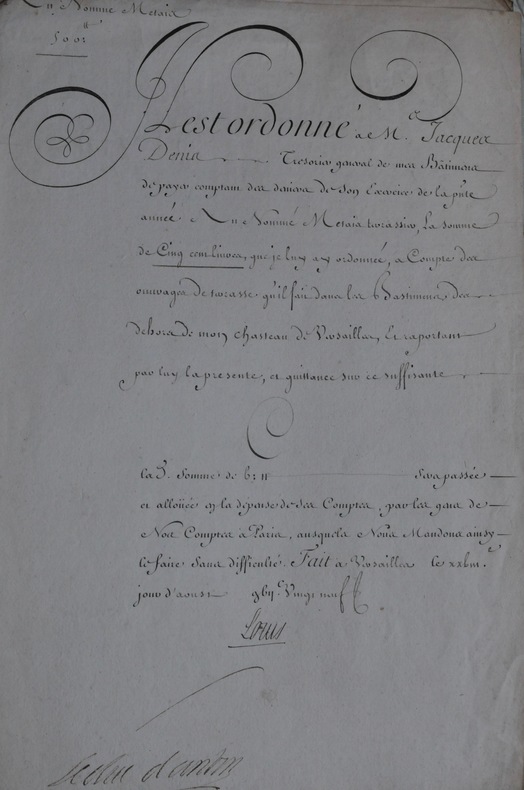
1729ref. 46405273, 1729-1733 ; 6 pp. sur 6 ff. in-folio, 6 pièces calligraphiées, signées par le roi et par le directeur des bâtiments royaux. 5 sont des ordres de payement pour des travaux effectués dans les châteaux et autres possessions royales à Versailles, Marly, Saint-Germain, Compiègne et Fontainebleau, le sixième concerne la passation de la charge de trésorier des bâtiments royaux de M. Denis, à M. Guenebault.1) du 28 août 1729. “Il est ordonné à M. Jacques Denis trésorier général des Bâtiments de payer comptant (...) au nommé Metaier terrassier, la somme de cinq cent livres (...) à compte des ouvrages de terrasse qu’il fait dans les bâtiments du dehors de mon château de Versailles...”2) du 10 oct. 1729. “Il est ordonné à M. Jacques Denis trésorier général des Bâtiments de payer comptant (...) au nommé Denibicq menuisier la somme de deux mille sept cent cinquante livres (...) réparations de menuiseries (...) de Marly qu’à celui de Saint-Germain...”3) du 2 nov. 1729. “Il est ordonné à M. Jacques Denis trésorier général des Bâtiments de payer comptant (...) à Michel Godard terrassier la somme quinze cent livres (...) à compte de labourer & défrichement de terres qu’il sait dans mes pépinières et avancées de mes maisons royales (...)”4) le 8 août 1730. “Il est ordonné à M. Jean-Baptiste Guenebault commis par arrêt de mon conseil pour achever l’exercice de feu M. Jacques Denis trésorier général de mes bâtiments de payer comptant des deniers de son exercice de l’année dernière aux arpenteurs et dessinateurs qui ont esté employés sous la conduite du Sr. Matis géographe et arpenteur de mesdits bâtim. à dessiner les nouvelles cartes de ma forest de Compiègne la somme de cinq cent dix livres (...) pour son payement de leurs journées et des menues dépenses à ce sujet (...)”5) le 20 mars 1731. “Il est ordonné à M. Jean-Baptiste Guenebault commis par arrêt de mon conseil (...) à Simon Couturier terrassier la somme de deux cent soixt huit livres six sols huit deniers (...) des ouvrages de convoy et terrasse (...) aux pièces d’eau et bassins du jardin de mon château de Fontainebleau (...)”6) du 6 mars 1733. “Il est ordonné à M. Jean-Baptiste Guenebault commis par arrêt de mon conseil (...) de remettre comptant des deniers de l’exercice 1729 à M. Jean-François Denis trésorier général de mes bâtiments la somme de seize mille trois cent livres restant en ses mains faisant partie de son dernier exercice 1729 (...)”
1880ref. 0267-05[ca. 1880]. [Album of views in Egypt]. 40 lose Orig.-Albumen-Photographien auf Kartons kasch. 21,5 x 27,5 cm. (Plattengr.). Ln.-Flügelmappe d. Zt. m. Deckelgoldprägung.
ref. 68080, Taschen, 1995 Limited Art Edition of 100 copies worldwide, clothbound in a clamshell box, SIGNED by Richard Meier in 1996, accompanied by a silk-screen print. Hardcover in clamshell box, 22.5 x 30 cm, 1.91 kg, 176 pages, Multilingual (English, French, German).
Very Good Turkish, Ottoman (1500-1928) Original manuscript autograph handwritten document sealed 'Hüsrev Mehmed' sent to (and responded by) Serkâtib Mustafa. Written in special paper with 'ahar'. 39x21 cm. In Ottoman script. Slightly tear on folded place and slightly stains. Otherwise a very good manuscript paper. The document was written in accordance with the Ottoman state correspondence tradition prior to modernization. However, it is an indication of modernization that it is written to the serkâtib of Humâyûn (head clerk of the Ottoman / Turkish court) and not to the Sultan directly. The importance of this document is that it has many hints of modernization movements of the last period of Empire, depiction of the division of the first modern Ottoman army (Asakir-i Mansure-i Muhammediye) that's before one year of Egyptian Campaign by Koca Husrev Pasha and before eight years of proclamation of Reform (Tanzimat) and after only 22 years of Turkish Magna Carta (Sened-i Ittifak). Husrev Pasha was 'serasker' (commandant and head) of Assakir-i Mansure-i Muhammediye Army in that year. Husrev's text starts as 'Devletlü, inayetlü, atufetlü, oglum.." in 'Elqab'. In the Ottoman diplomacy, first person who used 'oglum' [i.e. my son] in elqab of the documents was Koca Hüsrev Pasha. (Source: Osmanli Arsiv Belgeleri, Orhan Sakin). Koca Hüsrev Pasha (Khosrew Pasha) was an Ottoman Kapudan Pasha ("Grand Admiral") of the Ottoman Navy and statesman who reached the position of Grand Vizier rather late in his career, between 2 July 1839 and 8 June 1840 in the reign of Abdülmecid I. However, during the 1820s, he occupied key administrative roles in the fight against regional warlords, the reformation of the army, and the reformation of Turkish attire. In 1801, Hüsrev Pasha commanded the 6,000 Ottoman troops who assisted the British in removing the French from Rashid (Rosetta). For this, he was made governor of Egypt Eyalet (province), in which position he was charged with assisting Hüseyin Pasha in the killing or imprisoning the surviving leaders of the Mamluks. Many of these were freed by or fled with the British, while others held Minia between Upper and Lower Egypt. [.] He was later made governor again by Muhammad Ali for 2 days [.] After Diyarbekir and Salonica, in 1806 he was governor of Bosnia Eyalet, before being reappointed as governor of Salonica in 1808. Hüsrev Pasha held the rank of Kapudan Pasha of the Ottoman Navy from 1811 to 1818. He was then appointed governor of the Eyalet of Trabzon twice, during which time he conducted for the Black Sea region of Turkey the struggle the central Ottoman state was waging against local feudal rulers (Derebeys). During the Greek War of Independence, he was appointed Kapudan Pasha again in the end of 1822. In 1826, Husrev Pasha played vital roles both in the Auspicious Incident (the annihilation of the Janissary Corps in 1826) and in the formation of the new "Mansure Army" modeled after those of European Powers. Appointed as seraskier (commander the army) of the Mansure in May 1827, Husrev reformed and disciplined the corps. Himself ignorant of modern military methods, he assembled a staff of foreign experts and other personnel to assist him, the "Seraskeriye", which constituted the first staff in Ottoman history. Due to his early championing of military reform and virtual control over the new Ottoman army, Husrev was able to install many of his protégés in senior military positions. Husrev Pasha was also instrumental for the near-abandonment of the turban and the adoption of the fez as a universal headgear for Muslim men of the Ottoman Empire (excluding the religious classes) under Sultan Mahmud II. (Wikipedia). Möltke talks about him in famous book includes his personal letters as 'he is more powerful than sultan'. Following the suppression of the Janissaries in 1826, Sultan Mahmud II transferred the functions of the old Agha of the Janissaries to the seraskier.
In-folio, 57 ll., 1bl.; engraved title and 51 full-page engraved plates, giving geodetic and cosmographic instruments and measurements; woodcut ornate initials and tailpieces, large Aldus anchor woodcut device at the end. Bound in contemporary cartonnage (reliure d'attente), with weak hinges; occasional light foxing, light dampstain at the bottom of the last leaves. Despite the title the work includes 50 full-page engravings, of which the last 7 are a supplement by Scala and are especially devoted to architecture and perspective.
1673ref. 116729Coignard 1673 in-folio A Paris, Chez Jean-Baptiste Coignard, 1673, in-folio à grandes marges de 285x420 mm environ, (2) ff., 1 frontispice, page de titre, (8) ff. (Epistre, Préface), 325 pages, (7) ff. (Table), (1) f. (Privilège), (3) ff. Pleine reliure granitée d'époque, dos à 6 nerfs, titres dorés, caissons ornés, roulette dorée sur les coupes, tranches mouchetées. Reliure restaurée, ors passés, restauration de la page de titre, importantes traces de mouillures marginales sur les 4 feuillets liminaires puis petites auréoles marginales et éparses au long du volume, légères déchirures sans atteinte au texte sur 2 feuillets, pagination fantaisiste à partir de la page 238 (sans manque). Bel exemplaire malgré les défauts signalés, intérieur très frais.
200,00

