2158 resultados
2014ref. __1405774045LexisNexis 2014. Paperback. New. 656 pages. 9.69x5.98x1.50 inches. LexisNexis paperback
1933ref. 016313Paris Vincent Fréal 1933 In-4 En feuilles, portfolio éditeur
ref. SONG1873936478Used: Good unknown
1928ref. 0006338Stuttgart: Verlag Wedekind & Co. 1928. First edition. Hardcover. Good. Tall quarto 196 pages clothbacked boards numbered paper sticker on front free endpaper pictorial top cover stained. Very Rare - Worldcat lists only one copy in the U.S.A. This work focusses on new design work in Germany Austria Switzerland Belgium and Holland in 1927 which arose from the "Die Wohnung" exhibition which promoted new materials and new construction methods. This is the book that demonstrates and describes the new construction methods and techniques for the innovative designs. All of it influenced by the Bauhaus. Laid in is a Typed Letter Signed - apparently by Feifel - on Albert Feifel Architekt letterhead and dated 11 March 1928. Verlag Wedekind & Co. hardcover
2013New Turkish Original illustrated bdg. HC. 4to. (32 x 23 cm). In Turkish. 3 volumes set: (440 p., 1 folded color panorama of Istanbul; 442-875, [5] pp., 1 folded color panorama of Istanbul, 877-1289, [8] pp., 1 folded color panorama of Istanbul, b/w and color plates and photos. 20. Yüzyil'dan 21. Yüzyil'a Necip Bey Haritalari'ndan günümüze öncesi ve sonrasi Istanbul. 3 volumes set. [In special box]. First and Only Edition. Best and only reference on Nedjib [Necip] Bey maps.
ref. DADAX0419233008New unknown
ref. DADAX0419190201New unknown
2000ref. 2091502135420364Toshiro Yanabe 2000. Soft Cover. Fine. Number of books: 1 Toshiro Yanabe paperback
1913Fine Turkish, Ottoman (1500-1928) Original wrappers. Cr. 8vo. (20 x 14 cm). In Ottoman script (Old Turkish with Arabic letters). 120 p., ills. and many plans, one folded map (50x67 cm) of the Galata quarter surrounded by the Bosphorus and the Golden Horn of Constantinople, including Genoese and Byzantine architectural buildings. First edition of this rare and the early book on old Genoese and Byzantine buildings in the Galata quarter of Constantinople, written by Turkish art historian Celal Esat Arseven (1876-1972). The Galata quarter first appeared in Late Antiquity as Sykai or Syca. By the time the Notitia Urbis Constantinopolitanae has compiled in ca. 425 AD, it had become an integral part of the city as its 13th region. According to the Notitia, it featured public baths and a forum built by Emperor Honorius, a theatre, a portico street, and 435 mansions. It is also probable that the settlement was enclosed by walls in the 5th century. In the 11th century, the quarter housed the city's Jewish community, which numbered some 2,500 people. In 1171, a new Genoese settlement in the area was attacked and nearly destroyed. In 1233, during the subsequent Latin Empire (1204-1261), a small Catholic chapel dedicated to St. Paul was built in place of a 6th-century Byzantine church in Galata. This chapel was significantly expanded in 1325 by the Dominican friars, who officially renamed it the Church of San Domenico, but local residents continued to use the original denomination San Paolo. In 1407, Pope Gregory XII, in order to ensure the maintenance of the church, conceded indulgences to the visitors of the Monastery of San Paolo in Galata. The building is known today as the Arap Camii (Arab Mosque) as per its conversion into a mosque a few years later (between 1475 and 1478) under the rule of Ottoman Sultan Mehmed II with the name Galata Camii. In 1261, the quarter was retaken by the Byzantines, but Emperor Michael VIII Palaiologos granted it to the Genoese in 1267 in accordance with the Treaty of Nymphaeum. This rare book includes the history and the plans of the buildings such as the Arap Mosque (Church of San Domenico) (1325), Galata Tower (1348), Church of Saint Benoit (1427), Zülfaris Synagogue (1823), Church of Saints Peter and Paul (1843), Camondo Steps (1880), St. George's Austrian High School (1882), Ashkenazi Synagogue (1900), Italian Synagogue (1931), Neve Shalom Synagogue, etc. ABOUT THE AUTHOR: Celal Esat Arseven was a Turkish art professor and historian. Born the son of a pasha in Istanbul, Celal Esat Arseven graduated from Besiktas Military School in 1888 and studied drawing at a fine arts school for a year before going to military college. He continued writing and painting while in the army, from which he resigned in 1908. In the years before World War I, he worked at the humor magazine Kalem with Cemil Cem, one of the great early caricaturists of Turkey. Arseven was a writer and artist of diverse talents. In 1918, he wrote a libretto for one of the first Turkish operas and went on to write several musical plays performed at the Istanbul municipal and state theaters. In addition to being an accomplished watercolorist, he was also a professor of architecture and municipal planning at the Istanbul Fine Arts Academy from 1924 to 1941. He published a five-volume art encyclopedia between 1943 and 1954, and many books on Turkish painting and architecture throughout his lifetime. Before his death, he was awarded a doctoral degree by Istanbul University. He was also a delegate to the Turkish Grand National Assembly during its seventh and eighth sessions. (Sources: And, Metin. "Opera and Ballet in Modern Turkey." In The Transformation of Turkish Culture: The Atatürk Legacy, edited by Günsel Renda and C. Max Kortepeter. Princeton, NJ: Kingston Press, 1986). Özege 5112.; TBTK 4748.
ref. DADAX0081014880New unknown
1965ref. ZB394226National Council for Historic Sites and Buildings 1965-1995. volumes 17-47 all complete volumes lacking volume 38; partly bound library markings textually clean & tight price is for the set. - If you are reading this this item is actually physically in our stock and ready for shipment once ordered. We are not bookjackers. Buyer is responsible for any additional duties taxes or fees required by recipient's country. Photos available upon request. National Council for Historic Sites and Buildings unknown
2004ref. 2091502135420381Akenomura Yamanashi Prefecture Kinzo Yatsushiro 2004. Soft Cover. Fine. Number of books: 1 (Akenomura, Yamanashi Prefecture) Kinzo Yatsushiro paperback
2004ref. 2091502135300794Osaki hachimangu 2004. Soft Cover. Fine. Number of books: 2 Osaki hachimangu paperback
2011New English In original bdg. In publisher's special slip-case. Books are designed as a folder. 2 volumes set: [26], 86, [2], 286, [2], 180, [2], 20 p.; [4], 300, [2], 42, [2], 16, [2], 30 p. Vol. 1: Includes 43 white marbles, 149 beige marbles, 90 color marbles, 10 onyxes with their color catalogue illustrations and informations of locations in Turkey, Anatolia. Vol 2: Includes 150 travertines, 21 limestones, 8 granites, 15 other natural stones with their color catalogue illustrations and informations of locations in Turkey, Anatolia. Color ills. (Color catalogue). A very heavy volumes as set.
1982Text is in Japanese. 236 pages with a great many, often several per page, b&w photos taken in Japan very soon after the A-bomb explosions, both of survivors and their injuries and structural damage of all kinds, including close-ups of beams, trees, bridges, railroad tracks, etc. with maps specifying location of the adjacent photos. Many burn victims, many of which are children. Includes worn, folded and torn (1/2 page) 4-page fold-out photo of ground zero and surrounding city to mountains in the distance: totally decimated, a landscape of scorched rubble. Ex-library book with usual marks, stamps, etc. Library binding is solid with bent corners and text/interior is marked on a few pages with script in Japanese -- otherwise clean . A rare historical document. Publication information requires translation.
ref. De Long, David G. and PeaIn Pristine Condition. unknown
ref. DADAX0715308114New unknown
ref. DADAX143980480XNew unknown
ref. DADAX1439850895New unknown
1749ref. 814481749 A Paris, au Palais, chez Joseph Saugrain, au sixième pilier de la Grande Salle, vis-à-vis de l'Escalier de la Cour des Aydes, à la Bonne-Foi couronnée - M. DCC. XLIX. (1749) - 2 vol in-4 ( 25,9 x 21 cm), plein veau marbré du temps, 5 nerfs, caissons dorés et ornés, tomaison en doré dans caisson, pièce de titre rouge; tranches rouges - 1004 pp. + 992 pp. - Très nombreuses gravures en taille douce in et hors texte
1925126 marvelous black and white photographic plates. Map endpapers. Occasional traces of foxing. Light wear to unmarked book. Somewhat above-average wear to dust jacket which is now preserved in archival-grade Brodart. Nice copy of this wonderful compilation. Book
1972142 pages plus 40 pages of full-page black and white illustrations. Index. Reprint of the 1892 first edition. "Intended to 1) Place on record a full and connected description of the Sanchi memorials; and to show their connection with religious systems antecedent to what is now called Buddhism. 2) To give accurate illustrations, from the author's hand-drawn originals, of the Sanchi buildings, and sculptures 3) To invite attention to the evidence, which the Sanchi remains supply, that the Buddhism of Sakya - which is usually attributed to the sixth century B.C. - was introduced, as a reform of the pre-existing semi-Mithraic faith, about the commencement of the Christian era; that is, shortly before the time when the gateway sculptures of Sanchi were executed." - from Preface. Heavy external wear. Usual library markings. A worthy reading copy. Book
ref. DADAX0847804984New unknown
1912Very Good Turkish, Ottoman (1500-1928) A very attractive chromo-lithograph map on paper. Oblong: 26,5x37,5 cm. In Ottoman script (Old Turkish with Arabic letters). Light foxing and fading on margins and printed area. A very detailed and fine double hemisphere map of the northern and southern skies, showing the various constellations, together with a third map showing the zodiacs on one paper. On the bottom margin, it's written 'Printed in the 549 Numbered Press', and 'Dersaadet...'. This map seems to be influenced (or, a direct translation) from the map of the sky of Sir Francis Baily, (1774-1844), who was one of the leading English Astronomers of the first part of the 19th Century. He is most famous for his observations of "Baily's beads" during a total eclipse of the Sun. Baily was also a major figure in the early history of the Royal Astronomical Society, as one of the founders and as the president four times. After a tour in the unsettled parts of North America in 1796-1797, his journal of which was edited by Augustus de Morgan in 1856, he entered the London Stock Exchange in 1799. The successive publication of Tables for the Purchasing and Renewing of Leases (1802), of The Doctrine of Interest and Annuities (1808), and The Doctrine of Life-Annuities and Assurances (1810), earned him a high reputation as a writer on life-contingencies; he amassed a fortune through diligence and integrity and retired from business in 1825, to devote himself wholly to astronomy. He had already, in 1820, taking a leading part in the foundation of the Royal Astronomical Society. In 1827, the Society awarded him its Gold Medal for preparation of the Astronomical Society's Catalogue of 2881 stars. He was instrumental in the reform of the Nautical Almanac in 1829. In 1837, he recommended to the British Association and later worked extensively on the reduction of Joseph de Lalande's and Nicolas de Lacaille's catalogues containing about 57,000 stars. He also supervised the compilation of the British Association's Catalogue of 8377 stars (published 1845) and revised the catalogues of Tobias Mayer, Ptolemy, Ulugh Beg, Tycho Brahe, Edmund Halley and Hevelius. His notice of Baily's Beads, during an annular eclipse of the sun on May 15 1836, at Inch Bonney in Roxburghshire, started the modern series of eclipse-expeditions. Very rare.
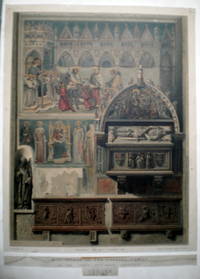
ref. biblio87First edition Wraps Arundel society London 1872 Herr Gnauth Good No dust jacket as issued large folio 510x645 cm 6 p 1 Chromolithography mounted on board Original printed wraps with tears repaired rebacked leaves very fragile torns along the edges not affecting the text repaired uncut margins soiled Very rare edition of this monograph by Ruskin still well preserved considering the size and fragility of the paper acidity Contains the chromolithograph missing in the 2 copies of the Ruskin Library mounted on board paperback