[Columbian Exposition]Biblio.com

9 336 résultats
1893réf. 20828Chicago 1893. Very good condition. Genuine Oil Painting executed at the Fair in less than three minutes by our celebrated Lightning Artist in the same manner in which he paints them on our machines". Signed advertising trade card with real landscape oil painting laid down on front and at verso wood engraving of the Walter A. Wood steel wheel binding harvester with steel bundle carrier in use harvesting a field of wheat. The verso with signed inscription from Walter A Wood above the wood engraving and the date in pencil below "Hoosick Falls June 14 1910". Trade card most likely made for the World's Columbian Exposition of 1893 held in Chicago to commemorate the 400th anniversary of Columbus's landing in the New World. The oil painting 6 3/4 x 4 1/2" laid down on card stock 9 x 7 unknown
réf. B257537-2Buffalo New York David Gray 1901. 96pp. 1 folding colored plan. Text illus. 4to. Orig. wraps. disbound. Buffalo, New York (David Gray), 1901. paperback
1972réf. 1371048Beijing China: Wenwu Press 1972. Hardcover. Large quarto 152 pages. In Very Good condition in plastic sleeve as issued and Good plus slip case. Oatmeal spine with red and black lettering. Slip case is light brown with black lettering. Slip case shows Light age toning and Light shelf wear overall with dents to spine head and tail and bookseller stamp to lower corner. Profusely illustrated with color and black-and-white photographs. Text in Chinese with fifteen-page descriptive insert. SH Consignment. Shelved Room A. 1371048. Special Collections. Wenwu Press hardcover
réf. B9781164799450New. unknown
réf. B9781164580898New. unknown
réf. B9781166627461New. unknown
réf. B9781168433367New. unknown
1858réf. 27950London 1858. First printing. Ephemera. Very good overall. Handbill advertising the opening of the London Crystal Palace on December 1 1858 soliciting "Applications for the remaining Space are requested to be made forthwith." The handbill touts the fair is "the largest number of First-class Exhibitors of any Building in Europe. THE PHOTOGRAPHIC ESTABLISHMENT IS THE FINEST IN LONDON." For the Sale of all kinds of Useful and Fancy Articles." 5 1/2 x 8 5/8" black type on cream paper verso has ad for Slate Billiard Tables by Messrs. Thurston & Co. Right edge slt. chipped. unknown
1867réf. 27354London: Illustrated London News 1867. First printing. Print. Very good overall. A panoramic view of Paris centered on the oval building of the International Exposition of 1867 held there from April 1st to November 3rd. After the resounding success of Britain's Great Exhibition of 1851 and the comparative failure of the 1862 London International Exhibition Napoleon decided to surpass their ancient rival. The result was that seven million people came to see the Paris International Exhibition of 1867. Large woodcut panorama "Supplement to the Illustrated London News July 6 1867." 16 3/4 x 47 1/4". Backed on archival tissue repairing some minor marginal tears. Period folds flattened. Illustrated London News unknown
1889réf. 206601889. Very good condition. An original pen and ink drawing showing Sir Edgar Boehm's 1834 - 1890 statue 'Young Bull and Herdsman' on a large plinth at the foot of the grand staircase at the Melbourne Centennial Exhibition of 1888. A stylishly-dressed Victorian crowd of exhibition viewers strolls about the great hall with the statue on a large plinth highlighted with white accents. With the title penned below the image. Sir Joseph Edgar Boehm 1834 - 1890 is recognized for his colossal statues including one of Queen Victoria executed in marble 1869 for Windsor Castle the monument of the duke of Kent in St. George's Chapel the statue of Carlyle on the Thames embankment at Chelsea and the equestrian statue of the Duke of Wellington at Hyde Park Corner. Boehm is also listed as a British exhibitor in the Reports of the United States Commissioners to the Centennial International Exhibition at Melbourne 1888 p111. The Young Bull and Herdsman was acquired by the Melbourne Art Gallery and Museum and was then gifted to the Royal Agricultural Society of Victoria where it is today outside the RASV offices in the show grounds. Unsigned with a small circular mark roughly at center of drawing and a closed tear through the caption but not affecting the drawing; mounted on an album page. 9 3/4 x 8 1/2" unknown
1993réf. 040258-53Wiley-Academy 1993. Soft cover. Fine/No Jacket. Wiley-Academy paperback
1956réf. BIBLIO-29813first edition 1956No publisher stated Oxford first edition 1956. Printed wrappers small 4to 22cm. 12 pp. 87 items. Catalogue of a hoax Ibsen exhbition mounted in 1956 by some exuberant Oxford undergraduates. According to a small press cutting laid in the exhibition attracted over 100 visitors and featured "a discussion of Ibsen by four experts tape recorded along with guttural sounds recognized as belonging to Ibsen's voice.". Wrappers a little duststained small mark to front inside wrapper otherwise Good. Laid in is an interesting 4 pp manuscript letter dated 26th March 1957 from one of the exhibition organizers Robert Nelson of Ruthven Coldstream Berwickshire to the distinguished collector of literary forgeries Stuart B. Schimmel sending the catalogue and discussing the success of the hoax. , , [first edition, 1956No publisher stated, Oxford, first edition, 1956 unknown
2004réf. 017591New York & London: Abbeville Press 2004. Hardcover. Near Fine/Very Good. Inscribed by Ellis on half title page DJ spine lightly sun-faded with one closed tear book is very clean bright and tight. Abbeville Press hardcover
1905réf. BIBLIO-22099No publisher stated revised and corrected edition 1905. Cloth gilt cover title 4to 27 cm. viii 203 pp 16 leaves of plates. From the introduction: "The Church History Exhibition held at St. Albans was intended to illustrate the History of the Church of England before and since the Reformation from the earliest times to the present day. With this object in view the Committee set themselves to gather together a selection of manuscripts books charters plans proclamations Acts of Parliament portraits views church-furniture vestments ornaments and plate and the result of their labours was an exhibition of great interest and of much educational value. Among the earlier exhibits may be mentioned the plan of the 4th Century Church at Silchester Hants the 8th or 9th Century Book of the Gospels from Hereford the 10th Century MS. of Bede on the Apocalypse from Lambeth William the Conqueror's Charter to Ramsey Abbey 12th Century Paten and Episcopal Ornaments from Chichester the Bishop of Truro's Mass-book of the 12th and 15th Centuries partly of the York Use the great MS. Bible written and illustrated at Winchester in the 12th Century the Hereford Breviary of the I3th Century the Sarum Breviary of the 14th Century from Lambeth Mr. Huth's MS. Missal of the 14th or 15th Century portions of a 14th Century Cope from Steeple Aston some 15th Century Panels of Alabaster MSS. of a Portiforium an Antiphonar a Grail a Processional and a Book of Hours - all of the 15th Century and all according to the use of Sarum - a MS. York Missal an Obituary Roll of an Abbot in Norfolk about 1450 a Herse Cloth or Funeral Pall 15th Century a sumptuously bound and illuminated Indenture dated 1504 concerning the Obit. of King Henry VII. in the Lady Chapel at Westminster a Pyx Cloth from Suffolk and the Dunstable Herse cloth. The Collection of Church Plate which was one of the features of the Exhibition included some earlv examples of Chalices and Patens found in the graves of Bishops and Clergy in various parts of England. It is not possible to call particular attention to any of the very large number of printed books which were exhibited but the cases full of Service books Primers &c were deeply interesting and Lord Crawford's collection of Proclamations and a collection of all the most important Acts of Parliament bearing on the Reformation added much to the educational value of the Exhibition. The wonderful series of Prayer Books from Edward VI. to Edward VII. and the collection of various translations of the Bible into English are catalogued apart from other MSS. and printed books." The section on bibles items 563-597 on pages 146-158 is entirely devoted to pre-1700 Bibles including one later facsimile with notes providing brief descriptions and putting each Bible in context. Covers rubbed edges of boards and spine darkened contents Good. No publisher stated, revised and corrected edition, 1905 hardcover
1857réf. 3220484Small folio; pp. 4 vii i 3-300 4 'Index' with two chromolithographic frontispieces showing the exterior and interior of the exhibition building bound within the preliminaries; numerous wood-engraved illustrations throughout the text; a little browned and spotted in places; in the original publisher's red cloth ornamented and lettered in gilt blind-stamped fleurons in the corners; hinges repaired and overall a good copy. 1857 was a turning-point in the history of art appreciation. The exhibition with its 16000 items on display made the public aware of the fabulous wealth of pictures by old masters and objects of art of every kind hidden away in English country houses and at the same time it opened up a new period of art-historical studies. The preface is at pains to extol the education value of the exhibition and to make known to the people of England the art-wealth of their own country and by inducing a greater familiarity with the beautiful to increase and extend its refining influence. gThe Art-Treasures Examinerg contains a series of articles probably under the editorship of the journalist William Blanchard Jerrold who contributed articles on various subjects. Other contributors included Henry Ottley on art criticism schools of painting and engraving; the poet Charles Swain contributing short plays on art; James Astbury Hammersley on watercolour art; George Jackson on photography; Charles Allen Duval on the spirituality of art; G.W. Anthony 'Peregrine Sketchly' on British landscapes and modern painting; a 'History of Caricature' by the radical Dr Robert Blakey and possibly as the most interesting contribution a series of fourteen autobiographical articles by Henry Merritt 1822–1877 the picture conservator and art critic who had risen from a very poor background: 'Where my shoes came from was never satisfactorily explained'. British landscape painters and the modern gallery by gBritish Art and Artistsg; a gHistory of Caricatureg by the radical Dr Robert Blakey gModern Galleryg by G.W. Anthony and possibly as the most interesting contribution a series of fourteen autobiographical articles by Henry Merritt 1822–1877 the picture conservator and art critic who had risen from a very poor background: 'Where my shoes came from was never satisfactorily explained'. Manchester, Alexander Ireland & Co., 22, Market Street, … W. H. Smith & Son, 186, Strand, London,
1851réf. 3220148Lithograph strip panorama consisting of four sheets conjoined measuring 12 x 230 cm overall some light dust-soiling in places; folding into publisher's original boards the upper cover with an illustration of a showman in military attire drumming up an audience for a show consisting of a Punch and Judy-style booth with what appear curiously to be marionettes rather than glove-puppets dancing on the stage spine expertly repaired covers slightly marked but nevertheless still a good example. Rare panorama consisting of 75 captioned vignettes of the people of many nationalities idly wasting time or misbehaving themselves in mostly harmless ways: "A Highland Gentleman practising the Art of Boozing" "John Bull sleeping on the National Debt" "A Hindoo Gentleman enjoying Hookah" "Young Irish Lady doing penance by walking on sharp stones round a well" "A New Zealand Chief polishing the skull of one of his enemies" and so on. It concludes with 'A French Patriot playing Battledoor i.e. battledore & Shuttlecock' the character hitting two crowns and a bonnet-rouge into the air. Although unsigned the artist for the work is clearly Benjamin Clayton 1809-1883 what little we know of him comes mainly from his daughter the writer and artist Ellen Creathorne 1834-1900. Benjamin was born in Dublin but moved his family to London in 1841 hoping to be a history painter however his gifts lay instead with illustration firstly producing his own periodicals gChatg and gPunchinello. A journal of wit wisdom and romanceg but later having to work for other publishers first with Ackermann & Co. and later for Dean and Son. The publisher George Mann at 39 Cornhill together with Dean & Son issued several panoramas at the time of the Great Exhibition the partnership ending with Mann's death in 1852. Dean & Son, Printers. [Published by] G. Mann, Cornhill [London].
réf. B254468-1Philadelphia/Chicago International Publishing Company 1893. 640pp. Prof. illus. 4to. Orig. full embossed leather disbound; head of spine damaged. A.e.g. Philadelphia/Chicago (International Publishing Company), 1893. hardcover
1997réf. mon0003215565Museu d'art contemporani d'Eivis 1997T. hardcover. Good. . Museu d'art contemporani d'Eivis hardcover
1854réf. BB120CRYSTAL PALACE aka GREAT EXHIBITION Descriptions of the Egyptian Court erected in the Crystal Palace by Owen Jones and Joseph Bonomi with an historical notice of the monuments of Egypt by Samuel Sharpe 71pp The Greek Court. 113pp An Apology for the Colouring of the Greek Court 56pp The Roman Court ii 86pp The Alhambra Court 119pp The Nineveh Court 80pp The Byzantine and Romanesque Court 116pp The Mediæval Court 123pp The Renaissance Court 108pp The Italian Court 91pp The Pompeian Court 73pp Guide to the Crystal Palace and Park by Samuel Phillips 193pp. London: Bradbury & Evans 1854 the last volume 1856. TWELVE volumes bound as three each of the dozen titles with a colored pictorial printed front wrapper folding frontispiece and profusely illustrated including additional folding plates. 8vo 3/4 leather scuffed marbled boards exterior worn internally near-fine. Individually issued as part of the Crystal Palace Library series rarely does one find such a large collection of these small titles bound together detailing the specific contents of each division. The Crystal Palace was a cast iron and plate glass structure originally built in Hyde Park London to house the Great Exhibition of 1851. After the exhibition the Palace was relocated to an area of South London known as Penge Place which had been excised from Penge Common. It was rebuilt at the top of Penge Peak next to Sydenham Hill an affluent suburb of large villas. It stood there from June 1854 until its destruction by fire in November 1936. The nearby residential area was renamed Crystal Palace after the landmark. The park still contains Benjamin Waterhouse Hawkins's Crystal Palace Dinosaurs which date back to 1854. Bradbury & Evans hardcover
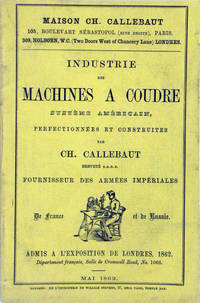
1862réf. 100967AParis & London Mai 1862. 8vo. 182 x 120 cm. 31 pp. Illustrated with woodcuts including 2 full-page. Published for the London World Fair 1862 with map of the exibition halls on the inside front cover. The "Expositions Universelles" or World Fairs were intended to show the latest innovations and inventions. The earliest of these fairs were held in France but were national. The first one of 1798 was the start of eleven national fairs. Sewing machines were invented during the first Industrial Revolution to decrease the amount of manual sewing work performed in clothing companies. Callebaut shows different models and explains the technqiue of them. Both full page illustrations of the factory show us what factories looked like at the time. At the 1862 exhibition about 50 types of sewing machine were on show on over 20 stands. M. Callebaut from Paris showed 'several modifications of shuttle sewing machines of the Singer type.' Callebaut was the Singer licencee in France the only occasion on which the Singer Co granted a licence rather than manufacturing itself. Callebaut patented these modifications in France and Britain in his own name. Most of them apply to the Singer No. 2 machine and enabled it to have a reversible wheel feed for finishing seams and to produce a 'herring-bone stitch' zigzag by moving the top feed presser foot from side to side. Another machine had twin needles on the same needle bar for making two lines of stitches on the top side and a zigzag on the underneath with a single shuttle thread. Not content with all these variants M Callebaut exhibited some glove making machines of fearsome complexity using detached lengths of thread!
1851réf. 3220040Engraved panoramic view measuring 460×235mm overall image 415×145 mm. Steel-engraved panoramic view published by Boyd & Cannavan London Wall & J. H. Woodley in the City. Text beneath the image provides statistics for the building such as length 1848 feet and cost for use & maintenance £79800. the commity decided to add three feet of steps at on end to make the leanght up to a more satisfying 1851 feet Boyd & Cannavan
1900réf. 23220Paris & Pise: Antonin L. Neurdein and Étienne Neurdein 1900. A good large-sized image of some of the buildings of this expo along the river with tour boats in the foreground and crowds of visitors along the opposite avenue; albumen process photograph mounted on pale ivory gilt-edged cardstock; with the studio stamp of N.D. Phot. at lower right margin Antonin L. Neurdein and Étienne Neurdein; photo is approx. 10 1/2" x 17" size the mount makes it 12 1/2" x 18 3/4" overall; light edge tips wear to the cardstock one corners' surface scraped away; image a bit faded still good; an interesting original Paris Exposition and photographic history photograph. Photograph. Not Bound. Very Good. Antonin L. Neurdein and Étienne Neurdein Paperback
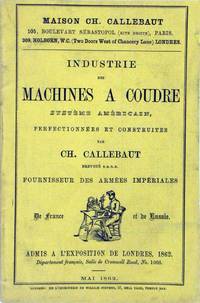
1862réf. 1009671862. Paris & London Mai 1862. 8vo. 182 x 120 cm. 31 pp. Illustrated with woodcuts including 2 full-page. Published for the London World Fair 1862 with map of the exibition halls on the inside front cover. The "Expositions Universelles" or World Fairs were intended to show the latest innovations and inventions. The earliest of these fairs were held in France but were national. The first one of 1798 was the start of eleven national fairs. Sewing machines were invented during the first Industrial Revolution to decrease the amount of manual sewing work performed in clothing companies. Callebaut shows different models and explains the technqiue of them. Both full page illustrations of the factory show us what factories looked like at the time. At the 1862 exhibition about 50 types of sewing machine were on show on over 20 stands. M. Callebaut from Paris showed 'several modifications of shuttle sewing machines of the Singer type.' Callebaut was the Singer licencee in France the only occasion on which the Singer Co granted a licence rather than manufacturing itself. Callebaut patented these modifications in France and Britain in his own name. Most of them apply to the Singer No. 2 machine and enabled it to have a reversible wheel feed for finishing seams and to produce a 'herring-bone stitch' zigzag by moving the top feed presser foot from side to side. Another machine had twin needles on the same needle bar for making two lines of stitches on the top side and a zigzag on the underneath with a single shuttle thread. Not content with all these variants M Callebaut exhibited some glove making machines of fearsome complexity using detached lengths of thread! hardcover
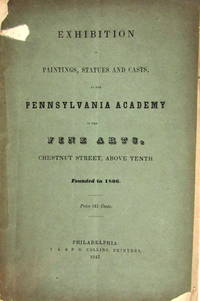
1847réf. 101635Philadelphia T.K. and P.G. Collins printers 1847. 32 pp. Original printed green paper wrappers sl. dam. Heavy foxing throughout. Catalogue listing 543 items. Pages 28 & 29 contain an index artists and pages 30 & 32 contain a publicity and the constitution of the Art-Union of Philadelphia fro the promotion of the arts of design in the United Stated incorporated 1844. The Pennsylvania Academy of the Fine Arts is a museum and art school in Philadelphia Pennsylvania. It is the first and oldest art museum and art school in the United States.
1986réf. 039391Los Angeles: Los Angeles County Museum of Art 1986 Square orientation. "The great epoch of the spiritual which is already beginning or in embryonic form began already yesterday. . . provides and will provide the soil in which a kind of monumental work of art must come to fruition." Wassily Kandinsky From the collection of Sanje Frank Elliott Buddhist mentor artist and friend to many. Condition notes: 435 numbered pp; TPB. Pages: clean bright tight black eps and edgestain color frontis; slightly cocked ghosts to front edge. Cover: black mat wraps gilt titles front/spine; light edge/shelfwear corners slightly thumbed shallow crease to front near head several small light ghosts front. Heavy. Los Angeles County Museum of Art paperback