8 617 résultats
réf. SONG1684052467Used: Good unknown
réf. BN91976Bauer. Bücher der praktischen Magie. Magie ihr Geheimsinn ihre Technik und praktische Anwendung. 12 Bücher in einem Band Hardcover Bücher der praktischen Magie. Magie ihr Geheimsinn ihre Technik und praktische Anwendung. 12 Bücher in einem Band Hardcover Bücher der praktischen Magie. Magie ihr Geheimsinn ihre Technik und praktische Anwendung. 12 Bücher in einem Band Hardcover Bauer hardcover
réf. BN97767Non Plus Ultra: Der Zauber des 19. Jahrhunderts. Johann Nepomuk Hofzinser 1806 - 1875. 1. Bd.: Über Hofziners Leben seine Familie seine Geheimnisse und seine geniale Zauberkunst. Non Plus Ultra: Der Zauber des 19. Jahrhunderts. Johann Nepomuk Hofzinser 1806 - 1875. 1. Bd.: Über Hofziners Leben seine Familie seine Geheimnisse und seine geniale Zauberkunst. unknown
1821réf. OKKU2111Mainz, Florian Kupferberg 1821. 8°. XII, 387(1); XII, 440 S. Mit einigen Textholzschnitten. Marmorierter Halblederband der Zeit m. goldgepr. Rü.verz., 2 mont. Rüschi. und Deckelbezug aus braunem Kleisterpapier. Buchdeckel mit Schabstellen, Exlibris auf vord. Spiegel, die ersten 160 Seiten mit Wurmgängen, Teil des Buchblocks wasserrandig, 2 Abteilungen im ersten Band sehr vereinz. m. Anstreich. u. Anmerk. v. alter Hd. (Bleistift). Caillet 5262; Graesse, BMP 131-42; Cornell Univ. Witchcraft Cat. 295. Die ersten beiden Bände der ersten Ausgabe dieses Kompendiums über Dämonologie und Hexenwesen in dem Hunderte von Manuskripten und Büchern über alle Arten des Aberglaubens, der Hexerei und Magie verwertet worden sind. - "Eines der gesuchtesten und wertvollsten Werke auf dem Gebiete des Aberglaubens" (Ackermann I, 494). Enthält reichhaltiges Quellenmaterial "zur Beförderung einer rein-geschichtlichen, von Aberglauben und Unglauben freien Beurtheilung dieser Gegenstände". "Da ein Verständnis des Aberglaubens vor allen Dingen erfordert, dass man die abergläubische Vorstellung selber kennt, so haben solche Sammlungen des Materials einen keineswegs geringen wissenschaftlichen Wert. Das grösste Verdienst in dieser Beziehung hat sich der Prediger Georg Conrad Horst (1767-1838) erworben." (Lehmann, Aberglaube, 269). - Ohne die Bde. 3-6.
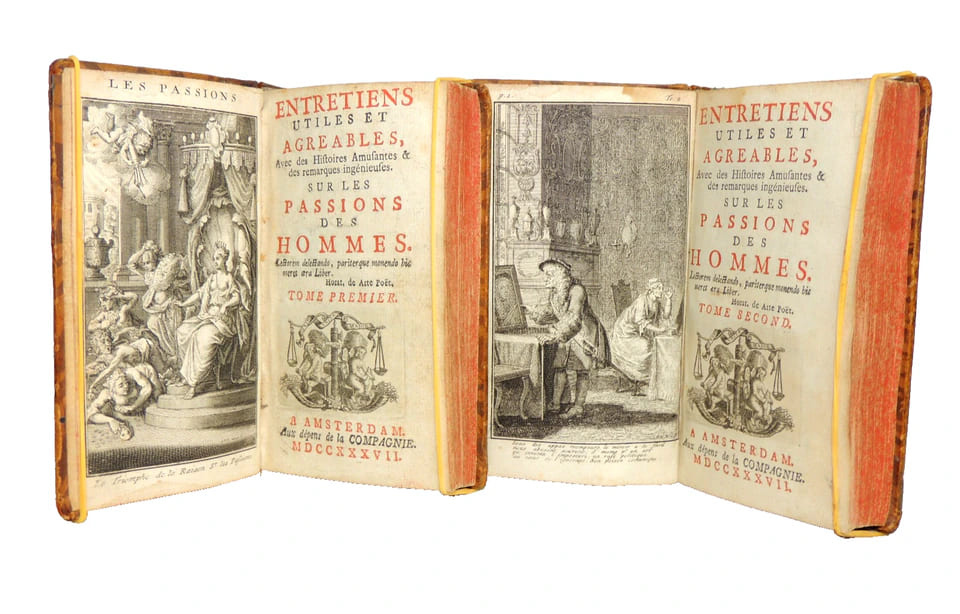
1737réf. CZC-86727 superbes gravures en taille douce Complet en deux vols in-12, 140x90, reliés pleine basane époque, solidement reliés, 340, 391pp, beaux & rares exemplaires. A Amsterdam, aux dépens de la Compagnie, 1737. Édition Originale. ref/24/6
réf. DADAX1408809621New unknown
réf. DADAX087905140XNew unknown
réf. DADAX0937866121New unknown
1881réf. 306001Small thin octavo. 17 b/w illustrations. Three pages of publisher's advertisements at end. Original stiff color pictorial wrappers with vignette portrait and view of a stage magician uncovering a goldfish bowl small stains. Very good. 32 pages including 3 pages of publisher's advertisements. Cover title: "De La Mano's Great Magic Book" "Containing an extensive collection of conjuring and legerdemain; sleights with cards ribbons rings fruit coin balls handkerchiefs etc. all of which may be performed in the parlor or drawing-room" title page. New York Popular Publishing Company paperback
1881réf. 306001Small thin octavo. 17 b/w illustrations. Three pages of publisher's advertisements at end. Original stiff color pictorial wrappers with vignette portrait and view of a stage magician uncovering a goldfish bowl small stains. Very good. 32 pages including 3 pages of publisher's advertisements. Cover title: "De La Mano's Great Magic Book" "Containing an extensive collection of conjuring and legerdemain; sleights with cards ribbons rings fruit coin balls handkerchiefs etc. all of which may be performed in the parlor or drawing-room" title page. New York Popular Publishing Company paperback books
réf. DADAX0802713408New unknown
1900réf. 145631900. Collection of two photographic lantern slides of Iran circa 1900 documenting village commerce vernacular architecture and camel transportation at the turn of the twentieth century. The images record daily activity within mud-brick settlements including villagers gathered in a public square and camels resting inside a walled enclosure. Particularly notable is the presence of a traditional wind tower or badgir an architectural feature associated with Yazd and other arid regions of central and southern Iran. The photographs preserve details of settlement design commercial activity and animal transportation during the late Qajar period when camel caravans continued to carry goods and travelers between Iranian towns and regional markets. Two photographic glass lantern slides circa 1900 each measuring approximately 3 1/4 x 4 inches. The first depicts an open square surrounded by mud-brick buildings with men women and children gathered in small groups near large sacks or bundles possibly containing merchandise or provisions. A prominent badgir rises above the surrounding structures identifying a traditional method of passive ventilation employed in Iran's hot dry climate. The second slide shows several saddled camels resting within a walled village courtyard or caravan enclosure. One camel lies prominently in the foreground while additional animals and villagers occupy the space beside the surrounding mud-brick buildings. The saddles and enclosed setting suggest a stopping place associated with caravan travel although the precise location is unidentified. The photographs date to a period when established caravan routes connected Iranian settlements and commercial centers with camels providing transportation across regions where wheeled vehicles faced difficult terrain and limited road infrastructure. The wind tower and mud-brick buildings also record architectural adaptations to local climatic conditions while the populated square preserves details of everyday activity in a provincial settlement. Both slides in very good condition. Two early photographic views preserving distinct aspects of Iranian village life regional transportation and traditional architecture during the Qajar era. unknown
1900réf. 145631900. Collection of two photographic lantern slides of Iran circa 1900 documenting village commerce vernacular architecture and camel transportation at the turn of the twentieth century. The images record daily activity within mud-brick settlements including villagers gathered in a public square and camels resting inside a walled enclosure. Particularly notable is the presence of a traditional wind tower or badgir an architectural feature associated with Yazd and other arid regions of central and southern Iran. The photographs preserve details of settlement design commercial activity and animal transportation during the late Qajar period when camel caravans continued to carry goods and travelers between Iranian towns and regional markets. Two photographic glass lantern slides circa 1900 each measuring approximately 3 1/4 x 4 inches. The first depicts an open square surrounded by mud-brick buildings with men women and children gathered in small groups near large sacks or bundles possibly containing merchandise or provisions. A prominent badgir rises above the surrounding structures identifying a traditional method of passive ventilation employed in Iran's hot dry climate. The second slide shows several saddled camels resting within a walled village courtyard or caravan enclosure. One camel lies prominently in the foreground while additional animals and villagers occupy the space beside the surrounding mud-brick buildings. The saddles and enclosed setting suggest a stopping place associated with caravan travel although the precise location is unidentified. The photographs date to a period when established caravan routes connected Iranian settlements and commercial centers with camels providing transportation across regions where wheeled vehicles faced difficult terrain and limited road infrastructure. The wind tower and mud-brick buildings also record architectural adaptations to local climatic conditions while the populated square preserves details of everyday activity in a provincial settlement. Both slides in very good condition. Two early photographic views preserving distinct aspects of Iranian village life regional transportation and traditional architecture during the Qajar era. unknown books
1725Cm. 15, piena pelle bazzana con fregi in oro a dorso a 5 nervi, pag. (8) 446 (2). Interessante e piacevole trattato in forma epistolarte sulla magia, i malefici e le streghe, con riferimenti alla demonologia. Piccolo restauro al dorso ma buon esemplare. Caillet, III, 453; Rosenthal, 4113 "Rare!"; Bibliotheca Magica, 1078 stesso anno ma con diverso stampatore (Despilly).
réf. SONG0439930464Used: Good unknown
réf. CZC-13130La première partie, bien développée, constitue une sérieuse histoire du magnétisme depuis Mesmer (vie et expérience de Mesmer, Puységur, Foissac, Berna, Dubois d'Amiens, Husson, Burdin, Pigeaire, etc.). Viennent ensuite les 12 leçons de magnétisme, somnambulisme : formes différentes, dangers, somnambules spiritualistes, Adèle Lefrey, Marie Lainé, extase magnétique, facultés exceptionnelles, phénomènes supérieurs, pratiques de Mesmer, Puységur, abbé Farina, Deleuze, Delauzanne, Dr Ruston, de Brivazac ; traitement des maladies, précautions réfléchies à prendre, dangers des négligences, sensations magnétiques, facultés exploratrices, qualités du fluide magnétique. Expériences personnelles de l'auteur avec observations et considérations : Calixte Renaux, lettres de M. Demay, lecture malgré l'occlusion des yeux ; traitement des sourds-muets ; jeune Daubas ; Mlle Dufourt ; Mme Bussière ; Marguerite de Niort ; catalepsie ; magnétisme en diligence ; extase magnético-poétique ; Victor de Paris ; Théodula, l'extatique en 1833 ; etc. vol relié demi cuir, frottements, bel état intérieur, 553pp. rare Paris, Germer Baillière, 1841. EO ref/BP
18812 vols., 8vo., First Edition, small personal name stamp on blank preliminaries; original dark green cloth, upper boards framed and blocked in black, gilt backs, chocolate endpapers, uncut, fore-edges faintly spotted else a near fine copy. BRIGHT COPY OF THE SOLE TWO-VOLUME EDITION. Each volume with 8pp publisher's catalogue (6 G-581) bound in at end. In the first volume p.4 of the catalogue is unnumbered (see Miller & Matthews p.245). Miller & Matthews, B14.1 printing variant (a); Sadleir 1317; Wolff 3627.
réf. DADAX1883403456New unknown
4 volumi rilegati in 1, in 8o, pagg. (6) 162; (6) 250; (6) 175; 138, mezza pelle con punte, tassello e fregi oro al dorso, tagli spruzzati, segnalibri di seta. Edizione conforme all'originale del Bollettino delle leggi, colla versione dei Motivi degli Oratori del Consiglio di Stato dell'Impero francese e della Commissione del Corpo òegislativo, collocati per ordine di materie. Aggiuntovi il confronto colle Leggi romane e con alcune ordinanze, dichiarazione e leggi della Francia, l'Appendice al Codice di procedura penale con osservazioni, l'Indice ragionato del Codice penale. Raro. Minime fioriture, ma ottima conservazione (18195/DIRITTO - GIURISPRUDENZA - CODICE NAPOLEONICO)
réf. 107579A Paris, chez Grégoire, libraire, rue du Coq-St-Honoré, n° 135, et chez Touvenin, libraire, quai des Augustins, n°44, An XI de la République (1803), 1 volume in-8 de 205x130x5 mm environ, 1f.blanc, iv-130 pages, 2ff.blancs, demi-basane vert foncé, titres dorés sur dos lisse. Cuir décoloré et frotté avec début de fente sur les mors, coins émoussés, mors interne fendu mais structure solide, manque de papier dans la marge d'une page, notes manuscrites anciennes sur la première garde, rares petites rousseurs et légers défauts de marge.
1777réf. 64911Frankfurt-Leipzig, J. B. Mezler, 1777. 8°. Mit gest. Titelvignette, einigen Holzschn.-Vignetten u. einer Kupfertafel. 4 Bll., 226; 256 S., Ldr. d. Zt. m. reicher Rückenverg., goldgepr. Rückenschild u. dreiseitigem Rotschnitt.
1816réf. 15402Lyon, Rusand, 1816 ; in-8, broché ; (1) f. blanc, IV, 139 pp., couverture factice.
réf. 223647Nuremberg, Raspe, 1764 fort vol. in-8, [3] ff. n. ch. (titre, préface), 1648 colonnes, texte sur deux colonnes, avec un frontispice allégorique gravé par Claussner, et une planche de géométrie hors texte, demi-vélin cerise à coins, dos à nerfs fleuronné, pièce de titre, tranches mouchetées (relirue de l'époque). Plat inférieur marqué par l'humidité, coupes abîmées, des mouillures claires angulaires au milieu de l'ouvrage.