16.650 risultati
1968rif. 231795New York: McGraw-Hill Book Company 1968. Hardcover. 173p. personal inscription to author Herbert Gold signed and dated August 1968 by Stern as Danny Stern very good first edition stated in boards and unclipped bright dj. From Gold's personal library. A dark Utopian science fiction concerning a facility where potential suicides come to reflect on their lives and choices. Characters include a Jewish Academy Director under attack from his Anti-Semitic African American assistant. McGraw-Hill Book Company hardcover books
1975rif. 909721975. Seino or Nishino Tomi 西野ã¨ã¿. Daradarakei 茶羅茶羅経. Shikaban ç§å®¶ç‰ˆ Privately published. 昭和50 1975 . 20.4 x 8.5cm slim volume with cream paper wrappers opens Japanese style and has a centered title slip stenciled in dark red ink with a brown background. Inside wrappers and free end papers are single sheets of dark blue paper. 20 inner cho are fukuoro-style with a single sheet colophon stenciled in red ink with a brown background. A limitation of 30 this is labeled number 16. Privately published. The 30 x 11cm outer wrapper is an envelope made of handmade paper that opens at the top with a centered laid-down title slip that is stencil printed in dark red ink. The title may be read as wordplay “The Gospel of Excess.” The book is rectangular and shaped like a sutra further contributing to the idea that this is “punny” erotica. Each cho has two stencils on one side one above the other with the other side blank. The top stencils are Japanese characters that describe the image below and are done in brown ink on a light brown background while the bottom stencil is in black ink on a light brown background. Many of the latter images are of figures most nudes both representational and abstract. The artist is believed to be Seino or Nishino Tomi 西野ã¨ã¿. Good condition. A well-done work of katazome 型染 stencil print designs. unknown books
rif. 432884New York: Robert Guinn / Galaxy Publishing / Universal Publishing & Distributing 1979. Softcover. Very Good. Magazines. Digests 12mos. Perfectbound in illustrated wrappers. Overall very good with moderate wear some toning and contemporary tape reinforcement to the spine ends of the early issues. A nearly complete 30-year run of Galaxy Science Fiction totaling 246 issues lacking only eight of this important and influential science-fiction anthology. Starting with its first year Galaxy set the standard for science fiction by offering authors top rates and providing a less ridged definition of science fiction that could incorporate sociology psychology and satire. The result was a stable of top writers such as Ray Bradbury Robert A. Heinlein Jack Vance Harlan Ellison Robert Silverberg Alfred Bester Philip K. Dick George R.R. Martin Frank Herbert James Blish Theodore Sturgeon. Larry Niven Ursula K. Le Guin Roger Zelazny and many others. In the first few year alone Galaxy publisher several important stories: Damon Knight's “To Serve Man” which was adapted into the classic Twilight Zone episode; Bradbury’s “The Fireman” which was expanded into the dystopian novel Fahrenheit 451; and Heinlein's The Puppet Masters. The magazine’s stature lead to the publication of a number of Hugo and Nebula Award-wining stories and novellas such: Bester’s “The Demolished Man” Fritz Leiber’s “The Big Time” Ellison’s “ ‘Repent Harlequin!’ Said the Ticktockman” Herbert's "Dune Messiah" Silverberg’s “Nightwings” and Zelazny's “Damnation Alley.” A wonderful nearly complete run of this important and influential science-fiction anthology. Robert Guinn / Galaxy Publishing / Universal Publishing & Distributing unknown books
1963rif. 516021New York: G. Schirmer 1963. Softcover. Near Fine. Sheet music. Quarto. Single bifolium with a single sheet insert making six pages. Some very light edgewear else near fine. For high voice and piano. Plate number 45275. G. Schirmer unknown books
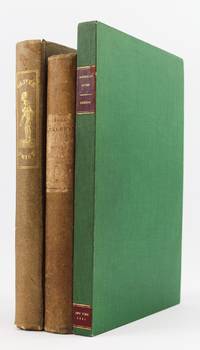
1839rif. ST16660aPhiladelphia: Lea & Blanchard; New York: Harper & Brothers 1839-42. Various Editions as described below. 16 pp. ads 2 leaves 13-212 pp. 8 leaves inserted ads; viii 13-403 1 pp.; 92 pp. 2 leaves ads. Three separately published works. Oliver Twist in publisher's purple-brown cloth smooth spine with gilt title and depiction of Oliver; "Nicholas Nickleby" in original tan paper boards backed with dark brown buckram smooth spine with paper label; "American Notes" in original brown paper wrappers printed in black in modern green buckram chemise and slipcase red morocco label. Oliver Twist with 24 plates by Cruikshank; "Nicholas Nickleby" with two plates by Phiz Hablot Knight Browne. Oliver Twist with the ex libris of W. Miller/ Dickensiana to the front pastedown additionally with the pencilled ownership inscription "J. B. Finlay Esq. Woodlea Saratoga Springs New York 1864" and an additional ink ownership inscription "Beekman Finlay" to the front flyleaf. "Nicholas Nickleby" with illegible early ink inscription to the front flyleaf. "American Notes" with the early ink ownership inscription of Marshall Whittemore and the pencilled inscription of M. A. Lebbette to the title. Oliver Twist: Wilkins p. 15; Podeschi A31. "Nicholas Nickelby": Podeschi A43; Wilkins p. 17. "American Notes": Podeschi A67; Wilkins p. 24. Bindings rather sunned; "Notes" with the wrappers a bit chipped and soiled "Notes" also rather foxed internally because of poor paper quality though the other two works generally quite clean scattered light stains plates with overall mild toning other trivial defects but all still perfectly acceptable in their solid unrestored original bindings. This is a pleasing group of three early American Dickens printings all in their original publisher's bindings and well preserved when considering the poor state of bookmaking in the United States at the time. Of "Oliver" one of the author's most famous works Day says "the novel's lasting achievement is the symbolic power of the dark underwolrd of the poor. The pitiful figure of Oliver holding out his little bowl and asking for more is an ineradicable symbol of all the needy children in the world pleading for sustenance. In such universalizing lies the magic of Dickens." The work first appeared in America in two volumes published by Lea & Blanchard previously Carey Lea and Blanchard in 1838-39. Our single volume edition followed shortly in 1839 initially in a state containing only two frontispiece etchings and shortly after with the full 24 as here. This copy which retains the original ads before and after the text is from the library of an important Dickens scholar: William Miller was a founding member of the Dickens Fellowship and helped create their journal "Dickensiana." He published a Dickens bibliography "The Dickens Student and Collector" in 1946 and had a large collection of Dickens' works and related ephemera particularly focusing on musical adaptations of Dickens' works. Our copy also belonged to John Beekman Finlay 1810-69 an early president of the First National Bank of Saratoga Springs and a justice of the peace. "Nicholas Nickleby" written during the same period as "Oliver" follows the eponymous character's attempts to get by and to protect his virtuous sister Kate from poverty suitors with evil motives and the pair's cartoonishly cruel uncle Ralph. Day writes that while the plot is "rather hopeless" in this novel "Dickens creates some of the most extraordinary scenes in English literature" with deliciously comic and highly theatrical juxtapositions of character and scene. Originally released in 20 parts by Lea & Blanchard from 1838-39 the present version is the first complete edition released in the United States. Apparently two concurrent states were released one with all 39 of the Phiz illustrations and the second as in our copy with two frontispiece illustrations only. The third work here is probably the most unfavorably received of all of Dickens' books particularly in the States. "Notes" reflects the hearty dislike the author developed for America during his tour there in the winter and spring of 1842. He was disgusted with the Americans' rough-hewn lack of sophistication and especially with the toleration of slavery and the book clearly shows his antipathy. Ours was one of three editions released in November of 1842; there is some disagreement about which of these is truly the first American edition but they all were issued within a few days of each other. Lea & Blanchard; New York: Harper & Brothers unknown books
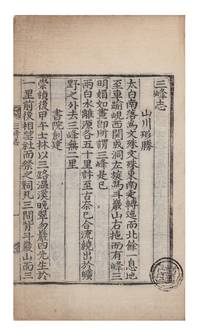
rif. 942031 folding leaves. Large 8vo 305 x 190 mm. orig. patterned semi-stiff wrappers wrappers slightly soiled new stitching. Yeongju: 1774. First edition and very rare of this gazetteer for the Confucian Three Peaks Academy WorldCat 46318280. The word “gazetteer” is used in reference to a genre of East Asian historical and geographical texts generally known in Korea as ŭpchi 邑志 which translates roughly to “local treatises.” The now rare word “gazetteer” is used in analogy with a similar genre that existed in British India. It was not unusual for Korean gazetteers to be published by a local Confucian academy as seems to be the case here. Confucian academies were important centers of intellectual life in ChosÅn Korea. Several of the leading thinkers of the era spent parts of their career teaching at academies thus creating a following. The Three Peaks Academy Sambong sÅwÅn 三峰書院 was founded in the village Valley of Three Peaks sambonggol 三峰谷 in 1654. The colophon explains the genesis of the gazetteer: “The late Mr. Ch’Ål-nam éµå— i.e. Kim Si-hwa é‡‘å§‹éµ 1662-1772 wrote and edited the gazetteer taking note of the geographical features and dates of buildings the positions and names of halls houses ponds and lookouts and recording them for posterity.” Kim Si-hwa furthermore recorded key events in the lives of scholars who had taught at the academy. Kim Wi 金㙔 1709-89 who authored the colophon dated 1774 wrote about the updates that had been made to Kim Si-hwa’s text for our edition. We find no record of an earlier printing; probably Kim Si-hwa’s text was first published in this edition. Nice copy. WorldCat locates only the Berkeley copy. References Digital culture encyclopedia for Yeongju 디지털ì˜ì£¼ë¬¸í™”ëŒ€ì „. http://www.grandculture.net/yeongju Korean Old and Rare Collection Information System í•œêµê³ 문헌종합목ë¡. https://www.nl.go.kr/korcis/index.do PÅk’ŭlli taehak Tongasia tosÅgwan sujip Han’guk kojÅnjÅk mongnok 버í´ë¦¬ëŒ€í•™ ë™ì•„시아ë„서관 수집 韓國å¤å…¸ç±ç›®éŒ„. Seoul: KoryÅ taehakkyo minjok munhwa yÅn'guwÅn 2009. “Sambong ha sambong sÅwÅn maŭl ‘Sambonggol’” 삼봉三峯 下 삼봉서ì›ä¸‰å³¯æ›¸é™¢ ë§ˆì„ ‘삼봉골三峯谷’. YÅngju simin sinmun ì˜ì£¼ì‹œë¯¼ì‹ 문 November 26 2018. https://www.yjinews.com/news/articleView.htmlidxno=49174. unknown books
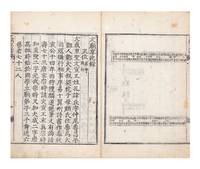
rif. 9430Four leaves of illus. 30 folding leaves. Large 8vo 305 x 208 mm. orig. yellow semi-stiff wrappers upper wrappers somewhat soiled both wrappers with some worming new stitching. Korea: 1765. First edition of this book published on royal command by King YÅngjo of ChosÅn. The book was compiled by Kim Kwi-ju 金龜柱 1740-86 the older brother of Queen Consort ChÅngsun 1745-1805. The royal Preface is furthermore written in Kim’s standard script calligraphy. Years after the compilation of this book factional intrigue under YÅngjo’s successor ChÅngjo led to Kim being exiled after which he soon died. Our book outlines sacrifices at the Confucian temple in Seoul including the KyesÅng å•“è–ç¥ and SongjÅl 崇節祠 shrines. The KyesÅng shrine built in 1669 was the site of sacrifices to the fathers of several Confucian sages including Confucius and Mencius. At the temple as a whole a number of Chinese and Korean Confucian sages and worthies were worshipped. The book contains illustrations outlining the layout of the shrines with the placement of the tablets for the various Confucian scholars marked with their names. The royal Preface is dated 1765. Ordering the compilation of a record of past exemplars apparently made the king reflect on his own character and actions. He wrote “when I with my shallow learning recite the writings of the sages and worthies but remain unable to learn the Way of the sages and worthies and when I admire the deeds of the sages and worthies but cannot act in their manner it is like knowing what something tastes like but not get to eat it or like knowing the road but being unable to follow it. Even though I might laugh at people of the past why would people of the future not laugh at me too” Minor worming mostly marginal towards end. See WorldCat 855527023 for a digital copy. unknown books
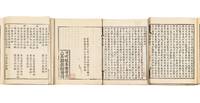
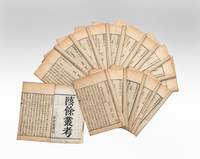
rif. 9439Six vols. 8vo orig. blue semi-stiff wrappers orig. block-printed title labels on upper covers label on Vol. I somewhat defective new stitching. Kyoto: Yao Kanbē 八尾勘兵衛 Preface by Nanshi Wenxiu dated 1417 but late 17th or 18th century. First edition to be printed in Japan of this collection of the words and deeds of famous Chinese monks of the Chan J.: Zen 禪 lineages. The Expanded Supplement was edited by Nanshi Wenxiu å—çŸ³æ–‡ç‡ 1345-1418 over a period of 30 years. It was first published in Jiaxing Zhejiang in 1671 a considerable time after Nanshi’s death. We assume that the Japanese edition to which our copy belongs postdates this Chinese edition. The entry for our edition in WorldCat 40222684 estimates that it is from the 17th century. The genre of records of the “transmission of the lamp” — a metaphor for the Buddhist teachings — fits somewhere between a biography and a collection of recorded sayings. It focuses more on the teachings of the monks featured than on the events of their lives. This makes the genre important for the intellectual history of Buddhism. Our copy represents the continuation of the genre which originated in the Song period. In 1004 CE the Chinese monk Daoyuan é“原 finished his great collection Jingde chuandeng lu 景德傳燈錄 Record of the Transmission of the Lamp of the Jingde Reign Period of the Song 1004-1007 CE. Daoyuan presented his work to the Song throne and the emperor had it included in the Tripitaka. Dachuan Puji 大å·æ™®æ¿Ÿ 1179-1253 subsequently expanded on Daoyuan’s and others’ works and compiled Wudeng huiyuan 五燈會元 Combined Sources for the Five Lamps published in the year of his death. Nanshi Wenxiu the 62nd abbot of Jingshan Temple in Hangzhou decided to compile the Expanded Supplement to Records of the Transmission of the Lamp upon noticing lacunae in Dachuan Puji’s work. The Expanded Supplement contains information on monks from the Song 960-1279 CE and Yuan 1271-1368 periods. Japanese reading marks have been added to parts of the text in black and red ink. Fine and fresh set of a very rare book; WorldCat locates only the Berkeley copy. Preserved in a chitsu. Occasional unimportant worming. References Digital Dictionary of Buddhism. http://www.buddhism-dict.net/. unknown books
rif. 950843 parts in 16 vols. 8vo orig. wrappers new stitching. China: Zhan yi tang Prefaces dated 1790 & 1791. First edition. Zhao 1727-1814 "was an important poet and historian from Yanghu. He was born poor and supported himself at first as a private tutor. In 1761 he passed the imperial examination and in a long career served in many official capacities. Upon being appointed the prefect of Zhenan Guangxi province in 1766 he showed himself to be a reformer dedicated to helping the common people. From 1784 to 1786 he became the director of the Anting Academy in Yangzhou. In addition to writing a collection of ‘poetry talk’ critical notes on poetry he wrote a dynastic history histories of military campaigns and other important works. He was a friend of Yuan Mei 1716-1798 and was considered along with Yuan Mei and the poet and playwright Jiang Shiquan 1725-1785 one of the three greatest poets of Southern China."–Barnstone & Chou eds. The Anchor Book of Chinese Poetry p. 339. The present work is a collection of Zhao’s miscellaneous poetry and writings on classical Chinese literature especially poetry history and historiography one volume is devoted to a discussion of the Tongjian Gangmu of 1172 politics dynastic history philosophy and various other subjects. One of the foremost historians of his day he was among the first to turn his attention to the larger more fundamental problems of historiographical method and social and institutional history. Fine set. ⧠Nienhauser ed. The Indiana Companion to Traditional Chinese Literature Vol. 1 pp. 229-30–”Chao’s literary talents were manifold encompassing those of poet essayist calligrapher and critic. He mastered many poetic forms including both old- and new-style verse…Chao was a prolific writer producing many works on a great variety of subjects including history politics and philosophy.”. unknown books
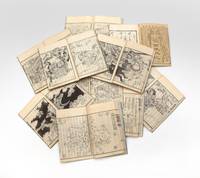
rif. 8576Many fine black & white double-page & single-page woodcuts throughout. Ten vols. 8vo orig. blue semi-stiff wrappers orig. block-printed title labels on upper covers three labels are somewhat defective new stitching. Osaka: Tenmaya Yasubei; Kyoto: Yoshida Jihei 1835. with: — & MATSUKAWA Hanzan; —. Ehon Toyotomi Ryukyu gunki Illustrated Tale of the Ryukyu War. Many fine black & white double-page & single-page woodcuts throughout six in Vol. I are color-printed. Ten vols. 8vo orig. pale blue patterned wrappers orig. block-printed title labels on upper covers new stitching. Osaka: Kawachiya Tobei & Kawachiya Mohei colophon dated 1864; title-page dated 1862. First edition of these finely illustrated stories of the conquest of the Ryukyu kingdom in 1609 by the Shimazu clan of southern Kyushu. The main artist Okada Gyokuzan Issei or Ishida is a rather shadowy figure; he probably studied under the famous Okada Gyokuzan of Osaka but we know very little about him. The second work Ehon Toyotomi Ryukyu gunki has an additional artist Matsukawa Hanzan 1818-82 who studied painting under Suga Shoho and worked in Osaka as a book illustrator. This is a splendid example of an ehon yomihon a type of long novel combining text with frequent illustrations. Our works are finely illustrated throughout with scenes of battles the notable figures in the conquest both winners and losers historical figures scenes of important ceremonies scenes of the extravagant lifestyles of the Ryukyu royal family seen in their gardens famous castles etc. The most useful captions in each woodcut name participants and explain the scene. The woodcuts are clear and impactful; many of the scenes have a pronounced Chinese atmosphere. Several types of battles are shown: conflicts involving cavalry fighting in the water assaults on castles hand to hand combat etc. In the first series Vol. I has a single-page woodcut world map and Vol. III has a fine double-page woodcut map of Ryukyu and its 36 islands. In the first volume of the second series are six full-page woodcut portraits of the heroic leaders of the Shimazu clan’s military forces in full attire with wonderfully delicate color printing. The text furnishes important details on the history of the relationship between Ryukyu and China and Japan; the quantities and types of weapons and number of soldiers drummers and doctors including veterinarians who traveled by ship to Ryukyu; and the major military actions of the conquest. These statistics are broken down by the contributions of men and materiel made by each region of Satsuma. The names of the leaders of each military section are given; we believe this is unique information. Family crests and banner symbols are depicted. Fine and fresh copies. Rare when complete and in excellent condition like our sets; WorldCat lists only the University of Hawaii copies part of the famous Frank Hawley Ryukyu collection. In Vol. 9 of the first series there is misnumbering but the text is absolutely complete and is identical to the set in the National Diet Library. unknown books
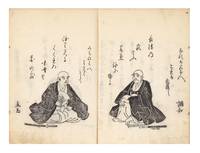
rif. 797121 full-page woodcuts. 30; 29; 26; 23; 31 folding leaves. Five vols. 8vo orig. wrappers wrappers rather rubbed & frayed new stitching. Kyoto: Izutsuya Shobei; Edo: Nishimura Uhei 1697. First edition of this collection of haikai written by several members of the circle surrounding Matsuo Basho 1644-94 Japan’s best-loved author. The poems were gathered by Taihakudo Torin d. 1719 a friend and disciple of Basho there is speculation that Torin was Basho’s nephew or younger brother. In 1696 to prepare for the third anniversary of Basho’s death Torin retraced Basho’s famous 1689 journey through the main island of Japan which resulted in Basho’s best-known work Oku no Hosomichi a poetic diary in the form known as haibun a combination of prose and haikai. Torin inspired by his own journey decided to collect the poems and have them printed in the present work. The poems arranged by the four seasons and with a section of poems written at the time of the third anniversary of Basho’s death were mainly written by a group of Edo-based poets and disciples of Basho. Torin has furnished a Preface and some of the poems. Many haiku are printed with the names or pen names of the authors. There is an Afterword by Sodo Yamaguchi 1642-1716 haiku poet flood-control expert and close friend and disciple of Basho. The second volume has a series of 20 attractive woodcuts of poets including on facing pages Basho and his disciple or nephew or younger brother Torin. Very good set. Extremely rare with no copy in WorldCat. Minor worming in the final volume mended. unknown books
rif. 8048Woodcut illus. five are double-page. .5 13 .5 ads; .5 ads 17 .5; .5 ads 14 .5 folding leaves. Three vols. 8vo orig. green patterned semi-stiff wrappers orig. block-printed title labels on upper covers new stitching. Kyoto: Honya Juemon 1789. First edition and very rare; this work was written as a result of the devastating Great Kyoto Fire which broke out on 7 March 1788 and lasted several days. It caused serious damage including the destruction of the Imperial Palace and the Nijo-jo Castle. The fire so shocked the bakufu that senior councillor Sadanobu Matsudaira was sent to Kyoto to investigate and consult with the Imperial Court. The first woodcut depicts how one can prepare for a quick escape in case of fire. This single-page illustration shows how to leave one’s street clothes at nighttime so that they can be put on quickly for a fast evacuation. The first double-page illustration is a map of Kyoto where the great fire occurred. The following two double-page woodcuts show scenes of the raging fire with citizens fleeing carrying their valuables. The next two-page woodcut shows refugees of all classes on the outskirts of Kyoto moving away from the city. The final double-page woodcut shows survivors beginning to rebuild their houses. The text gives detailed instructions on how to prevent fires and in the case of a fire breaking out what to do to contain and extinguish it. The block-printed title labels read “Banmin hinoyojin chinki” “Cautionary Instructions on Containing Fires for the Entire Nation”. Fine copy. Minor mostly marginal worming carefully mended in the first volume. unknown books
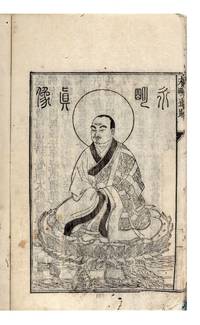
rif. 751132 fine full-page woodcuts. 42 folding leaves. Large 8vo orig. blue wrappers wrappers rather rubbed minor soiling modern manuscript label on upper cover new stitching. Japan: from the Japanese colophon on the penultimate leaf: “Nakano Zesui had the woodblocks carved & published this book mid-July 1655.” First edition to be published in Japan printed in Chinese with Japanese reading marks. Yongming Yanshou J.: Eimei or Yomei Enju 904-75 was a Chan master who had a profound impact on the development of Buddhism in East Asia. Yanshou was a widely influential proponent of a scripture-based Chan in opposition to the rhetorical and iconoclastic Chan of the Linji school. He became the first master to teach both Meditation and Pure Land Buddhism a synthesis that dominated Chinese Buddhism after the Song dynasty. This finely illustrated biography of Yanshou was written by the late Ming monk Dahe. It contains the later notes contributed by Yu Chunxi jinshi 1583 and Huang Ruheng 1558–1626. Yu Chunxi was a good friend of Zhuhong 1535-1615 and active in the late Ming Buddhist revival. Huang Ruheng who moved in the same intellectual circles was a noted calligrapher. This rare work is well illustrated with a series of 32 full-page woodcuts starting with a “true image” of Yanshou. The remainder of the woodcuts show the major religious events in his life from his youth to old age. We learn from the final leaf that our edition was copied from the Chinese edition of 1606. Some worming throughout. The woodcuts are largely free of worming at the beginning but the final eight leaves are more affected. ⧠In WorldCat the authorship of the copy at Harvard accession no. 43420760 is given as Daiei. unknown books
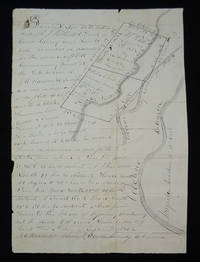
1852rif. 68368Placer County California 1852. GOLD RUSH. Gold Rush Map Manuscript. Being a Survey for the adjoining plots of land belonging to H.H. Watson and A.J. Polhill. Placer County California: 1852. Two pages on a single sheet 17 1/8 x 10 7/8 in.; 438 x 275 mm. Manuscript document with map dated variously between 4-24 September 1852 and signed by H.H. Watson A.J. Polhill and others. Sheet with some mild staining and ink blots. Some minor chipping at edges and some separations at the creases. Creases reinforced with nearly invisible tape. Overall a very interesting piece of gold rush history. We could not find any other California mine surveys at auction in the past 50 years. "Survey for H.H. Watson and A.J. Polhill. A Tract of land laying near ville bounded as described in the annex plot commencing point as the S.W. corner of J.H. Hancock survey." "Survey made by N.O. Hinman County Surveyor." "In the present survey the tracts of land being issued to Watson and Polhill are bounded on the right by the Volcano Mining Company Ditch and Volcano Canion sic with the Todds sic Valley Company Ditch running through each plot. The Volcano Gold Gravel Mining Company was one of the most extensive gravel mines during the Gold Rush and hundreds of acres of valuable mining lands were drained by its enterprises. Placer County falls in both the Sacramento Valley and Sierra Nevada regions in what is known as the Gold Country. The discovery of gold in this region in 1848 brought tens of thousands of miners from around the world and thousands more settled in the area to provide goods and services to them. The name "Placer" is taken from the Spanish word for gravel or sand deposits containing gold." From Sotheby's. HBS 68368. $3500. Placer County, California unknown books
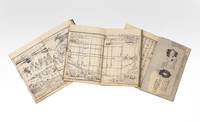
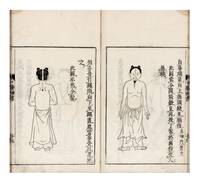
rif. 7008Twelve full-page woodcuts & numerous woodcuts in the text. 36 folding leaves. Two parts in one vol. 8vo orig. blue wrappers wrappers rubbed & somewhat wormed orig. block-printed title label on upper cover no longer present modern stitching. “Ichijo-dori” a street in Kyoto: Tomikura Tahei 1690. First edition of this early and rare book providing prescriptions for treatments in the different stages of tuberculosis. The author describes ten drugs made from vegetables that give miraculous results in treating the disease. The second part entitled “Mujo Gengen santen shinden gyokudo shoshi chiden shirochu soho” describes the parasitic worms said to grow in the stomach and intestinal system of patients suffering from tuberculosis. The text illustrations depict many of these parasites. The text is Chinese with Japanese reading marks presumably compiled in the 14th century by Ge 1305-53 a Yuan dynasty physician and writer. He came from a family of hereditary physicians and wrote a number of books. The Japanese reading marks have been provided by Shuhaku Asai 1643-1705 who was a fellow student with Ippo Okamoto of the prominent doctor Sanpaku Ajioka. There are substantial sections on acupuncture and moxibustion several of the full-page woodcuts depict pressure points. Very good copy. Minor marginal worming towards end. unknown books
1950rif. 37924Paris: Points 1950. Very Good -. Paris: Points 1950-1951. First Edition. Octavo; 95pp. Printed wraps. Wear to wraps with a tear to top of spine rubbing and spotting and curling to corners. Binding sound. Pages toned with a few spots and chips but overall legible and about Very Good. 8th issue of Bisiaux and Vail's literary magazine and includes "Shades of Darkness Three Impressions" an early work by Mordecai Richler. Points unknown books
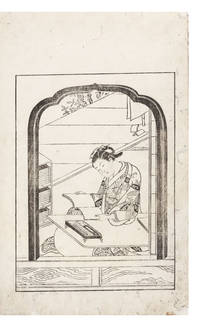
rif. 6330Edited by Yusuishi Tanaka. Woodcut frontis. & eight fine double-page woodcut illus. 21; 18 folding leaves. Two vols. Large 8vo orig. blue wrappers wrappers rather worn & rubbed orig. block-printed title labels on upper covers rubbed new stitching. Osaka Edo & Kyoto: 1749. First edition of this beautifully illustrated book; the fine woodcuts are by Sukenobu Nishikawa 1671-1750 or -51 or -54 who “counts among the foremost masters of so-called ukiyo-e primitive prints. His subject matter like that of his contemporaries revolved around images of women walking. These images are stylised lending the rhythmic movement of the sumptuous robes an almost sculptural effect. Nishikawa also did many book illustrations…Nishikawa founded a whole school and according to his family archives Harunobu 1725-1770 was a follower of his.”–Oxford Art Online. This work is concerned with the education of women in its widest sense combining knowledge with taste. Four types of girls’ “play” are described and illustrated; each providing instruction in behavior and ethics. The fine woodcut frontispiece depicts a young woman reading a book surrounded symbols of knowledge and refinement: bookshelves and brushes for calligraphy. Her clothes and hairstyle are appropriate. The first volume is concerned with dolls hina. In Japan dolls are not for play but have high spiritual value which offer girls preparation for adulthood and marriage. For the Japanese dolls are living creatures possessing heart and soul from which girls can learn discipline obedience and control. Nakanishi 1634-1709 was a scholar and writer on Shintoism and the present text was edited and posthumously published by Yusuishi Tanaka who has contributed a preface. The theme of the text is instructional and written for girls and young women: there are many references to texts essential for proper behavior and ethics. Nakanishi draws on the Nihon Shoki the oldest chronicle of Japan; Man’yoshu the eighth-century anthology of Japanese poetry; the Tale of Genji; and Makura no Soshi the famous Pillow Book. There are four fine double-page woodcut illustrations in the first volume. The first illustration depicts an upper-class woman sending her dolls away in a boat thereby sending her suffering away. The second illustration depicts the hinamatsuri doll festival with dolls arranged on shelves. The following illustration depicts a young woman facing her suitor her dowry behind her all are objects of knowledge and culture: a calligraphy set fine papers in a box picture scrolls books etc. The final illustration in this volume depicts an offering made to the sky referencing tanabata the star festival. According to legend the Milky Way separates two lovers; they are allowed to meet only once a year on the seventh day of the seventh lunar month of the lunisolar calendar. The second volume is concerned with kai-awase the Japanese shell-matching game. Again there are four fine double-page illustrations each filled with deep meaning. Matching the shells symbolizes the unity of partners in a marriage. There are many references to the Tale of Genji and Lady Murasaki; scenes from this novel were often used to illustrate the shells. One of the illustrations depicts the traditional card game called uta-garuta being played by several women. A very good set and rare. Some carefully repaired worming mostly confined to the margins. The lower outer corners of many leaves are “thumbed.” ⧠Brown Block Printing & Book Illustrations in Japan p. 131. unknown books
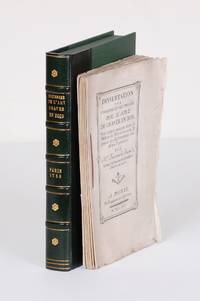
1758rif. 141839Paris: J. Barbou 1758. full brown leather border stamped in blind on the front and rear boards gilt ornaments on spine title in second compartment five raised bands all edges stained red marbled endsheets. small 8vo. full brown leather border stamped in blind on the front and rear boards gilt ornaments on spine title in second compartment five raised bands all edges stained red marbled endsheets. 1ff.-92 3 -263 pages. Pour éclaircir quelques traits de l"histoire de l'Imprimerie & prouver que Guttemberg n'en est pas l'Inventeur. Two works bound in one. Very rare first edition Bigmore and Wyman p.228. Private bookplate of Jackson Burke on the verso of the front free endpaper. Contemporary boards with some rubbing to the spine and extremities corners a bit worn gilt on the spine is lightly flaking evidence of bookplate removal to front and rear pastedowns. Else a fine copy of this very scarce work. Two works bound together. Complete titles are: Dissertation sur l'origine et les progrès de l'art de graver en bois 1758 and De l'origine et des productions de l'imprimerie primitive en taille de bois 1759. Fournier 1712--1768 was born in Paris and trained as a wood engraver. He later turned to steel engraving. In the first essay Fournier sets out to prove that Gutenberg was not the inventor of the printing press by examining the history of printing. He believes that the technology Gutenberg made popular existed long before the German printer's work. The second volume follows this up with further discussion of the origins of woodcut prints. Fournier wrongly disputes the dating of Mr. De Bure le Jeune concerning the Gutenberg Bible but he is the first with the help of an observation by Gerard Meerman to note the progressive increase in the number of lines per page in the early stages of Bible production. J. Barbou unknown books
1758rif. 76869Paris: J. Barbou 1758. unbound cord tied housed in a green half-morocco goat over cloth boards clamshell case spine tooled in gold leaf with title author and date. large 12mo. unbound cord tied housed in a green half-morocco goat over cloth boards clamshell case spine tooled in gold leaf with title author and date. 92 3 pages. Pour éclaircir quelques traits de l"histoire de l'Imprimerie & prouver que Guttemberg n'en est pas l'Inventeur. Very rare first edition Bigmore and Wyman p.227. Unbound textblock lightly soiled with minor creasing at corners. Faint moisture staining throughout with some affecting the text. In this text Fournier sets out to prove that Gutenberg was not the inventor of the printing press by examining the history of printing. He believed that the technology Gutenberg made popular existed long before the German printer's work. Fournier also followed up this text with two additional works which are not present: De l'origine et des productions de l'imprimerie primitive en taille de bois 1759 and Observations sur un ouvrage intitulé Vindiciae Typographicae 1760. These two works provided further discussion of the origins of woodcut prints including a passage refuting popular belief about the origin wood engraving and some ideas for further study. Fournier 1712--1768 was born in Paris and trained as a wood engraver and type founder being a member of the 18th century dynasty of the well-known Fournier family. He later turned to steel engraving. He published a table of the proportions of the different printing characters whose purpose was to propose for all typefaces a fixed measurement in "typographic points" and a systematic gradation. He worked closely with the collaborators of the Encyclopédie providing the printer Le Breton with all the documentation relating to the typographic foundry and plans for his own instruments as well as providing Diderot with his collection of ancient alphabets. Finally after multiple disputes with his Parisian colleagues he became infamous for the printing of his famous Manuel Typographique 1764 1766 just prior to his death. J. Barbou unknown books
1994rif. 30393New York: G.P. Putnam's Sons. Near Fine in Near Fine dj. c.1994. First Edition. Hardcover. tiny nick in top edge of rear cover no other significant wear to book; the jacket shows just faint surface wear. B&W photographs INSCRIBED and SIGNED by the author on the front endpaper: "To / Lynn -- / Happy / 50th / Birthday! / God bless / Ann-Margret." "For the first time Ann-Margret opens the door to her private world in a memoir that tells her life as it really was. Relentlessly honest these pages are filled with warmth wit poignancy and truth." Signed by Author . G.P. Putnam's Sons hardcover books
2021rif. 290571Los Angeles: Third Step 2021. Magazine. 40p. includes covers 8.25x11 inches articles opinion interviews reviews news services and resources ads photos very good LGBTQ glossy magazine in stapled pictorial wraps. Cover story on the fitness expert. Also: Bonds of Brotherhood; LA Leather Coalition. Love Without Fear; Biden Administration on LGBTQ Rights. The Envelope Please: Virtel's Oscar predictions. Monthly magazine with emphasis on LGBTQ rights and AIDS. Some entertainment and fashion. Only two holdings for the publication located in OCLC as of 5/2022 and those only a few issues. Third Step unknown books
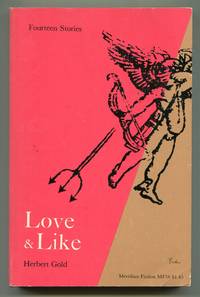
1961rif. 613091Cleveland: Meridian Fiction / World Publishing 1961. Softcover. Very Good. First paperback edition. Light rubbing sunned spine with creases very good. Collection of short stories of all types of love: erotic passionate filial parental etc. Meridian Fiction / World Publishing unknown books
1903rif. 79591Madison WI.: Wisconsin Historical Society. Very Good. 1903. Hardcover. Ex-library bound in brown cloth limited to 1000 copies - 7 1/2 x 6 inches with edgewear. Internally bright and illustrate folding maps. See Howes T254. . Wisconsin Historical Society hardcover books
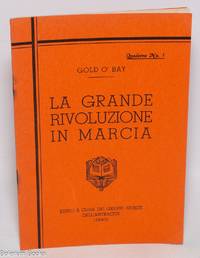
1940rif. 41547Newark NJ: L'Adunata dei Refrattari 1940. 28p. staplebound pamphlet small puncture near the bottom of the front cover otherwise very good. Quaderno no. 1. The anarchist poet journalist and author associated with the Futurist movement had arrived in the United States in 1938. L'Adunata dei Refrattari unknown books
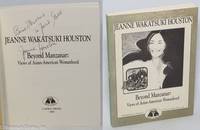
1985rif. 321252Santa Barbara: Capra Press 1985. Paperback. 65p. 65p. bound dos-a-dos 5.5x7.5 inches personal inscriptions to Herb Gold and signed and dated 1985 at their title pages by both authors very good first edition paperback in pictorial Frenchfold wraps. Capra Back-to-Back Series Volume III. From Gold's personal library. The husband and wife team who wrote "Farewell To Manzanar Capra Press paperback books