19.309 risultati
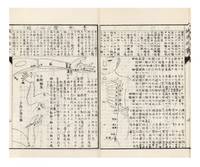
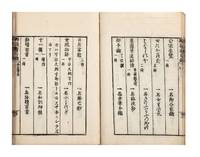
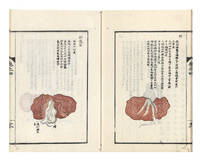
rif. 6006Numerous fine woodcut illus. 18 of which are finely handcolored. 48 irregularly paginated; 33; 39; 26; 28 3 folding leaves. Five vols. 8vo orig. wrappers some worming in upper margin of each vol. orig. block printed title label on each upper cover new stitching. Tokyo: Mankyudo Hanabusa Heikichi Preface dated 1810. First edition of one of the three most important early Japanese books on the history and technique of Chinese and Japanese acupuncture. This work is very different from all earlier Chinese and Japanese books on the subject. For the first time the illustrations are finely and realistically rendered and are anatomically accurate clearly influenced by European medical works which had circulated in Japan. Another important aspect of this book is that eighteen of the woodcuts each depicting organs of the body are finely handcolored. Also the body is described in full from head to foot and is not entirely dependent on the fourteen meridians. Kosaka was a court physician of the fiefdom of Kameyama who had studied under the famous physician Motonori Taki 1731-1801 who was himself a member of a distinguished family of doctors. The publisher of this work was the exclusive publisher for the government sponsored medical school. Very good set. unknown books
1965rif. 1402072New York: Harry N. Abrams 1965. Hardcover. Quarto 188 pages. In Fair plus condition. Spine is tan with gold print. Boards in tan cloth; wear to spine caps and corners tear to spine tail smudges on rear panel. Text block has cracked hinges spine break at page 9 age-toning to paper. Illustrated: “With 26 color plates tipped in and 56 monochrome plates”— title page. Oversized books. Additional postage necessary for expedited/international orders. Economy International shipping unavailable due to size/weight restrictions. For international/expedited customers please inquire for rates. NOTE: Shelved in Locked Annex in column ND-QC. 1402072. FP New Rockville Stock. Harry N. Abrams hardcover books
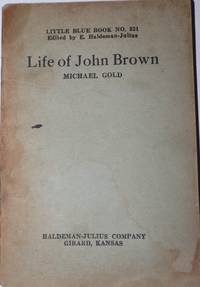
1924rif. 20528Girard Kansas: Haldeman-Julius Company 1924. First Edition. Wraps. Good. 16mo. 12.5 by 8.5 cm. 54 pp. Last page is listings of other Little Blue Books in microscopic print. This copy is heavily browned as inevitable given pulp content of paper. Wraps of a card thickness but low quality paper browned along edges. Dampstain of considerable size on title and continues on following pages getting lighter and smaller and some rippling of the leaves so affected. Haldeman-Julius Company unknown books
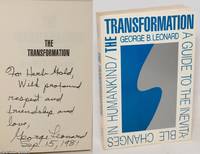
1972rif. 336765Los Angeles: J.P. Tarcher 1972. Paperback. xvi 258p. wraps very good condition inscribed & signed on the half-title page "For Herb Gold With profound respect and friendship and love George Leonard Sept. 15 1981. J.P. Tarcher paperback books
1976rif. 336766New York: Oxford University Press 1976. Hardcover. 365p. first edition inscribed & signed by Guerard to Herb Gold a few pages of the introduction have Gold's pen underlining & marginalia otherwise very good condition in an edge worn and chipped dj. Oxford University Press hardcover books
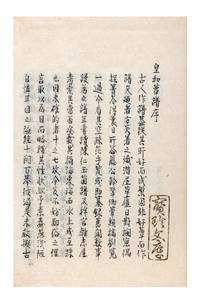
rif. 1053143 folding leaves. 8vo 240 x 170 mm. orig. patterned semi-stiff wrappers with orig. title-slip old stitching. Japan: 1791 date of Preface. A rare manuscript of Japanese natural studies or the “learning of roots and herbs” honzÅgaku 本è‰å¸ by ZÅ doctor and botanist 1758-1834. It was one of the major intellectual trends of the Tokugawa period with a large portion of the educated classes taking an interest in the topic. Initially inspired by the Chinese encyclopedic work Bencao gangmu 本è‰ç¶±ç›® Systematic Materia Medica Japanese natural studies came with time to focus on the natural environment of Japan in contradistinction to China. Our manuscript explicitly concerned with the mushrooms of “Our August Japan” is a case in point. It contains descriptions of 129 mushrooms divided into categories: wood mushrooms ground mushrooms bamboo mushrooms wood-ear mushrooms and poisonous mushrooms. Our author lists alternative names for a mushroom in question notes where it grows and describes its appearance. Literary references are given in many of the entries. Curiously despite the manuscript’s title ZÅ Han quotes from Chinese local gazetteers which often contained lists of local products. There is an appendix which contains four essays. discusses in turn different names of the mushroom in various parts of Japan; the etymology of the character kinoko 蕈 meaning mushroom; the method of ascertaining the poisonous character of a mushroom; and a prescription for breaking down the poison. ZÅ was the author of Seikei zusetsu An Illustrated Book of Agricultural Things the great agricultural and botanical work issued in the early years of the 19th century. It is an encyclopedic survey of all the agricultural products and practices of Japan. He served the Satsuma fiefdom under the lord Shimazu Shigehide Our text was never printed circulating only in manuscript form. ⧠Ueno MasuzÅ 上野益三 Nihon hakubutsugakushi 日本åšç‰©å¦å² Tokyo: Heibonsha 1973 p. 416. unknown books
rif. 7485Numerous woodcut illustrations in the text. Title-page 31 folding leaves one leaf of colophon. 8vo orig. patterned blue semi-stiff wrappers orig. block-printed title label on upper cover label rubbed new stitching. Tokyo Kyoto & Osaka: 1864. First edition and rare. Imamura 1814-90 was a leading physician and historian of Japanese medicine of his period. Professor of medicine at Tokyo University he was physician to the future Emperor Taisho when he was a youth. Imamura found that many of the contemporary Japanese works on acupuncture had strayed from the classic teachings of the Chinese physicians. In this work he makes a series of corrections to refine the fourteen meridians. The numerous woodcuts depict various parts of the body and pressure points. Very nice copy. Light stain to first few leaves. ⧠Mestler Old Japanese Medical Books I p. 297. unknown books
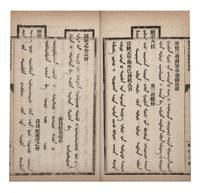
rif. 10372Ten vols. 8vo orig. wrappers old stitching. China: 1909-12. An important one-of-a-kind trilingual textbook. In 1905 the Qing government took the radical move to abolish the civil service examinations which had been contested for a long time and reformed in 1901. Rather than a system of examinations supported by schools preparing students for the lowest level of the exams the court instituted a tiered system of schools from elementary to advanced with students across the country using new textbooks. Our book is a product of the extension of this new educational regime to “present-day” Inner Mongolia. One of the two textbooks chosen for the new Chinese schools — and the most popular — was Zuixin chudeng xiaoxue guowen jiaokeshu 最新åˆç‰å°å¸åœ‹æ–‡æ•™ç§‘書 The Up-to-Date National Language Reader for Lower Primary Schools which Jiang Weiqiao 1873-1958 and Zhuang Yu 1878-1940 published in 1905 with the Commercial Press in Shanghai. Jiang was a low-level examination graduate who had been exposed to Western learning through the publications of the Jiangnan arsenal. After a first career as a teacher in new-style schools he entered the translation department at the Commercial Press in 1903 where he planned and wrote many of the textbooks that the press published. His later career was spent in education administration at the national provincial and university levels. Zhuang was trained in geography and entered the Commercial Press on Jiang’s recommendation. He too later worked in school administration while continuing to write textbooks. The purpose of Jiang and Zhuang’s book was as they explained in the Preface to “provide everyone basic moral values and knowledge and enable them to learn about important thoughts of ancient sages and academics arts and skills of all countries in the world.” Like others in the genre this book “touched on a wide range of topics such as science history geography and civics” and included “the newest terms concerning every subject at the time and reflected the most recent findings of scholars” He pp. 100-01. As the Qing government attempted to bring the empire’s Inner Asian possessions closer to China proper in the face of foreign aggression new schools were instituted in parts of Inner Mongolia. What textbooks to use presented a problem. Ungde or Rongde who was appointed as honorary supervisor of the Fengtian Mongolian Language School in what is now the city of Shenyang was aware of this issue. Ungde also taught Mongolian at the school. He noted that the school used Gao E’s 高鶚 Lizhi jiyao åæ²»è¼¯è¦ Essentials of Administrative Discipline which Tongšui 通瑞 had translated into Manchu and Meng boo å¤¢ä¿ in turn translated into Mongolian. Gao’s text had been written sometime before his death in 1814 and it was not a textbook fit for molding an informed citizenry in the early 20th century. Ungde therefore decided to translate Zuixin chudeng xiaoxue guowen jiaokeshu into Mongolian. Mongolia had traditionally been administered in the two languages of Mongolian and Manchu the Qing dynastic language and not in Chinese. Accordingly most of the Mongolian pedagogical literature that circulated in China — as opposed to the Tibeto-Mongolian literature that circulated in the Buddhist milieus of Mongolia itself — contained Manchu as a bridge language between Chinese and Mongolian. Ungde felt the need to keep Manchu in the new textbook as well. Translating a textbook concerned with modern industrial society meant that Ungde had to invent many new terms for which there were no Manchu or classical Mongolian equivalents. Scholars who have studied this issue in reference to Manchu have pointed out new words such as “society” ba-i acan “civilization” šu genggiyen “automobile” sukdun-i sejen “machine” šurdere tetun “telephone” talkiyan-i gisun and “telegraph” talkiyan-i serkin Qu p. 62. Before the translation received official endorsement Ungde translated four volumes between 1907 and 1909. These four were subsequently published along with two more in 1909 for distribution to the new schools. In 1910 Volumes 5 to 8 were published. Volumes 9 and 10 appeared only at the very end of 1912 when the Manchu dynasty had already fallen and China had been declared a republic. These different printings were presented to the throne and subsequently the president’s office. Reportedly an additional eight volumes were translated but they were never printed and do not appear to have survived Li first article p. 41. Our copy is a later printing. The Preface contains the list of Ungde’s students who assisted by writing the fair copy of the book which is missing in the early printings Li second article p. 67. The book is rare today; we are able to only locate four copies in North American libraries Walravens no. 248 WorldCat. Nice set with minor browning. Preserved in two hantao. ⧠Li Qinpu æŽå‹¤ç’ž Man-Meng-Han sanwen hebi jiaokeshu de fanyi banxing shang 《满蒙汉三文åˆç’§æ•™ç§‘书》的翻译é¢è¡Œï¼ˆä¸Šï¼‰ Manyu yanjiu 2014 No. 1: pp. 34-42; idem “.xia” 下 Manyu yanjiu 2014 No. 2: pp. 67-74; Qu Liusheng 屈六生 “Lun Qingmo Manyu de fazhan: Jianping Man-Meng-Han sanwen jiaokeshu” 論清末滿語的發展——兼評《滿蒙漢三åˆæ•™ç§‘書》 Manyu yanjiu 2004 No. 2: pp. 60-65; He Jiani “From Empire to Nation: The Politics of Language in Manchuria 1890-1911” PhD dissertation Cambridge 2018; Hartmut Walravens “Vorläufige Titelliste der Mandjurica in Bibliotheken der USA” Zentralasiatische Studien 10 1976: pp. 551-613. unknown books
1961rif. 531442Washington D.C.: The Federal Publishing Company 1961. Softcover. Very Good. First edition. Spiral-bound illustrated wrappers. 216pp. Illustrated. Spotting rubbing and creasing else very good with gift inscription on the first page. The Federal Publishing Company unknown books
1968rif. 335532Illinois: Scott Foresman and Company 1968. Paperback. 84p. index lightly worn wraps otherwise very good first edition paperback signed and inscribed by the author to Beat writer Herbert Gold. Scott, Foresman and Company paperback books
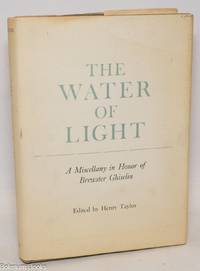
1976rif. 45559Salt Lake City: University of Utah Press 1976. Hardcover. 275p. very good condition dj with light wear and fading. Note card with a seventeen line inscription by Ghiselin signed "Brewster" while not stated it's to Herbert Gold thanking him for his contribution to the book it's dated December 17 1976. Festschrift for a not-well-known literary critic and poet much liked by his peers. University of Utah Press hardcover books
2021rif. 336167N.pl: Granitrose Press 2021. Paperback. 260p. wraps with minor creasing else very good condition inscribed and signed "To Herb Gold - Thanks you for your inspiration and leading the way! Diane LeBow. Granitrose Press paperback books
1979rif. 203204San Francisco: San Francisco Examiner 1979. Hardcover. 91p. illustrations very good first edition in pictorial boards. Signed by the author to Beat author Herbert Gold. Memoir of the little North Beach theatre club where greats like Woody Allen Dick Gregory Phyllis Diller and Barbara Streisand appeared. Illustrated with drawings of the stars. San Francisco Examiner hardcover books
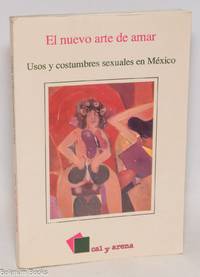
1992rif. 334712Mexico City: Cal y Arena 1992. Paperback. Cuarta edicion following the 1990 first 179p. illustrated with just two graphics both on the cover wraps find a tiny bump to the lower cover corner-tip and to adjacent leaves an else perfectly sound exemplar: square and tight clean and unmarked in any way. Cal y Arena paperback books
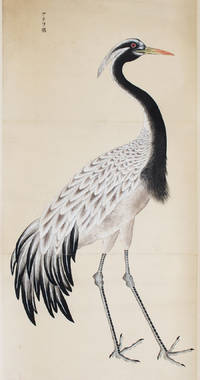
rif. 6952Scroll 420 x 12000 mm. with elaborate silk brocade endpaper at beginning. Japan: 1880-86. This beautifully rendered scroll of natural history paintings was executed with one exception by Akio or Keigu Yamamoto 1827-1903 Confucian scholar doctor botanist and highly gifted artist. He was born in Kyoto the son of the prominent doctor and botanist Boyo Yamamoto 1778-1859 the direct disciple of Ono Ranzan 1729-1810 the famous professor of botany who wrote a series of classic botanical books. Keigu “continued his father’s work in his private school in Osaka and spent his time organizing meetings that were regularly attended by both honzogaku amateurs and Japanese biologists.”–Federico Marcon The Knowledge of Nature and the Nature of Knowledge in Early Modern Japan p. 301. Keigu travelled widely throughout Japan drawing plants and animals. He gave botanical instruction to the Meiji emperor and other members of the royal family. Keigu also wrote several standard works on materia medica and left many sketch books and scrolls which entered the Kyoto rare book trade in 1932; some of these were published only in the 1980s. All of his sketch books and scrolls offered valuable and unique information regarding native plants and animals as well as those that had been introduced into Japan. Our scroll contains 14 very finely executed color paintings of plants birds and animals. The paintings are quite unique in their remarkable spaciousness. For instance the image of the octopus is 1410 mm. long. The images include a most unusual morning glory three joined sheets and 1190 mm. long; an edible yellow lily two joined sheets 800 mm.; an ungei flower two joined sheets 795 mm.; a magnificent red toki a now-endangered crane species three joined sheets 765 mm.; a large akowa tsuru another species of crane three joined sheets 815 mm.; a young white crane three joined sheets 935 mm.; a sea lion umiuso painted in many shades of delicate black two joined sheets 545 mm.; a carp two joined sheets 597 mm.; an octopus four joined sheets; a chameleon three joined sheets 844 mm. dated “1880”; a deer antler two sheets 545 mm.; a “Dutch” dog two sheets 545 mm.; a lion seen at exhibitions in Tokyo and Kyoto two sheets 640 mm. with a seal and note stating this was the work of “Ariyoshi” dated “1886“; and two camels two sheets 545 mm. long. Four of the paintings have the signature and seal of Yamamoto and another painting — the final — has the seal only. Three of the paintings have additional text by Yamamoto regarding where seen and painted alternative regional names date etc. Very fine condition preserved in a new wooden box. All but the penultimate painting are the work of Yamamoto. unknown books
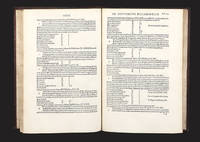
1494rif. 55951494. 148 leaves including the final blank Roman letter except for the two-line title in gothic type 51 lines & headline capital spaces with guide letters. Folio 290 x 188 mm. late 17th-cent. panelled English speckled calf rebacked with the orig. spine laid-down minor staining to a few leaves in blank upper margins. Basel: J. Amerbach 1494. First edition of the “first bibliography to be compiled as a practical work of reference.”–Grolier Club Bibliography 7. Tritheim 1462-1516 one of the leading polymaths of his age was appointed the 25th abbot of the monastery at Sponheim in 1483. “One of the first of his many self-imposed tasks was the reorganization and cataloguing of the monastic library if one can call reorganization the process of transforming forty-eight mongrel volumes into a splendid collection of 2000 printed books and manuscripts many of great importance and rarity… “It was during the progress of this work no doubt as his exceptional knowledge of books caused inquiries frequently to be addressed to him that he conceived the notion of compiling a new and ambitious bibliography of ecclesiastical writers. He began work in 1487 and by the spring of 1492 he was able to send the complete manuscript to the bishop of Worms. He then revised it and in 1494 the Liber de scriptoribus ecclesiasticis a folio of nearly 300 pages issued from the Basle press of Johann Amerbach… “From Alexander bishop of Cappadocia down to himself Tritheim sets out in chronological order nearly a thousand writers largely but not exclusively ecclesiastical giving a short account of each followed by a list of his or her writings. Nor are these lists merely perfunctory: it is obvious from such a heading as that for St. Augustine under which he enumerates 277 works that Tritheim must have lavished an immense amount of genuine research on his bibliography. In all about 7000 books are recorded. An alphabetical index of authors arranged of course by Christian names is added. The contrast between the feeble theological bibliographies of the manuscript age and this first attempt in the printing era is very striking.”–Besterman The Beginnings of Systematic Bibliography pp. 7-8. The title of the book is somewhat misleading since the work is not restricted to ecclesiastical writers but also includes authors such as Dante Poggio and Sebastian Brant. A fine and crisp copy of a book which has become uncommon on the market preserved in a box. Bookplate of the Society of St. John the Evangelist Cowley Oxford. With a note on the rear paste-down referring to “Derby” the Earls of Derby and a shelf-mark. ⧠Goff T-452. unknown books
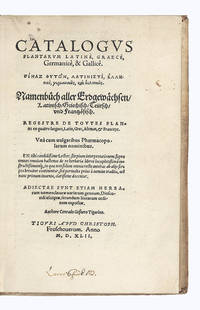
1542rif. 55061542. 4 p.l. 162 leaves. Small 4to cont. blindstamped panelled pigskin remains of two deerskin ties. Zurich: C. Froschauer 1542. First edition of a very rare book on the market; this is a lovely fresh copy in contemporary blind-stamped pigskin. This Gesner’s second botanical work is “an alphabetically arranged catalog of plant names in four languages the first of its kind and an indication of the growing interest in botany beyond purely philological investigations into the writings of the classics. The Greek names are based on the works of Dioscorides. This early work is already characteristic of Gessner’s life-long endeavour to arrange scientific topics in alphabetical or systematic order; it also show his proficiency in languages and his interest in their comparative treatment.”–Wellisch 8.1. A fine copy. Signature at foot of title of “Lucas Schröck M.D.” Schröck 1646-1730 was a professor of medicine at Jena and president of the Deutschen Akademie der Naturforscher see Hirsch V pp. 139-40. Early inscription on front free endpaper stating this is a duplicate from the Royal Library of Munich. Engraved armorial bookplate dated 1744 of Franziskus Topsl 1711-96 prior of the Polling Abbey in Upper Bavaria. Modern booklabel of D. Henry. Some minor worming to upper inner corner of first seven leaves touching a few letters of the first two leaves. ⧠Pritzel 3298. unknown books
rif. 7548151 folding leaves. Three parts in one vol. Thickish 8vo orig. patterned wrappers upper wrapper a little worn orig. block-printed title label on upper cover label somewhat defective new stitching. From the colophon: Kyoto: Nakamura Magobei 1710. First edition of this important and useful bibliography. In 1710 “the Kyoto publisher Nakamura Magobei compiled a catalogue known as Bengi shomokuroku. The aim of this catalogue was to help the reader disentangle book titles which could be easily confused because they were read in the same way because they used the same characters but different readings or because they were known by several titles…Nakamura Magobei included manuscripts kakihon and explained that he had ‘given the majority of the many titles of manuscripts that have been circulating since past times’.”–Laura Moretti “The Japanese Early-Modern Publishing Market Unveiled: A Survey of Edo-Period Booksellers’ Catalogues” in East Asian Publishing and Society Vol. 2 2012 pp. 206n & 245. Nice copy preserved in a chitsu. Some minor worming carefully repaired. ⧠Peter Kornicki The Book in Japan pp. 441-42–”The publication of Bengisho mokuroku in 1710 went considerably further. The author was Nakamura Magobee a Kyoto publisher and bookseller and it was written for fellow members of the book trade. He considered books printed with movable type as a separate category and was the first to draw up a catalogue of them. He directed some attention to the book trade which also explains his attention to the titles of books not yet published and to books with homophonic titles that could easily be confused. At the same time the compilation of catalogues for commercial and for private purposes was becoming commonplace and bespeaks a growing concern with the identification of books by their distinguishing characteristics.”. unknown books
1966rif. 53678Cambridge: W. Heffer & Sons Ltd 1966. Mixed edition set. Hardcover. Very good /very good. Large octavo. 3 volumes. xix 1 250; xxviii 368; xxxii 430pp. Indices. A very nice mixed set 1st & 2nd printings uniformly bound in original brown cloth spines lettered in gilt. Dust jackets. Illustrated with numerous photographic plates drawings maps & charts some folding. Dealer's rubber stamp on front free endpapers and extremities of dust jackets lightly rubbed otherwise near fine. Contents: The study of Chinese art and archaeology in China -- The exhibition of archaeological finds in China -- Tun-huang studies in China -- Animal styles in prehistoric and Shang China -- Floral patterns in Chinese decorative art -- Yin-yang wu-hsing and Han art -- The inconstancy of character structure in Chinese writing -- Numerals in ancient China -- Appendix I. Su Ying-hui : Tun-huang studies in the past seventy years -- Appendix II. Shih Hsio-yen : new problems in Tun-huang studies -- Appendix III. Zhang Zheng-lang : an interpretation of the divinatory inscriptions in early Chou bronzes -- Appendix IV. West China Union University Museum. W. Heffer & Sons Ltd hardcover books
1928rif. 50839London: Oxford University Press Humphrey Milford 1928. Second printing of the 1st edition. Hardcover. Very good. Small quarto 9-1/4" x 7-3/4". xi 1 96pp. Original black cloth gilt lettered spine with gilt publisher's device at foot and central gilt decoration on front cover. Illustrated with a color frontispiece and 6 plates 4 in color plus 9 additional black & white photographic plates of Mandu palace bound in at rear. Text in English. Oxford University Press, Humphrey Milford hardcover books
1944rif. 41711New York: Morgn-frayhayt 1944. Second edition. Hardcover. g- to vg. Octavo. 168pp. Brown illustrated faux-leather boards with red lettering on front cover and spine. Illustrated endpapers. The work contain amusing illustrations from acclaimed artist William Gropper throughout and focuses on the environment of working-class American Jews in the 1920s. Text in Yiddish. Binding with some rubbing to spine boards and corners. Book block tight. Binding in overall good- interior in very good condition. Benjamin Gold 1898–1985 was an American labor leader and active communist party member. William Victor "Bill" Gropper December 3 1897 – January 3 1977 was a U.S. cartoonist painter lithographer and muralist. A committed radical Gropper is best known for the political work which he contributed to such left wing publications as The Revolutionary Age The Liberator The New Masses The Worker and The Morning Freiheit. Morgn-frayhayt hardcover books
1958rif. 38938Tel Aviv: Edition "Olamenu 1958. First edition. Hardcover. g to vg. Folio. 12172 82281pp. Original red paper-covered boards decorative paper-covered board of deluxe edition of volume two with gilt lettering on cover and spine in original photo-illustrated dustjackets. Illustrated title page in vol. 1 color reproduction of a painting tipped-in on title page of vol. 2. Comprehensive history of the Jews in the administrative division of the Habsburg Monarchy known as the Bukovina an area now spilt between Romania and the Ukraine. Contributions by Dr. Samuel Josef Schulsohn Dr. Manfred Reifer Dr. N. M. Gelber and Dr. Leon Arie Schmelzer give a detailed account of the Jewish migration after the destruction of the first temple and the erection of the second temple tracing Jewish presence in the area north and northwest of the Black Sea Schulsohn the era of the Moldavian Counts from 1360-1774 Reifer the Habsburg Monarchy until 1914 Gelber and the time from 1914-1919 Schmelzer. Additional contributions by various historian cover the whole spectrum of the Jewish culture in Moldavia through the ages. Illustrated with numerous additional plates with b/w photographs mostly portraits groups and relevant architecture. Text in German. Dustjackets rubbed with light sunning of spines. Very light age toning of blocks. Dj in overall good binding and interior in very good condition. Edition "Olamenu hardcover books
2014rif. 38230New York: Assouline Publishing 2014. First edition. Hardcover. g to vg. Folio. 176pp. Original photo-illustrated dust-jacket over paper covered boards with silver lettering on spine and front cover. Half-title signed by both authors. "Mitchell Gold Bob Williams are known for producing beautiful and environmentally conscious home furnishings at friendly prices. After a quarter century in business the founders of this revolutionary company are celebrating the 25 characteristics that distinguish them. With gorgeous images of the furniture the people the groundbreaking ads and more "Who We Are" is the perfect accessory for your Mitchell Gold Bob Williams coffee table" from the publishers. Minor shelf wear. Dust-jacket in overall good binding and interior in very good condition. Assouline Publishing hardcover books
1693rif. 14396London: Printed by S. Roycroft for W. Bentley 1693. First edition. Hardcover. fair. 12mo. 32312pp. Original calf. Raised bands. Top and bottom part of spine crudely repaired with cello-tape. Scuffing rubbing and some staining to boards and spine. Wear to edges and corners. Pencil writing to front endpapers. Signature of previous owner on title page. Minor age browning to pages not affecting text. According to Cushing Querard Halkett and Laing Gabriel d'Emilliane is the pseudonym of Antonio Gavin Gauin. D'Emillianne was born in Spain became a secular priest in the Church of Rome and in 1715 was appointed minister of the church of England. Binding in fair interior in good condition. Printed by S. Roycroft for W. Bentley hardcover books
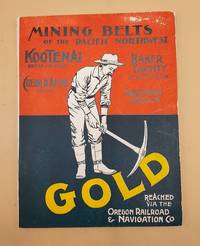
1897rif. 63736Portland OR: Issued by the Passenger Department of the Oregon Railroad and Navigation Company 1897. First edition. Good. 68pp. With Map. Covers detached but present map still attached to rear wrap. There is a small abraded area in the top fore-edge corner of the title page. The map has a handful of small closed tears. Scarce. The map entitled "Oregon Railroad and Navigation Co. Map of Principal Mining Districts of the Pacific Northwest" has an inset of the "Baker City Mining Region." From the opening of the text- "What the typical easterner never read or heard or imagined of that vast and varied empire vaguely characterized as The West includes about all there is to be told or written of it. Half the world- a mighty hemisphere incomparable in grandeur incomputable in riches and illimitable in possibilities- lies west of all their geographies. Their maps are all too narrow their ideas all too small. 'Having eyes they see not and having ears they hear not; neither do they understand' that all the boundless productive powers and possibilities of the new-world republic lie in the matchless region which they in their arrogant ignorance stigmatize as 'the wild and wooly west.' Issued by the Passenger Department of the Oregon Railroad and Navigation Company unknown books