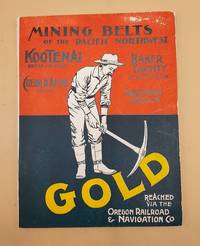
1897rif. 63736Portland OR: Issued by the Passenger Department of the Oregon Railroad and Navigation Company 1897. First edition. Good. 68pp. With Map. Covers detached but present map still attached to rear wrap. There is a small abraded area in the top fore-edge corner of the title page. The map has a handful of small closed tears. Scarce. The map entitled "Oregon Railroad and Navigation Co. Map of Principal Mining Districts of the Pacific Northwest" has an inset of the "Baker City Mining Region." From the opening of the text- "What the typical easterner never read or heard or imagined of that vast and varied empire vaguely characterized as The West includes about all there is to be told or written of it. Half the world- a mighty hemisphere incomparable in grandeur incomputable in riches and illimitable in possibilities- lies west of all their geographies. Their maps are all too narrow their ideas all too small. 'Having eyes they see not and having ears they hear not; neither do they understand' that all the boundless productive powers and possibilities of the new-world republic lie in the matchless region which they in their arrogant ignorance stigmatize as 'the wild and wooly west.' Issued by the Passenger Department of the Oregon Railroad and Navigation Company unknown books
2003rif. 183905East Sydney Australia: Studio Magazines 2003. Magazine. 112p. 9.5x13 inches profusely illustrated with both color and b&w physique and homoerotic photography very good first edition oversized trade paperback quarterly magazine in color pictorial wraps. Studio Magazines unknown books
2001rif. 332001Halifax: Fernwood Publishing 2001. 191p. paperback; b&w photos. covers slightly handled else in very good condition. Fernwood Publishing unknown books
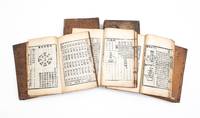
1634rif. 107041634. Several woodcut illus. in the text. 25 vols. Folio 346 x 230 mm. orig. wrappers rubbed & several with some wear three vols. with some staining occasional minor foxing orig. stitching. HansÅng: colophon in Vol. 2 dated 1634. Second edition 1st ed.: 1613 of a very great rarity “the greatest of all Korean medical treatises which devotes its last chapters to acupuncture and moxibustion.”–Lu & Needham Celestial Lancets p. 263n. It is considered to have one of the finest classification systems in traditional East Asian medicine. HÅ Chun 1539/46-1615 was a court physician of the Yangcheon HÅ clan during the reign of King Seonjo 1568-1608 of the Joseon dynasty in Korea. During the Japanese invasion of Korea 1592-98 HÅ faithfully accompanied the king through numerous difficult campaigns. Following the conflict the king commissioned HÅ to write a medical book for his citizens who suffered from post-war famines and epidemics. In 1610 HÅ completed his masterwork which was first published in 1613 an even rarer book. The Tongŭi pogam is divided into five broad sections: internal medicine four vols. external medicine four vols. miscellaneous diseases 11 vols. herbal remedies three vols. and acupuncture one vol. all preceded by a most useful two-volume Table of Contents. In the first section on internal medicine HÅ describes the interdependence of the liver lung kidney heart and spleen. The section on external medicine explains how the skin muscles blood vessels tendons and bones allow for movement and maintenance of posture. The part on miscellaneous diseases describes the symptoms diagnoses and treatment methods of various diseases. HÅ’s remedies rely on readily found medicinal herbs and plants and he provides impressively detailed instructions on how to extract maintain and consume the herbs. The last section explains acupuncture strategies. The work spread to other East Asian countries like China Japan and Vietnam and is still regarded as one of the classics of Asian medicine. “The Treasured mirror of eastern medicine was in fact one of the very few non-Buddhist works written outside China that achieved a wide circulation within China. It was written by HÅ Chun 1539-1615 as a summation of Korean medical knowledge and was printed in Korea in 1613. Copies were sent directly to China in 1721 and 1728 and a copy reached Japan in 1681. A revised edition was printed in Japan with glosses in 1724 and again in 1799; copies of the 1799 edition were sent to China via Nagasaki in 1811 and 1837. The Treasured mirror of eastern medicine was reprinted in China in the eighteenth and nineteenth centuries either from the Korean edition or from one of the Japanese editions with the glosses removed. This was a rare sign of high esteem for a book written outside China.”–Peter Kornicki Languages Scripts and Chinese Texts in East Asia Oxford: 2018 p. 144. HÅ Chun remains famous in Korea today: there are several recently created television series and films about him and his achievements; a best-selling novel about him was published in 1990; and a museum in Seoul is devoted to his life and works. A very good “married” set with the first volume of miscellaneous diseases coming from another set. One volume has a hole to about ten leaves touching a few characters. ⧠For an extended and excellent discussion of the contents and importance of this work see Yeonseok Kang “History and Characteristics of Korean Medicine” in Routledge Handbook of Chinese Medicine 2022 pp. 507-08. unknown books
1932rif. 008076New York 1932. First Edition. Wraps. Very Good. A souvenir for a High Society event that also involved the cream of the architectural field. Held at the brand new ultra-luxe Waldorf Astoria which had opened its doors at its new address on October 1 1931. Scarce -- no copies listed on OCLC First Search. 4to. 30 by 22 cm. 112 pp. plus wraps. With many advertisements especially for architectural firms and developers and these include often photographs and drawings of recently completed buildings or ones in the offing which were to become iconic -- the RCA Building as an example. Virtually all the ads relate to the building trades in one way or another including ads for brick companies heating or furnaces etc. Art Deco is the salient design although there are photos of private mansions in a range of styles found in upper crust suburbs to this day. The event itself was comprised of four "Episodes" in New York history. These were skits two of the Episodes having more than one scene in which the players drawn from the Upper Crust of New York Society both Old Knickerbocker and newer moneyed members surnames such as Pennoyer Schieffelin de Peyster van Alen a few descendants of the characters van Rensselaer but also at least one famous actress that being Beatrice Lillie with were decked out in period costume. The scenes re-enacted the arrival of the Half Moon in 1609 the purchase of Ma-na-ha-ta by Peter Minuet in 1626 Captain Kidd in New York in 1696 the Declaration of Independence as announced in City Hall Park July 9 1776 Washington's Inauguration in 1789 and the Inaugural Ball following. We would also mention that Tony Sarg was one of the people who put together the skits! Finally as befitting a Society event program there are copious lists of members of the various organizations and/or contributors to the event. Unlike today these lists provide the addresses of the listees many of whom were among the wealthiest New Yorkers of the day. First half dozen leaves have a distinct crease mark diagonally by the front corner. Front cover has light soiling and the like. Spine extremities with closed tears and wear. Clean within and overall a VG copy. unknown books
2000rif. 65964NY: HNL Publishing 2000. Paperback. Very good. Paperback. 197pp. Very good in publisher's wraps. HNL Publishing paperback books
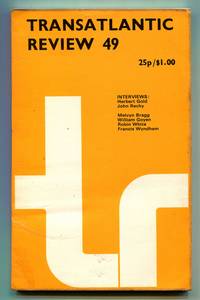
1974rif. 583878London: Transatlantic Review 1974. Softcover. Very Good. First edition. 160pp. Glossy printed wrappers. Lamination wrinkled on spine edges of covers soiled about very good. Includes interviews with John Rechy and Herbert Gold; additional contributions by William Hoffman William Goyen Steven Kroll Eileen Simpson Francis Wyndham and more. (Transatlantic Review) unknown books
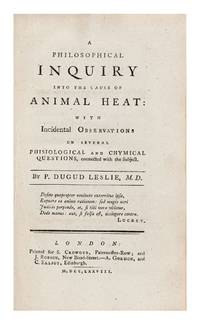
rif. 10694viii 362 pp. 8vo cont. tree calf flat spine gilt red morocco lettering piece on spine. London: S. Crowder & J. Robson 1778. First edition in English. “The greatly enlarged and only English version of Dissertatio physica inauguralis de caloris animalium causa Edinburgh 1775 by Patrick Dugud ca. 1755-1783 who changed his name to Leslie. In this work he further develops his ideas on the origin and maintenance of animal heat ascribing it to the presence of phlogiston. The second and major part pp. 91-352 discusses the nature and properties of phlogiston with good accounts of the theories of animal heat by Black Cullen Hales Lavoisier Priestley and others. The importance of this book in the history of chemistry is discussed by Partington and McKie Annals of Science 2 1937 384-387. Elected F.R.S. 1781 Leslie practiced as a physician in Durham but died prematurely at age twenty-eight.”–Neville II p. 58. Very nice copy with Christie’s facsimile bookplate of Matthew Boulton sold London December 1986. Boulton 1728–1809 manufacturer and entrepreneur was a partner of James Watt in the development of the steam engine. ⧠Cole 821–“The author has expanded his doctoral dissertation considerably and developed further his ideas concerning animal heat. Critical examinations are made of past and contemporary theories. Leslie gives an extended discussion of phlogiston.”. unknown books
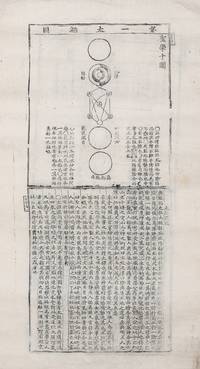
rif. 10716All sheets with woodblock diagrams. Ten woodblock-printed sheets each ca. 1045 x 580 mm. Korea: 18th or 19th century A very rare woodblock-printed broadside edition of the influential SÅnghak sipto by Yi Hwang 1501-71 “Korea’s greatest philosopher.”–Pratt & Rutt Korea. A Historical and Cultural Dictionary Curzon: 1999 p. 517. Yi a child prodigy was a scholar and government official. He served four kings in a number of high positions but his integrity and stand against corruption caused him to be relieved of his posts and sent into exile a number of times. “Yi Hwang better known by his penname T’oegye is generally reputed as Korea’s foremost Neo-Confucian thinker. From the very beginning of the Yi dynasty 1392-1910 the Neo-Confucian doctrine of the Ch’eng-Chu school was the officially sanctioned ideology but with T’oegye it arrived at its full maturity on the peninsula for he was the first to present it with a fully sophisticated and integral grasp of its scope unity and implications. Consequently his teaching became a constant reference point for subsequent generations of Korean Neo-Confucians and his understanding of Chu Hsi’s Zhu Xi’s vision exercised a profound and lasting influence… “One of his last and most important works was the Ten Diagrams on Sage Learning SÅnghak sipdo which he composed for the instruction of young King SÅnjo reigned 1567-1608 in 1568 two years before his death. Considered the summation of T’oegye’s lifetime of learning the Ten Diagrams became one of the classics of the Korean Neo-Confucian tradition: during the course of the Yi dynasty it was reprinted at least twenty-four times and it now circulates in three modern Korean translations… “‘Sage learning’ is a phrase that appears frequently in Neo-Confucian works meant for the instruction of rulers reflecting the view that the essential duty of a ruler is to learn from and emulate ancient sage kings. In terms of its origin the Ten Diagrams is certainly such a work. But T’oegye’s title is ambiguous for ‘sage learning’ also means ‘learning how to become a sage’ that is a fully perfected human being. This is a kind of learning that has to do with not only kings but every human being. Thus the provenance of this work is universal and through the centuries it has served as a basic handbook for generations of serious Neo-Confucians in their endeavor to understand and cultivate the full perfection of their humanity… “This kind of ‘sage learning’ in its full scope is a distinctively Neo-Confucian development. With the Neo-tradition revival of the tradition in the Sung dynasty Confucians finally developed a metaphysical psychological and ascetical framework that could fully describe the status of sagehood and delineate it. Sagehood became a practical goal rather than a theoretical ideal. T’oegye’s object in the Ten Diagrams is to present that framework and path… “Doing this of course amounts to presenting a structured summation of the essence of Ch’eng-Chu theoretical and practical learning. One could devote a large book to this topic; T’oegye compressed it into ten chapters each brief enough to be mounted on a single panel of a ten-paneled screen. Each chapter begins with a diagram and is followed by a text. T’oegye’s own remarks are only a short portion of each chapter. As far as possible he tried to make this a compilation of diagrams and words from other authoritative sources so that the work would clearly represent the cumulative wisdom of the Confucian tradition not just his own private opinion… “The compressed format is not a concession to hasty readers or beginners needing a simple introduction. Quite the opposite; whether as a short book or a screen placed in one’s quarters T’oegye intended this as a work to be lived with and absorbed slowly through repeated reading and leisurely reflection. In that way its compressed contents would unfold gradually and become a part of oneself through the lengthy and personal effort of apprehending its full meaning. The diagrammatic format he chose is ideal for such use for the categories correspondences and relationships suggested by spatial arrangement offer food for reflective thought far beyond the content of the words themselves. T’oegye could expect that the Ten Diagrams would be approached in this way because the Neo-Confucian approach to texts emphasized this kind of repeated reading prolonged reflection and personal assimilation. The theory was that reading should be a process of self-transformation not mere information gathering. T’oegye designed his Ten Diagrams precisely as a tool to be used in such a process.”–Michael C. Kalton “T’oegye’s ‘Ten Diagrams on Sage Learning’: A Korean View of the Essence of Chu Hsi’s Teaching” in The Journal of Korean Studies Vol. 7 1990 pp. 97-99–& see the rest of this wonderful article for the importance of this text which was influential in both Korea and Japan. The titles of the ten chapters are: The Diagram of the Supreme Ultimate The Western Inscription The Elementary Learning The Great Learning The Rules of the White Deer Grotto Academy The Mind Combines and Governs the Nature and Feelings Diagram of the Explanation of Humanity Diagram of the Learning of the Mind-and-Heart Diagram of the Admonition of Mindfulness Studio and Admonition on Rising Early and Retiring Late. As mentioned in Prof. Kalton’s essay these broadsides were intended to be made into a ten-panel standing screen. Fine condition and a remarkable survival. A few minor stains and a little dusty at extremities. We find no broadside edition in WorldCat. unknown books
1977rif. 178003New York: Arbor 1977. Hardcover. Very Good/Very Good. First edition. Very good or better in very good dust jacket. Book cover has minor rubbing. Dustwrapper has small stain along top of front cover. Arbor hardcover books
1958rif. 166500New York: Doubleday 1958. Hardcover. Very Good/Very Good. First edition. Very good in an about Very good dustwrapper. Light rubs at bottom of book spine. Dustwrapper has rubs along top edge at spine ends and corners. Doubleday hardcover books
1963rif. 265291New York: Dial 1963. Hardcover. Very Good. Very good hardcover. Text clean. Spine faded. Spine ends bumped. Dial hardcover books
1974rif. 212969New York: Bantam 1974. Softcover. Very Good. Very good paperback. The book spine ends and cover edges have light wear. The book spine has a light crease. The text is clean. Bantam unknown books
1989rif. 270685New York: Viking 1989. Hardcover. Very Good/Very Good. First edition. Very good in very good dust jacket; Book shows bumping of corners/ends and Spine/spine hinge dust jacket shows small stains on front panel. Viking hardcover books
1957rif. 184300New York: Doubleday & Company Inc 1957. Hardcover. Fine/Very Good. First edition. Cover corners and bottom spine end bumped else fine in a Very good dust jacket corners and spine ends worn with a few tiny tears on top spine end lightly browned spine a few insignificant stains on covers. Doubleday & Company, Inc hardcover books
1991rif. 159942New York: Alfred A. Knopf 1991. Hardcover. Fine/Fine. First edition. Fine in fine dust jacket. Alfred A. Knopf hardcover books
1958rif. 1394014Rindge: Richard R. Smith Publisher 1958. Hardcover. Octavo xi 196 pages. In Good condition with a Fair minus dust jacket. Spine is tan with black print. Dust jacket has edgewear with small tears at spine ends and flap corners small portions at spine ends are torn away toning to spine peripheral toning. Price clipped. Boards quarter bound with green cloth to spine and cream paper to boards. Wear to spine caps and corners. Text block has name in ink on front pastedown. NOTE: Shelved in Netdesk Column P. 1394014. FP New Rockville Stock. Richard R. Smith Publisher hardcover books
rif. 10493Woodblock-printed map 830 x 1715 mm. finely hand-colored. Edo: Sagamiya Tahei 相模屋太兵衞 1697. The 1697 printing of Ishikawa’s famous map of Japan; a less complex printing was first issued in 1691 an earlier version with a different title appeared in 1689. The series of maps published by Ishikawa an ukiyo-e artist “established a model for woodblock maps throughout most of the eighteenth century. Works based on Ishikawa's original version and published mainly in the area of Edo are referred to as Ryūsen-type maps of Japan. Ishikawa’s maps were both decorative and practical and they served as a combined Who’s Who and travel map. Useful information to administrators travelers and the general public included the names of feudal lords the standard productivity of the land in koku of rice and important and scenic places along the routes. Each new edition tended to expand both the informative and ornamental aspects of the work.”–Kazutaka Unno “Cartography in Japan” in The History of Cartography Vol. 2 Book 2 Chicago: 1994 pp. 412-13. Our map is finely hand-colored showing fiefdoms and includes lists of important place names and shrines a chart of tidal variations and a chart of seasonal changes. Another chart gives distances from Nagasaki to far-away destinations such as Holland Indonesia Thailand the Philippines and several port cities of China. The main highways are shown as well as the inland and coastal sea routes. Also indicated are post stations on highways such as the TÅkaidÅ running from Edo present-day Tokyo to Kyoto and the distances between stations. Thanks to the beautiful colors and wealth of information Ryūsen’s maps became very popular and this style of map set the pattern for most published maps of Japan for the next century. In the extremities of the map small portions of China Korea Ryūkyū and Hokkaido are shown. Fine copy. Short clean splits in a couple of folds. Well-backed and minor worming mended. ⧠Mary Elizabeth Berry Japan in Print. Information and Nation in the Early Modern Period California: 2006 pp. 2-3–The map is “so legible and packed with information that it has been revised and reissued annually since its first publication in 1689. It charts the nation’s provinces and castle towns land and water routes famous sites and scenic places. It labels every ferry crossing and every post station along the major highways listing the distances between stops in an index. Thick with social and political geography it also identifies all regional lords or daimyo with notes on the gross productivity of their domains.”. unknown books
1948rif. 1393217Hinsdale: Henry Regnery Company 21948. Hardcover. Octavo 145 pages. In Good condition. Spine is blue with black print. Boards in blue cloth. Light wear to spine caps and corners toning to spine peripheral toning. NOTE: Shelved in Netdesk Column P. 1393217. FP New Rockville Stock. Henry Regnery Company hardcover books
1969rif. 702801NY: Random House. 1969. Very Good in Very Good DJ. Unless otherwise noted our first editions are first printings. First Edition. Hardcover. Very Good. Random House hardcover books
1990rif. 702796NY: Prentice Hall Press. 1990. Advance Reading Copy. Very Good in wrappers. Unless otherwise noted our first editions are first printings. First Edition. Softcover. Very Good. Prentice Hall Press paperback books
1980rif. 702800NY: Arbor House. 1980. Very Good in Very Good DJ. Unless otherwise noted our first editions are first printings. First Edition. Hardcover. Very Good. Arbor House hardcover books
1988rif. 708070NY: Donald I. Fine. 1988. Very Good in Very Good DJ. Unless otherwise noted our first editions are first printings. First Edition. Hardcover. Very Good. Donald I. Fine hardcover books
1993rif. 702797NY: Simon & Schuster. 1993. Advance Uncorrected Proof. Very Good in wrappers. Unless otherwise noted our first editions are first printings. First Edition. Softcover. Very Good. Simon & Schuster paperback books
1990rif. 702799Boston: Houghton Mifflin. 1990. Very Good in Very Good DJ. Unless otherwise noted our first editions are first printings. First Edition. Hardcover. Very Good. Houghton Mifflin hardcover books