17.607 risultati
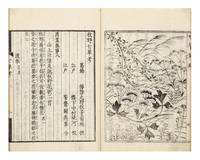
rif. 8333One full-page woodcut. .5 29 .5; 15.5 folding leaves. Two vols. 8vo orig. blue wrappers orig. block-printed title labels on upper cover later decorated wrappers later stitching. From the colophon at end of Vol. II: Edo Kyoto & Osaka: Hanabusaya Heikichi et al. 1812. with: —. Haru nanakusa ko Thoughts about Seven Herbs in Spring. Three full-page woodcuts & nine smaller woodcuts in the text. .5 36 folding leaves. 8vo orig. blue wrappers as above later decorated wrappers later stitching. From the colophon: Edo: Yamashiroya Sahei 1814. First editions a rare complete set of these two works which are concerned with two important seasonal celebrations. The first of the year is the Festival of Seven Herbs in Spring Nanakusa no sekku a traditional Japanese ritual of eating seven-herb rice porridge on the 7th of January; its consumption would bring longevity and health and ward off evil. The tradition derives from ancient China. The seven herbs are seri Japanese parsley nazuna shepherd’s purse gogyo cudweed hakobera chickweed tahirako nipplewort suzuna turnip and suzushiro daikon radish. The other is the Festival of Seven Autumn Herbs Akino nanakusa less well known then the spring celebration. These herbs are hagi bush clover obana/susuki Japanese pampas grass kuzu kudzu nadeshiko Japanese dianthus ominaeshi Patrinia scabiosifolia fujibakama Eupatorium fortunei and kikyo balloon flower. While many of them have medicinal qualities for this festival they are not for eating but for viewing and admiring. Kikuu Kitano 1762-1831 a native of Sendai came to Edo in the 1780s and opened an antiques gallery that enjoyed great success. In 1804 he purchased a large piece of land in the Mukojima section of Edo where he established a botanic garden today known as the Mukojima Hyakkaen Garden. It is Tokyo’s only surviving garden from the Edo period. There he planted a landscaped orchard of 360 plum trees and other plants including the seven herbs of both spring and autumn selected by Kitano and his literati friends both poets and painters. These works are very beautifully printed using a wide variety of character styles to express meanings and authorship. The first two volumes to be published — on the autumn festival — contain a fine full-page woodcut designed by the author showing all seven herbs. The text contains references to each herb in waka and kanshi Chinese poetry written by Japanese a guide to understanding the nuances of the poetry and the botanical literature. The spring festival volume published two years later describes each of the seven spring herbs and their uses in medicine and gastronomy with many references to the Japanese botanical literature. There is a long passage on how to prepare the springtime porridge. The woodcuts depicting each of the seven herbs are by prominent artists including Kita Busei 1776-1856 and an unidentified woman artist. PROVENANCE: With the seals of Mayori 1829-1906 and Mamichi 1866-1925 Kurokawa prominent father and son book collectors. Their collection was largely concerned with botanical and herbal books; most of the collection was destroyed in the great Kanto earthquake. Our set later entered the collection of Frank Hawley scholar and one of the most discerning collectors of Japanese books and manuscripts. His stamp appears on the first page of text. See R.H. van Gulik’s “In Memoriam. Frank Hawley 1906-1961” in Monumenta Nipponica Vol. 16 No. 3/4 Oct. 1960-Jan. 1961 pp. 434-47. Fine set preserved in a fine chitsu. With some mostly marginal worming much of which has been carefully repaired. unknown books
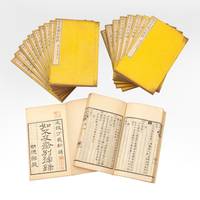
rif. 835348 parts & one index in 20 vols. 8vo orig. yellow wrappers orig. block-printed title labels on upper covers new stitching. Kubota: Meitokukan Academy 1827. Second edition 1st ed.: 1825 and rare; this was printed in the Kubota domain in northwestern Japan. Following the death of his father in 1785 Yoshimasa Satake 1775-1815 became daimyo of the Kubota domain in Dewa Province modern-day Akita Prefecture. He instituted a number of reforms ordering the planting of extensive windbreaks to improve crop yields; encouraged the mining silk and lacquerware industries; instituted land reforms; dismissed incompetent and corrupt officials; and hired forestry management experts. He also established the domain academy the Meitokukan “House of Virtues” which developed an active publishing division. The present work is a rare example of an early publication from the school which specialized in Chinese learning and Confucian traditions. The Preface was written under the pseudonym “Rakuo” by Sadanobu Matsudaira 1758-1829 who instituted the “Kansei Reforms” of 1789-1801 which included a number of educational changes improving the quality of learning through Japan. The compiler of this work Ichimei Suzuki d. 1818 was a teacher at the Meitokukan and was encouraged by Satake referred to here by his pen name “Jofukyusai” to prepare this work. It is a list of pseudonyms of authors and other people of the Three Kingdoms era 220-80 AD in China with biographical sketches of each person. For each name Suzuki and his fellow compilers have given citations of the Chinese books in which they were able to determine the actual names. Fine and fresh set preserved in two old chitsu. With the “Kanda ke zo” seal of the Kyoto collector Kogan Kanda d. 1918 who formed a large and fine library which was inherited by his grandson Kiichiro Kanda. unknown books
rif. 720220 pp. 8vo 198 x 125 mm. modern aubergine cloth head of spine a little worn title on upper cover. Paris: Félix & Regnault-Delalande 1822. An extremely rare auction catalogue inventorying the collection of an obscure painter active at the turn of the century. A contemporary annotator has written in the surname for this anonymous sale on the title-page corroborating Lugt’s attribution. An 1817 almanac of Paris records a painter with the same surname working at rue de Rohan 6. Viglianis also exhibited a landscape at the 1814 Salon — no. 948 in the exhibition livret. 184 lots consisting primarily of prints lots 1-132 by artists such as Bartolozzi Bervic Bloemaert Cochin Le Bas Desnoyers Earlom Green Ingouf Massard Morghen Strange Wille Woollett etc. We then find original engraved plates by a number of contemporary artists. The final section of drawings includes the work of Bruandet S. Gessner H. Robert and “Joseph Pascal Viglianis” presumably the seller. With the list of vacations on the final page. A very rare catalogue in fine condition. In the characteristic binding of the Bibliothèque Heim. ⧠Lugt 10220. unknown books
rif. 696929 pp. 8vo 206 x 132 mm. disbound stitched as issued. Paris: Henry & Olivier 1815. The scarce catalogue of an auction directed by Bon-Thomas Henry 1766-1836 first a painter then a respected dealer and tasteful collector. The supposed consigner “La Baronne de Vez” was very probably fictitious. This sale consisting mostly of Northern pictures offered 76 lots of paintings and 11 lots of engraved stones. Henry has contributed informative descriptions for most of the pictures. Attributed here to P. de Hooch lot 36 now at the Frick is today credited to Hendrik van der Burgh. Nice copy a little foxed. Stamp of the Bibliothèque Heim on upper wrapper. ⧠Lugt 8764. Oxford Art online Henry–“He studied under Charles Landon and Jean-Baptiste Regnault. In 1793 he began to deal in pictures and until 1812 spent part of his time travelling abroad mainly in Italy to increase his knowledge of art. In October 1816 he was appointed Commissaire-expert des Musées Royaux a post he held until his death. Between 1810 and 1830 he assembled an eclectic collection purchasing either privately or at sales among them the posthumous sales 1826 and 1827 of Vivant Denon. His tastes in Italian art ranged from the work of Fra Angelico to that of the 17th-century Bolognese masters…In 1834 Henry offered a large part of his collection to the town of Cherbourg and on 29 July 1835 a museum to house his works was opened on the second floor of the Hôtel de Ville; it was later named the Musée Thomas-Henry.”. unknown books
rif. 699232 pp. 8vo 195 x 129 mm. late 19th-century marbled boards spine a bit rubbed red morocco lettering-piece on spine. Paris: Bonnefons & Henry 1818. A very scarce sale catalogue mostly priced; we locate no copy in North America. A later 19th-century pencil inscription in the present copy as well as in two other inscribed catalogues suggests that the contents of this auction belonged to the art collector Hippolyte de Livry 1765-1834 — not to be confused with the author of the same name. Our Hippolyte had previously dispersed a portion of his collection through the expert and art critic Charles Landon in 1814 one sale but in two parts Lugt 8473 & 8515. The present catalogue details 134 lots of paintings by Boilly S. Bourdon Le Brun Guido Reni B. van der Helst Lairesse Largillière Oudry Leprince van Spaendonck D. & A. Teniers Tintoretto J. Vernet Veronese Vouet etc. and various curiosities lots 119-134 including sculptures clocks vases and drawings. Each painting is listed with measurements. In very good condition. Engraved bookplate of Georges Pannier 1853-1944 the Parisian art dealer and collector of auction catalogues on the front paste-down and stamp of the Bibliothèque Heim on verso of title. ⧠Lugt 9325. unknown books
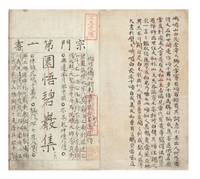
rif. 7036Printed in Chinese with Japanese reading marks. 11 columns per page 21 characters per column. 79; 59; 51; 49; 67 folding leaves. Ten parts in five vols. 8vo 240 x 149 mm. orig. brown wrappers new stitching. Japan: mid-Muromachi ca. 1440-50. An extremely rare and important “mid-Muromachi” Gozan-ban edition of The Blue Cliff Record in Chinese: Pi yen lu a collection of Chan Buddhist koan. These were verbal tests used to practice or test a student’s progress in Zen compiled in the Song Dynasty and expanded by the great Northern Song Chan master Yuanwu Keqin 1063-1135 abbot of Tianning Wanshou Chan Monastery in Beijing. The text was first printed in China in 1125 or 1128 and has long been celebrated for both its startling beauty and profound complexity. Around 1140 one of Yuan Wu’s successors Ta Hui destroyed the printing blocks and copies of the Pi yen lu because the work’s rapid and widespread popularity made him fear that its beauty of expression would distract its readers from seeking enlightenment directly within themselves. The text was brought back from China by Dogen 1200-53 the Japanese Buddhist priest who was a founder of the Soto school of Zen in Japan. He had studied in China for four or five years and returned to stay at the Kenninji temple where he introduced many texts. This text was first printed in Japan about 1336-50 early-Nanbokucho by Gyokuho Shorin at the Kenninji; there is a copy at the National Diet Library. Our edition is a reprint of that first Japanese edition using the same woodblocks with minor changes. A later edition appeared in the Donald and Mary Hyde sale lot 65. “For some time Chan monks had been in the habit of extracting snippets from the ‘records’ yulu of past masters isolated them as ‘ancient precedents’ and commenting on them sometimes in verse sometimes in prose. By the mid-eleventh century the core situation was known as a ‘case to be investigated’ or a gong’an. The process was incremental and difficult to stop. Yuanwu’s Emerald Cliff Record for example took a previous eleventh-century collection entitled Master Xuetou’s verses on a hundred old cases and added an introduction and extensive commentary to each ‘case’ sometimes also dropping in comments on the appositeness or more usually inappositeness of the relevant verse so becoming in his turn ‘magistrate.’ A gong’an collection therefore reveals many layers all of them dedicated to undercutting the stability of language while at the same time playing a complex game of competing authorities. Herein lies their fascination.”–Richard Bowring The Religious Traditions of Japan Cambridge U.P. p. 301. “Gozan-ban is a general term embracing all those books published by monks of the Zen sect chiefly at the five Zen monasteries at Kamakura and the five at Kyoto over a period of more than 200 years between mid-Kamakura and late Muromachi. The appearance of the printed page in most Gozan editions follows a distinctly Chinese style. The effect is somewhat dense and crowded caused by packing the Chinese characters tightly together with more regard for economy of space than for aesthetic effect. In this the Gozan editions differ markedly from all other early Japanese printed books which are more generously spaced. The reasons for this are twofold: the books tend to be chiefly reprints of Chinese song and Yuan editions and during the fourteenth century many Chinese blockcutters came over from the continent and practised their craft of a semi-commercial basis and on a fairly large scale.”–K.B. Gardner “Centres of Printing in Medieval Japan: late Heian to early Edo period” in British Library Occasional Papers 11. Japanese Studies ed. by Yu-Ying Brown London: 1990 p. 164. PROVENANCE: This copy has the seals of Hirokata Yashiro 1758-1841 “Shinobazu Bunko”; Awa no Kuni Bunko; and Goroza Uchino b. 1873 “Kyotei Bunko”. It later belonged to the great collector and bibliographer of early Japanese books Kazuma Kawase 1906-99 and has his seal. The chitsu has Kawase’s manuscript title label stating in trans.: “Gozan-ban. Hekiganroku. Mid-Muromachi edition. Shinobazu Bunko provenance. Kazuma put the title on this label” also with his seal. There are four Prefaces: the first is undated the second dated 1300 the third dated 1305 and the fourth is dated 1304. Two leaves of manuscript probably written by Yashiro have been inserted at the beginning of Vol. I. They provide a commentary and a sort of title-page the work was issued without a title. Following Part I there are another two leaves of manuscript relating to this text. Following the tenth part are five Afterwards dated 1125 undated 1302 1317 and 1317. In fine condition all contained in a modern wooden box. The top of the box has been covered in a most attractive silk brocade. A few natural paper flaws and minor staining. Berkeley has an edition of this text but because of the very vague WorldCat cataloguing it is impossible to tell which exact edition it is. ⧠Kornicki Language Scripts and Chinese Texts in East Asia p. 245. unknown books
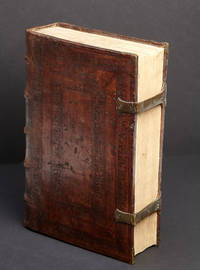
rif. 6759Numerous fine woodcut initials diagrams tables & maps in the text. Woodcut printer’s device at end. 14 p.l. 18 leaves 6 leaves 30 xxxi-cxxvi leaves 4 leaves. Folio cont. Flemish blindstamped calf binding over wooden boards rather well rebacked a few unimportant stains rolls of medallion heads & foliage forming a double panel orig. clasps and catches metal corner guards. Cologne: J. Prael for P. Quentel 1537. bound after: ANSELM ARCHBISHOP OF CANTERBURY. In Omnes Pauli Apostili Epistolas enarrationes. Title within fine woodcut border by Anton Woensam of Worms. Some fine large woodcut initials. 8 p.l. 531 pp. Folio. Cologne: E. Cervicornus for G. Hittorp 1533. A most attractive sammelband of two well-illustrated books in an attractive contemporary blind-stamped binding probably made at the Stavelot monastery in Belgium. I. First collected and illustrated edition of the scientific writings of the Venerable Bede including De Natura Rerum dealing with cosmology and natural history and De Temporum Ratione a work on chronology that still exercises a considerable influence over our daily life today. This edition was edited and commented upon by Joannes Noviomagus i.e. Jan van Bronchorst of Nijmegen 1494-1570 philosopher and mathematician then a professor of philosophy at the Collegium Montanum in Cologne. It would appear that he used the manuscript at the Dombibliothek no. 103 of Cologne to prepare this edition. The De Temporum Ratione is a significant book in several ways. Most notably “this book helped to establish the custom of counting years from the birth of Christ. When we say that Queen Elizabeth II was born in 1926 not ‘in the 16th year of the reign of George V’ or ‘in the year 2678 after the foundation of Rome’ or in the ‘2nd year of the 481st Olympiad’ we are indebted to the Venerable Bede.”–Printing & the Mind of Man 16n. “Bede’s greatest practical effect was on the Western calendar. His decisions beginning the year calculation of Easter names of days and months calculations of eras and so forth in most instances finally determined usage that was only refined not changed by Gregorian reform.”–D.S.B. I p. 565. “The De Ratione Temporum first published in 1505 is particularly important. It contains a remarkable theory of tides based upon Pliny but also upon personal observation; first mention of the establishment of a port i.e. the mean interval between the moon’s meridian passage and high water following; this interval is different in different ports.”–Sarton I p. 511. Pierre Duhem described Bede’s establishment of a port as the only original formulation of nature to be made in the West for some eight centuries. Also contained here is the De Natura Rerum 1st printing: 1529 which contains such physical science as was then known. It collects the wisdom of the ancient world on these subjects and has the special merit of referring phenomena to natural causes. It contains a particularly important section — the “De Comptu vel Loquela digitorum” — which is “our main almost our only source for the study of mediaeval finger reckoning or symbolism.”–Sarton I pp. 510-11. See also Smith History of Mathematics II p. 200. The rest of the book contains further treatises by Bede on arithmetic astronomy and the calendar and chronology. II. Very rare. PROVENANCE: Early inscription of “Antonius abbatis a Sancto Remaclo” on front flyleaf; Benedictine monastery of Stavelot Belgium inscription “Liber Monasterii Stabulensis” on title-page of Anselm; auction sale of the monastery library Catalogue d’une belle Collection de Livres et Manuscrits précieux sur vélin du VIIIe et du IXe siècle Ghent 26 April 1847 lot 42; Michel Chasles 1793-1880 the mathematician with bookplate his sale Paris 27 June-18 July 1881 lot 28; Robert B. Honeyman 1897-1987 his sale Sotheby’s 30 October 1978 lot 265. BINDING: Stavelot had its own bindery at this time and it is quite likely that this binding was executed there see Goldschmidt Gothic & Renaissance Bookbindings no. 90. Fine large copies preserved in a box. ⧠I. Adams B448–calling for two additional preliminary leaves but no other collation calls for them. Smith Rara Arithmetica p. 159n. Zinner 1657. II. Adams A1174. unknown books
rif. 6812Eight full-page drawings & one illus. in the text. 17 folding leaves. 8vo 243 x 165 mm. orig. blue semi-stiff wrappers some dampstaining to upper portion of each leaf. Japan: mid-Edo. Kagawa 1683-1755 a member of the medical family dynasty studied in Kyoto with Ryozan Goto and Jinsai Ito from whom he learned moxibustion and the therapeutic value of the waters of hot springs. Kagawa established the successful Ippondo medical school and was one of the most enthusiastic practitioners of moxibustion of his time. There is another manuscript of this text at Kyoto University attributed to Kagawa. Some of the illustrations are very different. The introductory remarks describe the importance of the precise placement of the moxa on the skin how to measure the placements based on distance from certain bones or joints of the body and the various techniques and occasions for moxibustion applications. Following this the text precisely describes the moxibustion locations on the body and how to locate each one with references to Simiao Sun’s classic text Qian jin fang Essential Prescriptions Worth a Thousand Gold Pieces compiled in 650-59. Kagawa lists many diseases and injuries for which moxibustion is appropriate. There is a most interesting section on how to treat unsuccessful moxibustion procedures application of certain ointments etc. The attractive illustrations depict moxibustion loci on an osteological background and loci on the stomach arms legs and feet. As mentioned above there is dampstaining to the upper fifth of each leaf but all the characters remain completely legible. unknown books
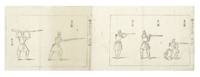
rif. 682128 folding engraved plates. 74; 86; 60; 35 folding leaves. Four vols. Oblong 8vo orig. patterned wrappers orig. block-printed title labels on upper covers new stitching. Tokyo: Government Publication issued under the Author’s name Yosoda Masayoshi a pen name for Tanabe 1869. First edition in Japanese translated from an unidentified French text which according to the Preface was issued in 1863 with a sequel in 1867. Tanabe also states that this work includes information gained from the French military mission of 17 men four officers ten non-commissioned officers and two soldiers led by staff captain Charles Sulpice Jules Chanoine who came to Japan in early 1867 at the request of the Japanese Shogunate for training in Western warfare. Several of these men became deeply involved in Japanese politics unsuccessfully fighting on the side of the Shogunate. Tanabe wrote several works on military subjects including military formations 1865 a glossary of French military terms with Japanese translations 1867 military gymnastics and training exercises 1868 and our work. This is a complete work on infantry drills and tactics including training of new soldiers how to form tactical units and deploy them effectively how to operate a variety of weapons etc. The fine copper-engraved plates depict military formations tactical positions military stances etc. Fine set. unknown books
rif. 6509Title within typographical border shaved at foot. 2 p.l. 14 pp. one blank leaf. Small 4to attractive antique panelled calf some shaving to bottom line or catchwords on several pages spine gilt red morocco lettering piece on spine. London: Printed by J.C. 1651. First edition. “The Reformed Husbandman…is sometimes attributed to Speed although it was probably written by Cressy Dymock…It is a pamphlet of some 16 pages and full of moral reflections a melodious exhortation to industry.”–Fussell I p. 45. “The most visible impact of Hartlib’s circle lay in the numerous pamphlets that he published…They comprised letters and treatises solicited or received from individuals in his circle upon a particular subject which had then been circulated for additional comments the results edited and then launched upon the public often without the express consent of the original author anticipating utility and inviting comment and amendment…His treatises spread a solvent of new ideas in a variety of contexts but they were particularly successful in husbandry. He publicized the advantages of planting new leguminous crops experimenting with fertilizers and manures and using seed drills and new ploughs and advocated the possibilities of apiculture rabbit farming fruit-tree propagation and silk cultivation in Virginia. His network included a group of innovative farmers willing to experiment. But his pamphlets should also be read as ideas models or patterns as to how the processes of reformation would occur. “–ODNB. Very good copy. Small rust-hole on one leaf. unknown books
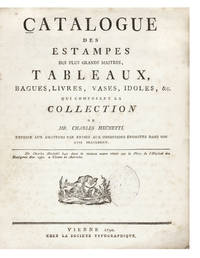
rif. 6413viii 120 pp. 4to cont. pale blue paper wrappers spine defective. Vienna: La Société Typographique 1790. The uncommon sale catalogue of the collections formed by the founder of the famous Viennese music publisher. Originally from Lucca Mechetti c. 1745-1811 encountered financial troubles and was forced to sell his collection of thousands of items primarily Italian prints and paintings. In the introduction Mechetti highlights certain pieces in his collection which was apparently not for sale by auction but rather private contract. Pages 113-20 describe a large library rich in books on the arts and history. Nice copy. This copy was inscribed on the inside front wrappers to the amateur geologist Baron de Beroldingen see Zittel. From the library of His Serene Highness Prince Fürstenberg at Donaueschingen with his stamp on title. ⧠Cicognara 4548. unknown books
rif. 6126Engraved frontis. viii 47 pp. 8vo later wrappers title a little browned uncut. London: Printed for W. Parker… 1777. First edition of “an important milestone in the early literature of gas analysis…Magellan 1722-90 was an Augustinian prior who emigrated to England and Protestantism in 1764. Elected F.R.S. 1774 he published this account of his researches on gases addressed to Joseph Priestley. The glass apparatus for impregnating water with fixed air carbon dioxide is described in detail. Newly improved by ‘Mr. Parker’ the apparatus was superior to that used by Priestley and described by him in 1772. Carbon dioxide was prepared by dissolving marble calcium carbonate in dilute sulphuric acid. Magellan also describes three new types of eudiometer he had designed; these and the apparatus for making carbonated waters are illustrated in the frontispiece.”–Neville II p. 125. Very nice copy inscribed by Magellan at the head of the title-page: “Comte de Castelbourgh par L’Auteur.” The attractive frontispiece depicts 24 figures of apparatus. ⧠D.S.B. IX pp. 5-6. unknown books
rif. 59282 p.l. 280 pp. 8vo cont. green sheep-backed marbled boards spine lettered in gilt. Paris: A. Labitte 1873. The first and most important private collection ever formed exclusively devoted to festivities; this sale catalogue has remained an indispensable work of reference to the present day. The 1200 lots are arranged under the sixteen different countries in which these festivities took place except for two amazing special sections: the first catalogues thirty-eight books published between 1515 and 1559 describing festivities and solemnities in honor of Emperor Charles V. The second describes almost 400 pieces concerning festivities held during the French Revolution offered in one lot but catalogued separately on pp. 259-277. Ruggieri d. 1885 was the last of a long line of Royal and Government “artificers” i.e. pyrotechnists which had been founded in 1730 when five Ruggieri brothers transferred themselves from Bologna to Paris. Fine and attractive copy. Original printed upper wrapper bound-in. ⧠Blogie col. 126. unknown books
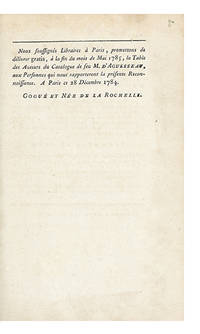
rif. 5858xxxvi 366 pp. one leaf but lacking as is often the case the 12-page schedule of sale & the 80-page author index. 8vo cont. speckled calf two corners a bit worn joints a little cracked but strong flat spine gilt red morocco lettering piece on spine. Paris: Gogué & Née de la Rochelle 1785. The rare sale catalogue of the great library of books and early manuscripts many illuminated founded by Henri François d’Aguesseau 1668-1751 Chancellor of France a man of great learning. According to the preface of the catalogue he had acquired the collection of the poet Florent Chrestien 1541-1596 and his son Claude b. 1567. His library passed to his second son Jean Baptiste Paulin d’Aguesseau Marquis de Mannoevre 1701-84 who considerably enlarged it. Between the two generations they created a most remarkable collection. The father and son employed fifteen versions of their coat-of-arms on their bindings. The sale included 5583 lots and was sold over a 57-day period. Payne and the Marquis de Méjanes were major buyers. Very good copy with some minor foxing. Short tear due to a paper flaw to title but with no loss of text. Bookplate of the great French bookseller Georges Heilbrun. As mentioned above this copy lacks — as does the Grolier Club copy — the schedule of sale and index but it does have a final leaf in which the auctioneers promise to deliver the index at no charge by the end of May 1785 to anyone who requests a copy. ⧠Gustave Brunet Dictionnaire de Bibliologie Catholique col. 405–“cette vaste réunion d’ouvrages importants.” Grolier Club Printed Catalogues of French Books Auctions…1643-1830 318–lacking both the schedule of sale and author index. Guigard II p. 173. Peignot p. 76. unknown books
rif. 4876Six folding engraved plates. 1 p.l. xvi 322 pp.; 1 p.l. 238 pp. Two vols. 8vo cont. marbled boards orange & pale blue lettering pieces on spines. Lausanne: J. Mourer 1789. First edition. Razoumovsky 1759-1837 a wealthy Russian aristocrat spent most of his life in Switzerland Austria and Italy and wrote many noteworthy works on geological and mineralogical subjects see Zittel pp. 91 & 119. “Very scarce…First and only edition of an illustrated account of the fauna and geology of the Swiss Jura in the vicinity of Neuchâtel Murten and Biel northwest of Bern…The first volume describes the fauna according to the Linnean system. The second includes a geological description with notes on mining minerals fossils etc. The illustrations cover zoology especially reptiles entomology and geology including fossils.”–Schuh Mineralogy & Crystallography: A Biobibliography 1469 to 1920 4045. Fine and attractive set. ⧠Poggendorff II 578-79. unknown books
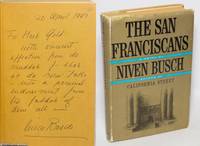
1962rif. 326742New York: Simon and Schuster 1962. Hardcover. 349p. stated first printing very good condition in price-clipped and shelfworn dj. From the library of Beat writer Herbert Gold. Signed and inscribed in a sort of in-joke dialect to Gold on front facing endpage. "20 April 1967 For Herb Gold: With sincerest affection from de muddah f--kkas at da two words indiscernible -- with a personal endorsement from the faddah of dem all-- Niven Busch Simon and Schuster hardcover books
1961rif. 326654New York: Basic Books 1961. Hardcover. 250p. light fading on the bottom edge of the spine lightly shelfworn otherwise very good condition in chipped and worn dj. From the library of Beat writer Herbert Gold. Inscribed by editor Rigney to Gold whose works are referenced twice in this volume. Two San Francisco psychologists take on a study of the Beat scene in the early sixties much on drug use and anti-establishment attitudes. Basic Books hardcover books
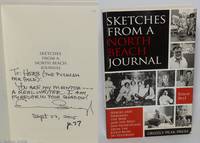
2015rif. 326733Kensington CA: Grizzly Peak Press 2015. Paperback. 221p. lightly shelfworn otherwise very good condition. From the library of Beat writer Herbert Gold the subject of a chapter herein. Inscribed to Gold "To: Herb The puckish Mr. Gold: You are my mentor--- a real writer. I am forever in your shadow! Ernest Beyl Sept 23 2015 p.77" On page 80 in the midst of Gold's chapter a sticky note laid in presumably by Gold that reads "Enough! Wrong in details Foolish in general but friendly. Grizzly Peak Press paperback books
1951rif. 1387095New York: The Viking Press 1951. First Edition First Printing. Hardcover. Octavo 370 pages. In Good plus condition with a Fair dust jacket. Spine greenish beige with black and beige lettering. Dust jacket protected with a mylar covering. Exterior has moderate plus wear including heavily slight soiling and some instances of chips to the head/tail edges. Boards have slight wear including sunning few small white marks and slightly rubbed head/tail edges. Text block has slight wear including mild age toning to the edges and head edge colored black. First edition first printing. NOTE: Shelved in Netdesk Column M ND-M. 1387095. FP New Rockville Stock. The Viking Press hardcover books
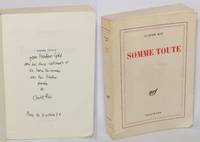
1976rif. 321037Paris: Editions Gallimard 1976. Paperback. 460p. text in French personal inscription in French to author Herb Gold signed and dated October 1976 by Roy good first edition paperback in cream printed wraps. Claude Roy's autobiographical writing personally inscribed to Gold. Claude Roy a French poet had been a member of the French Communist party but left after the 1956 Hungarian suppression. He was also involved with the Surrealists and signed the Manifesto of the 121 in support of Algerian Independence. Editions Gallimard paperback books
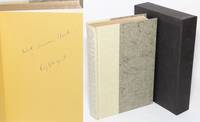
1964rif. 321144New York: Rand McNally 1964. Hardcover. 653p. inscription on flyleaf signed by Newquist limitation page states 319/2000 copies signed by both Newquist and Mark Van Doren very good first edition first printing stated in half-cloth boards in very good slipcase. Interviews with 63 writers actors photographers and others. From the library of Herbert Gold a contributor. Rand McNally hardcover books
1968rif. 321155Houston: Latitude Press 1968. Magazine. 80p. 8.5x10.75 inches poetry fiction profiles essays criticism photos corner bumped else very good magazine format literary journal. Interview with Miller. Profile of Gold. Five critics on the assassination of John F. Kennedy. Latitude Press unknown books
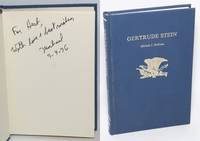
1976rif. 321055London & Boston: George Prior & Twayne Pub 1976. Hardcover. 159p. frontis-portrait of Stein preface chronology introduction conclusion notes & references selected bibliography index personal inscription to Herb Gold signed and dated 9/4/76 by the author very good first edition in blue buckram cloth and gilt. Twayne's United States Authors Series TUSAS 268 Sylvia Bowmnan editor. George Prior & Twayne Pub hardcover books
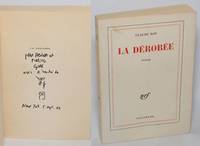
1969rif. 321049Paris: Editions Gallimard 1969. Paperback. 255p. text in French personal inscription in French to author Herb Gold signed and dated 1969 by Roy good first edition paperback in cream printed Frenchfold wraps. Claude Roy's novel personally inscribed to Gold. Claude Roy a French poet had been a member of the French Communist party but left after the 1956 Hungarian suppression. He was also involved with the Surrealists and signed the Manifesto of the 121 in support of Algerian Independence. Editions Gallimard paperback books
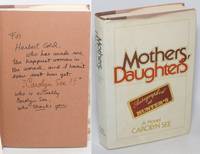
1977rif. 321058New York: Coward-McCann 1977. Hardcover. 288p. personal inscription signed by See to Herbert Gold very good first edition in quarter-cloth boards and price-clipped dj. See's third book. Coward-McCann hardcover books