17 480 résultats
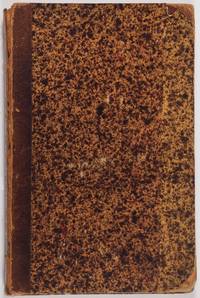
1796réf. 54848London: Printed for G. Sael 1796. Hardcover. Poor to very good condition. Octavo bound in three quarter calf over marbled boards containing eight pamphlets and ephemera. Binding with front cover and spine detached but present wear along edges with leather at corners missing. Illustrated book plate of Joseph Swift Whistler on inside front cover. Signature of three free endpapers title page and leaf with pages 1-2 loosely laid in. Short New York Times article on Shakespeare dispute from the 1940s laid in. Some sporadic offsetting and light foxing. 1. A Comparative Review of the Opinions of Mr. James Boaden Editor of the Oracle. .2 59 1pp. Original cream wraps with black lettering on cover authors and publishing date entered by hand. "It is not because the style or the matter of Mr. Boaden's Critical Examination of the Shakespeare MSS. appears to possess any intrinsic merit that it is made the subject of consideration in the following pages. Much less is this slight attempt dictated by any apprehension that the authenticity of those MSS. will be materially affected either by the arguments of such an examiner or the detection of his sophistry. But when an individual pretends to direct the taste of the public when relying on the fancied ingenuity and importance of his criticism he attempts to depreciate real merit it becomes at least necessary to examine the purity of his motives and the consistency of his conduct. The authenticity of the MSS. in the hands of Mr. Ireland must ultimately be refereed to a higher tribunal" First paragraph. "The "Shakespeare MSS." are the Ireland forgeries. Sometimes ascribed to Matthew Wyatt." Folger Shakespeare Library 2. An Historical Account of the Monumental Bust of William Shakespeare in the Chancel of the Church at Stratford-Upon-Avon Warwickshire. With critical remarks on the authors who have written on it by Abraham Wivell Portrait Painter. London. Published by the author. 1827. iv 28pp. Original tan wraps with black lettering and ruling on cover. Frontispiece engraving. With preface to the author's pamphlet of 1825. "The following remarks on the Monumental Bust of Shakespeare in the Church of the Holy Trinity Stratford-upon-Avon in Warwickshire is printed from my Pamphlet 1825 with additions." Page 5. 3. Traditionary Anecdotes of Shakespeare. Collected in Warwickshire in the Year MDCXCIII. Now first published from the original manuscript. London. Thomas Rodd. 1838. 19 1pp. Original cream wraps with black lettering on cover. Contains four page advertisement and the letter addressed to Mr. Edward Southwell signed "John at Stiles." The last page contains the printed text "10. April 1693 - From Mr. Dowdall Description of Severall places in Warwickshire" at top and "These for Mr. Southwell p' Sent." 4. Observations on an Autograph of Shakespeare and the Orthography of his Name. Communicated to the Society of Antiquaries by Sir Frederic Madden in a letter to John Gage. London Thomas Rodd. MDCCCXXXIII. 16 2pp. Light brown wraps with black lettering and triple framing on cover. Title page with facsimile of Shakespeare signature. Reprinted from the Archaeologia vol. xxvii pp. 113-123 with some corrections. 5. For Private Circulation Was Lord Bacon the Author of Shakespeare's Plays A Letter to Lord Ellesmere by William Henry Smith. London: Printed for the Author by Woodfall and Kinder. 1856. 15 pages. 6. Shakespeare No Deerstealer or A Short Account of Fulbroke Park Near Stratford-On-Avon. By C. Holte Bracebridge Sometime Hon. Sec. to the Shakespeare House Committee. London: Printed by Harrison and Sons. 1862. 4 original watercolor. 32pp. Extensive appendix notes A through F. 7. The Stratford Portrait of Shakespeare. Copies of communications to The Times made subsequent to that which appeared April 5th. The recently discovered portrait of Shakespeare. To the Editor of The Times. Two 1861 letter by Charles Weight with commentary. 4 pages. 8. The Stratford Portrait of Shakespeare and The Athenaeum; Also Ben Jonson; and the Macaulay-Penn Controversy; in Connexion with That periodical-or its Editor. "Jones is immortal until he is found out; and then down comes the extinguisher and the immortal is dead and burried." Roundabout Papers NO XII. Text by Charles Weight. 307 Regent Street W. May 31st 1861. 19 pages. "The "New Facts" of the Athenaeum in reference to Ben Jonson Examined. And some facts of real importance in relation to the Macaulay and Penn Controversy Displayed. Printed for G. Sael hardcover books
1996réf. 49643Leiden: E.J. Brill 1996. Hardcover. Fine. 8vo. vi24913pp. Indices and bibliography. Blue cloth front cover & spine stamped in gilt. This is a reviewer's copy with the reviewer's extensive and interesting comments on post-it notes throughout the text. Volume VII in the series "Studies in the History and Culture of the Ancient Near East. S.H.A.N.E. E.J. Brill hardcover books
1900réf. 45326Cambridge: Cambridge University Press 1900. First edition. Hardcover. g to vg. Small folio 12 x 9 1/2". viii 2 438pp Vol. 1; vii 3 597 1pp Vol. 2. Modern blue cloth with gold lettering to spines. Rare first edition of this first catalogue of the Greek manuscripts on Mount Athos a mountain and peninsula in northeastern Greece and an important centre of Eastern Orthodox monasticism. In this 2-volume set the author lists no less than 6618 fully annotated religious manuscripts at the time of publication 1895-1900. From the time monks first settled on the Holy Mountain and formed an organized monastic community there was a need for books to satisfy their devotional and liturgical needs and also to cultivate the mind. These factors proved decisive in determining the types and content of the manuscripts which gradually began to accumulate in the monasteries and other foundations and which were eventually to form the manuscript collection of each. Includes an extensive Index and bibliography at the end of second volume pp. 477-597. Ex-library bookplate on inside of each front cover and reference sticker on inside of back covers. Stamp at top and bottom edges. Some ink staining at verso of title page and first text page of second volume with one stain slightly affecting lettering. Title pages in English and Greek. Catalogue in Greek. Binding in overall good interior in good to very good condition. Cambridge University Press hardcover books
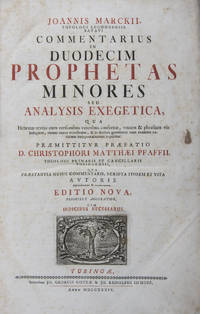
1734réf. 43194Tubingae Tübingen: Jo. Georgii Cottae & Jo. Rudolphi Im Hoff 1734. Editio Nova New edition. Hardcover. poor to vg. Folio 15 1/4 x 10 1/4". 24 1300 36pp. Contemporary full calf. Title page in red and black lettering. Title vignette. Decorative initials and tailpieces. Book housed in a modern orange cloth covered clamshell box with gold lettering to spine. Written by Johannes Marckius 1656-1731 a Dutch reformed theologian and Church historian and edited by Christoph Matthäus Pfaff 1686-1760 a German theologian these commentaries on the twelve minor prophets are divided into the following two parts: - In Vol. 1 are featured Marckius' commentaries on Hoseah; Joel; Amos; Obadiah; Jonah; and Micah. - In Vol. 2: are featured Marckius' commentaries on Nahum; Habbakuk; Zephaniah; Haggai; Zechariah; and Malachi Binding heavily rubbed with abrasion to leather on spine. Both hinges starting. Ex-library bookplate on inside of front cover. Minor to moderate sporadic foxing throughout. Text in Latin with some Hebrew and Greek. Clamshell box in overall very good binding in poor interior in good to very good condition. Jo. Georgii Cottae & Jo. Rudolphi Im Hoff hardcover books
1725réf. 43116Lugduni Batavorum Leiden: Apud Abrahamum Kallewier 1725. First edition. Hardcover. g to vg. Octavo 8 x 7". 28 883 33pp. Contemporary full parchment with handwritten title in ink to spine. Title page in red and black lettering. Title vignette. Decorative headpiece and initials. Written by Johannes Marck 1656-1731 a Dutch reformed theologian and Church historian this Old Testament commentary provides an exhaustive look at many verses from Genesis 1-9 to 24-25 to Daniel 1; 16. Binding partly soiled / age-toned and darkened along spine. Ex-library on inside of front cover. Minor and sporadic foxing throughout. Text in Latin. Binding in overall good interior in good to very good condition. Apud Abrahamum Kallewier hardcover books
1883réf. 28015Gottingae Gottingen: Prostant in Aedibus Dieterichianis Arnoldi Hoyer 1883. First edition. Hardcover. g. Quarto. IV 204pp. Green cloth with gold lettering on spine. Fascinating work being Alharizi's "Tahkemoni" composed between 1218 and 1220 in the Arabic form known as maqama Macamae. This is written in Hebrew in unmetrical rhymes in what is commonly termed rhymed prose. It is a series of humorous episodes witty verses and quaint applications of Scriptural texts. The episodes are bound together by the presence of the hero and of the narrator who is also the author. Some age-wear on binding with corners bumped not affecting pages and head and tail of spine partly chipped. Sticker with Hebrew lettering at head of spine. Pages slightly age-toned throughout. Introduction in Latin text in Hebrew. Binding in overall good- interior in good to good condition. Prostant in Aedibus Dieterichianis Arnoldi Hoyer hardcover books
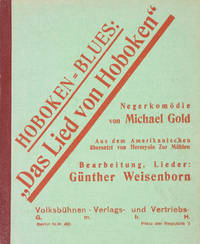
1929réf. 19326Berlin: Volksbünen-Verlags- und Vertriebs-G.m.b.H. 1929. Softcover. vg. 8vo. 100pp. Maroon cloth spine over green wraps with red lettering. Sunning to top edge of front- and rear wraps. Translated from the English into German by Hermynia zur Mühlen. "Bearbeitung Lieder: Günther Weisenborn." The News Playwrights' Theatre production of "Hoboken Blues" in 1928 was a bold experiment that failed with audiences and critics because it appeared to be racist although the playwright wrote it to expose the injustice done to African-Americans. Michael Gold wanted African-Americans to play the parts but director E. Massey cast white actors wearing black make-up. Fascinating piece of American Theatre history. Mimeographed typescript. Wraps in very good interior in near fine condition. Rare German edition. Volksbünen-Verlags- und Vertriebs-G.m.b.H. unknown books
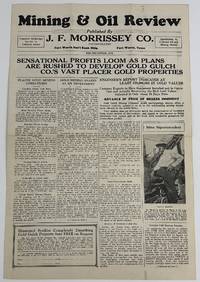
1931réf. 13205Fort Worth TX: Mid-December 1931. 4pp. on a single folded folio sheet. Old folds short separation along one fold line. Very good. A fascinating newspaper-style promotional touting the potential of Gold Gulch in the Dos Cabezas mountains of Cochise County Arizona published by J.F. Morrissey of Fort Worth Texas. Morrissey's Gold Gulch project seems to have had a short burst of activity with a note in the Fort Worth Star-Telegram and The Austin American on November 25 1931 and notes in the Arizona Republic October 2 1932 and El Paso Herald Post November 5 1932. The first two announce the company charter. The second two suggest an offloading of equipment for officials of the company called "one of the largest and most complete plants ever built in Arizona" for placer mining. After November the venture seems to have evaporated. The present promotional includes short articles mostly designed to focus the reader's attention on the Gold Gulch opportunity. Headlines state that an "Engineer's Report Indicates at Least $20000000 in Gold Values" "Gold Mining Booming" "Facts You Should Know About Gold Gulch Mining Co." and so forth. We could locate no other examples of this promotional or any other issues of Morrissey's review. Mid-December unknown books
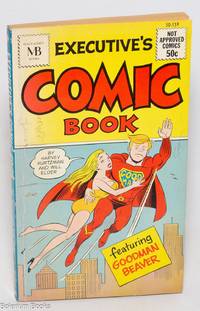
1962réf. 326953New York: Macfadden Books 1962. Mass Market Paperback. 157p. author bios three words penciled on front cover otherwise very good condition original mass market paperback. From the library of Beat writer Herbert Gold signed and inscribed by Kurtzman to Gold: "Herb- see page 119-- HK" Macfadden 50-159. On page 119 begins the story "Goodman Goes Playboy" where Goodman returns to River City and the old high school gang to find they've become well hip. Macfadden Books paperback books
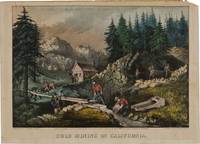
1871réf. 67574New York: Currier & Ives 1871. Attractive Gold Rush Print by Currier & Ives A fine handcolored lithograph by Currier & Ives depicting placer miners in California during the Gold Rush. In the foreground two men are shown shoveling sediment into a Long Tom capped with a sluice box while another man scoops up the remainder and deposits it into a rocker box. Behind them another trio work hard rock with pickaxes and a high-pressure hose. A small mining camp can be seen in the distance with a group of redwood stumps as evidence of their construction activities. Number eleven in the New Best 50 Currier & Ives prints. Not in Peters. Light tanning and soiling small chip to upper right corner. Very good. Matted. CONNINGHAM 2412. CURRIER & IVES CATALOGUE RAISONNÉ 2622. unknown books
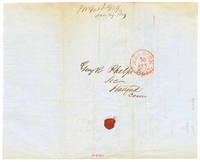
1850réf. 68036Northumberland NY and Tuolumne County CA. 1850–1857. New Yorker in the "Land of Gold" A scattered but intriguing collection of manuscripts related to New York native Isaac Vanderwerker or Vanderwarker who made for the California gold mines in 1850 and remained out west until at least 1857. This group consists primarily of letters written to Isaac by his brother at home in Northumberland inquiring after Isaac's activities in the gold fields and commenting on matters at home though it also contains a detailed letter from Isaac himself a letter from his ill-fated sister Joann and two letters written by business partners in California. The earliest letter here written by Isaac's brother who signs only with initials is dated October 7 1850 shortly after Isaac arrived in California. Isaac was apparently one of many gold-seekers who elected to take a slow sailing ship from Panama rather than wait on the heavily delayed steamships though he weathered the journey better than most. Isaac's brother also notes several acquaintances who "have returned without making their fortune" and still more who are leaving regularly for the mines including a "Justus" who "made a vendue and sold his personal property" in order to fund the journey. Everyone in town it seems either wants to head to California or has an excuse not to. "I hope you will be one of the lucky ones and get well paid for all your toil sufferings and anxieties" he writes to his brother. "We have most of the California news every month. I saw in the last paper an account of the riot and burning of Sacramento City it spoke of some large lumps of gold being taken out weighing from one to forty pounds at Carsons new diggings on the Stanislaw another instance where a man took out four thousand dollars in two days at Murphy diggings but these cases are something extra John L. Cramer is at the Northern Mines on the Yuba…." The Vanderwerkers were early settlers of upstate New York and appear to have done well for themselves – Isaac and his brother are involved in several substantial properties and much of their correspondence relates to the management of their farms. The next letter in the group comes from the following summer written by Isaac's sister Joann. Joann discusses more details of the family's properties and notes that her health is poor enough that she is not sure to see the end of the week. Regardless news of California remains at front of mind: "There is a story in circulation that Aron Bliss Jaines Brother in law has stoll 15 thousand dollars at San Francisco and the owner has followed him here and there a going to take him back and hang him. John Cramer is on the yube never his Father said he guest by his writing he was not doing very well." From here we skip two years to October 16 1853 when Isaac's brother writes to tell him that large numbers are still heading for California. Joann has been holding on the last two years and "Old Frank" who used to work with them before moving to Canada would like to know if Isaac has work for him in California. He also goes on to discuss a bit of contentious New York politics: "We shall have five state tickets this fall viz whig Barnburner or soft hunker Adamantine or hard Temperance & abolition. The whigs no dout will carry the Election. The Barnburners had quite a majority in the State Convention….the Canal board are Barnburners & they are making a clean sweep of the hunkers." The letters continue over the next few years regarding more transcontinental legal matters real estate dealings Joann's eventual death in 1855 and the usual litany of deaths and marriages at home. The most content rich letter in the group is the only one written by Isaac himself sent to New York from Tuolumne County on May 18 1857. As Isaac describes his life in the west he also reveals himself to be a talented writer: "Dear Brother I will again endeavour to correspond with you by a few rude caught characters on paper which may put you in mind that you have a Brother Still in the land of gold…." He sends some gold home not present describes a chance meeting with the aforementioned John Cramer remarks on the high cost of goods in the mines and recent fires in San Francisco and Stockton. Business isn't cheap in the "land of gold" and he claims he "can do as much business in the States for 10 Dollars as I can Here for one Hundred." With that in mind he adds a postscript stating that he has sold out his plot and mining apparatus for $1500 and will try to go into business burning lime or supplying bricks and lumber in Benicia. He describes the new town and the rapid pace of development in California: "Benicia is situated about thirty miles up the Bay from San Francisco and about Six miles from the present Capital of the state named Vallejo. About three months ago the first building was erected which is a Hotel about two weeks ago they commenced building there is now about twenty small houses up and one three story Hotel. The government officers reside at Vallejo after the 10 of this month. I had an introduction to the governor at Vallejo last week he is a clever sort of man but not Dignified hardly fit for the Station…." Isaac's brother responds to this letter a few months later curious about his sibling's new business ventures. He also comments that "by what I can learn of the character of the Mexicans and Indians I should hate to travel alone without being well armed. I see by our papers that Lynch Law is that that governs all the mines I saw an account of a man being hung at San Francisco by Mr. Lynch at short notice." Unsurprisingly more and more are returning home by 1857 including a man named Wells " come in the same steamer your letter did he was sick but made out to keep up till he got home and died less than a week after he was not very successful in California." A heartfelt letter from a friend about the health of Isaac's mother also present seems to have convinced him and Isaac returned home for a visit to New York in the latter part of 1857. A September 3rd letter from his business partner John W. Kelly sent from Sawmill Flatt is addressed to Isaac in Saratoga and discusses business dealings in California. It would appear Isaac never pulled completely out of mining as the letter regards efforts to secure mortgage payments for Isaac's "ditch." The final letter in this collection is dated December 17 1857 and is addressed to Isaac from the offices of A.C. Goodrich in Columbia California. Goodrich describes a large flume his company has built 180 miles long and twelve feet wide by three feet deep "exclusive of the artificial embankment or five hundred ton stream capacity this day and night as we have reservoirs in abundance to hold the night & Sunday water. Would give 1000 ton streams which sold at the precent price viz $4.00 per day would pay ten per cent on a Capital of $1000.000. This would give a large basis for waste and reduction in price and still leave room for handsome profits on our Capital stock of $450000. The present cost of the work we can only approximate to but it is not far from 100000$." They hope that Isaac can become their agent and help them find investors. An interesting group of letters sent between brothers in California and New York during the Gold Rush stretching across seven long years of separation. Old folds occasional light tanning and staining. Very good. unknown books
1802réf. 54267Boston: Printed by Russell and Cutler 1802. Dedicated to John Quincy Adams this work contains anonymously written letters collected from the New York COMMERCIAL ADVERTISER commenting on issues of the day particularly Mary Wollstonecraft's RIGHTS OF WOMEN. Attributed by Shaw & Shoemaker to Samuel Knapp though the Library of Congress gives Silliman as the author. 152pp. Half title. Contemporary tree calf spine gilt with leather label. Hinges cracked spine ends and corners worn. Bookplate and library pocket on endpapers. Light foxing and toning. Good. SHAW & SHOEMAKER 2490. hardcover books
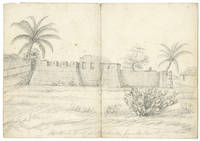
1819réf. 52991N.p. but near present-day Prampram Ghana. ca. 1819–1836. The British on the Gold Coast of Africa: Three Drawings An attractive set of skillfully executed original pencil sketches featuring British colonial structures in Prampram Gold Coast present-day Ghana likely between 1819 and 1836. The sketches are titled in pencil as follows: "Commandant's Residence Pam Pram Gold Coast" "Lower Town Pam Pram from the Upper Town" and "Abandoned Fort at Appolonia from the Beach." The Union Jack flies proudly in the foreground of the sketch of the Commandant's residence. Officially Great Britain colonized the Gold Coast region from 1867 until the independence of Ghana in 1957 though the British had maintained and controlled forts along the West African coastline since long before 1867. Fort Appolonia in the extreme southwestern corner of the country had been a British trading and military outpost from 1691 until 1819 and then again from 1836 onwards when it changed hands from the British to the Dutch then back to the British again. As such if the artist here labeled Fort Appolonia as "Abandoned" he or she most likely sketched the fort during the period it was shuttered between 1819 and 1836. A fascinating trio of original sketches offering unique views from a rarely visualized period in British colonial affairs in West Africa. Central vertical crease to each drawing the first two titled in a contemporary hand in pencil to verso the third similarly titled below the image. Very good. unknown books
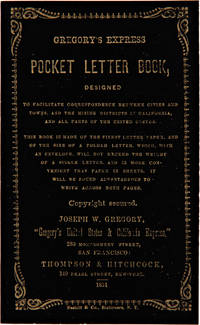
1851réf. 58179San Francisco: Thompson & Hitchcock 1851. Lovely Unused California Gold Rush Letter Book A lovely example of an unused Gold Rush letter book intended to advertise Joseph Gregory's California and New York Express Line as a convenient way for gold seekers in California to communicate with friends and family back home. Gregory's California Express according to the wrapper is "one of the oldest established in the business dispatch messengers BY EVERY STEAMER leaving New-York and San Francisco in charge of Letters Parcels Packages Gold Dust and valuables for distribution throughout the United States and California." Also according to Gregory's text "this book is made of the finest letter paper and of the size of a folded letter which with an envelope will not exceed the weight of a single letter and is more convenient than paper in sheets." The inside rear wrapper prints two testimonials from the PANAMA STAR praising the express line's speed and volume. Gregory also published a pamphlet titled GREGORY'S GUIDE FOR CALIFORNIA TRAVELLERS; VIA THE ISTHMUS OF PANAMA 1850 primarily to promote his business. A scarce and well-preserved piece of Gold Rush ephemera here with the original unused envelope. 24mo. Original dark purple wrappers printed in gilt. Very minor wear to wrapper edges. Near fine with the original unused plain paper envelope. unknown books
1849réf. 49949New York. January 29 1849. Life Insurance for a Forty-Niner Who Went West with John Woodhouse Audubon An intriguing note regarding life insurance for a forty-niner traveling to California in 1849 with Henry Webb and John Woodhouse Audubon. The note reads: "Langdon H. Havens wants a life insurance permit for California to go over the Overland Route in company with persons bearing dispatches from our Government in a Company of 100 or more. He wants to leave for Washington immediately." Perhaps the twenty-six-year-old Haven sometimes spelled Havens originally intended to join a safe government-sponsored expedition from Washington but he was in fact among the 100 Forty-Niners who embarked on a famously ill-fated overland expedition led by Army Colonel Henry Webb with John Woodhouse Audubon son of the famous ornithologist as his second in command which left New York on February 8. The company proceeded by ship train stagecoach and riverboat to New Orleans and from there by steamer across the Gulf of Mexico to the mouth of the Rio Grande where they arrived on March 13 - an odd overland route dictated by Webb a veteran of the Mexican-American War. There disaster struck. A dozen men died of cholera the company's money was stolen and leadership conflict led Webb to leave the company with a dozen followers. Some of the remaining stalwarts including Haven followed Audubon onward trekking for seven months through Mexico and Arizona the survivors finally reaching San Diego in November. Some then took a boat to San Francisco; others continued overland to the gold fields. As meticulously recorded by Audubon a naturalist and painter in his own right the entire venture has gone down in history as "one of the most poorly-planned" Forty-Niner expeditions "on record." Haven though nearly dying en route was one of the fortunate few who "made it to California." An appealing note dated in the famous year of the California Gold Rush that eerily anticipates the dangers inherent in overland travel in America in the 19th century. Mailing folds slight edge discoloration else fine. unknown books
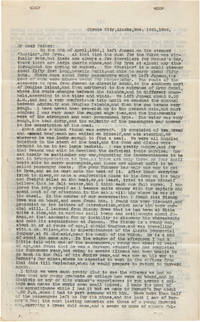
1718réf. 43100Circle City Alaska and on a steamer between Juneau and Seattle. Nov. 10 1896; Feb. 17 1897. Typed Letters from a Miner in Alaska During the Klondike Gold Rush A very interesting pair of typed letters from a young man in Alaska during the Klondike Gold Rush. The anonymous author wrote these two letters to his parents describing his journey overland and by water to the Birch Creek mining district his experiences mining for gold and his decision to go into business as a merchant. The letters are written in a detailed style that indicates an educated author. They include three manuscript sketches showing the routes traversed in Alaska and provide a great deal of information about the writer's experiences in the Klondike. These letters are typed but they were likely originally handwritten by the author who later typed them and included his manuscripts maps and sketch in order to send them to his family when he arrived in Seattle or San Francisco. The letter dated Nov. 10 begins with a description of the writer's boat journey from Juneau to Dyea actually before the discovery of gold around Dyea was widely announced which was a popular disembarkation point for the Chilkoot Trail to Dawson City a center of the gold rush. He arrived at Dyea on April 23 and notes that "dinner at the Dyea post was the last square meal I have had up to the present date November 10." After dinner he loaded his equipment on horses for the journey inland: "My outfit consisted of about 1000 lbs. of provisions guns amunition sic tools for boat building a whip-saw jack-plane cross-cut saw hand saw rip saw hatchet hammer draw knife brace and bits square etc. and clothing blankets tent sheet-iron stone and in fact I think I had about every thing that ever went down the Yukon. Altogether my outfit weighed about 1302 pounds which is much more than is usually taken into the interior." The author spent the next several days transporting his provisions between Dyea and Lake Linderman and he includes in his letter a sketch of the route from Dyea through the valley to the lake noting several camps along the way as well as a sketch of his sled. The second letter dated Feb. 17 1897 was written on board the steamer Al Ki between Juneau and Seattle. He continues the narrative of his trip inland explaining that he arrived at Lake Linderman on May 14. A month later on June 14 the author and a partner their canoe loaded with provisions departed for Circle City which they reached on June 29. There they stored most of their provisions and headed for the mines in the Birch Creek region. Mining was at its height in the middle of the summer but rather than seek out a claim on their own the author and his companion Jim Wishard decided to work for other miners earning some $10 a day. He describes working at mining from 7 p.m. until 6 a.m. the long days making the task of working at night possible. In August the author bought a claim in the Harrison Creek region but decided to forego mining in favor of establishing himself as a merchant: "From what I could see the miners are poorly supplied with food by the two companies and there is always a great demand for luxuries; that is something out of the ordinary and even the necessaries of life. I made up my mind last summer that I could do as well bringing in some food - in other words being something of a merchant - as in any other way to start and having a good knowledge of the country and keeping my eyes open I would undoubtedly have many good chances for speculation. It is a conceded fact that one cannot lose money taking in such an outfit. Everything brings in an average profit of 400 per cent. over the original cost and whatever any one has to sell in the 'grub' line is in demand." The author then describes his construction of a small cabin in Circle City and his decision soon afterward to leave Alaska for the winter. He describes the trip to Dyea undertaken in January and the hardships of winter overland travel in Alaska. Included are some very practical tips: "In crossing water when it is thirty or forty degrees below zero one should dip his moccasins into the water very quickly taking them out before the moccasin is wet through. They will then freeze in a mass on your feet and will serve the same purpose as rubber boots. You can then walk right through water though I would not advise any one to tempt Providence too much." The letter concludes with a description of a recently discovered gold strike called "Bonanza" not far from the Forty Mile camp. The author describes the high hopes around the strike and includes a manuscript map of the region indicating the location of a claim in which he himself has invested. He hopes that his mine will bring him some wealth but reiterates his belief that the way to wealth in the Yukon Gold Rush is by supplying miners with goods and that he is on his way to Seattle and San Francisco to buy provisions to resell. The Beinecke Library holds what appear to be typed drafts of these same letters with somewhat more typographical errors and less polished maps which they attribute to the merchant Cameron C. Burns. We locate no other copies of these letters nor any published version of the text. A detailed and ephemeral first-hand account of an early Alaska gold-seeker. Stapled at upper edge. Three horizontal folds. Near fine. hardcover books
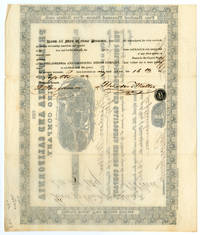
1618réf. 51617Philadelphia. Sept. 16 1852. Invest in California Gold Mines! A certificate for stock in the Philadelphia and California Mining Company completed on Sept. 16 1852 granting one Theodore Walter fifty shares in the venture and signed by the Secretary L. Alter and the President Pearson Serrill. The central woodcut depicts a mining scene representing the company's California operations. The Philadelphia and California Mining Company was founded in the same year on the basis of a land lease from John Fremont in the area of the Mariposa River. A rare piece of mining ephemera: OCLC records only one other example of a stock certificate from this company held by the California Historical Society. Previously folded with small chip at edge of a fold line. Printed form completed in manuscript by several hands. With a woodcut mining vignette. Near fine. OCLC 828929436. unknown books
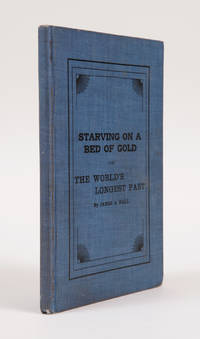
1909réf. 67360Santa Cruz CA: Press of the Sentinel 1909. Inscribed Klondike Gold Rush Narrative of a Greenhorn Lost and Starving in the Alaskan Wilderness An inscribed copy of what Kurutz calls "one of the most dramatic and riveting recollections that can be found in the literature of the Alaska gold rushes." The text recounts trials and tribulations while lost in the wilderness of Alaska's Seward peninsula from July through August 1900 where the author nearly starved to death. Written in Teller Alaska in the months during his recovery from his near-death experience the author self-published his story nine years later. This copy was inscribed by the author two decades after the events described: "With the most pleasant recollections of old times I remain your friend the author Watsonville May 23rd 1921." James Hall was a lawyer from Watsonville California practicing in San Francisco. In early 1900 a friend asked Hall to accompany him to the gold fields of Alaska and after some consideration Hall decided to try his luck. After some preparation and an uneventful journey by steamboat and foot to Teller Alaska Hall was asked in July to accompany some men on a four-day journey to look at a quartz prospect that could be rich with gold. During a mountain climb Hall was separated from the other members of his team in the fog becoming hopelessly lost. Thus began Hall's sixty-seven-day journey in the Alaskan wilderness subsisting on water roots and berries. This eminently readable narrative takes the reader through the Alaskan wilderness as the author tries to return to Teller without a compass or food. Over two months later Hall is found by some young prospectors who save him from starvation and bring him back to the camp where he wrote this article and worked briefly with a doctor to administer to other poor injured prospectors. Hall eventually returned to California in 1901. The illustrations show Hall in black-and-white photographs both before and after his arduous journey. The text of Hall's journey is followed by four affidavits vouching for Hall's honesty a nine-page description of Inuit culture life in Nome and his stories of prospectors. An inscribed copy of this entertaining and enlightening Klondike classic. Light blue publisher's cloth titles stamped in black on front board. Light soiling and shelf wear starts to front hinge. Faint toning to margins and light offsetting to endpapers otherwise clean internally. Inscribed in ink by the author on front free endpaper. A very good copy. KURUTZ KLONDIKE 229. LINGENFELTER AK:729. hardcover books
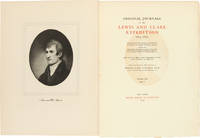
1904réf. 52627New York: Dodd Mead & Company 1904-1905. One of 200 Sets on Large Paper One of 200 large paper sets on Van Gelder paper with the atlas supplied from the reprint edition done by Argosy-Antiquarian Press. "The most elaborate work on this expedition" - Howes. A cornerstone of modern historical research printing for the first time many major primary documents which did not appear in the Biddle edition including the Floyd and Whitehouse journals and material from the Clark-Voorihis papers along with facsimile manuscripts maps portraits and other illustrative matter. Also valuable is Victor Paltsits' bibliography of the Lewis and Clark expedition in the first volume. "This edition is notable for its thorough Introduction covering the history of the expedition and earlier exploration and a detailed account of the original journals and their various editions.In its maps and numerous illustrations the Thwaites edition is an outstanding source of visual materials relating to the expedition" - LITERATURE OF THE LEWIS AND CLARK EXPEDITION. Quarto. Original gilt green cloth. Octavo atlas maps laid in a red cloth drop-front box. Cloth somewhat worn particularly at spine ends. Ex-library bookplates with withdrawal stamps on front pastedowns shelf labels on spines reference stamps across top edges. Some occasional offsetting from plates but generally clean internally. A good set. Text volumes untrimmed. HOWES L320 "c." LITERATURE OF THE LEWIS AND CLARK EXPEDITION 5d.1. WAGNER-CAMP 13:7 note. TWENEY WASHINGTON 76. REESE BEST OF THE WEST 233 note. hardcover books
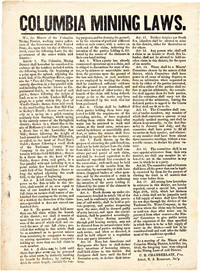
1853réf. 46036Columbia Ca.: Gazette Print 1853. The Laws of the Diggings A rare broadside printing of the laws of the Columbia Mining District in California in 1853 created and enforced by the miners for their own self-government. The seventeen articles all deal with regulations for mining and claims. The first nine set out rules for making and operating claims. The next three address foreign ownership of claims. Article 10: "None but Americans and Europeans who have or shall declare their intentions of becoming citizens shall hold claims in this district." Article 11: "Neither Asiatics nor South Sea Islanders shall be allowed to mine in this district either for themselves or for others." Article 12 sets out a punishment for any miner who sells a claim to an Asian or a Polynesian. The final five articles set out rules for enforcing the laws including the creation of a Miners Committee and a system of binding arbitration. According to the text the laws were adopted "at a meeting of the Miners of the Columbia Mining District held Oct. 1st 1853." and the laws are signed in print by "C.H. Chamberlain Pres." and "R.A. Robinson Sec'y." "The item is of basic importance.as an example of how the California miners - or men beyond the reach of government anywhere else in our States and Territories for that matter - banded together and enacted and enforced codes of law for their own protection" - Eberstadt. The COLUMBIA GAZETTE which printed this broadside was according to Kemble the second newspaper to operate in Columbia starting operations in the fall of 1852. The first newspaper in the area the COLUMBIA STAR apparently printed only two or three issues in October-November of 1851 before the printing press was destroyed by vandals. Greenwood locates only three copies at the California Historical Society and the Bancroft Library and the Streeter copy which was sold at the Clifford sale in 1994. Rocq lists a copy at the Huntington Library. OCLC adds copies at Yale Library of Congress University of California at San Diego Stanford and DeGolyer Library at Southern Methodist University. A rare and interesting example of the search for order in the tumult of the gold rush. The Streeter copy sold to Howell for $550 in 1968. It later reappeared in the sale of California collector Henry Clifford in 1994. Broadside 10¾ x 8 inches. Printed in three columns. A bit of light foxing mostly in margins. Near fine. In a folding cloth clamshell case spine gilt. GREENWOOD 381. ROCQ 15427. EBERSTADT 131:105. STREETER SALE 2735. CLIFFORD SALE 26. OCLC 29876358. hardcover books
réf. 5391CALIFORNIA GOLD RUSH. DS. 1pg. July 22 1850. Sacramento City California Territory. A demand note signed Barton Lee as a banker. The partially-printed note entitles the bearer to two hundred dollars plus 5% interest payable in gold dust one month hence. Barton Lee and Baker & Company was a popular Sacramento bank. California would become a state seven weeks later on September 9 1850. This interesting piece of California Gold Rush memorabilia is in very good condition with light wear. unknown books
1911réf. M7939London:: Henry Frowde Oxford University Press; Hodder & Stoughton 1911. 1911. Series: Oxford Medical Publications. 214 x 138 mm. 8vo. viii 83 pp. Indexes. Blind- and gilt-stamped red cloth. Fine. Henry Frowde, Oxford University Press; Hodder & Stoughton, 1911. hardcover books
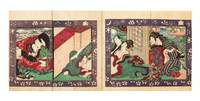
réf. 8347Vol. I: Illustrated "title-page" one double-page woodcut with foldouts to form a four-panel diptych with the addition of a "trick super flap" depicting three female genitalia young woman mistress & wife six double-page woodcuts & two single-page woodcuts all color-printed; & three double-page black & white woodcuts. Vol. II: Illustrated "title-page" five double-page woodcuts & two single-page woodcuts all color-printed; & four double-page black & white woodcuts. Vol. III: Illustrated "title-page" four double-page woodcuts & two full-page woodcuts all color-printed; & three black & white double-page woodcuts. All leaves have color-printed borders. .5 1 folding leaf of preface color-printed 13 folding leaves; .5 13 folding leaves; .5 12 folding leaves. Three vols. 8vo orig. decorated semi-stiff patterned boards with color-printed symbols of the moon flowers & snowflakes orig. block-printed title labels on upper covers of Vols. I & II lacking on Vol. III but there is no evidence a label was ever there new stitching. Japan: Preface dated 1850. First edition and very rare; we can find no copy in WorldCat or NIJL. Almost all of the techniques that make Japanese illustrated books so remarkable are utilized here. Finely illustrated and richly colored this late shunga employs bokashi the delicate variation of shading of pigment within the image; blind-embossing; and the very ample use of metallic pigments. The depicted garments are a mixture of extremely complex textures colors and patterns all accentuated by blind-embossing and multiple woodblock impressions. In Vol. I the folding woodcuts - which reveal a man and woman engaging in sex - open to reveal a fine and complex four-panel scene in which we see three couples also having sex: a young couple a man with his mistress and the same man with his wife. On the third panel from the right a hidden "trick" flap is revealed depicting and comparing the genitalia of these three women. This "trick" panel has the title printed with seven kanji characters the first two are indecipherable: ".mitate setsugekka" ".Visual Puns of Snow Moon Flower". Each volume begins with a finely colored paste-down leaf artistically depicting the themes of snow moon and flower with poems. Facing each of these leaves is a portrait of a woman: mistress young and wife. All the black & white woodcuts also depict men and women engaging in sex and self-pleasuring. Koikawa 1821-1907 was a prolific artist. He illustrated as well as wrote numerous books under various pen names. At the end of the Preface in Vol. I we find "Insuitei" one of his pen names. Fine set with fresh coloring. The four-panel diptych has several small burn holes on the right-hand side. One black & white illustration has been "heightened" with red ink in a very minor way. Slight thumbing and a few minor stains. unknown books
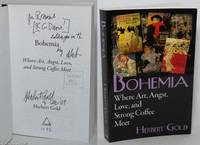
1993réf. 102297New York: Simon and Schuster 1993. 253p. paperback from the library of SF Mime Troupe founder R. G. Davis with an inscription to him by the author. Simon and Schuster unknown books
1936réf. 69089New York: International Publishers 1936. Hardcover. 272p. spine faded. Seidman G185. International Publishers hardcover books