[COSTUMES]. HECKEL, Catharina SPERLINGBiblio.com
2683 risultati
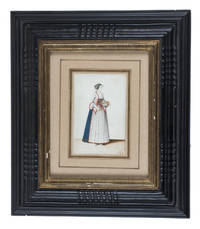
1720rif. 9AHF2VYD4ZB1Augsburg 1720. Each mounted in a later passe-partout with a gold border in an ebonized wooden frame with a gilt lip glazed 23.5 x 20.5 cm. Four drawings in brown ink watercolour and coloured gouaches on vellum highlighted with gold each 5.9 x 9.0 cm. A matching set of four lovely and delicate watercolour drawings each depicting a young lady in a fancy German costume drawn and painted on vellum by the Augsburg artist Catharina Sperling Heckel 1699-1741. She learned painting and drawing from her father the Augsburg goldsmith Michael Heckel engraving from Johann Ulrich Kraus and married the engraver Hieronymus Sperling 1695-1777 in 1725. It is not clear whether she made these drawings shortly before or shortly after her marriage. She is best known for her ca. 1728 miniature portrait of Charles Edward Stuart Bonnie Prince Charlie the young pretender to the English throne. She never recovered from the birth of her first child in 1741 dying within a few weeks. Each drawing shows a young German lady wearing a long gown and a cap or bonnet but one also carries a hat. The four drawings differ in the style of the gowns and other elements.In very good condition. With a few small chips in the paint of the frame. Lovely watercolour costume drawings of four young German ladies perhaps from a court wedding in the free Imperial city of Augsburg.l Cf. Thieme & Becker XVI pp. 208-209. ABE CAT Costumes & Uniforms hardcover
rif. DADAX113802533XNew unknown
rif. DADAX1934159190New unknown
rif. DADAX0486427722New unknown
rif. DADAX0486407233New unknown
rif. DADAX0713463414New unknown
rif. DADAX1907030549New unknown
1928rif. 33146Paris: Librairie Henri Leclerc / L. Giraud-Badin 1928. Paperback. xvi340 pp.: 57 plates with ill.; 28x19 cm. Uncut unopened. sl. browned Very good. Librairie Henri Leclerc / L. Giraud-Badin paperback
rif. SONG0486428958Used: Good unknown
rif. SONG0786431202Used: Good unknown
rif. SONG0136542786Used: Good unknown
rif. SONG0823956679Used: Good unknown
rif. SONG0300074840Used: Good unknown
rif. SONG0764368524Used: Good unknown
rif. SONG1138742260Used: Good unknown
rif. DADAX1931503095New unknown
rif. SONG113802533XUsed: Good unknown
rif. DADAX0240821335New unknown
1888rif. 145681888. Collection of 3 chromolithographic prints from The Illustrated History of Costume : period styles and accessories by Albert Racinet published by Firmin Didot & Cie in Paris in 1888. Titled: PERSIA - PERSE- PERSIEN. 7 ½" x 8 ¾". These lithographs beautifully depict Persian costumes and interior décor from Iran. In the first lithograph we can see 10 men and one woman dressed in the various traditional Qajar attires of Iran. The second lithograph shows the beautiful interior décor including very intercate and vibrant Persian rugs elaborately scrolled door and window frames of a Kajar residence. The third lithograph captures five musicians playing various instruments and four women dancers. In very good condition. unknown
1864rif. 145861864. Two original antique steel costume engravings of a Persian Iran Royal Officer and Noble woman printed in 1864. Overall size: 9" x 12.5." The plate illustrations are brightly colored and intricately detailed characterization of the traditional costumes of a Persian Royal Officer and Noble woman. In the engraving of the Royal Officer titled "Khatchadour D'hohannes: Officier du Prince Royal de Perse" his attire entails a vibrant green coat with gold trimmings which covers a gold-colored ensemble with a purple sash that stores his dagger. In the engraving of the Persian Woman titled "Dame Persane" she is depicted in traditional costume as imagined by Europeans in the 1800's. The woman is shown leaning against a banister wearing an embroidered white satin gown with a pink silk and fur trimmed coat and a feathered headdress. General age related toning. Overall both prints are in very good condition. unknown
1748rif. 143711748. Mallet Allain Manesson. "Arabes" 1748 presents two male figures identified as Arabs through the conventions of European geographical and costume illustration derived from Mallet's Description de l'Univers. Mallet's original work first published in Paris in 1683 combined maps city views portraits and images of dress with accounts of the customs religions and governments attributed to different nations; its second volume treated Asia. The engraving records the visual vocabulary through which Arab clothing and appearance were presented to European readers within this encyclopedic geographical tradition. Mallet Allain Manesson. "Arabes." 1748. Engraving. Overall page 10" x 7.25"; image 5.5" x 7.5". Beneath a decorative banner lettered "Arabes" two standing men wear contrasting garments against a mountainous landscape. One wears a buttoned tunic overcoat pointed shoes and a large turban; he holds a decorative cane while resting his other hand at his belt. The second wears a decorated collared tunic beneath an overcoat pointed shoes and a tall head covering from which a long length of fabric descends. The paired figures allow differences in headwear garment ornament and accessories to be compared within a single composition. The plate derives from an illustrated geographical work conceived by Mallet a French military engineer and mathematics teacher whose Description de l'Univers organized contemporary geographical knowledge alongside images of the "divers habillemens" of different peoples. The "Arabes" composition therefore records an eighteenth-century European printed conception of Arab dress rather than serving as direct ethnographic documentation of a specific Arab population or locality. Overall very good condition. The combination of costume detail and explicit ethnic captioning documents how Arab peoples were visually categorized for European audiences in early modern geographical publishing. unknown
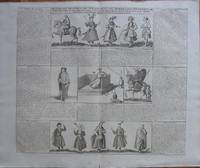
1720rif. 143601720. Atlas historique engraving of Persian costume and customs 1720 records an early eighteenth-century European presentation of dress military equipment horsemanship and tobacco use in Persia during the late Safavid period. Rather than presenting a single landscape or event the plate assembles male and female costume hairstyles turbans footwear weapons armor horses and smoking implements into a comparative visual survey. Its attention to cavalry equipment and what the accompanying description calls the "militia and their weapons" and the "offensive and defensive" equipment worn by soldiers at war documents the categories through which European geographical publications described Persian society and military culture. Atlas historique. Description of Persia and Persian costumes. 1720. Sheet size 51 x 43 cm. The engraving contains numerous individual figures and objects arranged for comparison including four men in different Persian costumes women in period dress examples of female hairstyles turbans and shoes and representations of tobacco smoking and pipes including a hookah. Military subjects include armor weapons cavalry horses an elaborate bow and equestrian equipment. The combination of human figures with separately illustrated articles of clothing arms and personal equipment allows individual elements of Persian dress and material culture to be examined across the sheet. Published in 1720 the engraving dates to the final years of Safavid rule when European atlases and geographical compilations increasingly combined maps with images and written accounts of the peoples clothing military practices and customs of regions beyond Europe. Here Persian men and women cavalry weapons tobacco consumption and dress are organized as subjects of geographical and ethnographic description providing evidence of how Persia was visually classified for an early eighteenth-century European audience. The detailed renderings of costume armor weapons horses hairstyles and smoking implements also preserve period representations of material culture associated with Safavid Persia. Very good condition. unknown
rif. DADAX1904668895New unknown
rif. SONG0240821335Used: Good unknown
rif. DADAX0136542603New unknown