2647 resultados
1864ref. 145861864. Two original antique steel costume engravings of a Persian Iran Royal Officer and Noble woman printed in 1864. Overall size: 9" x 12.5." The plate illustrations are brightly colored and intricately detailed characterization of the traditional costumes of a Persian Royal Officer and Noble woman. In the engraving of the Royal Officer titled "Khatchadour D'hohannes: Officier du Prince Royal de Perse" his attire entails a vibrant green coat with gold trimmings which covers a gold-colored ensemble with a purple sash that stores his dagger. In the engraving of the Persian Woman titled "Dame Persane" she is depicted in traditional costume as imagined by Europeans in the 1800's. The woman is shown leaning against a banister wearing an embroidered white satin gown with a pink silk and fur trimmed coat and a feathered headdress. General age related toning. Overall both prints are in very good condition. unknown books
1888ref. 145681888. Collection of 3 chromolithographic prints from The Illustrated History of Costume : period styles and accessories by Albert Racinet published by Firmin Didot & Cie in Paris in 1888. Titled: PERSIA - PERSE- PERSIEN. 7 ½" x 8 ¾". These lithographs beautifully depict Persian costumes and interior décor from Iran. In the first lithograph we can see 10 men and one woman dressed in the various traditional Qajar attires of Iran. The second lithograph shows the beautiful interior décor including very intercate and vibrant Persian rugs elaborately scrolled door and window frames of a Kajar residence. The third lithograph captures five musicians playing various instruments and four women dancers. In very good condition. unknown books
1748ref. 143711748. Mallet Allain Manesson. "Arabes" 1748 presents two male figures identified as Arabs through the conventions of European geographical and costume illustration derived from Mallet's Description de l'Univers. Mallet's original work first published in Paris in 1683 combined maps city views portraits and images of dress with accounts of the customs religions and governments attributed to different nations; its second volume treated Asia. The engraving records the visual vocabulary through which Arab clothing and appearance were presented to European readers within this encyclopedic geographical tradition. Mallet Allain Manesson. "Arabes." 1748. Engraving. Overall page 10" x 7.25"; image 5.5" x 7.5". Beneath a decorative banner lettered "Arabes" two standing men wear contrasting garments against a mountainous landscape. One wears a buttoned tunic overcoat pointed shoes and a large turban; he holds a decorative cane while resting his other hand at his belt. The second wears a decorated collared tunic beneath an overcoat pointed shoes and a tall head covering from which a long length of fabric descends. The paired figures allow differences in headwear garment ornament and accessories to be compared within a single composition. The plate derives from an illustrated geographical work conceived by Mallet a French military engineer and mathematics teacher whose Description de l'Univers organized contemporary geographical knowledge alongside images of the "divers habillemens" of different peoples. The "Arabes" composition therefore records an eighteenth-century European printed conception of Arab dress rather than serving as direct ethnographic documentation of a specific Arab population or locality. Overall very good condition. The combination of costume detail and explicit ethnic captioning documents how Arab peoples were visually categorized for European audiences in early modern geographical publishing. unknown books
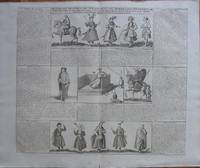
1720ref. 143601720. Atlas historique engraving of Persian costume and customs 1720 records an early eighteenth-century European presentation of dress military equipment horsemanship and tobacco use in Persia during the late Safavid period. Rather than presenting a single landscape or event the plate assembles male and female costume hairstyles turbans footwear weapons armor horses and smoking implements into a comparative visual survey. Its attention to cavalry equipment and what the accompanying description calls the "militia and their weapons" and the "offensive and defensive" equipment worn by soldiers at war documents the categories through which European geographical publications described Persian society and military culture. Atlas historique. Description of Persia and Persian costumes. 1720. Sheet size 51 x 43 cm. The engraving contains numerous individual figures and objects arranged for comparison including four men in different Persian costumes women in period dress examples of female hairstyles turbans and shoes and representations of tobacco smoking and pipes including a hookah. Military subjects include armor weapons cavalry horses an elaborate bow and equestrian equipment. The combination of human figures with separately illustrated articles of clothing arms and personal equipment allows individual elements of Persian dress and material culture to be examined across the sheet. Published in 1720 the engraving dates to the final years of Safavid rule when European atlases and geographical compilations increasingly combined maps with images and written accounts of the peoples clothing military practices and customs of regions beyond Europe. Here Persian men and women cavalry weapons tobacco consumption and dress are organized as subjects of geographical and ethnographic description providing evidence of how Persia was visually classified for an early eighteenth-century European audience. The detailed renderings of costume armor weapons horses hairstyles and smoking implements also preserve period representations of material culture associated with Safavid Persia. Very good condition. unknown
1864ref. 145861864. Two original antique steel costume engravings of a Persian Iran Royal Officer and Noble woman printed in 1864. Overall size: 9" x 12.5." The plate illustrations are brightly colored and intricately detailed characterization of the traditional costumes of a Persian Royal Officer and Noble woman. In the engraving of the Royal Officer titled "Khatchadour D'hohannes: Officier du Prince Royal de Perse" his attire entails a vibrant green coat with gold trimmings which covers a gold-colored ensemble with a purple sash that stores his dagger. In the engraving of the Persian Woman titled "Dame Persane" she is depicted in traditional costume as imagined by Europeans in the 1800's. The woman is shown leaning against a banister wearing an embroidered white satin gown with a pink silk and fur trimmed coat and a feathered headdress. General age related toning. Overall both prints are in very good condition. unknown
1888ref. 145681888. Collection of 3 chromolithographic prints from The Illustrated History of Costume : period styles and accessories by Albert Racinet published by Firmin Didot & Cie in Paris in 1888. Titled: PERSIA - PERSE- PERSIEN. 7 ½" x 8 ¾". These lithographs beautifully depict Persian costumes and interior décor from Iran. In the first lithograph we can see 10 men and one woman dressed in the various traditional Qajar attires of Iran. The second lithograph shows the beautiful interior décor including very intercate and vibrant Persian rugs elaborately scrolled door and window frames of a Kajar residence. The third lithograph captures five musicians playing various instruments and four women dancers. In very good condition. unknown
1748ref. 143711748. Mallet Allain Manesson. "Arabes" 1748 presents two male figures identified as Arabs through the conventions of European geographical and costume illustration derived from Mallet's Description de l'Univers. Mallet's original work first published in Paris in 1683 combined maps city views portraits and images of dress with accounts of the customs religions and governments attributed to different nations; its second volume treated Asia. The engraving records the visual vocabulary through which Arab clothing and appearance were presented to European readers within this encyclopedic geographical tradition. Mallet Allain Manesson. "Arabes." 1748. Engraving. Overall page 10" x 7.25"; image 5.5" x 7.5". Beneath a decorative banner lettered "Arabes" two standing men wear contrasting garments against a mountainous landscape. One wears a buttoned tunic overcoat pointed shoes and a large turban; he holds a decorative cane while resting his other hand at his belt. The second wears a decorated collared tunic beneath an overcoat pointed shoes and a tall head covering from which a long length of fabric descends. The paired figures allow differences in headwear garment ornament and accessories to be compared within a single composition. The plate derives from an illustrated geographical work conceived by Mallet a French military engineer and mathematics teacher whose Description de l'Univers organized contemporary geographical knowledge alongside images of the "divers habillemens" of different peoples. The "Arabes" composition therefore records an eighteenth-century European printed conception of Arab dress rather than serving as direct ethnographic documentation of a specific Arab population or locality. Overall very good condition. The combination of costume detail and explicit ethnic captioning documents how Arab peoples were visually categorized for European audiences in early modern geographical publishing. unknown
ref. DADAX0810935163New unknown
1855ref. 16796Paris, Dero-Becker, s.d., (1840-1855) 1855 12 lithographies en couleurs. In-4 39 x 22cm. En feuillets. Armée française République : N 251, N 5, Régiment des Dromadaires ; Armée française Empire : N 28, N 3, Cuirassier ; N 61, N 5, Officier de chasseur à cheval de la Garde ; N 84, N 6, Lancier de la Garde ; N 105, N 8, Officier des grenadiers à cheval de la Garde ; N 116, N 9, Garde d’honneur ; N 130, N 11, Officier de cuirassiers ; N 123, N 12, Mameluck de la Garde ; Mameluck de la Garde, n 12 ; N 140, N 13, Officier de carabiniers ; N 168, N 18, Officier des dragons de l’Impératrice - Armée française 1840 : Officier de cuirassiers, 5e régt., porte-étendart ; N 145, N 37, Cuirassiers grande et petite tenue. Quelques planches brunies.
1896ref. 4811CBZürich, Brunner & Hauser, 1896. XI (1) S. Mit 45 Tafeln mit Abb. nach Fotografien von Johannes Meiner. Farb. illustr. Orig.-Leinenmappe.
ref. 136578aafs.d. vers 1830, 23x15 cm, (Vue), gravure coloriée à la main encadrement baguette doré (31x25 cm.
ref. 100295aafs.d., vers 1830, 22x28 cm, encadrement bois ancien
ref. 919.1aafs.d., XIXè, 27 x 41 cm le cadre. 2 aquarelles en couleur signées Bader. Dans un encadrement baguette or.
ref. 99939aafS.d., vers 1846, 15.5 x 10.5 cm, 4 lithographies originales coloriées à la main, papier légèrement bruni, n°. 4 avec tache d’encre marginale,
ref. 1048.1aafvers1870, 18.6 x 26.8 cm lithographie originale finement coloriée à la main, tirée de: Régiments Suisses au service étranger, costumes militaires, avec légendes imprimées, 1 feuille.
ref. 1030.1aafvers 1893, 18.6 x 26.8 cm planche lithogr. finement coloriée à la main, Einzelblatt
ref. 1050.1aafvers 1893, 18.4 x 26.4 cm lithographie originale finement coloriée à la main, tirée de: Régiments Suisses au service étranger, costumes militaires, avec légendes imprimées, 1 feuille.
ref. 132023aafNeuchâtel, Wolfrath, 1824, 15x12 cm. (l’image), , farb-frische Aquatinta, links im Bild signiert G. Lory fils / aquatinte coloriée, tiré de „Costumes Suisses dédiées à son Altesse Royal de Prusse par G. Lory fils et F.-W. Moritz“ planche n° 32, 1 feuille / 1 Blatt (30.3x25.5 cm)
ref. 100626aafNeuchâtel, Wolfrath, 1824, 20x15 cm, farb-frische Aquatinta / aquatinte coloriée planche n° 7, 1 feuille / 1 Blatt, alt, auf hellgrauem Papier aufgezogen.
ref. 100010aafNeuchâtel, Wolfrath, 1824, 21.215 cm, farb-frische Aquatinta / aquatinte coloriée planche n° 32, signée dans l’image en bas à gauche, tirée de Costumes Suisses, 1 Blatt, alt, auf hellem Papier aufgezogen /1 feuille montée sur papier.
ref. 88438aafNeuchâtel, Wolfrath, 1824, 20x15 cm, farb-frische Aquatintaradierung / Tirée de Costumes Suisses par G. Lory fils et F.-W. Moritz, aquatinte coloriée planche n° 36, 1 feuille / 1 Blatt, alt, auf hellbraunem Papier aufgezogen.
ref. CZC-12183illustrés par W. Diez, C. Frohlich, C. Haberlin, M. Heil, A. Muller, F. Rothbart, and J. Watter. Une histoire illustrée impressionnante de costumes de la préhistoire à 1886. Des études très détaillées avec deux ou trois personnes dans chaque illustration format 30x25cm, ensemble en très bel état, planches libres, qq petites déchirures sur 5/6 planches
1754ref. PHO-1733Paris, Nyon fils, 1754. Veau marbré de l'époque, dos à nerfs ornés avec tomaison et pièce de titre, tranches marbrées, frottées et coins usés, petit manque, début de fentes , 2 volumes in-12 (6), de (2) ff., xxiv pp., 417 pp.; (2) ff., lxxxv pp., (1) f., 429 pp., sans les planches.
ref. 6336ou scènes historiques,monuments, médailles,costumes,armes, portraits,esquisses biographiques,éphémérides,sites pittoresques,châteaux,édifices,églises,monastères,cultes religieux,curiosités naturelle,peinture de moeurs, coutumes,cérémonies civiles militaires et religieuses, contes,légendes,traditions populaires,impressions de voyage,géographie,statistique, commerce, littérature, poésie,beaux-arts,théâtre,musique,rédigé par une société de littérateurs sous la direction de Léonard CHODZKO sixième édition.Grand in 4 demi-cuir marron glacé à bandes,bords biseautés, dos lisse,pièce de titre fers à froid sur les plats.1 feuillet de justification des différents tirages, celui-ci est à 1000 exemplaires, œuvres de l’auteur, prospectus, portait gravé de l’auteur en frontispice, titre,1 feuillet de table des matières,et du placement des gravures, complet des planches et de la carte.Au bureau central 1846-1847