361.163 resultados
1562ref. 376729Frankfurt am Main: David Zöpfel 1562. Woodcut title vignette 43 woodcut illustrations some repeated. Title page in red and black. 8 300 leaves. Small 4to 7-3/4 x 5-7/8 inches. Late nineteenth century brown crushed morocco gilt by Frances Bedford marbled endpapers gilt edges. Provenance: William Title inscription dated 1856 on front free endpaper; C. S. Ascherson bookplate and inscription to; Edward Ascherson bookplate. Woodcut title vignette 43 woodcut illustrations some repeated. Title page in red and black. 8 300 leaves. Small 4to 7-3/4 x 5-7/8 inches. The first of two Frankfurt printings by David Zöpfel that year using the same woodcuts. The text is descended from the Low German version Reynke de Vos first printed at Lübeck in 1498. Among the most widely adapted of the beast fables the tales of Reynard the Fox originated in the 12th and 13th centuries with early versions in French Dutch Latin and German being notable. One of the most important secular literary traditions of the Middle Ages Reynard the Fox is at its essence biting satire and parody. The character of Reynard an anthropomorphic fox and trickster has since become almost an archetype in the literatures of many languages. "The supreme 'anti-hero' of medieval fiction" Cambridge Guide to Children's Books in English. This copy from the renowned library of the eminent British architect and book collector Sir William Tite 1798-1873 whose sale at Sotheby's in May-June 1874 took sixteen days certainly one of the greatest collections of the time. [David Zöpfel] unknown books
1860ref. 19066France: Unique ca1860. Original black full Russia leather with a fine pebble grain pattern; a.e.g. Near fine; binding bumped and a bit rubbed. Oblong 4to 33 unnumbered pages stiff glazed paper with 22 mounted star maps various sizes drawn on deep violet colored paper in black and gold ink. An accomplished manuscript beautifully rendered by an individual with advanced knowledge of interstellar space. It is also unusual in that the text initially emphasizes findings in the southern hemisphere. Discussion involves fixed stars double stars and variable stars and the seasonal variation as to what is observable. The color of stars distances culminate in the author's consideration of observable nebulae and reference to the then recent discoveries of Lord Rosse of new spiral galaxies beautifully illustrated in this text. Robert Grant History of Physical Astronomy pp. 568 - 577 London 1852 provides contemporary context for the speculations of the author and for Rosse's important discoveries - only possible with the use of the largest reflector constructed to date 1845. It is most unusual to find such a self-aware manuscript that is well in advance of any academic exercise. The author's avowed consideration - from the title - of the large structures of the observable universe segue to informed speculation about the processes that made possible these structures. Unique hardcover books
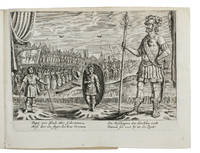
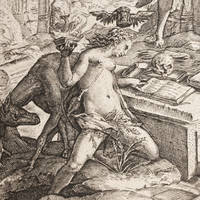
1648ref. B1GGR2474I77Amsterdam 1648. Small 4to 19 x 15 cm. Tymen Houthaeck Modern marbled wrappers. With a engraved illustration of a labyrinth on title-page an engraved plate by P. Holsteyn after A. Vinckenbrinck 3 engravings in text and a folding engraved plate of David & Goliath. 8 ll. Extremely rare third edition the first with poems by Jan Vos and double the size of the two earlier editions of a description intended as souvenir of the "Oude Doolhof" literally: old labyrinth of Amsterdam a sort of amusement park at the Looiersgracht. It was the first public doolhof founded by the wine merchant and inn-keeper Vincent Jacobsz. Coster at the beginning of the 17th century. The Doolhof was a sculpture garden with a labyrinth exhibiting fountains sculptures and automata showing historical mythical and biblical figures and spectacles. The booklet was first published ca. 1645 by Crispyn Passe the younger in 4 leaves and other versions followed soon after. For the present edition one full-page and one folding engraved plate were added together with poems by Jan Vos 1612-1667 the most popular Dutch playwright of his time.With the outer corner of the foot of the title-page and the first plate torn off and two minor waterstains on the title-page otherwise in very good condition.l Franken 1375 note; Meijer "Het oude doolhof te Amsterdam" in: Oud Holland I 1883 pp. 119-135; Spies De Amsterdamse doolhoven pp. 70-71; STCN 2 copies; WorldCat same 2 copies. unknown
2020ref. 2081502111906754Hoo shubbansha 2020. Soft Cover. Fine. The book is in fine condition. Hoo shubbansha paperback
2019ref. 2081502111906862Hoo shubbansha 2019. Soft Cover. Fine. The book is in fine condition. Hoo shubbansha paperback
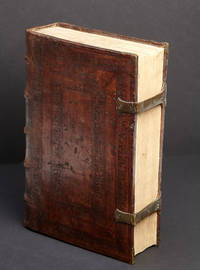
ref. 6759Numerous fine woodcut initials diagrams tables & maps in the text. Woodcut printer’s device at end. 14 p.l. 18 leaves 6 leaves 30 xxxi-cxxvi leaves 4 leaves. Folio cont. Flemish blindstamped calf binding over wooden boards rather well rebacked a few unimportant stains rolls of medallion heads & foliage forming a double panel orig. clasps and catches metal corner guards. Cologne: J. Prael for P. Quentel 1537. bound after: ANSELM ARCHBISHOP OF CANTERBURY. In Omnes Pauli Apostili Epistolas enarrationes. Title within fine woodcut border by Anton Woensam of Worms. Some fine large woodcut initials. 8 p.l. 531 pp. Folio. Cologne: E. Cervicornus for G. Hittorp 1533. A most attractive sammelband of two well-illustrated books in an attractive contemporary blind-stamped binding probably made at the Stavelot monastery in Belgium. I. First collected and illustrated edition of the scientific writings of the Venerable Bede including De Natura Rerum dealing with cosmology and natural history and De Temporum Ratione a work on chronology that still exercises a considerable influence over our daily life today. This edition was edited and commented upon by Joannes Noviomagus i.e. Jan van Bronchorst of Nijmegen 1494-1570 philosopher and mathematician then a professor of philosophy at the Collegium Montanum in Cologne. It would appear that he used the manuscript at the Dombibliothek no. 103 of Cologne to prepare this edition. The De Temporum Ratione is a significant book in several ways. Most notably “this book helped to establish the custom of counting years from the birth of Christ. When we say that Queen Elizabeth II was born in 1926 not ‘in the 16th year of the reign of George V’ or ‘in the year 2678 after the foundation of Rome’ or in the ‘2nd year of the 481st Olympiad’ we are indebted to the Venerable Bede.”–Printing & the Mind of Man 16n. “Bede’s greatest practical effect was on the Western calendar. His decisions beginning the year calculation of Easter names of days and months calculations of eras and so forth in most instances finally determined usage that was only refined not changed by Gregorian reform.”–D.S.B. I p. 565. “The De Ratione Temporum first published in 1505 is particularly important. It contains a remarkable theory of tides based upon Pliny but also upon personal observation; first mention of the establishment of a port i.e. the mean interval between the moon’s meridian passage and high water following; this interval is different in different ports.”–Sarton I p. 511. Pierre Duhem described Bede’s establishment of a port as the only original formulation of nature to be made in the West for some eight centuries. Also contained here is the De Natura Rerum 1st printing: 1529 which contains such physical science as was then known. It collects the wisdom of the ancient world on these subjects and has the special merit of referring phenomena to natural causes. It contains a particularly important section — the “De Comptu vel Loquela digitorum” — which is “our main almost our only source for the study of mediaeval finger reckoning or symbolism.”–Sarton I pp. 510-11. See also Smith History of Mathematics II p. 200. The rest of the book contains further treatises by Bede on arithmetic astronomy and the calendar and chronology. II. Very rare. PROVENANCE: Early inscription of “Antonius abbatis a Sancto Remaclo” on front flyleaf; Benedictine monastery of Stavelot Belgium inscription “Liber Monasterii Stabulensis” on title-page of Anselm; auction sale of the monastery library Catalogue d’une belle Collection de Livres et Manuscrits précieux sur vélin du VIIIe et du IXe siècle Ghent 26 April 1847 lot 42; Michel Chasles 1793-1880 the mathematician with bookplate his sale Paris 27 June-18 July 1881 lot 28; Robert B. Honeyman 1897-1987 his sale Sotheby’s 30 October 1978 lot 265. BINDING: Stavelot had its own bindery at this time and it is quite likely that this binding was executed there see Goldschmidt Gothic & Renaissance Bookbindings no. 90. Fine large copies preserved in a box. ⧠I. Adams B448–calling for two additional preliminary leaves but no other collation calls for them. Smith Rara Arithmetica p. 159n. Zinner 1657. II. Adams A1174. unknown
ref. 6759Numerous fine woodcut initials diagrams tables & maps in the text. Woodcut printer’s device at end. 14 p.l. 18 leaves 6 leaves 30 xxxi-cxxvi leaves 4 leaves. Folio cont. Flemish blindstamped calf binding over wooden boards rather well rebacked a few unimportant stains rolls of medallion heads & foliage forming a double panel orig. clasps and catches metal corner guards. Cologne: J. Prael for P. Quentel 1537. bound after: ANSELM ARCHBISHOP OF CANTERBURY. In Omnes Pauli Apostili Epistolas enarrationes. Title within fine woodcut border by Anton Woensam of Worms. Some fine large woodcut initials. 8 p.l. 531 pp. Folio. Cologne: E. Cervicornus for G. Hittorp 1533. A most attractive sammelband of two well-illustrated books in an attractive contemporary blind-stamped binding probably made at the Stavelot monastery in Belgium. I. First collected and illustrated edition of the scientific writings of the Venerable Bede including De Natura Rerum dealing with cosmology and natural history and De Temporum Ratione a work on chronology that still exercises a considerable influence over our daily life today. This edition was edited and commented upon by Joannes Noviomagus i.e. Jan van Bronchorst of Nijmegen 1494-1570 philosopher and mathematician then a professor of philosophy at the Collegium Montanum in Cologne. It would appear that he used the manuscript at the Dombibliothek no. 103 of Cologne to prepare this edition. The De Temporum Ratione is a significant book in several ways. Most notably “this book helped to establish the custom of counting years from the birth of Christ. When we say that Queen Elizabeth II was born in 1926 not ‘in the 16th year of the reign of George V’ or ‘in the year 2678 after the foundation of Rome’ or in the ‘2nd year of the 481st Olympiad’ we are indebted to the Venerable Bede.”–Printing & the Mind of Man 16n. “Bede’s greatest practical effect was on the Western calendar. His decisions beginning the year calculation of Easter names of days and months calculations of eras and so forth in most instances finally determined usage that was only refined not changed by Gregorian reform.”–D.S.B. I p. 565. “The De Ratione Temporum first published in 1505 is particularly important. It contains a remarkable theory of tides based upon Pliny but also upon personal observation; first mention of the establishment of a port i.e. the mean interval between the moon’s meridian passage and high water following; this interval is different in different ports.”–Sarton I p. 511. Pierre Duhem described Bede’s establishment of a port as the only original formulation of nature to be made in the West for some eight centuries. Also contained here is the De Natura Rerum 1st printing: 1529 which contains such physical science as was then known. It collects the wisdom of the ancient world on these subjects and has the special merit of referring phenomena to natural causes. It contains a particularly important section — the “De Comptu vel Loquela digitorum” — which is “our main almost our only source for the study of mediaeval finger reckoning or symbolism.”–Sarton I pp. 510-11. See also Smith History of Mathematics II p. 200. The rest of the book contains further treatises by Bede on arithmetic astronomy and the calendar and chronology. II. Very rare. PROVENANCE: Early inscription of “Antonius abbatis a Sancto Remaclo” on front flyleaf; Benedictine monastery of Stavelot Belgium inscription “Liber Monasterii Stabulensis” on title-page of Anselm; auction sale of the monastery library Catalogue d’une belle Collection de Livres et Manuscrits précieux sur vélin du VIIIe et du IXe siècle Ghent 26 April 1847 lot 42; Michel Chasles 1793-1880 the mathematician with bookplate his sale Paris 27 June-18 July 1881 lot 28; Robert B. Honeyman 1897-1987 his sale Sotheby’s 30 October 1978 lot 265. BINDING: Stavelot had its own bindery at this time and it is quite likely that this binding was executed there see Goldschmidt Gothic & Renaissance Bookbindings no. 90. Fine large copies preserved in a box. ⧠I. Adams B448–calling for two additional preliminary leaves but no other collation calls for them. Smith Rara Arithmetica p. 159n. Zinner 1657. II. Adams A1174. unknown books
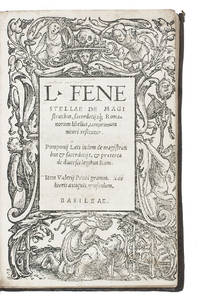
1523ref. 6849Basel: colophon: Valentino Curio 1523. Contemporary panel-stamped calf sewn on 4 supports each board with the same 3 panel stamps: 2 virtually identical panels 76 x 52 mm with the foot of the panels toward the spine with 6 animals in 2 grape vines the animals from head to foot in the left vine: a monkey dog and wyvern 2-legged dragon; and in the right vine: a squirrel hare and lion in a border of a diaper of quatrefoils in lozenges the two separated by a small panel stamp 12 x 75 mm with a peacock right side up with its head toward the right but turned back and pecking at the ground paste-downs made from a leaf from an Aristotle manuscript on vellum with a fragment of another manuscript in a bastarda script under it. 8vo 16 x 10.5 cm. Ad 1: With the general title in a woodcut border with a woman mounting a man as if he were a horse a head on a stake and other grotesque or satirical figures Curios large architectural woodcut device on the otherwise blank final page with a shield held by 4 putti bearing a hand emerging from a cloud painting or writing on a tablet with what appears to be a brush 4 woodcut decorated initials 2 series: roman inscriptional capitals with pictorial backgrounds and a vine-leaf ornament Vervliet 7. Ad 2: With 2 woodcut decorated initials. Ad 3: With 3 woodcut decorated initials 2 series and 2 different vine-leaf ornaments Vervliet 7 & 8. All three editions set in italic type with upright capitals ad 2 with equally extensive passages in roman. 3 works in 1 volume. Including with a drop-title: POMPONIO LETO Giulio. De Romanorum. magistratibus .With:2 LUCIANUS OF SAMOSATA. Complures . dialogi à Desiderio Erasmo Roterodamo . in Latinum conversi & à Nicolao Buscoducensi illustrati additis Fabularum & difficilium vocabulorum explanationibus.Colophon: Antwerp Michael Hillen van Hoochstraten 1524.3 MOSELLANUS Petrus Peter SCHADE. Paedologia . in puerorum usum conscripta & aucta. Dialogi XXXVII. Dialogi pueriles Christophori Hegendorphini. XII. .Including with a drop-title: HEGENDORF Christoph. Dialogi pueriles . XII. .Colophon: Antwerp Michael Hillen van Hoochstraten 1523. Three rare editions of humanist works in a contemporary panel-stamped binding all well produced and the panel stamps finely rendered. Fogelmark p. 33 calls panel-stamps with gothic animals in foliage "the Flemish panel stamp par préférence". We have not found an exact match in the literature. The impressions of the panels are very crisp and clear especially that on the lower half of the front board.Ad 1: First Basel edition of an account of the sacerdotium priesthood and administration in ancient Rome written by the Florentine humanist Andrea Domenico Fiocco d. 1452 assuming the name of a first century Roman writer Lucius Fenestella. It is followed by a work on the same subject by the Italian humanist Giulio Pomponio Leto 1428-1498 and a list of abbreviations by Valerius Probus. While these works by Fiocco and Leto had been published together since 1510 the present edition introduces a new form that seems to have become the standard followed by others.Ad 2: Rare Antwerp edition of satirical dialogues by the 2nd-century rhetorician Lucianus of Samosata now in Turkey near the Syrian border often simply called Lucian in English. They come from his Dialogues of the gods and Dialogues of the dead. The present translation from the Greek by Erasmus first appeared at Louvain in 1512. Only one other copy of the present edition is known.Ad 3: Rare early Antwerp edition of a very popular pedagogical work by the German humanist and professor at Leipzig Peter Schade better known as Petrus Mosellanus 1493-1524. The present edition includes as usual the dialogues for children by the German Hellenist Christoph Hegendorf 1500-1540. Only one other copy of the present edition is known.With several early owners' and other inscriptions and an occasional manuscript note or underlining in the text. The title page of ad 1 with an owner's inscription removed and about a millimetre shaved from the fore-edge of the woodcut border a small worm hole in the first 5 leaves and some mostly marginal water stains not significant outside the last 8 leaves: still in good condition. Recased with the four corners of each board and the head and foot of the spine restored and a few small wormholes and cracks in the calfskin of the boards slightly affecting the panel stamps but nearly all of each of the 6 panel impressions survives in very good condition. Three humanist works in Latin two in extremely rare Antwerp editions with finely executed contemporary panel stamps.l Ad 1: Adams F597; BMC STC German p. 300; Hieronymus Oberrhein. Buchillustr. 377c; USTC 671401; VD16 F1641; ad 2: Netherlandish books 19680 1 copy; Nijhoff & Kronenberg 1401 same copy; USTC 437231 same copy; not in Adams; BMC STC Dutch; UniCat; ad 3: Netherlandish books 21706 1 copy; USTC 404733 same copy; not in Adams; BMC STC Dutch; Buisson; EOL www.erasmus.org; Nijhoff & Kronenberg; UniCat; the main panel stamps not in Fogelmark; Goldschmidt; Indestege "De boekband in de Zuidelijke Nederlanden ." in De Gulden Passer XXXIV 1956 or the addendum in XXXV 1957; Oldham; Weale. (colophon:) Valentino Curio, hardcover
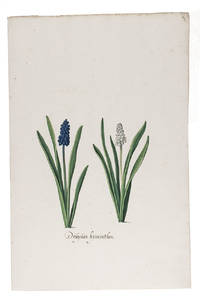
1650ref. 19905Netherlands 1650. Watercolour ca. 13.5 x 13 cm on laid paper 31.5 x 21 cm with caption below. Delicate watercolour of two grape hyacinths by the Dutch watercolour painter and engraver Pieter Holsteyn de Jonge 1614-1673. Holsteyn made many drawings of plants birds and insects which were often composed in albums. Some of those albums are still intact and supplied with a title-page by the artist himself and as a result many of the drawings in those albums were not signed. These grape hyacinths were in such an album which was later taken to pieces. With certificate from Dr. S. Segal Amsterdam. In very good condition. unknown
1923ref. 12039ABBerlin, Amsler & Ruthardt, (1923). 36,5 : 26 cm. Title, 76 pages, 2 leaves with 46 original aquatinta-etchings by Max Klinger. Original blue morocco, spine and boards with gilt fillets, inside dentelles.
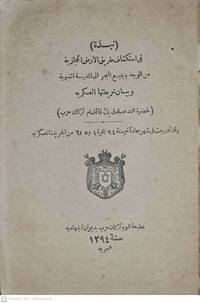
1877ref. 000604Cairo: Diwan al- Jihadiyya war office 1877 Book. Very Good. No Binding. 1st Edition. 12mo - over 6¾ - 7¾" tall. An early work about Hejaz and the Hajj by Muhammad Sadiq bey mainly published in the military newspaper of the Egyptian general military staff Nos. 4 5 and 6 in 1294 AH. 1877 AD. and published separately by the same press in the same year. 28 p. and 4 lithographic plates of which one is folding. kindly check item no. 000217 for the relating photographs album Diwan al- Jihadiyya (war office)
1929ref. 2091502135421944Not Available 1929. Soft Cover. Fine. Volume: 56 Not Available paperback
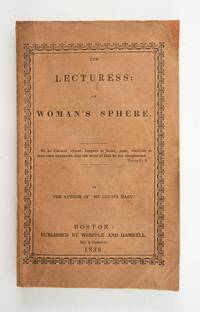
1839ref. ST20899Boston: Whipple and Damrell 1839. FIRST EDITION. 155 x 95 mm. 6 x 3 3/4". 124 pp. 1 leaf ads. Original brown printed paper wrappers flat spine inside wrappers and back cover with ads discreet repairs to upper corners of front cover. Housed in a fine custom made green cloth drop-back box. Wright I 1081. For the author see: Oxford Companion to Women's Writing in the United States pp. 371-72; Feminist Companion to Literature in English pp. 474-75. See also: Ganter "The Unexceptional Eloquence of Sarah Josepha Hale's 'The Lecturess'" in "Journal of the American Antiquarian Society" 2004. Covers vaguely soiled front corners a little creased text with frequent foxing sometimes noticeable due to paper quality but still an extremely well-preserved copy of a fragile item with joints and hinges as good as new. In an excellent state of preservation in its original wrappers this is the first known American novel featuring a women's rights activist written by one of the 19th century's leading editors and tastemakers. The story follows Marian Gaylord an educated and outspoken young woman who earns a living by lecturing on the importance of female education. As the story progresses Marian's attempts to step into public life bring serious personal consequences affecting her reputation relationships and health. At the novel's end Marian on her deathbed repents her lifestyle to a close friend telling her that "approaching death has taught me how wrong were all my opinions. It taught me that true pride true independence in a woman is to fill the place which her God assigns her; to make her husband's happiness her own and to yield her will to his in all things." Despite the author's apparent belief that woman's natural place is in the home Sarah Josepha Hale 1788-1879 was herself a successful career woman and seems to have been as progressive as often as she was conservative on a number of issues related to women's rights. According to ANB "In an age when women were regarded as natural invalids confined to the home she urged the necessity for women doctors women nurses and women teachers and helped found schools for their training; she advocated physical exercise and fresh air for women sensible dress and an end to tight lacing. In addition she supported the use of any labor-saving devices that would make domestic work easier such as the sewing machine and the washing machine and in spite of religious opposition she fought for the use of anesthesia for surgery and in childbirth." Hale was not however a suffragist and the "Oxford Companion to Women's Writing in the United States" notes that "Debate continues about the nature of Hale's feminism. Some scholars criticize her as a proponent of 'women's sphere'; as a believer in women's moral superiority she expected women to provide spiritual leadership for western civilization and for the Christianization of the world. . . . But she disliked women public speakers abolitionists and women's rights proponents. Yet she advocated property rights for married women female doctors and in her later life support for working women." Despite displaying considerable ambivalence in the world of emerging feminism Hale is acknowledged by modern scholars as having an important role in literary history being "the most prominent American woman engaged in literary enterprise in the mid-nineteenth century" and "the first of the great 'lady editors." Oxford Companion Widowed at the age of 34 and with five children to support Hale turned to writing to provide a living for her family. Her first successful novel "Northwood" 1827 is considered to be "one of the first American novels to deal with the question of slavery." ANB She also wrote children's books and poetry including the popular nursery rhyme "Mary Had a Little Lamb." Her success led to editorial positions at "Ladies' Magazine" and "Godey's Lady's Book" where she remained for 40 years. There she made her most enduring marks on American culture publishing original work by American writers particularly women campaigning for causes such as the Bunker Hill Monument and a national Thanksgiving Day and promoting female education including the founding of Vassar College. "The Lecturess" is a very rare book in the marketplace: we could find just one rather dog-eared copy sold at auction fetching $6930 at Christie's in 2023. Whipple and Damrell unknown
1839ref. ST20899Boston: Whipple and Damrell 1839. FIRST EDITION. 155 x 95 mm. 6 x 3 3/4". 124 pp. 1 leaf ads. Original brown printed paper wrappers flat spine inside wrappers and back cover with ads discreet repairs to upper corners of front cover. Housed in a fine custom made green cloth drop-back box. Wright I 1081. For the author see: Oxford Companion to Women's Writing in the United States pp. 371-72; Feminist Companion to Literature in English pp. 474-75. See also: Ganter "The Unexceptional Eloquence of Sarah Josepha Hale's 'The Lecturess'" in "Journal of the American Antiquarian Society" 2004. Covers vaguely soiled front corners a little creased text with frequent foxing sometimes noticeable due to paper quality but still an extremely well-preserved copy of a fragile item with joints and hinges as good as new. In an excellent state of preservation in its original wrappers this is the first known American novel featuring a women's rights activist written by one of the 19th century's leading editors and tastemakers. The story follows Marian Gaylord an educated and outspoken young woman who earns a living by lecturing on the importance of female education. As the story progresses Marian's attempts to step into public life bring serious personal consequences affecting her reputation relationships and health. At the novel's end Marian on her deathbed repents her lifestyle to a close friend telling her that "approaching death has taught me how wrong were all my opinions. It taught me that true pride true independence in a woman is to fill the place which her God assigns her; to make her husband's happiness her own and to yield her will to his in all things." Despite the author's apparent belief that woman's natural place is in the home Sarah Josepha Hale 1788-1879 was herself a successful career woman and seems to have been as progressive as often as she was conservative on a number of issues related to women's rights. According to ANB "In an age when women were regarded as natural invalids confined to the home she urged the necessity for women doctors women nurses and women teachers and helped found schools for their training; she advocated physical exercise and fresh air for women sensible dress and an end to tight lacing. In addition she supported the use of any labor-saving devices that would make domestic work easier such as the sewing machine and the washing machine and in spite of religious opposition she fought for the use of anesthesia for surgery and in childbirth." Hale was not however a suffragist and the "Oxford Companion to Women's Writing in the United States" notes that "Debate continues about the nature of Hale's feminism. Some scholars criticize her as a proponent of 'women's sphere'; as a believer in women's moral superiority she expected women to provide spiritual leadership for western civilization and for the Christianization of the world. . . . But she disliked women public speakers abolitionists and women's rights proponents. Yet she advocated property rights for married women female doctors and in her later life support for working women." Despite displaying considerable ambivalence in the world of emerging feminism Hale is acknowledged by modern scholars as having an important role in literary history being "the most prominent American woman engaged in literary enterprise in the mid-nineteenth century" and "the first of the great 'lady editors." Oxford Companion Widowed at the age of 34 and with five children to support Hale turned to writing to provide a living for her family. Her first successful novel "Northwood" 1827 is considered to be "one of the first American novels to deal with the question of slavery." ANB She also wrote children's books and poetry including the popular nursery rhyme "Mary Had a Little Lamb." Her success led to editorial positions at "Ladies' Magazine" and "Godey's Lady's Book" where she remained for 40 years. There she made her most enduring marks on American culture publishing original work by American writers particularly women campaigning for causes such as the Bunker Hill Monument and a national Thanksgiving Day and promoting female education including the founding of Vassar College. "The Lecturess" is a very rare book in the marketplace: we could find just one rather dog-eared copy sold at auction fetching $6930 at Christie's in 2023. Whipple and Damrell unknown books
1604ref. 009462 10 1 leaves Bound suite of prints 204 x 165 mm ---- First and only edition of this Mannerist triumph of early European political propaganda a suite of engravings glorifying the House of Habsburg that storied dynasty that so long ruled much of Europe including three centuries of the Holy Roman Empire. The engravings here depict ten Habsburg rulers from Rudolphus I ca. 1282-1307 through Rudolf II 1552-1612 Holy Roman Emperor at time of publication. An allegorical engraving on death and fame precedes the gallery of Habsburg rulers as does the fully engraved title on its own a beautiful display of Mannerist figures with delicately elongated bodies. The suite finishes with the arms of Rudolf II as Holy Roman Emperor featuring four of the most jacked putti we've ever seen for a complete set of thirteen engravings altogether. A quatrain of engraved text by Gaspar Ens heaps praise on each ruler. ¶ If not best known for his Hortus Floridus "one of the most important early examples of botanical illustration" Gerard then Crispijn might be best known for fathering four children who themselves went on to work as engravers—including his daughter Magdalena van De Passe who taught engraving to Anna Maria van Schurman. He was the patriarch of a prodigious print dynasty which produced all told some 14000 prints and worked as far afield as Paris and London. While De Passe has signed these plates excudit typically denoting a publisher's role curators Julie Aronson and Marjorie E. Wieseman remarked that he "was an accomplished draftsman who made most of his prints after his own designs" with a focus on portraits especially after 1618. Ilja Veldman who ranks De Passe "among the foremost portraitists of his age" suggests these were done after Cologne artist Augustin Braun though only the Matthias portrait a later addition is so signed. Veldman too remarks that De Passe designed most of his prints himself. Whatever the case the suite is a De Passe publication and "all the prints that De Passe published were engraved by him or his studio" Veldman. ¶ The present work combines two of De Passe's specialties: portraits of eminent Europeans and the publication of books of prints. It's a masterful example of the classicized portrait deployed as contemporary political propaganda—among the family's "classicizing apotheoses" according to art historian Milan Pelc. "It seems as if de Passe wanted to combine in these portraits the mounted knights of the late gothic Nine Worthies series with the impressively animated portraits of the Roman emperors by Titian which Aegidius Sadeler reproduced as prints. For the recipients who at that time could find similar portrait series of Roman emperors on horseback or in triumphal chariots.the symbolic and propagandistic allusions of such Habsburg portraits were probably immediately understandable." ¶ Like so many things during the Renaissance the taste among the elite for producing their own likenesses was heavily influenced by the discoveries of ancient Roman models. The portrait however got off to a relatively slow start in print. Paintings were certainly a popular medium for portraiture and original drawings circulated among Europe's courts to help satisfy the demand. And in the 16th century no portrait medium held quite as much sway as the medal the "currency of fame" as Lisa Jardine put it. "In an era where portraits were still rare and the image had yet to lose any of tis magic the power of such likenesses is hard to overstate" Konraad Jonckheere remarks. "The portrait has plainly lost none of its potency even today" he continues "with visual culture such as television film and social media continuing to promote a form of idolatry." ¶ By the early 1600s the portrait print had become a potent medium second only to religious subjects in the pantheon of printed imagery in France at least. "To a certain extent this can be explained by the development of book illustration and its increased use of engraving instead of woodcut since some of these portraits were used as book frontispieces. But the real impetus must have come from the urgency of current events the consequent propagandistic use of images and the curiosity of the urban middle-class about the protagonists of public life" Zerner. ¶ These are hardly the first Habsburg portrait prints—Rudolf II had commissioned others and he was among Europe's most voracious collectors and patrons of art. Even still these engravings stand out for the sense of power they convey not least for their imperial pedigree. Pelc suggested De Passe might have blended Titian's portraits with the Nine Worthies on horseback but we'd be shocked if these prints rather weren't influenced by the series of Roman emperors designed by Jan van der Straet or Antonio Tempesta. To be sure De Passe himself produced a series of Roman emperors based on Van der Straet's designs. De Passe's portrait of Frederick III for example was almost certainly based on either van der Straet's Otho or Tempesta's Julius Caesar. Those two artists together exerted a profound influence on the 17th-century equestrian portrait in Europe—influence that is here on full display. De Passe has even added background battle scenes reminiscent of the backgrounds in Van der Straet and Tempesta's work. ¶ Rare. We find no copies at auction since 1923. ---- CONDITION: Bound ca. 1900 in half burgundy goatskin and marbled boards the spine tooled in gold; marbled endpapers and gilt edges. Each engraving—surely trimmed but all plate marks preserved—is tipped to a separate leaf. ¶ Hollstein omits the final plate arms of Rudolf II but adds an unnumbered portrait of Matthias who succeeded Rudolf II as Holy Roman Emperor in 1612. Hollstein's copy must have been updated sometime after Matthias's accession and Veldman suggests the Matthias plate may have become a standard addition. ¶ The occasional spot of light soiling or small stain from the adhesive used to tip them but really a nice set. Binding extremities gently rubbed. ---- REFERENCES: Hollstein Dutch and Flemish Etchings Engravings and Woodcuts v. 15 p. 217-218 #655-665 ¶ On De Passe: Milan Pelc Illustrium Imagines: Das Porträtbuch der Renaissance 2021 p. 105 cited above; Robert A. Gerard "Woutneel de Passe and the Anglo-Netherlandish Print Trade" Print Quarterly 13.4 Dec 1996 p. 363 cited above; Jef Schaeps "Passe family van de" The Oxford Companion to the Book 2010 accessed online "Dutch engravers and print publishers. CrispijnvandePassethe elder 1564–1637 with his children Simon Crispijn the younger Willem and Magdalena ran one of the largest print-publishing firms in the Dutch Republic first in Utrecht and from 1639 in Amsterdam. Their output comprises some 14000 prints ranging from biblical and mythological series to portraits allegorical scenes and illustrations to emblem books and other elegant publications aimed at an elite clientele all over Europe."; Amy Namowitz Worthen "Engraving" Grove Art Online 2003 accessed online "Crispijn van de Passe founded a dynasty that was active well into the next century in Utrecht Cologne London and Paris"; Ilja M. Veldman "Passe Crispijn Crispiaen van de Arnemuiden Grove Art Online 2003 accessed online "Crispijn's engravings were popular throughout Europe and cover a remarkably wide range of subjects.He engraved portraits of the most prominent royal and aristocratic families in Europe.In many cases Crispijn signed his prints as 'inventor' indicating that he must have made preliminary drawings; but there are only a few dozen that can be ascribed to him with certainty"; Julie Aronson and Marjorie E. Wieseman Perfect Likenesses: European and American Portrait Miniatures from the Cincinnati Art Museum 2006 p. 37 cited above; Ilja M. Veldman "Crispijn de Passe: his books and prints for the English market" The Bookshop of the World: The role of the Low Countries in the book-trade 1473-1941 1999 p. 159 "De Passe settled in Cologne in 1589 and set up a productive and distinguished print business producing portraits of the European nobility and religious mythological and allegorical prints for which he found a ready market in Europe. He was a gifted draughtsman who designed more than half of the prints he produced.His collaboration with book printers resulted in books of prints becoming one of his specialties."; Ilja M. Veldman Michael Hoyle tr. Crispijn de Passe and His Progeny 1564-1670 2001 p. 45 "it was in Cologne that he rose to become a prominent and prolific print publisher" 46 "All the prints that De Passe published were engraved by him or his studio and he designed most of them as well" 85 on his portraits: "De Passe drew most of the designs himself. The few drawn portraits of his that have come down to us display great vivacity and spontaneity which confirms that portraiture was his great speciality and ranks him among the foremost portraitists of his age." 99 the Maurits portrait reproduced 100 confirming 10 portraits in the series "after August Braun" and commenting that "a portrait of the new emperor Matthias was added to the suite after 1611"; and on his own series of Roman emperors after the Stradanus designs which informed the present series ¶ On portraits broadly: Mieczysław Morka Polski nowożytny portret konny i jego europejska geneza 1986 v. 3 p. 235 "The greatest influence on equestrian portraits and battle iconography from the 17th century was exerted by two cooperating artists: Jan van der Straet called Stradanus painter and draftsman and Antonio Tempesta"; Henri Zerner "Introduction" The French Renaissance in Prints 1994 p. 27 cited above; Cynthia Burlingham "Portraiture as Propaganda: Printmaking during the Reign of Henri IV" French Renaissance in Prints p. 139 "The reign of Henri IV 1589-1610 witnessed an enormous increase in the popularity of the printed portrait. Demand for engraved portraits during this period was second only to that for prints with religious subjects.During this period 16c it was limited to drawings distributed within close-knit European court circles. By the end of the century however more than forty years of civil war and religious strife were making new demands upon the emerging Bourbon dynasty. What started out as an elite genre began to appeal to a broader audience with the introduction of printed portrait albums and finally widely circulated single-sheet prints."; Lisa Jardine Worldly Goods 1996 p. 416 cited above; on portraits medals especially; Penelope J.E. Davies et al. Janson's Basic History of Western Art 2014 p. 327 "The idea of recording specific likenesses was inspired by the fifteenth century's increasing awareness of the individual but also by the study of Roman art where portraits abound.Florentine families who commissioned works of art often included portraits of their political allies as well as themselves to make their political and social networks clear to their neighbors" 353 "Mannerism became a style of utmost refinement which emphasized grace variety and virtuoso display instead of clarity and unity. Mannerist artists self-consciously explored definitions of beauty: Rather than repeat ancient forms they experimented with proportions ideal figure types and unusual compositions."; Koenraad Jonckheere A New History of Western Art 2022 p. 296 cited above; Walter A. Liedtke and John F. Moffitt "Velázquez Olivares and the baroque equestrian portrait" The Burlington Magazine 123.942 Sept 1981 p. 529 "For a monarch to be mounted on a horse seems as natural to the modern eye and evidently to the seventeenth-century viewer as well as the image of a king on a throne or of a conqueror armed with a sword" Crispijn van de Passe hardcover
1735Professionally rebound, including 95% of the contemporary full leather boards. New endpapers. Original bookplate (steel engraving) Frontispiece of "Capt. Lemuel Gulliver, Splendide Mendax. Hor. " Four steel engraved maps of the islands and numerous ornaments and smaller illustrations throughout the book. A very handsome, tight, early edition of one of the most famous books ; Including the four parts: I: A Voyage to Lilliput. II: A Voyage to Brobdingnag. III: A Voyage to Laputa, Balnibarbi, Luggnagg, Glubbdubdrib and Japan. IV: A Voyage to the Country of the Houyhnhnms. This is the (apparent) third editon, lightly corrected and preceded by the London edition and the first Dublin edition. - Stored in a custom-made decorative box with petrol colored marbled paper and leather spine with gilt lettering; 8vo; 404 pages
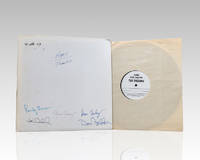
ref. 152399Los Angeles California: Asylum Records 1976. Rare Columbia Record Productions test pressing of Hotel California the Eagles’ landmark fifth studio album boldly signed by all five members of the band. Signed on the plain album sleeve in blue felt tip by Don Henley Don Felder Randy Meisner Glenn Frey and Joe Walsh. With an additional contemporary inscription in an unknown hand “Mark Thanks” and annotation in the upper left “7E-1084 A/B” the matrix number for both sides of the album. The test pressing itself is present bearing the plain “Columbia Record Productions Santa Maria Test Pressing” label to both sides the runouts stamped with the matrix numbers “7E 1084 A-2 RE CSM ‘IS IT 6 O’CLOCK YET’ A1 STERLING LH 1S” and “7E 1084 B-4 RE CSM ‘V.O.L. IS FIVE PIECE LIVE’ A STERLING LH 1S.” In fine condition with light scuffing and edgewear to the sleeve. Accompanied by full letters of authenticity from PSA/DNA and JSA. A scarce and highly desirable band-signed pre-release pressing of one of the best-selling and most acclaimed albums in the history of American rock. Released in December 1976 Hotel California was the Eagles’ fifth studio album and the summit of their commercial and critical success capturing the seductive glamour and unease of 1970s California in songs that have become touchstones of American popular music. The album held the top of the Billboard charts for a total of eight weeks and won Grammy Awards for the title track “Hotel California” named Record of the Year and for “New Kid in Town” honored for Best Arrangement for Voices. The cryptic “secret messages” engraved in the record’s run-out grooves were present on the original commercial release; the second of them “V.O.L. is five piece live” refers to the album’s sixth track “Victim of Love” which the band recorded live in the studio in a single take with no overdubbing. Test pressings such as this were produced in tiny numbers ahead of commercial release for the band and label to review making an example signed by the complete Hotel California lineup of Don Henley Glenn Frey Don Felder Joe Walsh and Randy Meisner exceptionally rare. Asylum Records unknown
ref. 66887Oxford: Printed by John Baskett Printer to the King's most Excellent Majesty for Great Britain; and to the University 1717-1716. 2 vols. Large folio 48.5 x 31 cm. Text in double columns title-page and calendar printed in red and black with the Apocrypha. Full 19th century brown morocco the covers elegantly decorated in blind and with central gilt-tooled panel spines with gilt-tooled raised bands compartments stamped in blind gilt lettering direct to two panels gilt inner dentelles brown-coated endpapers all edges gilt. The Old Testament with additional engraved title by Du-Bose depicting Moses writing the first words of Genesis trimmed to the neatline on right side with partial loss to bottom margin and laid down engraved vignette of Oxford by G. Vander Guchtto to letterpress title and 49 engraved illustrations; New Testament with engraved vignette to title-page dated 1716 and 16 engraved illustrations. Historiated initials throughout. Provenance: Sir Herbert Eustace Maxwell 1845-1938 Scottish novelist essayist artist antiquarian horticulturalist prominent salmon angler and author of books on angling and Conservative politician who sat in the House of Commons from 1880 to 1906 with his engraved armorial bookplates to front pastedowns. Some scuffs to boards intermittent toning and spotting final leaf in Vol.2 remargined at bottom generally a very handsome set. This edition's sobriquet comes from the misprint "the parable of the vinegar" in Luke XX in place of the "parable of the vineyards." While a contemporary lambasted Baskett for this and other typographical errors in the text calling it a "Baskett-ful of errors" Oxford historian of printing Harry Carter states that "only Baskerville's Bible is its equal among English Bibles for beauty of type impression and paper" The History of the Oxford University Press I:171. Accuracy aside the most special aspect of the book's beauty resides in the sixty large and attractively-engraved head- and tailpieces featuring biblical scenes. Perhaps not until the monumental Macklin Bible of 1800-1816 does one see decoration to rival Baskett's edition. John Baskett purchased a royal patent to print Bibles from the executors of Thomas Newcomb and Henry Hills and his name began appearing with theirs on Bibles from 1710. Baskett was jealous of his privilege and won a suit against Scottish printer James Watson who had dared to sell his Bibles in England. He did not win a similar suit against the University of Cambridge. Darlow and Moule 735A; Herbert 942 Oxford: Printed by John Baskett, Printer to the King's most Excellent Majesty, for Great Britain; and to the University, 1717-17 hardcover
1881ref. SET25-A-3London : Trustees of the British Museum 1881-1904. Fine Binding. Very Good Indeed. 13.5" by 10". None. An extensive and comprehensive catalogue of the printed books included in the British Museum at the end of the nineteenth century in a fine binding. Organised alphabetically by author. The volumes contained in this set cover authors A. through to Z. in forty-seven volumes along with nine volumes of supplements to the main catalogue. Also included are one volume containing a catalogue of every edition of the Bible in the posession of the British Museum at the time of publication 1892 a volume on the periodicals in the collection 1885 and two volumes containing a list of the laws statutes and treaties of England 1900 and France and Germany 1898. During its long history the British Museum Library/British Library has published several catalogues describing its collections of printed books periodicals and ephemera. Each edition is inclusive incorporating all material included in previous versions. BL This edition was originally published in three-hundred and ninety-three parts with a forty-four part supplement and is referred to by the British Library and British Museum as GK1. Complete in sixty volumes. In half-morocco bindings. Externally mainly smart although with some rubbing in places particularly to the spines and a few marks to the boards. Dusting to textblock edges. Five joints of one hundred and twenty starting. Internally generally firmly bound although slightly strained in places. Hinges of the third volume have failed and textblock is detached. Hinges are reinforced with cloth tape. Pages are mainly bright and clean with just some scattered light spotting in places. Very Good Indeed Trustees of the British Museum unknown
1842ref. 098065Great Britain 1842. A near complete run from 1842 to 1930 lacking only 3 half years Jan/Jun 1848 1899 & 1916 . 133 volumes. Books measures 13 x 9 inches or slightly larger 13 1/2 x 9 inches. 115 volumes bound in red quarter calf or red cloth with gilt title lettering. All these volumes are in very good clean firm condition. The other 18 volumes are bound in black half calf. Showing some minor wear occasional abrasion wear with minor loss. All in good firm condition. Generally all volumes are in very good clean firm condition. Internally extensively illustrated throughout many single page and folding plates occasional small library mark/stamp occasional minor defect or repair. Pages in very good clean condition throughout. A very nice clean well bound run. . Very Good Plus. Small Folio. hardcover
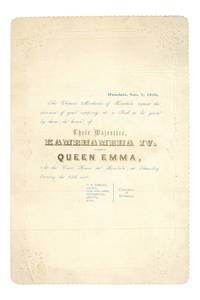
1856ref. 140946651Honolulu HI: Committee of Invitation 1856. Near Fine. 5.8"x7.25. Single sheet with scalloped edges and decorative embossed borders with text printed in gold and blue. Near Fine with minor soiling light toning and old folds. One of the earliest printed works commissioned by Chinese immigrants in what is now the United States. While the first Chinese explorers reached Hawaii in the late 18th century Chinese immigration to any part of the United States began in appreciable numbers about the time of the California Gold Rush. While much writing about Chinese immigrants survives from the mid-19th century almost nothing survives by any of those immigrants. This invitation represents a rare and very early instance of such printed matter. The Great Chinese Merchants' Ball of 1856 was thrown in celebration of the marriage of Liholiho Kamehameha IV to Emma Naea Rooke. Following a series of celebrations including balls thrown by the American Club and German Club roughly three dozen Cantonese in Honolulu felt that it was necessary for them if they were to succeed in the mercantile trade during the reign of the king to have a personal relationship with him. They decided to demonstrate the depth of their loyalty to the throne by presenting an extravaganza that would surpass those given by the Americans and Germans. A respected Cantonese merchant Chun Afong who was proficient in the Hawaiian and English languages and conversant with Western manners was persuaded to head the committee of arrangements for a ball. Afong would eventually become the first Chinese millionaire in Hawaii. The Chinese Merchants' Ball was one of the most Hawaiian elaborate affairs of the 1850s. It was a key event in Honolulu's social history where for the first time "East" and "West" met as social equals greatly solidifying the Chinese community's position in Honolulu. A rare survival of an invitation to an important social event in Hawaiian cultural history as well as an unusually early document printed by Chinese immigrants in America. Committee of Invitation unknown
1856ref. 140946651Honolulu HI: Committee of Invitation 1856. Near Fine. 5.8"x7.25. Single sheet with scalloped edges and decorative embossed borders with text printed in gold and blue. Near Fine with minor soiling light toning and old folds. One of the earliest printed works commissioned by Chinese immigrants in what is now the United States. While the first Chinese explorers reached Hawaii in the late 18th century Chinese immigration to any part of the United States began in appreciable numbers about the time of the California Gold Rush. While much writing about Chinese immigrants survives from the mid-19th century almost nothing survives by any of those immigrants. This invitation represents a rare and very early instance of such printed matter. The Great Chinese Merchants' Ball of 1856 was thrown in celebration of the marriage of Liholiho Kamehameha IV to Emma Naea Rooke. Following a series of celebrations including balls thrown by the American Club and German Club roughly three dozen Cantonese in Honolulu felt that it was necessary for them if they were to succeed in the mercantile trade during the reign of the king to have a personal relationship with him. They decided to demonstrate the depth of their loyalty to the throne by presenting an extravaganza that would surpass those given by the Americans and Germans. A respected Cantonese merchant Chun Afong who was proficient in the Hawaiian and English languages and conversant with Western manners was persuaded to head the committee of arrangements for a ball. Afong would eventually become the first Chinese millionaire in Hawaii. The Chinese Merchants' Ball was one of the most Hawaiian elaborate affairs of the 1850s. It was a key event in Honolulu's social history where for the first time "East" and "West" met as social equals greatly solidifying the Chinese community's position in Honolulu. A rare survival of an invitation to an important social event in Hawaiian cultural history as well as an unusually early document printed by Chinese immigrants in America. Committee of Invitation unknown books
1519ref. 69853Princeton:: Princeton Tiger 1915-1916. framed to an overall size of 15-1/4 x 18-1/4 inches. Very slightest of silvering to the outside areas of the image; otherwise very fine. . Image size 9-3/4 x 13 inches . The sitters are named by last name only on the verso in ms. Signed in the image by the photographer: initial illegible White N.Y." Princeton Tiger, unknown
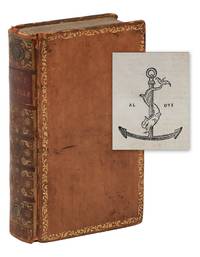
1508ref. 140949452Venice: Aldi et Andreae Asulani soceri Aldine Press 1508. First Edition Thus. Near Fine. The first Aldine Press edition of Pliny's letters and the first book to include Asulanus Andrea Torresani as Aldus' partner on the colophon. Octavo 8 4 a-z8 aa-kk8. xxiv; 525 3 pp. 46 '47' 47 '46' 119 '129' 206 '106' 210 '120' 226 '194' 245 '24' 250 '218' 254 '222' 258 '158' 274 '247' 373 '341' 457 '451' 461 '462' 497 '49' 508 '580'. Printed on laid paper text in Latin colophon and Aldine device at rear. Bound in 18th century polished calf decorative gilt tooling morocco title label and emblems to spine. All edges stained yellow marbled endpapers green silk ribbon marker. UCLA Aldine Press 100 USTC 849906. Near Fine with shallow chipping to spine ends and loss of 3 morocco spine emblems darkening to upper textblock edge; joints rubbed and starting at upper ends. Armorial bookplate of Lewis Montolieu 3rd Baron St Hippolyte to front pastedown worming to lower right corner of title page. Occasional faint foxing to contents Latin marginalia in old hand throughout trimmed short for present binding. Binding very firm; a solid copy attractively marked by a reader whose title page inscription is dated 1605. Aldus Manutius 1450-1515 founded what was to become the most important Renaissance printing press in Venice around 1490. His first dated publication was a book of Greek grammar to which Aldus added his own Latin translations. He had been an independent scholar and a tutor to the young princes of Capri and he saw a need for a new kind of book: a pocket-sized volume of classical literature something relatively affordable and very portable that a gentleman could take with him on his travels. With support from the two princes and financial backing from Andrea Torresani d'Asola whose daughter he married in 1505 Aldus set out to print Greek texts for the first time - "building a library which knows no walls save those of the world itself" in the words of his friend Erasmus. By the time he died in 1515 his books were famous across Europe. To cover their costs Aldus and his successors had to print in large runs of a thousand copies instead of the usual 250 or fewer. They also had to fit as much text on the page as possible. Aldus worked with the punch-cutter Francesco Griffo to create a slanting font modeled on the handwriting of papal chancery scribes. This condensed typeface first used in an edition of Virgil in 1501 became known as italics after it spread through Europe. The newness of the innovation can be traced in this scarce book published in Aldus' lifetime: they had not yet found a good way to italicize uppercase letters. Aldi, et Andreae Asulani soceri [Aldine Press] unknown
1508ref. 140949452Venice: Aldi et Andreae Asulani soceri Aldine Press 1508. First Edition Thus. Near Fine. The first Aldine Press edition of Pliny's letters and the first book to include Asulanus Andrea Torresani as Aldus' partner on the colophon. Octavo 8 4 a-z8 aa-kk8. xxiv; 525 3 pp. 46 '47' 47 '46' 119 '129' 206 '106' 210 '120' 226 '194' 245 '24' 250 '218' 254 '222' 258 '158' 274 '247' 373 '341' 457 '451' 461 '462' 497 '49' 508 '580'. Printed on laid paper text in Latin colophon and Aldine device at rear. Bound in 18th century polished calf decorative gilt tooling morocco title label and emblems to spine. All edges stained yellow marbled endpapers green silk ribbon marker. UCLA Aldine Press 100 USTC 849906. Near Fine with shallow chipping to spine ends and loss of 3 morocco spine emblems darkening to upper textblock edge; joints rubbed and starting at upper ends. Armorial bookplate of Lewis Montolieu 3rd Baron St Hippolyte to front pastedown worming to lower right corner of title page. Occasional faint foxing to contents Latin marginalia in old hand throughout trimmed short for present binding. Binding very firm; a solid copy attractively marked by a reader whose title page inscription is dated 1605. Aldus Manutius 1450-1515 founded what was to become the most important Renaissance printing press in Venice around 1490. His first dated publication was a book of Greek grammar to which Aldus added his own Latin translations. He had been an independent scholar and a tutor to the young princes of Capri and he saw a need for a new kind of book: a pocket-sized volume of classical literature something relatively affordable and very portable that a gentleman could take with him on his travels. With support from the two princes and financial backing from Andrea Torresani d'Asola whose daughter he married in 1505 Aldus set out to print Greek texts for the first time - "building a library which knows no walls save those of the world itself" in the words of his friend Erasmus. By the time he died in 1515 his books were famous across Europe. To cover their costs Aldus and his successors had to print in large runs of a thousand copies instead of the usual 250 or fewer. They also had to fit as much text on the page as possible. Aldus worked with the punch-cutter Francesco Griffo to create a slanting font modeled on the handwriting of papal chancery scribes. This condensed typeface first used in an edition of Virgil in 1501 became known as italics after it spread through Europe. The newness of the innovation can be traced in this scarce book published in Aldus' lifetime: they had not yet found a good way to italicize uppercase letters. Aldi, et Andreae Asulani soceri [Aldine Press] unknown books