331.469 risultati
1842rif. 44147Leipzig Johann Ambrosius Barth 1842. Without wrappers. In "Annalen der Physik und Chemie. Hrsg. von J.C. Poggendorff" Ergänzungsband 1 Stück 2. Pp. 193-384 a. 1 folded engraved plate. The entire issue offered. Henry's paper: pp. 282-312. First German version of Henry's description of his discovery of self-induction. He missed the credit for the discovery of induction to Faraday but he had done the key experiment ahead of Faraday but Faraday was the first to publish. But he is credited for the discovery of self-induction 1832 and Faraday discovered it independently two years later 1834."In Henry's paper however he explained thet the electric current in a coil can induce another current not only in another coil but in itself. The actual current observed in the coil is then the combination of the original current and the induced current. This is called self induction."Isac Asimov.The issue contains further notable papers Michael Faraday's "Vierzehnte Reihe von Experimental-Untersuchungen über Elektricität" § 2o-22. Nos 1667-1748. Pp. 249-281. First German version. In this paper FARADAYamplifies his theory of electrostatic induction by making further use of the analogy with the induction of magnetism. Whittaker describes the paper as having "THE FUNDAMENTAL EQUATION OF ELECTROSTATICS" as modified in order to take into account the effect of the specific inductive capacity."Whittaker I pp.187-89. unknown
1822rif. 43751Leipzig Johann Ambrosius Barth 1822. Without wrappers as extracted from "Annalen der Physik und der Physikalischen Chemie. Hrsg. Ludwig Wilhelm Gilbert" Bd. 71. Titlepage to vol. 71 pp. 124-171 a. pp. 172-176 and 1 folded engraved plate showing experimental apparatus. Clean and fine. First German edition of Faraday's famous paper "On some new Electro-Magnetical Motion and on the Theory of Magnetism. By Michael Faraday Chemical Assistant in the Royal Institution. 1821" recording one of the most influential discoveries in physics in the 19th Century as Faraday here as the very first showed how to CONVERT THE ELECTRICAL AND MAGNETIC FORCES INTO CONTINUAL MECHANICAL MOVEMENT thus creating the first electric motor using the principle of electromagnetic rotation. In the first paper he introduced for the first time the concept of "LINE OF FORCE" and hereby deliniating "a picture of the universe as consisting of fields of various types one that was more subtle flexible and useful than the purely mechanical picture of Galileo and Newton. The FIELD UNIVERSE was to be recognized with Maxwell half a century later and with Einstein after an interval of another halfcentury."Asimov."Ever since Hans Christian oersted's announcement of the discovery of electromagnetism in the summer of 1820 editors of scientific journals had been inundated with articles on the phenomenon. Theories to explain it had multiplied and the net effect was confusion. Were all the effects reported real Did the theories fit the facts It was to answer these questions that Phillips turned to Faraday and asked him to review the experiments and theories of the past months and separate truth from fiction.Faraday agreed to to undertake a short historical survey.His entusiasm was aroused in September 1821 when he turned to the investigation of the peculiar nature of the magnetic force created by an electrical current. Oersted had spoken of the "electrical conflict" surrounding the wiree and had noted that "this conflict performs circles".Yet as he experimented he saw precisely what was happening. Using a small magnetic needle to map the pattern of magnetic force he noted that oneof the poles of the needle turned in a circle as it was carried around the wire. He immediately realized that a single magnetic pole would rotate unceasingly around a current-carrying wire so long as the current flowed. He then set about devising an instrument to illustrate this effect. His paper "On some new Electro-Magnetical Motion and on the Theory of Magnetism" appeared in the 21 October 1821 issue of the "Quarterly Journal of Science" The paper offered in the first German edition. It records the first conversion of electrical into mechanical energy. It also contained the first notion of the line of force."DSB IV pp. 533. unknown
1853rif. 43449Leipzig Johann Ambrosius Barth 1853-54. No wrappers. "Annalen der Physik und Chemie. Hrsg. von J.C. Poggendorff" Vol. 89 No 8 and vol. 91 No 2 a. 4. Pp. 497-628 pp. 161-320 a. pp. 497-628 a. 1 folded plate. 3 entire issues offered. Clausius's papers pp. 568-579 vol. 89 "Heft" 8 a. pp. 601-604 vol. 91"Heft" 4. Helmholtz paper: pp. 241-260 vol. 91 "Heft" 4. With titlepages to both volumes 89 a. 91. All three issues clean and fine. First printing of the 3 main papers in the famous Helmholtz-Clausius controversy about the principle of the "Conservation of Energy". His reply to Clausius contains very importent additons to his conservation law as it clarifies his use of the concepts of "energy" "vis viva" "electrical tension" "potentials" etc.Helmholtz famous work Über die Erhaltung der Kraft" from 1847 gave the first comprehensive statement of the first law of thermodynamics: All modes of energy heat light electricity and all chemical phenomena are capable of transformation from one to the other but are indestructible and cannot be created. Clausius in the papers offere critized helmholtz on his theory of heat over the consistency of the physical interpretation and of the use mathematics. He argued that Helmholtz's demonstration of his conservation law was valid only for Helmholtz's particulat model of matter and that he had not understood the notion of the potential. This criticism lead Helmholtz expand and clarify the central concepts of physics importent steps in the history of theoretical physics. unknown
1834rif. 45159Leipzig Johann Ambrosius Barth 1834. Without wrappers. Extracted from "Annalen der Physik und Chemie. Hrsg.von Poggendorff" Bd. 31 No 5. Pp. 65-80. First printing of the paper in which Runge discloses his discovery of carbolic acid or phenol and how he prepared it by distilling coal.Parkinson "Breakthroughs" 1834 C. - Partington IV pp. 183-84. unknown
1884rif. 44837Leipzig Johann Ambrosius Barth 1884. Without wrappers as issued in "Annalen der Physik und Chemie. Hrsg. von G. Wiedemann." Neue Folge Bd. 22 5. Heft = No 5. Pp. 1-144 a. 1 folded plate. entire issue offered. Boltzmann's papers: pp. 31-39 a. pp. 39-72 First appearance of an importent paper in which Boltzmann followed up his theoretically confirmation of Stefan's experimental findings - the "Stefan-Boltzmann law" - by combining the Second Law of Thermodynamics with the theory of the pressure of radiation. unknown
1854rif. 43057Leipzig Johann Ambrosius Barth 1854. No wrappers as extracted from: "Annalen der Physik und Chemie. Hrsg. von J.C. Poggendorff" Vierte Reihe Bd. 3 = Poggendorff Bd. 93 No. 12. Pp. 481-506. Clean and fine. First printing of this milestone paper in thermodynamics which together with his paper from 1850 established the second law of thermodynamics. In the offered paper Clausius introduces the symbol T for the universal function of temperature a 1 and he introduces the concept of "entropy" the greek word for 'transformation' but without using the word Clausius introduced the word later in 1865 he calls this new theorem "the principle of the equivalence of transformations". This principle paints a dramatic picture of the end of the world the so-called "heath-death of the universe"."Entropy on the other hand of the complementary experience of water seeking its own level of hot bodies cooling of springs untensing of magnetism wearing off and electrical charges leaking away of a destiny suchThat no life lives forever; - That dead men rise up never; that even the weariest river Winds somewhere safe to sea: a world getting old and running down."Gillespie in "The edge of Objectivity" p. 400-01."Clausius discovered that if he took the ratio of the heat content of a system and its absolute temperature this ration would always increase in any process taken place in a closed system. A closed system is one that loses no energy to the outside world and gains no energy from it. With perfect efficiency which is never realized in the real world of course the ratio would remain constant but i would never under any circumstances decrease."Asimov. - Parkinson: Breakthroughs 1854 C. unknown
1854rif. 44808Leipzig Johann Ambrosius Barth 1854. No wrappers in "Annalen der Physik und Chemie. Hrsg. von J.C. Poggendorff" Bd. 93 No 12 entire issue offered. Titlepage to vol. 93. Pp. 481-632. Clausius's paper pp. 481-506. First printing of this MILESTONE PAPER IN THERMODYNAMICS which together with his paper from 1850 established the second law of thermodynamics. In the offered paper Clausius introduces the symbol T for the universal function of temperature a 1 and he introduces the concept of "entropy" the greek word for 'transformation' but without using the word Clausius introduced the word later in 1865 he calls this new theorem "the principle of the equivalence of transformations". This principle paints a dramatic picture of the end of the world the so-called "heath-death of the universe"."Entropy on the other hand of the complementary experience of water seeking its own level of hot bodies cooling of springs untensing of magnetism wearing off and electrical charges leaking away of a destiny suchThat no life lives forever; - That dead men rise up never; that even the weariest river Winds somewhere safe to sea: a world getting old and running down."Gillespie in "The edge of Objectivity" p. 400-01."Clausius discovered that if he took the ratio of the heat content of a system and its absolute temperature this ration would always increase in any process taken place in a closed system. A closed system is one that loses no energy to the outside world and gains no energy from it. With perfect efficiency which is never realized in the real world of course the ratio would remain constant but i would never under any circumstances decrease."Asimov. - Parkinson: Breakthroughs 1854 C. unknown
1863rif. 45072Leipzig Johann Ambrosius Barth 1863. Without wrappers. In "Annalen der Physik und Chemie. Hrsg. von J.C. Poggendorff" Bd. 120 No.11. Pp. 337-512 a. 2 plates. Entire issue offered. Clausius' paper: pp. 426-452. With titlepage to volume 120. First appearance of one of Clausius' importent papers in which he gives further proofs of the Second Law of thermodynamics."Clausius discovered that if he took the ratio of the heat content of a system and its absolute temperature this ration would always increase in any process taken place in a closed system. A closed system is one that loses no energy to the outside world and gains no energy from it. With perfect efficiency which is never realized in the real world of course the ratio would remain constant but i would never under any circumstances decrease."Asimov. unknown
1854rif. 46907Leipzig Johann Ambrosius Barth 1854. Contemp. marbled boards. In: "Annalen der Physik und Chemie. Hrsg. von J.C. Poggendorff" Vierte Reihe Bd. 3 = Poggendorff Bd. 93. Entire volume offered. Two stamps to titlepage. X632 pp. and 4 folded engraved plates. Clausius's paper: pp. 481-506. Internally clean and fine. First printing of this milestone paper in thermodynamics which together with his paper from 1850 established the second law of thermodynamics. In the offered paper Clausius introduces the symbol T for the universal function of temperature a 1 and he introduces the concept of "entropy" the greek word for 'transformation' but without using the word Clausius introduced the word later in 1865 he calls this new theorem "the principle of the equivalence of transformations". This principle paints a dramatic picture of the end of the world the so-called "heath-death of the universe"."Entropy on the other hand of the complementary experience of water seeking its own level of hot bodies cooling of springs untensing of magnetism wearing off and electrical charges leaking away of a destiny suchThat no life lives forever; - That dead men rise up never; that even the weariest river Winds somewhere safe to sea: a world getting old and running down."Gillespie in "The edge of Objectivity" p. 400-01."Clausius discovered that if he took the ratio of the heat content of a system and its absolute temperature this ration would always increase in any process taken place in a closed system. A closed system is one that loses no energy to the outside world and gains no energy from it. With perfect efficiency which is never realized in the real world of course the ratio would remain constant but i would never under any circumstances decrease."Asimov. - Parkinson: Breakthroughs 1854 C. hardcover
1831rif. 43326Leipzig Johann Ambrosius Barth 1831. Contemp. hcalf raised bands gilt spine with gilt lettering. A few scratches to binding. In "Annalen der Physik und Chemie. Hrsg.von Poggendorff" Bd. 21. VIII63022 pp. and 6 engraved plates. The entire volume offered. Small stamps to verso of titlepage and plates. Liebig's paper: pp. 1-42. Internally fine and clean. First printing of Liebig's milestone work describing the methods for analyzing organic compounds by the "combustion method for determining carbon and hydrogen in organic compounds a method still in use. The paper was first published in "Annalen" in 1831 the paper offered. His insistence that chemistry could be applied to agriculture marks the beginning of the practical applications of chemistry which dominated his life."Dibner "Heralds of Science" No 46. - He notably introduced a method for determining the amount of urea in a solution. This substance is found in blood and urine of mammalss and was the first organic compound to be sunthetized that is to be built up from inorganic substances.The work is more often referred to under the title "Anleitung zur Analyse organischer Körper" published 6 years later in 1837 this is the case for both Dibner and Horblit. Horblit in "Milestones of Science" No. 67 adds that it "Appeared earlier in "Annalen der Physik und Chemie vol. 31.the paper offered He calls it "Importent publication of the constitution of organic compounds with descriptions in detail of the modern method of chemical analysis"."Organic compounds generally had molecules of far more complicated structure than those of inorganic ones and methods for analyzing the former quantiiavily lagged. Gay-Lussac and Thénard had worked out a way of burning organic compounds and measuring the quantity of carbon dioxide and water that was formed. By 1831 Liebig had taken this technique in hand and perfected it to a point where from the figures on carbon dioxide and water formed accurate measurements of the carbon and hydrogen in the original compound could be obtained."Asimov.Dibner No 46 - Horblitt No 67.The volume contains other importent papers Sefström "Ueber das Vanadium." discovery of Vanadium August von Strombeck H. Hess Humboldt Sérullas 2 more by Liebig Liebig & Wöhler "vermischte Bemerkungen." Gay-Lussac transl. into German A. Fresnel "Auszug aus einer Abhandlung über .Doppelbrechung." August von Seebeck Hansteen Rose Brewster etc. hardcover
1898rif. 48742Leipzig Johann Ambrosius Barth 1898. Contemp. hcloth A small nick to boards on frontcover. Light wear to spine ends. Gilt lettering to spine. A stamp to verso of title-page. In Annalen der Physik und Chemie Neue Folge Band 64. VIII2812 a. 2 plates. Röntgen's papers: 1. pp. 1-11 pp. 12-17 a. pp. 18-37. Internally clean and fine. First full exposition of Röntgen's discovery of X-rays the foundation stones of roentgenology unveiling a new form of matter and offering a new revolutionary method for medical diagnosis.In order to ensure priority for his discovery Röntgen first published the two first papers Erste-Zweite Mittheilung as offprints from "Sitzungsberichte der Physikalisch-medicinischen Gesellschaft zu Würtzburg" in 1895-96 but his discovery only finds its full form in the offered papers as "Dritte Mittheilung" appears here."Aside from its obvious applications Roentgen's discovery galvanized the world of physics and led to a rash of further discoveries that so completely overturned the old concepts of the science that the discovery of X-rays is sometimes considered the first stroke of the Second Scientific Revolution. The First Scientific Revolution is of course that which included Galileo and his experiments on falling bodies. Within a matter of months investigations of X rays led to the discovery of radioactivity by Becquerel.The importence of the discovery was well recognized in its own time. In 1896 Roentgen shared the Rumford Medal with Lenard and in 1901 when Nobel Prizes were set up.the first to be honoured with a Nobel Prize in Physics was Roentgen." Asimov.Garrison & Morton No 2683 only listing 1. paper - PMM No 380 listing only 2 parts - Dibner: 162 listing only 2 parts. hardcover
1898rif. 48027Leipzig Johann Ambrosius Barth 1898. Contemp. hcalf spine gilt and with gilt lettering. Some scratches to spine and corners bumped and with wear. Some scratching to boards.Stamps to titlepage and one leaf. In: "Annalen der Physik und Chemie" Neue Folge Band 64. VIII2812 a. 2 plates. Entire volume offered. Röntgen's papers: 1. pp. 1-11 pp. 12-17 a. pp. 18-37. Internally clean. First full exposition of Röntgen's discovery of X-rays the foundation stones of roentgenology unveiling a new form of matter and offering a new revolutionary method for medical diagnosis.In order to ensure priority for his discovery Röntgen first published the two first papers Erste-Zweite Mittheilung as offprints from "Sitzungsberichte der Physikalisch-medicinischen Gesellschaft zu Würtzburg" in 1895-96 but his discovery only finds its full form in the offered papers as "Dritte Mittheilung" appears here."Aside from its obvious applications Roentgen's discovery galvanized the world of physics and led to a rash of further discoveries that so completely overturned the old concepts of the science that the discovery of X-rays is sometimes considered the first stroke of the Second Scientific Revolution. The First Scientific Revolution is of course that which included Galileo and his experiments on falling bodies. Within a matter of months investigations of X rays led to the discovery of radioactivity by Becquerel.The importence of the discovery was well recognized in its own time. In 1896 Roentgen shared the Rumford Medal with Lenard and in 1901 when Nobel Prizes were set up.the first to be honoured with a Nobel Prize in Physics was Roentgen." Asimov.Garrison & Morton No 2683 only listing 1. paper - PMM No 380 listing only 2 parts - Dibner: 162 listing only 2 parts. hardcover
1897rif. 43448Leipzig Johann Ambrosius Barth 1897. No wrappers. In "Annalen der Physik und Chemie Neue Folge" Bd. 60 No 3. Pp. 401-576 textillustr. and 2 folded plates. the entire issue offered "Heft 3". Braun's paper: pp. 552-559 a. 6 textillustrations showing the Braun tube and its operations. Clean and fine. First printing of this groundbreaking paper being the first description of the principles governing the "BRAUN TUBE" which moves the elctron beams of alternating voltage the principle on which ALL TELEVISON TUBES operate. - Braun shared the Nobel Prize for 1909 with Marconi "in recognition of their contributions to the development of wireless telegraphy"."Cold cathode tube with side anode annular diaphragm to control spot size and built-in fluorescent screen. Beam deflection by one external coil with the trace viewed indirectly in a rotating mirror or by two coils at right angles for direct viewing. Excitation by hand-drive influence machine friction generator or by an induction coil. This "indicator tube" which enabled Braun to demonstrate how a variety of periodic and transient electrical phenomena could be visually examined is the ancestor of electric oscilloscopes televison picture tubes and other electron-beam display devices." Shiers & Shiers "Early Televison. A Bibliography to 1940" No. 263."The first oscilloscope or Braun tube was introduced in 1897. In order to study high-frequency alternating currents Braun used the alternating voltageto move the electron beam within the cathode tube. The trace on the face of the cathode tube represented the amplitude and frequency of the alternating-current voltage. He then produced a graph of this trace by use of a rotating mirror. The Braun tube was a valuable laboratory instrument and modifications of it are a basic devise in electronic testing and research. The principle of the Braun tube moving a electron beam by means of alternating voltage is the principle on which all televison operate."DSB II pp. 427-428.In 1909 he shared the Nobel Prize for physics with Guglielmo Marconi for their development of wireless telegraphy. unknown
1875rif. 45074Leipzig Johann Ambrosius Barth 1875. Without wrappers. In "Annalen der Physik und Chemie. Hrsg. von J.C. Poggendorff" Bd. 156 No 12 . Pp. 497-668 a. 1 plate. Clausius' paper: pp. 657-660. With titlepage to volume 156. A nick to inner margin of titlepage. First appearance of Clausius first paper on electrodynamics in which he replaced Weber's Law with another that would not give an unwanted force between charge and current."Clausius’ major effort in mathematical physics after 1875 involved his quest for an adequate electrodynamic theory. He spelled out the fundamental tenets to his approach in 1875: Weber’s law was incorrect for the case where only one kind of electricity is assumed to move since the equation entails that a current exert a force on a charge at rest; 2 a revision would be possible if one assumed that the electrodynamic action occurred via an intervening medium for then electric particles that are not moving relative to each other moving at equal velocities could still exert forces on one another by virtue of their absolute motion in the medium; forces should not be restricted to the line joining two charges. In 1876 Clausius simplified the equation he had previously proposed by subjecting it to the condition of the conservation of energy. In doing so however he ignored the possibility that energy changes might occur in the intervening medium."DSB. unknown
1889rif. 1016694Halle - Wittenberg, 1889. 54 S. Br. (locker).
1899rif. 1209545Leipzig, 1899. Gr.-8vo. 69, (3) S. Br. (unten etwas nässerandig u. wellig, Stempel a. Titel).
1889rif. 1142068Erlangen, 1889. 32 S. OBr. (Umschl. m. kl. Läsur).
1891rif. 1002244Marburg, 1891. 68 S. Br.
1862rif. 44063Leipzig Johann Ambrosius Barth 1862. Without wrappers as issued in "Annalen der Physik und Chemie. Hrsg. von J.C. Poggendorff" Vierte Reihe Bd. 27 117 Stück Zwei No. 10. The entire issue offered. Titlepage to vol. 27. Pp. 193-352 a. 1 engraved plate. Ångströms paper: pp. 290-302. First appearance in German of Ångström's famous paper in which he announced the discovery of hydrogen in the atmosphere of the sun and in which he also confirmed the probable existence of of other elements there. The paper appeared in "Oefversigt af K. Vet. Acad. Förhandl." in 1861. The German paper here is expanded. At the same time it was translated into English and publishe as "On the Fraunhofer Lines Visible in the Solar Spectrum".Ångström was one of the early formulators of the science of modern spectroscopy; he wrote extensively on terrestrial magnetism the conduction of heat and especially spectroscopy. He published a monumental map of the normal solar spectrum that expressed the length of light waves in units of one ten-millionth of a millimeter a unit of length now known as the angstrom. He discovered that hydrogen is present in the sun's atmosphere and he was the first to examine the spectrum of the aurora borealis. unknown
1874rif. 49327Leipzig Johann Ambrosius Barth 1874. 8vo. Contemp. hcalf. 5 raised bands gilt spine and gilt lettering to spine. A few scratches to spine. Small stamp on verso of first -and general- titlepage. In: "Annalen der Physik und Chemie. Hrsg. von J.C. Poggendorff" Sechste Reihe Bd. 3 = Poggendorff Bd. 153. X636 pp. 4 plates. Entire volume offered. Braun's paper: pp. 556-563. First printing of Brown's importent paper in which he described his discovery of a semiconductor diode noting that electrical currents flows freely in only one direction at the contact between a metal point and a galena crystal."In 1874 Braun published the results of his research on mineral metal sulfides. He found that these crystals conducted electric currents in only one direction. This information was important in electrical research and in measuring another property of substances the electrical conductivity but Braun’s discovery did not have immediate practical application. In the early twentieth century the principle that Braun had discovered was employed in crystal radio receivers."DSB.The Nobel Prize in Physics 1909 was awarded jointly to Guglielmo Marconi and Karl Ferdinand Braun "in recognition of their contributions to the development of wireless telegraphy". hardcover
1858rif. 43056Leipzig Johann Ambrosius Barth 1858. Contemp. hcalf. 5 raised bands gilt spine and gilt lettering to spine. A few scratches to spine. Small stamp on verso of first -and general- titlepage. In: "Annalen der Physik und Chemie. Hrsg. von J.C. Poggendorff" Vierte Reihe Bd. 15 =Poggendorff Bd. 105. X636 pp. and 4 folded lithographed plates. Clausius's paper: pp. 239-258. The entire volume offered. Fine and clean. First printing of this main paper in the working out of the Kinetic Theory of Gases in which Clausius announced his determination of the equation governing the mean free path lenght of a molecule moving freely in gases. By this he inscribed his name as one of the founders of the Kinetic Theory of Gases."Clausius was one of the founders of the kinetic theory of gases and of the science of thermodynamics. He and Lord Kelvin at about the same time and independently announced the Second Law of thermodynamics. Clausius particularly developed the theory of thermodynamics by applying it to the study of gases and vapors."Magie in "A Source Book in Physics" p. 228."In order to analyze the process of molecular collisions Clausius adopted a simplified model for his admittedly complicated molecule. He assumed that whatever the actual patterns on intermolecular forces one could suppose that there is some advantage distance between the centers of molecules which would represent a general boundary between attractive and repulsive forces. If two molecules were to approach each other within that boundary repulsion would generally occur. Thus the very complex problem of intermolecular action was reduced to a "billiard ball" model." DSB III p. 307-06. - Parkinson Breakthroughs C/P 1858. hardcover
1864rif. 45076Leipzig Johann Ambrosius Barth 1864. Without wrappers. In "Annalen der Physik und Chemie. Hrsg. von J.C. Poggendorff" Bd. 121 No 1. Pp. 1-192 a. 2 plates. Entire issue offered. Clausius' paper: pp. 1-44. With titlepage to volume 121. First apperance of an importent paper in which Clausius shows that radiant heat is not an exception to the Second Law of Thermodynamics; - it is and answer to some suggested counter-entropic processes."In 1864 he answered it in a long and detailled paper in which he made use of Kirchhoff's recent work on heat or blackbody radiation. Clausius' conclusion was unambiguous: radiant heat was no exception to the second law and it could not provide a means for escaping the heat death."Helge Kragh "Matter and Spirit in the universe." p. 48. unknown
1862rif. 45071Leipzig Johann Ambrosius Barth 1862. Without wrappers. In "Annalen der Physik und Chemie. Hrsg. von J.C. Poggendorff" Bd. 116 No. 5. Pp. 1-192 a. 1 folded lithographed plate. Entire issue offered. Clausius' paper: pp. 73-112. With titlepage to volume 116. First appearance of the paper in which Clausius makes importent contributions to the generalization and understanding of the Second Law of Thermodynamics by introducing the concept of disgregation and proving the equivalence of the transformation of heat."Clausius began that search for understanding in 1862 by introducing the concept of disgregation a concept that he said was based on an idea he had long held: that the force of heat for performing mechanical work both internal and external together was proportional to the absolute temperature.13 Clausius had never stated this idea explicitly before although he had argued in 1853 by adopting an analogy between a reversible steam engine and a thermocouple that the potential difference at a thermocouple junction should be proportional to the absolute temperature. In any event he now wished to assert that the work which can be done by heat in any change of the arrangement of a body is proportional to the absolute temperature multiplied by a function of molecular arrangement the disgregation Z. Given this assumption and his postulate that the heat in a body H was only a function of temperature he was able 1 to prove his theorem of the equivalence of transformations and 2 to separate the equivalence function entropy into a temperature-dependent term and a configurational-dependent term."DSB.The issue contains other notable papers Plücker "Ueber recurrente Ströme und ihre Anwendung zur Darstellung von Gasspectra" pp. 27-54 Tyndall "Ueber Strahlung und Absorption der Wärme durch gasförmige Materie" pp. 1-27. unknown
1850rif. 53436Leipzig Johann Ambrosius Barth 1850. Contemp. marbled boards. Gilt spine titlelabel with gilt lettering. Light wear to spineends corners and edges. Stamps on title-page Gusstahlfabrik Fried. Krupp. In "Annalen der Physik und Chemie" Dritte Reihe 19. Band 79. Band der ganzen Reihe. IX1580 pp. and 3 folded engraved plates. Entire volume offered. Endpapers and the first and last few leaves with brownspots. Clausius's paper: pp. 368-397 a. pp. 500-524. Internally clean. First edition of this monumental famous paper in thermodynamics in which Clausius for the first time states the Second Law of Thermodynamics one of the most importent laws of Nature having a huge impact on the development of physical theory cosmology communications and information theory. The law states that a the energy of the Universe is constant and b the Entropy of the Universe tends to a maximum."Clausius' contribution to thermostatics is comparable to those of Newton and Maxwell to mechanics and electromagnetism respectively. In the obituary J.W. Gibbs remarked that Clausiu's first memoir "marks an epoch in the history of physics."" Chowdhury and Stauffer in "Principles of Equilibrium Statistical Mechanics".In "The Nature of the Physical World" Eddington writes: "The Law that entropy increases - the Second Law of Thermodynamics - holds I think the supreme position among the laws of Nature. If someone points out to you that your pet theory of the Universe is in disagreement with Maxwell's equations - then so much the worse for Maxwell's equations. If it is found to be contradicted by observation - well these experimentalists do bungle things sometimes. But if your theory is found to be against the Second Law of Thermodynamics I can give You no hope; there is nothing for it but to collapse in deepest humiliation.".Parkinson "Breakthroughs" 1850 P. hardcover
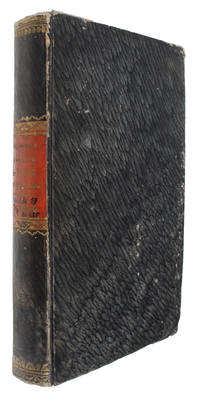
1803rif. 44129Halle Rengerschen Buchhandlung 1803. Without wrappers as extracted from "Annalen der Physik. Herausgegeben von Ludwig Wilhelm Gilbert" Bd. 12. Pp. 310-318 a. pp. 385-395. First German edition of both papers constituting the first 2 papers in his "Experimental Essays on the constitution of mixed gases." 1802 in which he formulated his famous gas laws and raised the foundation of the atomic theory in chemistry.The publication of these papers gave him at once international reputation they tried to explain why the gases of the atmosphere remain mixed instead of segregating with the heaviest element at the bottom it states that the maximum density of a vapour in contact with its liquid remains the same whether other gases be present or not and the vies that the particles of everykind of elastic fluid are elastic only with regard to their own kind and that the total pressure of the atmosphere equals the sum of the pressures exerted by the individual gases each of which excerts its pressure independently of the others. This was the first step toward his atomic theory of in chemistry. unknown