330.921 risultati
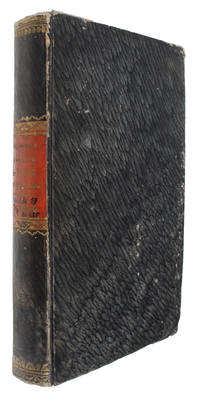
1858rif. 48805Leipzig und Heidelberg, C.F. Winter'sche Verlagshandlung, 1858. 8vo. Later hcloth. Spine with gilt lettering. In: ""Annalen der Chemie und Pharmacie. hrsg. von Friedrich Wöhler, justus Liebig und hermann Kopp"", Band CVI. With both titlepages. (8),392 pp. a. 1 litographed plate (shaved in outer margin, ut not belonging to Kekule's paper). (Entire volume offered). Kekule's paper: pp. 129-159. Internally clean.
1834rif. 43361Leipzig, Johann Ambrosius Barth, 1834. Without wrappers as issued in ""Annalen der Physik und Chemie. Hrsg.von Poggendorff"", 1. Bd. (31. Bd. der Reihe), No. 21, 22 a. 23. Pp. 321-368. Liebig's paper: Titlepage to 1. Bd. pp. 321-360. Clean and fine.
1859rif. 43325Leipzig, Johann Ambrosius Barth, 1859. Without wrappers as issued in ""Annalen der Physik und Chemie. Hrsg.von Poggendorff"", Bd. 107, Viertes Stück.(= Heft No. 8 of 1859). (The entire issue offered (Heft 4 of vol. 107 with titlepage to vol. 107). Pp. 497-660. - Plücker's papers: pp. 497-539 a. 638-643. Clean and fine.
1864rif. 45076Leipzig, Johann Ambrosius Barth, 1864. Without wrappers. In ""Annalen der Physik und Chemie. Hrsg. von J.C. Poggendorff"", Bd. 121, No 1. Pp. 1-192 a. 2 plates. (Entire issue offered). Clausius' paper: pp. 1-44. With titlepage to volume 121.
1891rif. 1002244Marburg, 1891. 68 S. Br.
1837rif. 43739Leipzig, Johann Ambrosius Barth, 1837. Without wrappers as issued in ""Annalen der Physik und Chemie. Hrsg.von Poggendorff"", Bd. 41, Zweites Stück. (Entire issue No 6 offered). Titlepage to vol. 41. Pp. 225-448 a. 2 folded engraved plates. Wöhler & Liebig's papers: pp. 345-366, pp. 366-374 a. pp. 393-397. Clean and fine.
1880rif. 43412Leipzig, Johann Ambrosius Barth, 1880. Without wrappers as issued in ""Annalen der Physik und Chemie. Hrsg.von G. Wiedemann."", Neue Folge Band IX, Heft 4. Titlepage to Bd. 9. Pp. 513-680 a. 1 folded engraved plate. + Neue Folge Band XI, Heft 9. Titlepage to Bd. 11. Pp. 1-176 a. 2 folded plates. Lorentz's paper"" pp. 641-665 (of Heft 4). Lorenz's paper: pp. 70-103. (2 entire issues offered). A stamp on titlepapges and verso. Both clean and fine.
1857rif. 45075Leipzig, Johann Ambrosius Barth, 1857. Without wrappers. In ""Annalen der Physik und Chemie. Hrsg. von J.C. Poggendorff"", Bd. 100, No 2 . Pp. 177-252 a. 1 plate. (Entire issue offered). Kirchhoff's paper: pp. 193-217. With titlepage to volume 100.
1850rif. 53436Leipzig, Johann Ambrosius Barth, 1850. Contemp. marbled boards. Gilt spine, titlelabel with gilt lettering. Light wear to spineends, corners and edges. Stamps on title-page (Gusstahlfabrik Fried. Krupp). In ""Annalen der Physik und Chemie"", Dritte Reihe, 19. Band (79. Band der ganzen Reihe). IX,(1),580 pp. and 3 folded engraved plates. (Entire volume offered). Endpapers and the first and last few leaves with brownspots. Clausius's paper: pp. 368-397 a. pp. 500-524. Internally clean.
1829rif. 43602(Leipzig, Johann Ambrosius Barth, 1829). Without wrappers as issued in ""Annalen der Physik und Chemie. Hrsg.von Poggendorff"", Bd. 16, Fünftes Stück. Halftitle to vol. 16. Pp. 1-192 a. 2 engraved plates. (Entire issue offered). Hoffmann's paper: pp. 1-40 and 1 folded engraved handcoloured plate ""Geognostische Skizze von Rom"". Clean and fine.
1803rif. 44129Halle, Rengerschen Buchhandlung, 1803. Without wrappers as extracted from ""Annalen der Physik. Herausgegeben von Ludwig Wilhelm Gilbert"", Bd. 12. Pp. 310-318 a. pp. 385-395.
1862rif. 45071Leipzig, Johann Ambrosius Barth, 1862. Without wrappers. In ""Annalen der Physik und Chemie. Hrsg. von J.C. Poggendorff"", Bd. 116, No. 5. Pp. 1-192 a. 1 folded lithographed plate. (Entire issue offered). Clausius' paper: pp. 73-112. With titlepage to volume 116.
1808rif. 43629(Halle, Rengerschen Buchhandlung, 1808). Without wrappers as published in ""Annalen der Physik. Herausgegeben von Ludwig Wilhelm Gilbert"", Bd. 28, Viertes Stück. The entire issue offered (=Heft 4). Titlepage to vol. 28 (small stamps on verso). Pp. 377-496 a. 3 engraved plates. Dalton's paper: pp. 397-416 a. 1 engraved plate showing apparatus.
1862rif. 44063Leipzig Johann Ambrosius Barth 1862. Without wrappers as issued in "Annalen der Physik und Chemie. Hrsg. von J.C. Poggendorff" Vierte Reihe Bd. 27 117 Stück Zwei No. 10. The entire issue offered. Titlepage to vol. 27. Pp. 193-352 a. 1 engraved plate. Ångströms paper: pp. 290-302. First appearance in German of Ångström's famous paper in which he announced the discovery of hydrogen in the atmosphere of the sun and in which he also confirmed the probable existence of of other elements there. The paper appeared in "Oefversigt af K. Vet. Acad. Förhandl." in 1861. The German paper here is expanded. At the same time it was translated into English and publishe as "On the Fraunhofer Lines Visible in the Solar Spectrum".Ångström was one of the early formulators of the science of modern spectroscopy; he wrote extensively on terrestrial magnetism the conduction of heat and especially spectroscopy. He published a monumental map of the normal solar spectrum that expressed the length of light waves in units of one ten-millionth of a millimeter a unit of length now known as the angstrom. He discovered that hydrogen is present in the sun's atmosphere and he was the first to examine the spectrum of the aurora borealis. unknown
1874rif. 49327Leipzig Johann Ambrosius Barth 1874. 8vo. Contemp. hcalf. 5 raised bands gilt spine and gilt lettering to spine. A few scratches to spine. Small stamp on verso of first -and general- titlepage. In: "Annalen der Physik und Chemie. Hrsg. von J.C. Poggendorff" Sechste Reihe Bd. 3 = Poggendorff Bd. 153. X636 pp. 4 plates. Entire volume offered. Braun's paper: pp. 556-563. First printing of Brown's importent paper in which he described his discovery of a semiconductor diode noting that electrical currents flows freely in only one direction at the contact between a metal point and a galena crystal."In 1874 Braun published the results of his research on mineral metal sulfides. He found that these crystals conducted electric currents in only one direction. This information was important in electrical research and in measuring another property of substances the electrical conductivity but Braun’s discovery did not have immediate practical application. In the early twentieth century the principle that Braun had discovered was employed in crystal radio receivers."DSB.The Nobel Prize in Physics 1909 was awarded jointly to Guglielmo Marconi and Karl Ferdinand Braun "in recognition of their contributions to the development of wireless telegraphy". hardcover
1858rif. 43056Leipzig Johann Ambrosius Barth 1858. Contemp. hcalf. 5 raised bands gilt spine and gilt lettering to spine. A few scratches to spine. Small stamp on verso of first -and general- titlepage. In: "Annalen der Physik und Chemie. Hrsg. von J.C. Poggendorff" Vierte Reihe Bd. 15 =Poggendorff Bd. 105. X636 pp. and 4 folded lithographed plates. Clausius's paper: pp. 239-258. The entire volume offered. Fine and clean. First printing of this main paper in the working out of the Kinetic Theory of Gases in which Clausius announced his determination of the equation governing the mean free path lenght of a molecule moving freely in gases. By this he inscribed his name as one of the founders of the Kinetic Theory of Gases."Clausius was one of the founders of the kinetic theory of gases and of the science of thermodynamics. He and Lord Kelvin at about the same time and independently announced the Second Law of thermodynamics. Clausius particularly developed the theory of thermodynamics by applying it to the study of gases and vapors."Magie in "A Source Book in Physics" p. 228."In order to analyze the process of molecular collisions Clausius adopted a simplified model for his admittedly complicated molecule. He assumed that whatever the actual patterns on intermolecular forces one could suppose that there is some advantage distance between the centers of molecules which would represent a general boundary between attractive and repulsive forces. If two molecules were to approach each other within that boundary repulsion would generally occur. Thus the very complex problem of intermolecular action was reduced to a "billiard ball" model." DSB III p. 307-06. - Parkinson Breakthroughs C/P 1858. hardcover
1864rif. 45076Leipzig Johann Ambrosius Barth 1864. Without wrappers. In "Annalen der Physik und Chemie. Hrsg. von J.C. Poggendorff" Bd. 121 No 1. Pp. 1-192 a. 2 plates. Entire issue offered. Clausius' paper: pp. 1-44. With titlepage to volume 121. First apperance of an importent paper in which Clausius shows that radiant heat is not an exception to the Second Law of Thermodynamics; - it is and answer to some suggested counter-entropic processes."In 1864 he answered it in a long and detailled paper in which he made use of Kirchhoff's recent work on heat or blackbody radiation. Clausius' conclusion was unambiguous: radiant heat was no exception to the second law and it could not provide a means for escaping the heat death."Helge Kragh "Matter and Spirit in the universe." p. 48. unknown
1862rif. 45071Leipzig Johann Ambrosius Barth 1862. Without wrappers. In "Annalen der Physik und Chemie. Hrsg. von J.C. Poggendorff" Bd. 116 No. 5. Pp. 1-192 a. 1 folded lithographed plate. Entire issue offered. Clausius' paper: pp. 73-112. With titlepage to volume 116. First appearance of the paper in which Clausius makes importent contributions to the generalization and understanding of the Second Law of Thermodynamics by introducing the concept of disgregation and proving the equivalence of the transformation of heat."Clausius began that search for understanding in 1862 by introducing the concept of disgregation a concept that he said was based on an idea he had long held: that the force of heat for performing mechanical work both internal and external together was proportional to the absolute temperature.13 Clausius had never stated this idea explicitly before although he had argued in 1853 by adopting an analogy between a reversible steam engine and a thermocouple that the potential difference at a thermocouple junction should be proportional to the absolute temperature. In any event he now wished to assert that the work which can be done by heat in any change of the arrangement of a body is proportional to the absolute temperature multiplied by a function of molecular arrangement the disgregation Z. Given this assumption and his postulate that the heat in a body H was only a function of temperature he was able 1 to prove his theorem of the equivalence of transformations and 2 to separate the equivalence function entropy into a temperature-dependent term and a configurational-dependent term."DSB.The issue contains other notable papers Plücker "Ueber recurrente Ströme und ihre Anwendung zur Darstellung von Gasspectra" pp. 27-54 Tyndall "Ueber Strahlung und Absorption der Wärme durch gasförmige Materie" pp. 1-27. unknown
1850rif. 53436Leipzig Johann Ambrosius Barth 1850. Contemp. marbled boards. Gilt spine titlelabel with gilt lettering. Light wear to spineends corners and edges. Stamps on title-page Gusstahlfabrik Fried. Krupp. In "Annalen der Physik und Chemie" Dritte Reihe 19. Band 79. Band der ganzen Reihe. IX1580 pp. and 3 folded engraved plates. Entire volume offered. Endpapers and the first and last few leaves with brownspots. Clausius's paper: pp. 368-397 a. pp. 500-524. Internally clean. First edition of this monumental famous paper in thermodynamics in which Clausius for the first time states the Second Law of Thermodynamics one of the most importent laws of Nature having a huge impact on the development of physical theory cosmology communications and information theory. The law states that a the energy of the Universe is constant and b the Entropy of the Universe tends to a maximum."Clausius' contribution to thermostatics is comparable to those of Newton and Maxwell to mechanics and electromagnetism respectively. In the obituary J.W. Gibbs remarked that Clausiu's first memoir "marks an epoch in the history of physics."" Chowdhury and Stauffer in "Principles of Equilibrium Statistical Mechanics".In "The Nature of the Physical World" Eddington writes: "The Law that entropy increases - the Second Law of Thermodynamics - holds I think the supreme position among the laws of Nature. If someone points out to you that your pet theory of the Universe is in disagreement with Maxwell's equations - then so much the worse for Maxwell's equations. If it is found to be contradicted by observation - well these experimentalists do bungle things sometimes. But if your theory is found to be against the Second Law of Thermodynamics I can give You no hope; there is nothing for it but to collapse in deepest humiliation.".Parkinson "Breakthroughs" 1850 P. hardcover
1803rif. 44129Halle Rengerschen Buchhandlung 1803. Without wrappers as extracted from "Annalen der Physik. Herausgegeben von Ludwig Wilhelm Gilbert" Bd. 12. Pp. 310-318 a. pp. 385-395. First German edition of both papers constituting the first 2 papers in his "Experimental Essays on the constitution of mixed gases." 1802 in which he formulated his famous gas laws and raised the foundation of the atomic theory in chemistry.The publication of these papers gave him at once international reputation they tried to explain why the gases of the atmosphere remain mixed instead of segregating with the heaviest element at the bottom it states that the maximum density of a vapour in contact with its liquid remains the same whether other gases be present or not and the vies that the particles of everykind of elastic fluid are elastic only with regard to their own kind and that the total pressure of the atmosphere equals the sum of the pressures exerted by the individual gases each of which excerts its pressure independently of the others. This was the first step toward his atomic theory of in chemistry. unknown
1808rif. 43629Halle Rengerschen Buchhandlung 1808. Without wrappers as published in "Annalen der Physik. Herausgegeben von Ludwig Wilhelm Gilbert" Bd. 28 Viertes Stück. The entire issue offered =Heft 4. Titlepage to vol. 28 small stamps on verso. Pp. 377-496 a. 3 engraved plates. Dalton's paper: pp. 397-416 a. 1 engraved plate showing apparatus. First appearence i German of Dalton's epoch-making paper in which is contained THE FIRST CLEAR STATEMENT OF MODERN ATOMIC THEORY and having the FIRST LIST OF ATOMIC WEIGHTS "Verhältniss der Gewichte der kleinsten Theilschen von gasförmigen und andern Körpern." Table of the relative weights of the ultimate particles of gaseous and other bodies. The paper offered is a free translation of Dalton's paper "On the Absorption of Gases by Water and Other Liquids" published 1805 in "Memoirs of the Literary and Philosophical Society of Manchester"."The paper was read to the Manchester Philosophical Society by Dalton in 1803 and printed in 1805. The appended table in this paper is the first list of atomic weights. Dalton in this publication took the law which William henry had recently enunciated that the amount of of gas absorbed by a liquid is proportional to the pressure and extended it to apply to mixtures of gases using his own law of partial pressures." Leicester & Klicktein "A Source Book in Chemistry" p. 258.Parkinson "Breakthroughs" 1803 C.- Smyth No. 38. unknown
1810rif. 43627Halle Rengerschen Buchhandlung 1810. Without wrappers as published in "Annalen der Physik. Herausgegeben von Ludwig Wilhelm Gilbert" Bd. 36 Neuntes Stück. The entire issue offered =Heft 9. Titlepage to vol. 36. Pp. 1-112. a. 2 engraved plates. Gay-Lussac's papers: pp. 6-36 a. pp. 37-51. First German edition of this classic paper in chemistry in which he states the law that when two gases combine chemically they do so that the volumes are in the ratio of whole small numbers."In 1805 with Alexander von Humboldt he observed the already known fact that hydrogen and oxygen combines in the ratio of 2 to 1 by volume. Stimulated by this work he studied the reactions of other gases to see whether there were other simple relationshipas and in 1808 he announced the la of combining volumes which is now known as GAY-LUSSAC'S LAW This generalization obviously connected with some fundamental property of matter was in part responsible for Avogadro's hypothesis."Leicester & Klickstein.Parkinson "Breakthroughs" 1809 C. - Leicester & Klickstein "A Source Book in Chemistry" pp. 292 ff. unknown
1851rif. 43324Leipzig Johann Ambrosius Barth 1851. Without wrappers as issued in "Annalen der Physik und Chemie. Hrsg.von Poggendorff" Bd. 83 Viertes Stück.= Heft No. 8 of 1851. The entire issue offered Heft 2 of vol. 83 with titlepage to vol. 83. Pp.469-600 a. 2 engraved plates. Helmholtz's paper: pp. 505-540. Clean and fine. First appearance of this paper in which Helmholtz for the first time measures and gives the mathematical formula for the duration of induced electrical currents and thus distinguished with mathematical accuracy from those due to nerve-action."In the offered paper he begins by stating a mathematical law which he had verified by a long and difficult series of experiments. By means of this law F. neumann was enabled to solve the problem he had previously laid aside as to the distribution of current in a copper disk rotating below the two poles of a magnet.After Helmholtz had extended this exponiential law mathematically to divided circuits he tested it experimentally by means of a new type of galvanic contact-key which madeit possible to vary the interval between the opening and closing of any current as required."Koenigsberger "Hermann von helmholtz" pp. 79-80. unknown
1889rif. 197743Munchen: K. Akademie bei G. Franz. 1889. vg-. Hardcover. Original 1899 edition in later reinforced binding; Infusorien describes. various freshwater microorganisms. 83 pages 4 stiff color illustrate. plates; text in German with a few very faint pencil marks previous. owner name on front ep; 11" tall; shelf wear to green cover with boards. showing at bottom front corner; no dj. K. Akademie bei G. Franz hardcover
1888rif. 44843Leipzig Johann Ambrosius Barth 1888. Conemp. hcalf. 5 raised bands gilt spine and gilt lettering to spine. A few scratches to spine. Small stamp on verso of first -and general- titlepage and small stamps to verso of plates. "Annalen der Physik und Chemie. Hrsg. von G. Wiedemann." Neue Folge Bd. 34. VIII1048 pp. a. 8 folded engraved plates. Entire volume offered. Hertz' papers: pp. 155-170 pp. 273-285 pp. 551-569 pp. 609-623. First appearance of 4 famous and importent papers 2 of them in their final form in which Hertz established by experiments the similarities between electric waves and light waves."Hertz followed up his determination of the finite velocity of electric waves by performing a series of more qualitative experiments in 1888 on the analogy between electric and light waves. Passing electric waves through huge prisms of hard pitch he showed that they refract exactly as light waves do. He polarized electric waves by directing them through a grating of parallel wires and he diffracted them by interrupting them with a screen with a hole in it. He reflected them from the walls of the room obtaining interference between the original and the reflected waves. He focused them with huge concave mirrors casting electric shadows with conducting obstacles. The experiments with mirrors especially attracted attention as they were the most direct disproof of action at a distance in electrodynamics. They and the experiments on the finite velocity of propagation brought about a rapid conversion of European physicists from the viewpoint of instantaneous action at a distance in electrodynamics to Maxwell’s view that electromagnetic processes take place in dielectrics and that an electromagnetic ether subsumes the functions of the older luminiferous ether." DSB-. hardcover