33.059 Ergebnisse
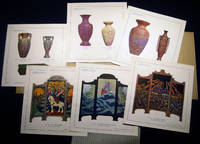
1925Best.-Nr. 029771New York NY: Messmore & Damon 1925. A printed paper folder with 6 loose color-illustrated sheets. Presented ".for the benefit of Display Managers and Merchants.showing some of our screens vases and plateaux in colors which are reproductions of the finished product. The screens are made of papier mache in a low relief hinged to fold either way and painted on back in a panel effect to give you two displays. The vases are made substantial of heavy papier mache with wooden bottoms and handles. Plateaux are made in two sizes to give you two elevations.built to carry any weight required for window display. All our decorations are artistically finished in a polychrome effect." The sample sheets give catalog item title numbers sizes; laid-in loosely in the folder and protected by a textured ribbed-pattern opaque sheet. Printed by John H. Smith Press Inc. NY; undated and circa 1920s. Messmore & Damon were a ".Design and construction firm begun in 1914 that produced a wide variety of parade floats dioramas for museums exhibits for expositions displays for department stores scenery for films Broadway and TV shows and exhibits for corporate clients." Smithsonian site. Approx. 8 1/4" x 9" size; light wear; n very good condition. First Edition. Soft Cover. Very Good. Messmore & Damon paperback
1981Best.-Nr. 7128An as new copy without previous owners' names or other markings. All shipments through boxed USPS Priority Mail Elandon Books, Inc. Cleveland Heights, Ohio 1981 hardcover
Best.-Nr. 1708365559.Gpaperback. Good. Access codes and supplements are not guaranteed with used items. May be an ex-library book. paperback
Best.-Nr. 0866361170.Ghardcover. Good. Access codes and supplements are not guaranteed with used items. May be an ex-library book. hardcover
2004Best.-Nr. 9703Inscribed by Carlo Mariotti owner of the firm profiled here to Richard presumably the author of the introduction and Alene dated 2004 on the title page see image. Black cloth covered boards with a dustjacket. Some wear to the top of the jacket see image but otherwise a clean copy with no defacements. Please expect the possibility of additional postage as this is a larger book. 11.75 x 16.25 in 30 x 41 cm Carlo Mariotti hardcover
1972Best.-Nr. 30290HBDJ 1972 on Title & Copyrite pg 1st EditionPg Light wear to boards EXTREMITIES tiny chips tears . Content is clean with a slight tone. Signed and inscribed by author to title page. DJ has edge tears Small CHIP that have been tape repaired to inside DARK PURPLE CLOTH TITLES IN GOLD GILT ON SPINE Cvr W.H. Allen / Virgin Books, howard wyndham hardcover
1955Best.-Nr. SF1225John C. Winston Company. Good in Good dust jacket. 1955. First Edition; First Printing. Hardcover. Book has mild toning light edgewear some foxing/light soiling to page ends some light fading to covers; DJ has some very small chips 1-1/4" tear and some small tears w/creases light toning little bit of foxing to interior tiny CH in pencil on front flap small pull mark to front fold; DJ in protective Brodart cover ; 206 pages . John C. Winston Company hardcover
1953Best.-Nr. SF1222John C. Winston Company. Good in Good dust jacket. 1953. First Edition; First Printing. Hardcover. Book has little bit of rubbing to edges of covers top edge of front cover has some chipping to cloth from tiny animal teeth little bit of foxing to page ends mild toning page 157 is creased; DJ has several small chips to spine tiny chips to fold corners two 1" tears and several 1/4" tears w/creases shelfwear light toning foxing to interior little bit of light soiling; DJ in protective Brodart cover ; 207 pages . John C. Winston Company hardcover
1929Best.-Nr. 26388Berlin: Ernst Pollak 1929. Hardcover book. Very good condition. B&w photographs of modern shop designs exterior and interior. Most photos are of shops in Berlin some in Munich Cologne Holland Prague. With a full list of illustrations. Text in German. 4to XIV 165pp blue cloth with gilt design on spine and orange title label gilt title on front. Slt. dusty internally clean and bright. Ernst Pollak hardcover
1951Best.-Nr. E13057New York: Clarke & Way 1951. Limited ed. Hardcover. fine. 1/900 copies of 1000 copies total in navy blue cloth decorated in gilt with spine lettered in gilt. 56 pp. with glossary. Designed and illustrated in pastel color silhouette drawings of classical Greek figures by Bruce Rogers. Introductory note on the design by Rogers. Printed on Eglish handmade rag paper at the Thistle Press in New York. A reprint of Nicholas Breton's 1626 portion of "Fantastickes" with a brief essay on each of the 12 months and on Christmas. The second portion "A Prognostication" is a month by month calendar usable for calculating the days of the week from 1951 to 1979. AS NEW in original red cardboard slipcase alos fine and the original glassine dust wrapper with panels and flaps intact but spine strip lacking. A beautifully and elegantly produced book. Clarke & Way hardcover
2009Best.-Nr. 1398857Washington D.C.: The Washington Ballet 2009. First Edition. Hardcover. Thin quarto unpaginated. In Very Good condition in a Very Good dust jacket. Spine black with white lettering. Dust jacket protected in mylar covering no price printed. Minor shelfwear and soiling. Edgewear to head of jacket. Text block clean. Signed flat by Septime Webre on the title page. Shelved front table. 1398857. Shelved Dupont Bookstore. The Washington Ballet hardcover
1927Best.-Nr. 3081London: Robert Holden and Co Ltd 1927. FIRST TRADE EDITION SIGNED BY AUTHOR. 8vo. Original brown cloth gilt lettered black stamped title panel to spine gilt stamped decoration to upper board. Gentle pushing to spine ends bump to bottom corner edges and margins foxed. Inscribed by Davies in black ink to ffep: "Yours sincerely Rhys Davies." a number of short closed tears to pages repair to rear hinge else clean. In the wonderful William Roberts illustrated dust jacket: price-clipped toned and rubbed nicked and chipped. Good/ good A solid signed copy of Rhys Davies' first novel in the striking original dust jacket designed by his friend the 'English Cubist' William Roberts. Dubbed 'the Welsh Chekhov' Rhys Davies 1901-1978; OBE was a prolific and prize-winning author who chronicled working class life especially of industrial Wales and women's lives. Davies met Roberts 1895–1980 through The New Coterie Magazine published by Charles and Esther Lahr. The artist also produced a portrait of the Welsh author which featured as the frontispiece to his first book The Song of Songs a collection of stories published in the same year. Roberts was a signatory of the Vorticist manifesto and his work featured in Blast; he later referred to himself as an 'English Cubist'. With a printed dedication: "To Charles Lahr" who typed the novel up for Davies. Robert Holden and Co Ltd hardcover
2012Best.-Nr. 51616Singapore: Work 2012. First edition. Softcover. Fine. 1/1000.Small folio. Unpaginated approx. 300 pages. Printed beige wrappers with black lettering on the front cover. Orange spine. Front and back wrappers intentionally "individually and uniquely aged" and torn for the publication by the creators. The 20th issue of the scarce Singaporean avant-garde art and photography periodical. The series was published semi-annually starting in 2000 under the direction of acclaim graphic designer Theseus Chan and continuing until the present. This issues examines the design of the previously released issues of the magazine and explores themes relating to printed materials. Each issue was printed in a limited run of only 800 to 1000 copies. The magazine won a D&AD Wood Pencil Award in 2013. In fine condition and protected in modern mylar. Work unknown
1940Best.-Nr. 50407Berlin: Vereinigte Verlagsgesellschaft Franke & Co 1940. First edition. Loose leaf. Good to good- condition. Quarto. 8pp. Original photo-illustrated wraps with white lettering on cover. Illustrated promotional supplement of the periodical Illustrierter Film-Kurier in gravure. The 1940 film "Der ewige Jude" is a propaganda documentary about the world Jewry after an idea by Eberhard Taubert. As part of Goebbels' anti-Semitic strategy this film followed the 1937 art exhibition "Der ewige Jude" in Munich and the publication of a book in the same year and with the same title both with derogatory captions asserting the "degenerate Jewish race." Goebbels took an active role in the production of the film and insisted on Fritz Hippler as the director for the film. After the invasion of Poland Goebbels instructed Hippler to send camera crews to Poland to collect footage of Polish Jews. The film starts with an "impressive" foray through the Jewish ghettos in Poland depicting the Jews in filthy living conditions making a living through profiteering instead of honest work. The footage was manipulated in a way to show the Jews as originating in Palestine and from there flooding the earth drawing parallels to the way rats spread through new territory stressing the Jew's ability to adapt to various life styles. The promotional is illustrated with photomontages depicting Jews from various walks of life Polish street scenes a Rabbi holding up a knife in line with the brutal depiction of a Shechita as the face of Jewry juxtaposed with gleaming pictures of content German people and thankfulness towards a government willing to solve the "Jewish problem." Text in German. Illustrated wraps with some wear horizontal fold small creases and chips along edges and covers reinforced with transparent tape; administered with a quarter inch tape along inside edges along bottom and foredge on back cover. Same with centerfold along bottom and foredges. Vereinigte Verlagsgesellschaft Franke & Co unknown
1947Best.-Nr. 39069Fanara Egypt: Der Tribüne 1947. First edition. Softcover. g to g. Folio. Unpaginated. 11 leaves. Original illustrated wrappers. This rare issue of "Schlemil" a German POW Camp Newspaper provides a first-hand account of the feelings and emotions of the men as well as their day-to-day activities during their internment in Fanara Egypt. This issue the fourth was the first published in 1947 issues 1-3 were published in 1946. The last issue No. 8 was also also published in 1947 shortly before the prisoners were shipped home 1947 through 1948. Of all the German POW camps camp 307 had the highest rate of German mortality. The reason can primarily be found in the harsh climatic conditions. Indeed unlike to the soldiers of the Africa corps who were fit for the tropics the soldiers who were taken prisoners in Italy Greece and its islands had many difficulties with the climate in Egypt. Hot wind and sandstorms in spring great heat in summer and severe cold in the winter impaired life in the strange climate. This led to the well known "Declaration of the captured Lutheran Pastors in Egypt". The front cover of this copy of "Schlemihl" features a drawing depicting a German POW painting a newlywed couple with the year 1947 at the upper left corner. The illustrator must have expressed to see his wish come true being freed and shipped home and marry his sweetheart. The newspaper contains poetry and short stories with a strong anti-Nazi stance. There are 5 other illustrations throughout the whole issue. Each leaf is printed on recto only. Some age-toning and creasing to wrappers with tiny chipping and closed tear at upper front and back cover. Upper corner slightly creased throughout. Text in German. Wrappers in overall good interior in good condition. Declaration of the captured Lutheran Pastors in Egypt: The captured Lutheran Pastors in Egypt moved by the emotional situation of their fellow prisoners in the Middle East which has become extraordinarily critical and in obedience to their sworn duties of office would like to make the following declaration before the British authorities before the German public before their fellow prisoners and also before the Christians of the world. For at least the last two and a half years and for the most part substantially longer periods German Prisoners of War have been held in the Middle East whose number at this time amounts to more than 60 000. They have been put to work in a climate which for half the year is positively unbearable for a European. Through the long duration of imprisonment through the separation from their relatives through the bad news from home through the impossibility of effectively helping them their relatives and for many the “C” people through the completely immeasurable continuance of their imprisonment the emotional burden of these prisoners has reached a degree which gives grounds for the gravest fears for the future. The symptoms which are already manifesting themselves are shocking enough: the incidences where prisoners break down emotionally so completely that they become mentally ill are increasing. Alone in one Work Company 2719 of 5000 men no fewer than six prisoners have been admitted to the appropriate department of the British military hospital because of mental illness. Above all the cases are increasing where prisoners are ending their own lives which appear unbearable to them. In the last month in just one of the three British Military Districts in Egypt five cases of suicide are known to us. This is because the majority of Prisoners of War in the Middle East have come to a total collapse of trust in the promises and declarations of the British custodial powers. The emotional strain which has arisen from this among the Prisoners of War is extreme. The most important reasons to name only these few which have led to this crisis are the following: 1. At the end of last year more than eighteen months after the capitulation the Prisoners of War were advised of the Repatriation Plan as it was to be binding for the year 1947. This Repatriation Plan gave the individual the opportunity to envisage within an admittedly broad framework according to his score and his political classification his return home. This plan has not been carried out. On 30 September 1947 the British Government announced that it would be necessary for it to reduce the repatriation to a fraction of the planned quota because of shortages of ships. Can one think ill of Prisoners of War that they held the following declaration which had been printed in the papers for some time against the British Prime Minister Attlee: that the work of the Prisoners of War at this time was the only available reparation from Germany and could not be done without Or that they received the impression from the speech to the Lower House on March 27 of the Member of Parliament for Ipswich Mr. R.R. Stokes that the reason for the sluggish pace of the repatriation from the Middle East is that the local British authorities held the manpower of the Prisoners of War to be so indispensable that they would simply have to wait for repatriation Can one think ill of the German Prisoners of War who due to previous experience are already full of mistrust today take into consideration that the almost complete halt to repatriation will not just last until the end of the year but that probably the closing date for repatriation the end of 1948 won’t be adhered to With great and honest thankfulness the Prisoners of War of the Middle East have experienced the intervention for the easing of the lot of the captured and their speedier return home by men of the British public above all from a great number of Bishops the Member of Parliament Stokes a man such as Viktor Gollancz and finally a group of more than sixty Lower House members. In the Middle East hardly any of this has come about and the result is growing bitterness and hopelessness instability and despair amongst the Prisoners of War. 2. A further and exceedingly grave burden for the morale and emotional bearing of the Prisoners of War lies in the recently released regulation that in future Prisoners of War will only be allowed to take in the vicinity of ten pounds of approved luggage to Germany. Germany faces another winter of starvation. Thousands of Prisoners of War have saved their hard earned tiny wages for months and years and have allowed themselves nothing in order to be able to bring a few tins of fat which is lacking most and other foodstuffs to their relatives. Many came to terms with the repeated deferment of their repatriation and found themselves a new mainstay by telling themselves: I can help my relatives to at least a small extent by sending along foodstuffs especially fat with returning comrades. Because of the new announcement all this is brought to nought. It has aroused bitterness particularly because it is so completely incomprehensible. The foodstuffs in question are in the markets in Egypt and can be obtained in the camp canteens in great quantities to be used by the Prisoners of War at will. Why should they not be able to save these and take them home No one is hurt by this and the money which is spent stays in the country. Finally particularly destructive and embittering is the thought that contrary to the natural development of things where the treatment of Prisoners of war should be gentler and better with the growing interval since the end of the war it is only becoming sharper and more severe. The Prisoners of War can absolutely not understand that they who have actually already have been discriminated against through their late return home are further discriminated against in the hardest and most burdensome way by the aforementioned announcement while the comrades who were lucky enough to return home earlier could take such foodstuffs so vitally necessary for a starving Germany freely and without limits. 3. A further hardship and exceedingly heavy emotional burden is the treatment of the Prisoners of War who have placed under “Automatical Arrest” A.A. namely those whose identity is suspected to be that of a wanted war criminal or those who are needed as witnesses in such a case. They are held in custody here indefinitely often being unable to discover why and without sentence. Despite the fact that the British authorities have had at least two years and often considerably longer at their disposal to prove identities and make investigations in countless cases the affected Prisoners of War are put under “A.A.” only hours before their repatriation. In two cases men were even fetched down from the repatriation ship a procedure which it is hardly too harsh to characterise with the expression “emotional abuse”. Apart from all rules about humanity this kind of procedure also contradicts all accepted laws in the Allied countries in that Prisoners of War are punished for being war criminals when they haven’t been convicted. Indefinite imprisonment for a Prisoner of War who has waited for repatriation according to a classification and score is nothing other than punishment. An example: A Prisoner of War rank Oberfeldwebel Staff Sergeant was placed under “A.A.” in December 1945 without being given any notice because he was mistaken for his brother a Leutnant Second Lieutenant who had died in the war. His assertions were not believed. He pointed out that a comrade of his dead brother could be found in the same camp and could be interrogated about this. This was refused. Only after the intervention of a Lower House member Mr. Stokes who was approached about it was the case taken up. The interrogation of the commandant was carried out and the affected person released although subject to the agreement of a superior central office. He has still not been repatriated to this day despite being scheduled for repatriation by British doctors since April because of severe asthma. That is one of several dozen cases. It is understandable that the feeling of complete absence of rights emotionally oppresses particularly these Prisoners of War and brings them to despair. 4. The Prisoners of War gratefully acknowledge that the vast majority of commandants of camps and of work companies honestly strive to lighten their burden through good food through the improvement of canteens and recreation rooms through sporting events radio cinema theatre and musical performances and also through opportunities for further education. They have complete understanding for the fact that because of their special situation in Egypt their freedom of movement cannot be as extensive as in England itself. What they do not understand however is the severity of punishment with which often only a trifling offence is often only punished by mistake. In many cases the admissible maximum penalty – twenty-eight days’ detention - is lengthened. In most of the cases the severity of the punishment bears no relationship to the severity of the misdemeanour. An example: In recent times a Prisoner of War was punished with fourteen days’ detention and loss of Work Points ie the extension of his captivity by many months because he had accidentally and not on purpose had the command post flag of a passing British military car. Examples of this sort could be continued for a long time. The severity of such penalties have a particularly hard emotional effect on the Prisoners of War who are in the third to fifth year of their captivity none of them any longer in complete possession of their emotional resilience. They therefore experience these punishments as more severe than another person would. We captured Lutheran Pastors in Egypt have hitherto purposely kept silent before the public about the completely unnecessary cases of severity and the partly open injustice for example physical mistreatment of Prisoners of War in the Detention Centres. We have tried through personal calls at the responsible British departments to do away with these things in the belief that this was about the unauthorised actions of a subordinate authority such as they appear in every human community. We asked ourselves earnestly whether we could continue to keep silence in the present situation. In thinking this we considered that one had - and rightly so - reproached our Nation and our Lutheran Church with silence when we should have spoken out. In the Stuttgart Declaration of October 1945 the Lutheran Church did penitence for this failure before the whole world. From this in earnest self-examination we came to the opinion that in further silence toward the injustice that has happened and still does happen to the Prisoners of War in the Middle East we would be guilty before the office of spiritual care which is our command before our consciences before our Lutheran Church in Germany and our German People and not least before God the Lord in front of whose Judgment Seat we will all one day need to answer for ourselves. We would have to be silent if our opponents in the past war had told us that they wanted to fall upon us in the name of revenge and retaliation. Then we would only have been able to say to our fellow captives: See where unlawfulness and Godlessness lead; see how the dreadful law of retaliation makes itself felt! In that case we could only have bowed dumbly before the deserved justice of God. But our former opponents did not say this. Rather they ceremoniously proclaimed that in the names of justice and humanity and in the spirit of Christendom with their unchanging qualities they had gone into the war and brought it to an end. In this spirit they would lead our people in a new way. That however gives us the courage and the right; today it lays the holy duty upon us as spiritual carers for our fellow captive brothers with all the earnestness of our duty of care to beg their leading personages and their responsible authorities to no longer passively watch the injustice that has been and is still being done to the Prisoners of War in the Middle East but rather to remedy the great spiritual need and despair which daily continue to gain ground through practical effective and quick measures. We have the bitter and serious concern that otherwise our fellow captives in the Middle East will lose the ultimate and best thing that we in the spirit of Christ so dearly wanted to show them how many have already lost it!: the belief and trust that in this world not power not the spirit of vengeance and retribution not the justice of the strong have the last word; rather that co-existence in the spirit of right justice humanity reconciliation and brotherly helpfulness within nations and between nations is possible. In the name and by order of the captured Lutheran Pastors in Egypt. Signed Norbert Rückert Dean of Pastors for the Middle East P.W. Camp 380 11 October 1947. Der Tribüne unknown
1858Best.-Nr. 43744San Francisco: Whitton Towne & Co 1858. Hardcover. g- to g. Octavo. 324pp. Original blind-stamped cloth with gilt lettering on spine. Illustrated frontispiece. The life of Samson presents many examples of the principle on which the providence of God is conducted his power to deliver his people by whatever means he pleases the bitter consequences that results to them from their sins and the terrible judgments with which he overwhelms his enemies. Illustrated throughout with a total of 14 woodcut illustrations mostly plates with a few in-text. Binding with some bumping rubbing and sunning to extremities. Covers with some staining and scratches. Interior with light foxing. Starting at a few pages throughout. Binding tight overall. Binding in good- interior in good condition overall. Whitton, Towne & Co hardcover
1978Best.-Nr. 38911NP: Pacific Lithograph Company 1978. First edition. Softcover. g to vg. Large glossy page folded to make four 9" x 12" pages. 50th Wedding Anniversary announcement for Virginia and Ansel Adams. Inside features a striking photolithographic reproduction of one of Adams' iconic images: "Monolith the Face of Half Dome Yosemite Valley" with Ansel Adams' facsimile signature at lower right margin. On page facing the photolithograph is a poem titled "I have learned" written in 1798 by William Wordsworth. On the back cover features a personal lengthy printed message from the Adams to their frends and family in recognition of their 50th wedding anniversary. Moderate shelf wear and creasing along spine. Covers in overall good interior in very good condition. Pacific Lithograph Company unknown
1965Best.-Nr. 30273HBNO DJ 1965 Stated 1st Edition Pictorial Blue Cover Minor Wear & Small Corner Bump 96 pgs Interior Nice Tight Clean NF/VG AS-IS NODJ First Edition. Hardcover. Very good. 12mo 96pp. A very good copy in the publisher's printed boards with mild even rubbing. SIGNED and INSCRIBED by Cox on the front free endpaper: "To Mrs. Rivard Best wishes Wally Cox." Cox was a popular character actor who famously portrayed the title character in the NBC sitcom "Mister Peepers." Cox was Marilyn Monroe's co-star in the film "Something's Got to Give" which was still in production when Monroe died on August 4 1962 the film was never finished and much of the footage remained unseen for decades after production. Cox's autograph is uncommon. Simon & Schuster NY hardcover
2021Best.-Nr. DBS.Management-9781774077Society Publishing 2021. 1st. Hardcover. New. Society Publishing hardcover
2021Best.-Nr. DBS.Management-9781774077Society Publishing 2021. 1st. Hardcover. New. Society Publishing hardcover
Best.-Nr. 9788589059602SOLISLUNA - WMF. new. A lenda de Obalua pesquisada pelo etn�logo Pierre Verger na �frica narra a chegada desse orix� e o desenvolvimento de seu culto no territ�rio Mahi no Daom�. Foi a lenda escolhida para inspirar a criao deste livro pela artista Edsoleda Santos uma homenagem ao ""Velho"" como � carinhosamente chamado na Bahia. Orix� de culto particular cercado de mist�rios e dogmas espec�ficos exigiu da artista Edsoleda Santos uma profunda dedicao e apuro no seu trabalho iconogr�fico. Em suas pesquisas de campo Edsoleda buscou orientao de uma sacerdotisa a senhora Maria C�lia Reis Me Branca de Omol Yalorix� do terreiro l� s� Taoy� Lonin que h� mais de cinquenta anos zela com rigor orgulho e um profundo respeito pelos preceitos que regem esse orix�. Como resultado surge um trabalho impec�vel na sua t�cnica suntuoso na construo pl�stica e sofisticado no trato da aquarela e suas transparncias. Cada linha cada forma cada elemento utilizados como representao da lenda foram cuidadosamente observados com o firme prop�sito de manter os mist�rios e segredos que cercam esse orix�. Aprendemos neste hist�ria que debaixo de suas palhas est� o segredo da sua luz SOLISLUNA - WMF unknown
2011Best.-Nr. 66756Bronx New York: The New York Botanical Garden 2011. First edition. Hardcover. Very Good /Very Good . 116pp. Quarto 34 cm Light brown cloth over boards with gilt lettering on the backstrip and front board. The top fore-edge corners of the covers are gently bumped. In the illustrated dust jacket with light surface and edge wear. May require extra postage due to weight. With a passion for nature the discerning eye of an art dealer and a childlike sense of wonder and curiosity Ed Merrin creates striking floral arrangements using materials as diverse as lotus and kale seed pods and summer grasses. The New York Botanical Garden hardcover
1930Best.-Nr. 59165New York: Doubleday Doran & Company 1930. First edition. Hardcover. Good/good. Rockwell Kent. 436pp. Octavo 21 cm The fore-edge of the front board is prominently dampstained however the book is internally free of moisture damage. There is a contemporary gift inscription on the front free endpaper. In a dust jacket attractively designed by Rockwell Kent with tape repairs and moisture damage to the reverse not noticeable on the recto of the wrapper. Written by the younger brother of Frank Norris author of "The Octopus." From the dust jacket- "To Bart and Peggy life was to be different. With youth and love and courage they came to New York. Bart was to write famous novels and Peggy to take care of him. There was no room in their little apartment for babies and no money in the exchequer. But the first baby came and then four others in a disorderly cramped suburban house for Peggy's religion taught her to believe that any means of contraception were wrong. The debts piled up the novel faded farther and farther into the future. What was to become of their fine young love that had started out so bravely. "In this drama of the marital lives of an American family clan Charles Norris writes frankly about the most delicate and personal of human relationships and the most absorbing social problem of contemporary life. Doubleday, Doran & Company hardcover
Best.-Nr. 1713223422.Gpaperback. Good. Access codes and supplements are not guaranteed with used items. May be an ex-library book. paperback
1966Best.-Nr. 4878N.p.: Vandal Publications for Gear 1966. Poster poem offset lithograph 58x45cm. Very good with pinholes and wear at corners some toning to edges and a few light scuffs and smudges. Psychedelic poster-poem from one of the pioneers of the genre English poet Christopher Logue 1926-2011. Logue produced the first of these poems with designer Germano Facetti in 1958 which was titled "To My Fellow Artists" and would go on to produce several more in collaboration with other artists the posters mainly reflecting his pacifist beliefs. The image on this poster is of infamous outlaw Rube Burrow who was shot dead while attempting an escape from jail in Marengo County Alabama in 1890. The poem was later set to music as "Be Not Too Hard" by Joan Baez and appeared on her album "Joan" in 1967. Vandal Publications for Gear unknown


