BARBIER GeorgeMareMagnum

10,959 results
1915- Lucien Vogel éditeur, Paris Eté 1915, 36,5x24cm, une feuille. - Double original color print heightened with gold, printed on vergé paper, signed in the plate. An original print used to illustrate the Gazette du bon ton, one of the most attractive and influential 20th century fashion magazines, featuring the talents of French artists and other contributors from the burgeoning Art Deco movement. A celebrated fashion magazine established in 1912 by Lucien Vogel, La Gazette du bon ton appeared until 1925, with a hiatus from 1915 to 1920 due to the war (the editor-in-chief having been called up for service). It consisted of 69 issues printed in only 2,000 copies each and notably illustrated with 573 color plates and 148 sketches of the models of the great designers. Right from the start, this sumptuous publication "was aimed at bibliophiles and fashionable society," (Françoise Tétart-Vittu, "La Gazette du bon ton", in Dictionnaire de la mode, 2016) and was printed on fine vergé paper using a type cut specially for the magazine by Georges Peignot, known as Cochin, later used (in 1946) by Christian Dior. The prints were made using stencils, heightened in colors, some highlighted in gold or palladium. The story began in 1912, when Lucien Vogel, a man of the world involved in fashion (he had already been part of the fashion magazine Femina) decided, with his wife Cosette de Brunhoff - the sister of Jean, creator of Babar - to set up the Gazette du bon ton, subtitled at the time: "Art, fashion, frivolities." Georges Charensol noted the reasoning of the editor-in-chief: "'In 1910,' he observed, 'there was no really artistic fashion magazine, nothing representative of the spirit of the time. My dream was therefore to make a luxury magazine with truly modern artists...I was assured of success, because when it comes to fashion, no country on earth can compete with France.'" ("Un grand éditeur d'art. Lucien Vogel" in Les Nouvelles littéraires, no. 133, May 1925). The magazine was immediately successful, not only in France but also in the United States and Latin America. At first, Vogel put together a team of seven artists: André-Édouard Marty and Pierre Brissaud, followed by Georges Lepape and Dammicourt, as well as eventually his friends from school and the School of Fine Arts, like George Barbier, Bernard Boutet de Monvel and Charles Martin. Other talented people soon came flocking to join the team: Guy Arnoux, Léon Bakst, Benito, Boutet de Monvel, Umberto Brunelleschi, Chas Laborde, Jean-Gabriel Domergue, Raoul Dufy, Édouard Halouze, Alexandre Iacovleff, Jean Émile Laboureur, Charles Loupot, Chalres Martin, Maggie Salcedo. These artist, mostly unknown when Lucien Vogel sought them out, later became emblematic and sought-after artistic figures. It was also they who worked on the advertising drawings for the Gazette. The plates put the spotlight on, and celebrate, dresses by seven designers of the age: Lanvin, Doeuillet, Paquin, Poiret, Worth, Vionnet and Doucet. The designers provided exclusive models for each issue. Nonetheless, some of the illustrations are not based on real models, but simply on the illustrator's conception of the fashion of the day. The Gazette du bon ton was an important step in the history of fashion. Combining aesthetic demands with the physical whole, it brought together - for the first time - the great talents of the artistic, literary, and fashion worlds; and imposed, through this alchemy, a completely new image of women: slender, independent and daring, which was shared by the new generation of designers, including Coco Chanel, Jean Patou, Marcel Rochas, and so on... Taken over in 1920 by Condé Montrose Nast, the Gazette du bon ton was an important influence on the new layout and aesthetics of that "little dying paper" that Nast had bought a few years earlier: Vogue. [FRENCH VERSION FOLLOWS] Estampe double originale en couleur rehaussée à l'or, tirée sur papier vergé, signée en bas à droite
1836ref. 41586Paris, Jeannin, s.d. (1836). Titre et 12 planches lithographiées montées sur chine appliquée (17 x 21 cm), encadrements historiés, reliées en 1 vol. in-folio oblong (38 x 55 cm), demi-chagrin rouge à petits coins, dos lisse orné (reliure de l'époque).
Acquaforte. (Lastra depositata presso la Biblioteca comunale di Faenza) Firma, titolo e numertazione a matita. Esemplare 92/107. Cm 22x15 (Foglio 70x50). . . Ottimo (Fine). . Tiratura 110 + 10 p.a.. .
Aquatint etching on paper (leaf ca. 290 x 380 mm; plate 270 x 350 mm; illustration 245 x 315 mm). A domestic scene of a couple fighting at a table, a shrouded dark figure watching from the background. Captioned "Vexation and Strife" and signed "Calcutta J. M. del. et sculp. 1797". Printed on laid paper with the bend watermark of J. Whatman (Heawood 104). Very rare aquatint and etching by James Moffat, with a rare Calcutta imprint. The subject of the print is a subtle caricature of domestic strife over the intoxication of a (supposedly) British colonial. The only other known copy is described as follows by Yale's Lewis Warpole Library catalogue: "In the center of the image a woman, dressed in a short shift, angrily pulls a bottle from the hand of a drunken man. The man sits at an oval drop-leaf table with his right fist raised and a cigar hanging from his mouth as smoke billows around his head. He holds onto a bottle with his left hand, a glass and pile of cigars at his elbow. The woman standing over the table on the left angrily points with her left hand to a clock on the wall which shows the time as 5:05. In the background on the left, a dark-faced, cloaked figure stands before the curtained doorway on the left; the double doors on the right are shut. Also on the table is a lit candle in a glass globe; an overturned pitcher pours onto the floor in the foreground". - James Moffat (1775-1815) was a Scottish engraver who worked in India. He arrived in Calcutta in 1789, joining the "Calcutta Gazette" in 1797. Moffat is mainly known for his topographical views of India, but he also produced several satirical prints such as the present specimen. He "supplemented his income by producing satires of Anglo-Indians (British colonials who spent time in India) at a time when these were becoming increasingly popular" (Smylitopoulos, p. 12). Most of these satirical scenes were sent by the amateur artist to London to be engraved and published, but the present example with its Calcutta imprint in the signature proves the exception to this rule. - Moffat's topographical views of cities, buildings, rivers and other landscape features are rare, and his satirical domestic scenes are even rarer. The only other copy that can be traced in institutional possession that that in the Lewis Warpole Library at Yale University, and it almost never appears in the trade, with only two records in historical auction results (one in 1933 and one in 2020, possibly the present copy). - Two small tears, one in the top margin and the other in the bottom, neither affecting the illustration. Very slightly stained in the margins. Overall in very good condition. OCLC 701812946 (a single copy, at Yale). For Moffat's career cf. H. de Almeida & George H. Gilpin, Indian Renaissance: British Romantic Art and the Prospect of India (2005) pp. 249f.; C. Smylitopoulos, "Portrait of a Nabob: Graphic Satire, Portraiture, and the Anglo-Indian in the Late Eighteenth Century", in: RACAR 37.1 (2012), pp. 10-25.
1650ref. 279001650 c. 1650, Paris.- 12.10 Veuë particulière de Florence.Silvestre fe. Israël excudit- H : 98 L : 173- Faucheux : 12.10 - Cette image fait partie de la suite 12 : Vues de Rome et d'ItalieBaré : N° 726- de la Suite de 10 pièces sans numéros.Faucheux : Vue d'un des ponts de Florence et d'une partie de la ville.Baré — 2. FLORENCE (Veuë particulière de). (Vue d'un des ponts de FLORENCE et d'une partie de la ville.) — Silvestre fe. Israel excudit— (H : 98 - L : 173). — 2e état, les inscriptions modifiées ; 3e état, Silvestre fecit effacé et remplacé par une légende.
1650ref. 278921650 c. 1650, Paris.12.3 Veuë du Palais Major de Rome (Sur le mont Palatin.)- Silvestre f. Israël ex. - H : 97 L : 173 - Faucheux : 12.3 - Baré : N° 905. Planche montée dans papier postérieur à grandes marges.
1650ref. 278971650 c. 1650, Paris. Silvestre fe. Israël excudit- H : 95 L : 170- Faucheux : 12.9 / Baré : N° 910- Cette image fait partie de la suite 12 : Vues de Rome et d'Italie.Suite de 10 pièces sans numéros.Baré :— 8. VEUË DU LAC DE BOLSENE (dans les états du Pape). — Silvestre fe Israel excudit — (H : 95 - L : 170)- 2e état. Les inscriptions ont été modifiées en partie.
1650ref. 278941650 c. 1650, Paris.Veuë de l'Arc de Constantin a Rome. Silvestre F. Israël excudit- H : 98 L : 170 - Faucheux : 12.5 / Baré : N° 907- Cette image fait partie de la suite 12 : Vues de Rome et d'Italie.- de la Suite de 10 pièces sans numéros. Planche montée dans papier postérieur à grandes marges.
1650ref. 278931650 c. 1650, Paris.12.8 Veuë de Caprarole. Silvestre f. Israël excudit- H : 95 L : 170- de la Suite de 10 pièces sans numéros. Faucheux : 12.8 Baré : N° 723. Planche montée dans papier postérieur à grandes marges.
ref. 5047Gravée par Silvestre. Très bonne impression où l’on voit le dessin primitif du graveur en lettres … Faucheux p. 283 n° 8. Accident dans la marge de droite et taches. Israel excudit 13 x 26,1 cm.
1650ref. 278891650 c. 1650, Paris. P. Mariette excudit - Eau-forte 12,4 x 25,8 Dessinée et gravée par Silvestre. 2è état sur 3.De la plus belle suite de gravures de Silvestre.Planche montée dans papier postérieur à grandes marges.
1965Acquaforte acquatinta originale stampata in rosso Firma, data e numerazione a matita. Carta Fabriano. Esemplare 25/30. cm 48x32 (Foglio cm 70x50). pp.. . Molto buono (Very Good). . Tiratura: 30. .
1849ref. 255181849 LE CHARIVARI Aubert et Cie, imprimeur-lithographe. 1849- Lithographie - Hauteur: 35.9cmx Largeur: 27.6cm - Description:Planche n° 16- Assemblée législative, . -1 feuillet (4 pages) numéro complet ; illustration page 3.-- texte imprime au dos,bon etat,rousseurs.
Litografia originale su pietra Bavarese impressa a 5 colori Carta magnani di Pescia. Timbro a secco dell'Artista e dell'Editore. Certificato di autenticità rilasciato dall'Editore con la sua firma e quella dell'Artista. Esemplare 60/75. Cm 45x63 (Foglio 50,5 x 70). pp.. . . . Tiratura 75 + XXV + 20 p.d.a. + 10 H.C.. .
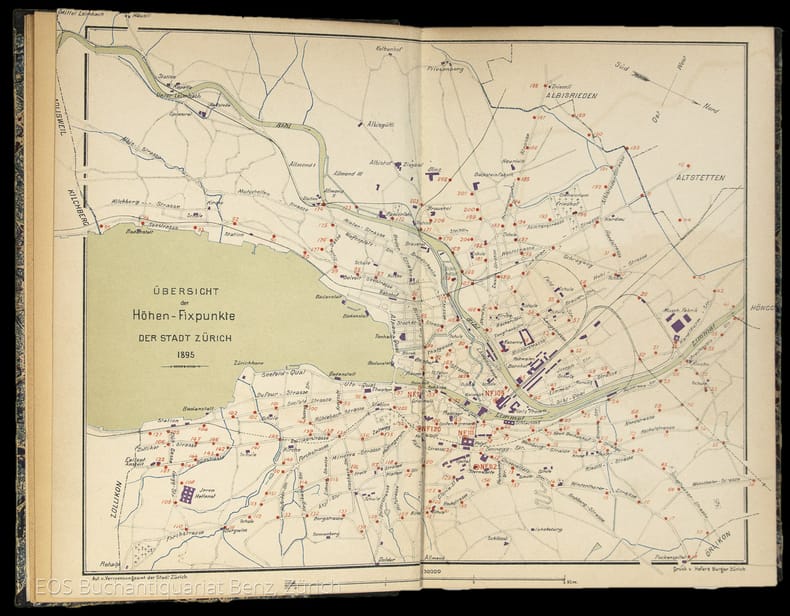
1895ref. 4834DBZürich, Museumsgesellschaft Zürich, 1895. 8°. 166 S., mit vielen ganzseitigen Abbildungen. Halbleinenband mit handschriftlichem Bibliotheks-Rückenschild. + Wichtig: Für unsere Kunden in der EU erfolgt der Versand alle 14 Tage verzollt ab Deutschland / Postbank-Konto in Deutschland vorhanden +, 4834DB|4834DB_2 [2 Warenabbildungen]
1895ref. 4834DBZürich, Museumsgesellschaft Zürich, 1895. 8°. 166 S., mit vielen ganzseitigen Abbildungen. Halbleinenband mit handschriftlichem Bibliotheks-Rückenschild.
Two volumes, complete. The catalogue raisonne of Munch's etchings, drypoints, lithographs, and woodcuts. 519 items exhaustively described. 4to. Publisher's cloth. FINE AND BRIGHT. New.
1830ref. 1618CBZürich, Orell, Füssli u. Comp., o.J. (1830). 8°. VII, 266 Seiten. Späterer Halblederband mit Rückenschild. + Wichtig: Für unsere Kunden in der EU erfolgt der Versand alle 14 Tage verzollt ab Deutschland / Postbank-Konto in Deutschland vorhanden +
1894ref. 19990ABAarau, Emil Wirz, 1894. Gr.-8°. 2 Bl., 38 S., 1 Bl. Orig.-Broschur. + Wichtig: Für unsere Kunden in der EU erfolgt der Versand alle 14 Tage verzollt ab Deutschland / Postbank-Konto in Deutschland vorhanden + = "Kleine Mitteilungen", Bd. II. der "Mittelschw. Geographisch-Kommerzielle Gesellschaft in Aarau".
1894ref. 19990ABAarau, Emil Wirz, 1894. Gr.-8°. 2 Bl., 38 S., 1 Bl. Orig.-Broschur. = "Kleine Mitteilungen", Bd. II. der "Mittelschw. Geographisch-Kommerzielle Gesellschaft in Aarau".
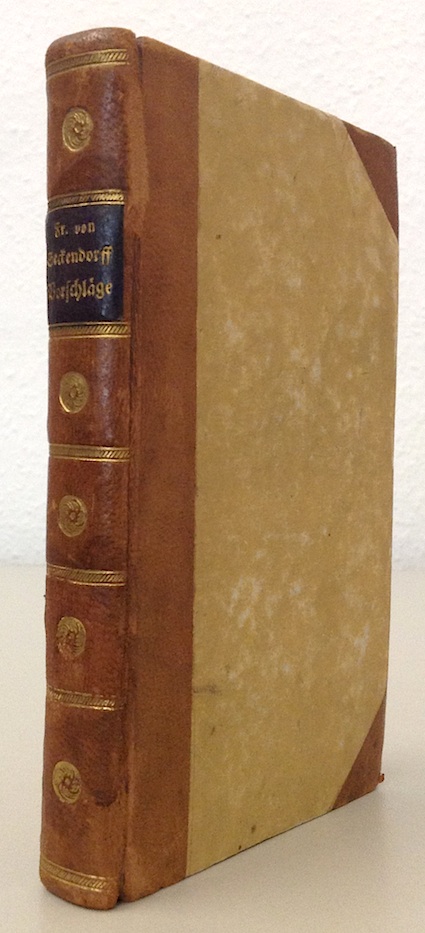
1802ref. 168651Leipzig, Comptoir für Litteratur, 1802. 8 Bl., 226 S., 1 Bl. Halbleder d. Zeit mit Rückenschild u. Rückenvergoldung (berieben, Ecken etwas bestoßen). [2 Warenabbildungen]
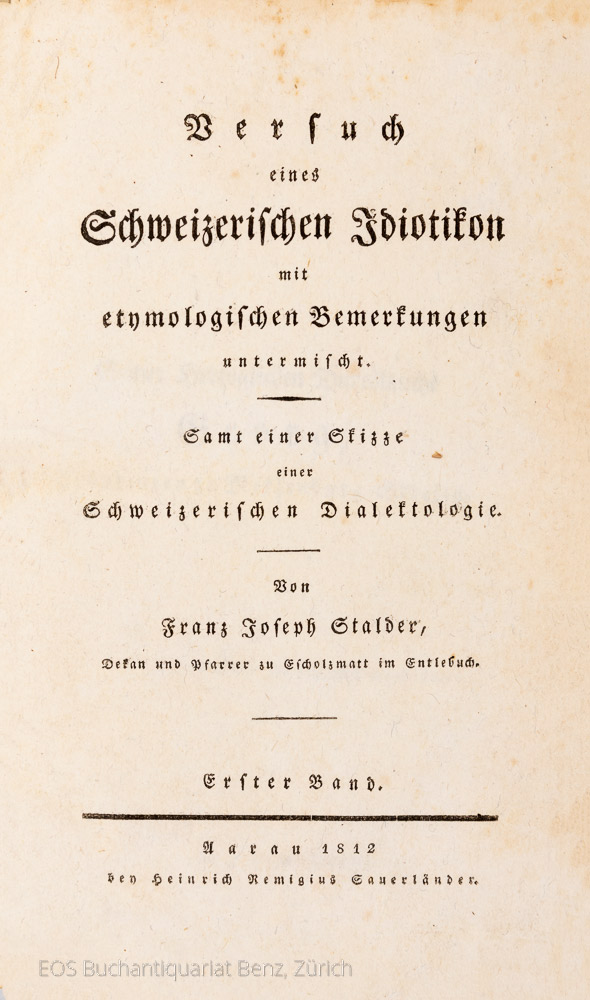
1812ref. 4626DBAarau, Heinrich Remigius Sauerländer, 1812. 8° (21 cm). 507, XII, 528 S. Halblederbände der Zeit. + Wichtig: Für unsere Kunden in der EU erfolgt der Versand alle 14 Tage verzollt ab Deutschland / Postbank-Konto in Deutschland vorhanden +, 4626DB|4626DB_2 2 Bände. [2 Warenabbildungen]
1812ref. 4626DB2 Bände. Aarau, Heinrich Remigius Sauerländer, 1812. 8° (21 cm). 507, XII, 528 S. Halblederbände der Zeit.
1812ref. 7882CB2 Bände in einem Band. Basel u. Aarau, Flick u. Sauerländer, 1812 8°. 507 S.; XII, 528 (4) S. Halblederband der Zeit mit Rückenvergoldung und Rückenschild.
1756ref. 5873BBBasel, Emanuel Thurneysen, 1756. 8°. (2) S., S. 1831-1955. Mit 1 (v. 4) gest. gef. Tafel Emanuel Büchel sowie zahlr. Textholzschnitten. Pappbd. d. Zt. mit handschriftl. Rückenschild + Wichtig: Für unsere Kunden in der EU erfolgt der Versand alle 14 Tage verzollt ab Deutschland / Postbank-Konto in Deutschland vorhanden + Teil XVI (v. 23 Tln.). (stärker berieben u. bestossen).