10.975 resultados
ref. 89806CREATIVE PRINTS WATARAI Jun'suke artist. KOROPOKKURU NO SHI. a little 9.8 x 7.4 cm leather wraparound box gold embossed with 13 copperengravings inside illustrating a text of POEMS OF THE LITTLE PEOPLE the little people being humanculi of Ainu legend who "take their ease under the trees" of the great northern forests. Though undated this copy is #9 of 50 copies and was produced by Sawamura Gallery probably in the 1970s. In perfect condition throughout with the original wraparounds the text pamphlet and the outer shipping box as well. unknown
ref. 89806CREATIVE PRINTS WATARAI Jun'suke artist. KOROPOKKURU NO SHI. a little 9.8 x 7.4 cm leather wraparound box gold embossed with 13 copperengravings inside illustrating a text of POEMS OF THE LITTLE PEOPLE the little people being humanculi of Ainu legend who "take their ease under the trees" of the great northern forests. Though undated this copy is #9 of 50 copies and was produced by Sawamura Gallery probably in the 1970s. In perfect condition throughout with the original wraparounds the text pamphlet and the outer shipping box as well. unknown books
1954ref. 9407Lexington KY: Gravesend Press 1954. Vellum Binding. Near Fine binding. 18mo. 10 48 4 pp. illus. Limited edition number 9 of 200 copies. As issued in vellum-backed patterned-paper over boards. Lacking the slipcase. A handsome copy with only light toning to the perimeters of the boards; contents clean. This copy with 4-page prospectus. This work was the first book issued by the Gravesend Press that was actually printed using the Graves' press in their stable by Graves and Jacob Hammer. Kredel's charming engraved pressmark of a sleeping pressman graces the final page. Graves writes about this in his Bibliographical Confession the donkey in the window was their family pet Patience. Graves operated the press as a sideline from about 1949 through to the end of his life in 1960 issuing scarcely more than half a dozen books. While less known that some of his contemporaries he took his place amidst a vibrant mid-century printing and illustrating scene—friends with Victor Hammer Carolyn Reading Fritz Kredel John DePol John Fass and others. H. Richard Archer in a history of the Graves and his press published in The Kentucky Review Spring 1987 summarizes Graves's work thus: "All of the books whether pamphlets or bound books reflect the taste and high standards of a true amateur craftsman and as such they certainly qualify as choice examples from one of this generation's most distinguished private presses." Press historian Roderick Cave notes that this was "probably the most successful Gravesend book" p. 263. Cave The Private Press 2nd edition; Graves The Gravesend Press: A Bibliographical Confession p. 11-13. Gravesend Press unknown
1915- Lucien Vogel éditeur, Paris Eté 1915, 36,5x24cm, une feuille. - Double original color print heightened with gold, printed on vergé paper, signed in the plate. An original print used to illustrate the Gazette du bon ton, one of the most attractive and influential 20th century fashion magazines, featuring the talents of French artists and other contributors from the burgeoning Art Deco movement. A celebrated fashion magazine established in 1912 by Lucien Vogel, La Gazette du bon ton appeared until 1925, with a hiatus from 1915 to 1920 due to the war (the editor-in-chief having been called up for service). It consisted of 69 issues printed in only 2,000 copies each and notably illustrated with 573 color plates and 148 sketches of the models of the great designers. Right from the start, this sumptuous publication "was aimed at bibliophiles and fashionable society," (Françoise Tétart-Vittu, "La Gazette du bon ton", in Dictionnaire de la mode, 2016) and was printed on fine vergé paper using a type cut specially for the magazine by Georges Peignot, known as Cochin, later used (in 1946) by Christian Dior. The prints were made using stencils, heightened in colors, some highlighted in gold or palladium. The story began in 1912, when Lucien Vogel, a man of the world involved in fashion (he had already been part of the fashion magazine Femina) decided, with his wife Cosette de Brunhoff - the sister of Jean, creator of Babar - to set up the Gazette du bon ton, subtitled at the time: "Art, fashion, frivolities." Georges Charensol noted the reasoning of the editor-in-chief: "'In 1910,' he observed, 'there was no really artistic fashion magazine, nothing representative of the spirit of the time. My dream was therefore to make a luxury magazine with truly modern artists...I was assured of success, because when it comes to fashion, no country on earth can compete with France.'" ("Un grand éditeur d'art. Lucien Vogel" in Les Nouvelles littéraires, no. 133, May 1925). The magazine was immediately successful, not only in France but also in the United States and Latin America. At first, Vogel put together a team of seven artists: André-Édouard Marty and Pierre Brissaud, followed by Georges Lepape and Dammicourt, as well as eventually his friends from school and the School of Fine Arts, like George Barbier, Bernard Boutet de Monvel and Charles Martin. Other talented people soon came flocking to join the team: Guy Arnoux, Léon Bakst, Benito, Boutet de Monvel, Umberto Brunelleschi, Chas Laborde, Jean-Gabriel Domergue, Raoul Dufy, Édouard Halouze, Alexandre Iacovleff, Jean Émile Laboureur, Charles Loupot, Chalres Martin, Maggie Salcedo. These artist, mostly unknown when Lucien Vogel sought them out, later became emblematic and sought-after artistic figures. It was also they who worked on the advertising drawings for the Gazette. The plates put the spotlight on, and celebrate, dresses by seven designers of the age: Lanvin, Doeuillet, Paquin, Poiret, Worth, Vionnet and Doucet. The designers provided exclusive models for each issue. Nonetheless, some of the illustrations are not based on real models, but simply on the illustrator's conception of the fashion of the day. The Gazette du bon ton was an important step in the history of fashion. Combining aesthetic demands with the physical whole, it brought together - for the first time - the great talents of the artistic, literary, and fashion worlds; and imposed, through this alchemy, a completely new image of women: slender, independent and daring, which was shared by the new generation of designers, including Coco Chanel, Jean Patou, Marcel Rochas, and so on... Taken over in 1920 by Condé Montrose Nast, the Gazette du bon ton was an important influence on the new layout and aesthetics of that "little dying paper" that Nast had bought a few years earlier: Vogue. [FRENCH VERSION FOLLOWS] Estampe double originale en couleur rehaussée à l'or, tirée sur papier vergé, signée en bas à droite
1915- Lucien Vogel éditeur, Paris Eté 1915, 36,5x24cm, une feuille. - Double original color print, printed on vergé paper, signed in the plate. An original print used to illustrate the Gazette du bon ton, one of the most attractive and influential 20th century fashion magazines, featuring the talents of French artists and other contributors from the burgeoning Art Deco movement. A celebrated fashion magazine established in 1912 by Lucien Vogel, La Gazette du bon ton appeared until 1925, with a hiatus from 1915 to 1920 due to the war (the editor-in-chief having been called up for service). It consisted of 69 issues printed in only 2,000 copies each and notably illustrated with 573 color plates and 148 sketches of the models of the great designers. Right from the start, this sumptuous publication "was aimed at bibliophiles and fashionable society," (Françoise Tétart-Vittu, "La Gazette du bon ton", in Dictionnaire de la mode, 2016) and was printed on fine vergé paper using a type cut specially for the magazine by Georges Peignot, known as Cochin, later used (in 1946) by Christian Dior. The prints were made using stencils, heightened in colors, some highlighted in gold or palladium. The story began in 1912, when Lucien Vogel, a man of the world involved in fashion (he had already been part of the fashion magazine Femina) decided, with his wife Cosette de Brunhoff - the sister of Jean, creator of Babar - to set up the Gazette du bon ton, subtitled at the time: "Art, fashion, frivolities." Georges Charensol noted the reasoning of the editor-in-chief: "'In 1910,' he observed, 'there was no really artistic fashion magazine, nothing representative of the spirit of the time. My dream was therefore to make a luxury magazine with truly modern artists...I was assured of success, because when it comes to fashion, no country on earth can compete with France.'" ("Un grand éditeur d'art. Lucien Vogel" in Les Nouvelles littéraires, no. 133, May 1925). The magazine was immediately successful, not only in France but also in the United States and Latin America. At first, Vogel put together a team of seven artists: André-Édouard Marty and Pierre Brissaud, followed by Georges Lepape and Dammicourt, as well as eventually his friends from school and the School of Fine Arts, like George Barbier, Bernard Boutet de Monvel and Charles Martin. Other talented people soon came flocking to join the team: Guy Arnoux, Léon Bakst, Benito, Boutet de Monvel, Umberto Brunelleschi, Chas Laborde, Jean-Gabriel Domergue, Raoul Dufy, Édouard Halouze, Alexandre Iacovleff, Jean Émile Laboureur, Charles Loupot, Chalres Martin, Maggie Salcedo. These artist, mostly unknown when Lucien Vogel sought them out, later became emblematic and sought-after artistic figures. It was also they who worked on the advertising drawings for the Gazette. The plates put the spotlight on, and celebrate, dresses by seven designers of the age: Lanvin, Doeuillet, Paquin, Poiret, Worth, Vionnet and Doucet. The designers provided exclusive models for each issue. Nonetheless, some of the illustrations are not based on real models, but simply on the illustrator's conception of the fashion of the day. The Gazette du bon ton was an important step in the history of fashion. Combining aesthetic demands with the physical whole, it brought together - for the first time - the great talents of the artistic, literary, and fashion worlds; and imposed, through this alchemy, a completely new image of women: slender, independent and daring, which was shared by the new generation of designers, including Coco Chanel, Jean Patou, Marcel Rochas, and so on... Taken over in 1920 by Condé Montrose Nast, the Gazette du bon ton was an important influence on the new layout and aesthetics of that "little dying paper" that Nast had bought a few years earlier: Vogue. [FRENCH VERSION FOLLOWS] Estampe double originale en couleur, tirée sur papier vergé, signée en bas à droite de la planche. Elle représente des mod
1915- Lucien Vogel éditeur, Paris Eté 1915, 36,5x24cm, une feuille. - Double original color print, printed on vergé paper, signed in the plate. An original print used to illustrate the Gazette du bon ton, one of the most attractive and influential 20th century fashion magazines, featuring the talents of French artists and other contributors from the burgeoning Art Deco movement. A celebrated fashion magazine established in 1912 by Lucien Vogel, La Gazette du bon ton appeared until 1925, with a hiatus from 1915 to 1920 due to the war (the editor-in-chief having been called up for service). It consisted of 69 issues printed in only 2,000 copies each and notably illustrated with 573 color plates and 148 sketches of the models of the great designers. Right from the start, this sumptuous publication "was aimed at bibliophiles and fashionable society," (Françoise Tétart-Vittu, "La Gazette du bon ton", in Dictionnaire de la mode, 2016) and was printed on fine vergé paper using a type cut specially for the magazine by Georges Peignot, known as Cochin, later used (in 1946) by Christian Dior. The prints were made using stencils, heightened in colors, some highlighted in gold or palladium. The story began in 1912, when Lucien Vogel, a man of the world involved in fashion (he had already been part of the fashion magazine Femina) decided, with his wife Cosette de Brunhoff - the sister of Jean, creator of Babar - to set up the Gazette du bon ton, subtitled at the time: "Art, fashion, frivolities." Georges Charensol noted the reasoning of the editor-in-chief: "'In 1910,' he observed, 'there was no really artistic fashion magazine, nothing representative of the spirit of the time. My dream was therefore to make a luxury magazine with truly modern artists...I was assured of success, because when it comes to fashion, no country on earth can compete with France.'" ("Un grand éditeur d'art. Lucien Vogel" in Les Nouvelles littéraires, no. 133, May 1925). The magazine was immediately successful, not only in France but also in the United States and Latin America. At first, Vogel put together a team of seven artists: André-Édouard Marty and Pierre Brissaud, followed by Georges Lepape and Dammicourt, as well as eventually his friends from school and the School of Fine Arts, like George Barbier, Bernard Boutet de Monvel and Charles Martin. Other talented people soon came flocking to join the team: Guy Arnoux, Léon Bakst, Benito, Boutet de Monvel, Umberto Brunelleschi, Chas Laborde, Jean-Gabriel Domergue, Raoul Dufy, Édouard Halouze, Alexandre Iacovleff, Jean Émile Laboureur, Charles Loupot, Chalres Martin, Maggie Salcedo. These artist, mostly unknown when Lucien Vogel sought them out, later became emblematic and sought-after artistic figures. It was also they who worked on the advertising drawings for the Gazette. The plates put the spotlight on, and celebrate, dresses by seven designers of the age: Lanvin, Doeuillet, Paquin, Poiret, Worth, Vionnet and Doucet. The designers provided exclusive models for each issue. Nonetheless, some of the illustrations are not based on real models, but simply on the illustrator's conception of the fashion of the day. The Gazette du bon ton was an important step in the history of fashion. Combining aesthetic demands with the physical whole, it brought together - for the first time - the great talents of the artistic, literary, and fashion worlds; and imposed, through this alchemy, a completely new image of women: slender, independent and daring, which was shared by the new generation of designers, including Coco Chanel, Jean Patou, Marcel Rochas, and so on... Taken over in 1920 by Condé Montrose Nast, the Gazette du bon ton was an important influence on the new layout and aesthetics of that "little dying paper" that Nast had bought a few years earlier: Vogue. [FRENCH VERSION FOLLOWS] Estampe double originale en couleur, tirée sur papier vergé, signée en bas à droite de la planche. Elle représente des mod
1860ref. 823CG(um 1860). Chromolithographie hinter Glas. Bildausschnitt: 24 x 33,5 cm.
1835ref. 7942CBSchaffhausen, um 1835. Bildausschnitt: 29 x 19 cm. Kolorierte Aquatinta von Bebi nach Johann Ludwig Bleuler. Hinter Passepartout in Goldrahmen.
1835ref. 7934CBSchaffhausen, um 1835. Bildausschnitt: 19 x 29 cm. Kolorierte Aquatinta von Johann Hürlimann nach Johann Ludwig Bleuler. Hinter Passepartout in Goldrahmen.
1789ref. 6848CBCellerina, Giuseppe Bistzi, 1789. 8°. (12) Bl., 1047, (9) S. Lederband der Zeit in zeitgenössischem Halbschuber.
1742ref. 4415CBZürich, Heidegger, 1742. Kl.-4°. (16) 903 (1) S. Pergamentband der Zeit (fleckig).
1839ref. 030612London: William S. Orr & Co. 1839. 1st Edition 1st Printing. Hardcover. Very Good. Xxiii 356 Pp. First Printing 1839. Quarter Calf Calf Tips Over Marbled Boards Marbled Endpapers And With Matching Marbling To Edges Of Page Block. Captions Printed On The Tissue Guards. Binding Is Early Or Original Wear But Nicely Refurbished New Morocco Spine Label Hinges Intact And Solid. Contents Very Clean Light Foxing To A Few Plates But Almost All Are Entirely Clean And With Clean Intact Tissue Guards. Wordsworth Was The Youngest Son Of The Rev. Dr. Christopher Wordsworth Master Of Trinity And A Nephew Of The Poet William Wordsworth. He Was The Younger Brother Of The Classical Scholar John Wordsworth And Charles Wordsworth Bishop Of Saint Andrews Dunkeld And Dunblane. He Was Educated At Winchester And Trinity Cambridge. Like His Brother Charles He Was Distinguished As An Athlete As Well As For Scholarship. He Won The Chancellor's Gold Medal For Poetry In 1827 And 1828. He Became Senior Classic And Was Elected A Fellow And Tutor Of Trinity In 1830; Shortly Afterwards He Took Holy Orders. He Went For A Tour In Greece In 1832-1833 And Published Various Works On Its Topography And Archaeology The Most Famous Of Which Is "Wordsworth's" Greece 1839. In 1836 He Became Public Orator At Cambridge And In The Same Year Was Appointed Headmaster Of Harrow A Post He Resigned In 1844. In 1844 Sir Robert Peel Appointed Him As A Canon Of Westminster 1844-1869. He Was Vicar Of Stanford In The Vale Berkshire 1850-1869 And Archdeacon Of Westminster 1864-1869. In 1869 Benjamin Disraeli Appointed Him Bishop Of Lincoln Which He Retained Until His Death In 1885. William S. Orr & Co. hardcover
1906ref. 4245DBZürich, A. Bergeret & Co., Graph. Kunstanstalt, (um 1906). (2) Bl. Mit 30 fotografischen Tafeln. Lose Tafeln in Orig.-Leinenumschlag (kartoniert). + Wichtig: Für unsere Kunden in der EU erfolgt der Versand alle 14 Tage verzollt ab Deutschland / Postbank-Konto in Deutschland vorhanden +, A|B [2 Warenabbildungen]
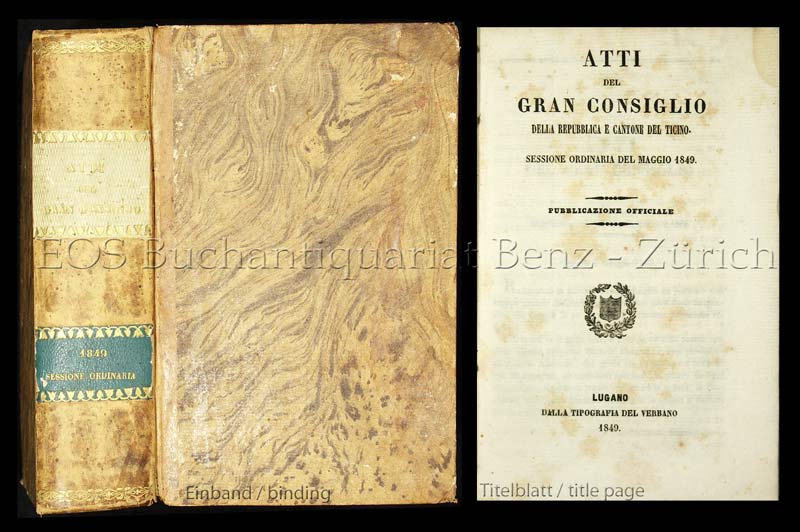
1849ref. 2583DBLugano, Dalla Tipografia Verbano, 1849. 8°. 826 S. Halblederband der Zeit mit 2 verg. Rückensch. + Wichtig: Für unsere Kunden in der EU erfolgt der Versand alle 14 Tage verzollt ab Deutschland / Postbank-Konto in Deutschland vorhanden +, 2583D
1695ref. 482986(Leipzig), Gleditsch (Juxta exemplar Parisiis antehac excusum), 1695. Folio. 32 Bl., 492 S.; 6 Bl., 488 S., 41 Bl.; 4 Bl., 140 S. Mit 2 gestochenen Titelvignetten, 1 gestochenen Kopfvignette u. 2 ganzseitigen Kupfern (Stammbäume). Pergament d. Zeit (fleckig, hinterer freier Vorsatz fehlt).
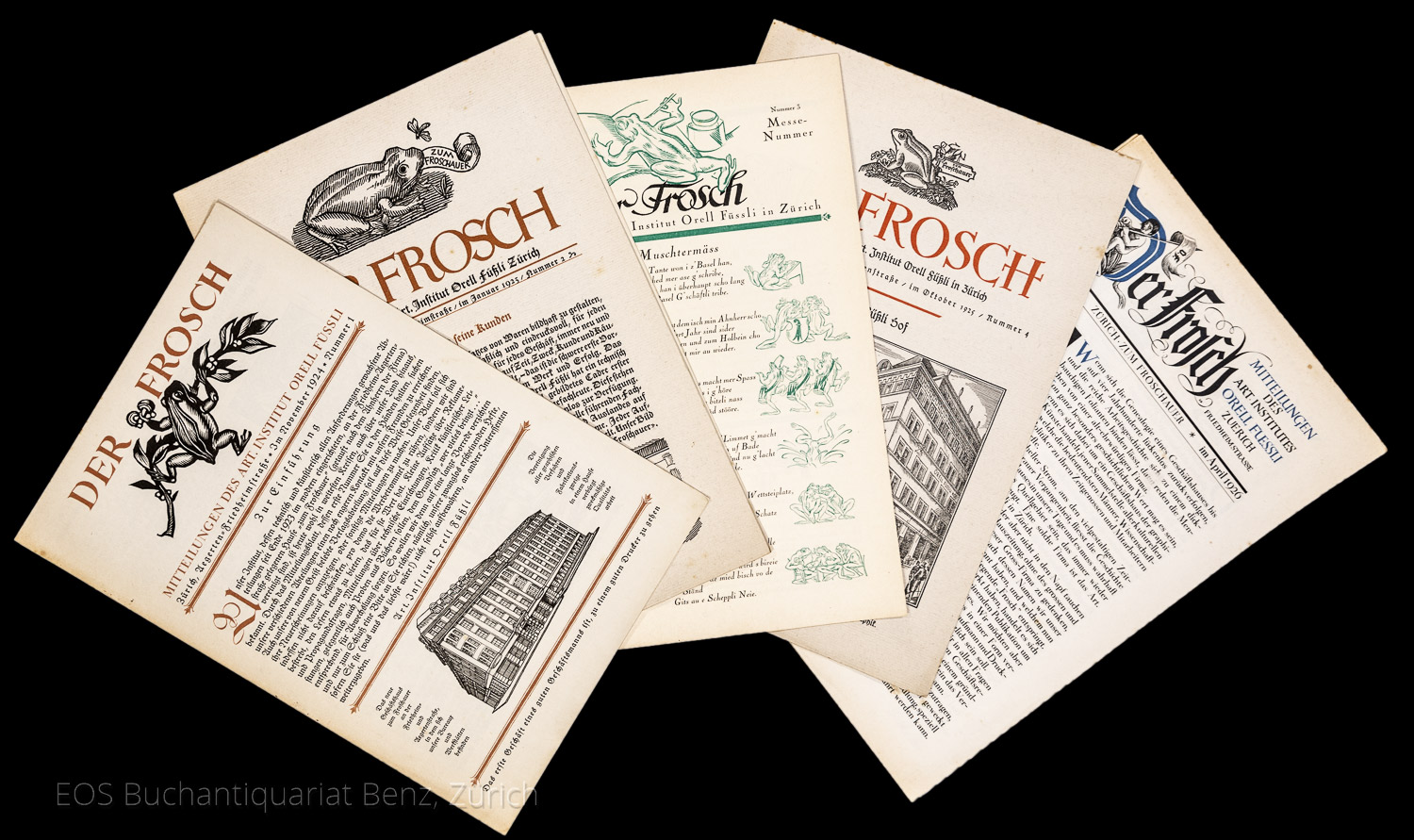
1924ref. 7170CBZürich, Orell Füssli, 1924. 4°. Je 8 Seiten. Mit Illustrationen. + Wichtig: Für unsere Kunden in der EU erfolgt der Versand alle 14 Tage verzollt ab Deutschland / Postbank-Konto in Deutschland vorhanden +, A 7 Hefte ? Nr. 1?5.
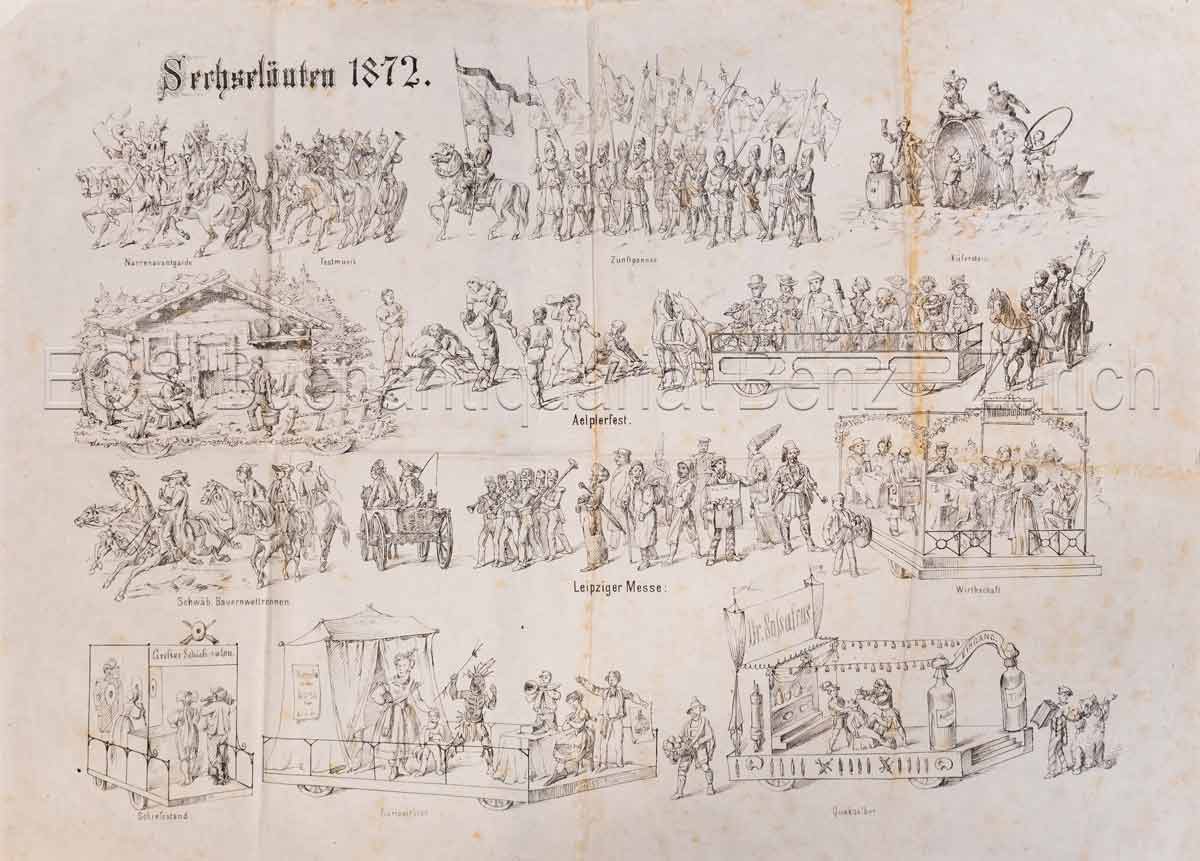
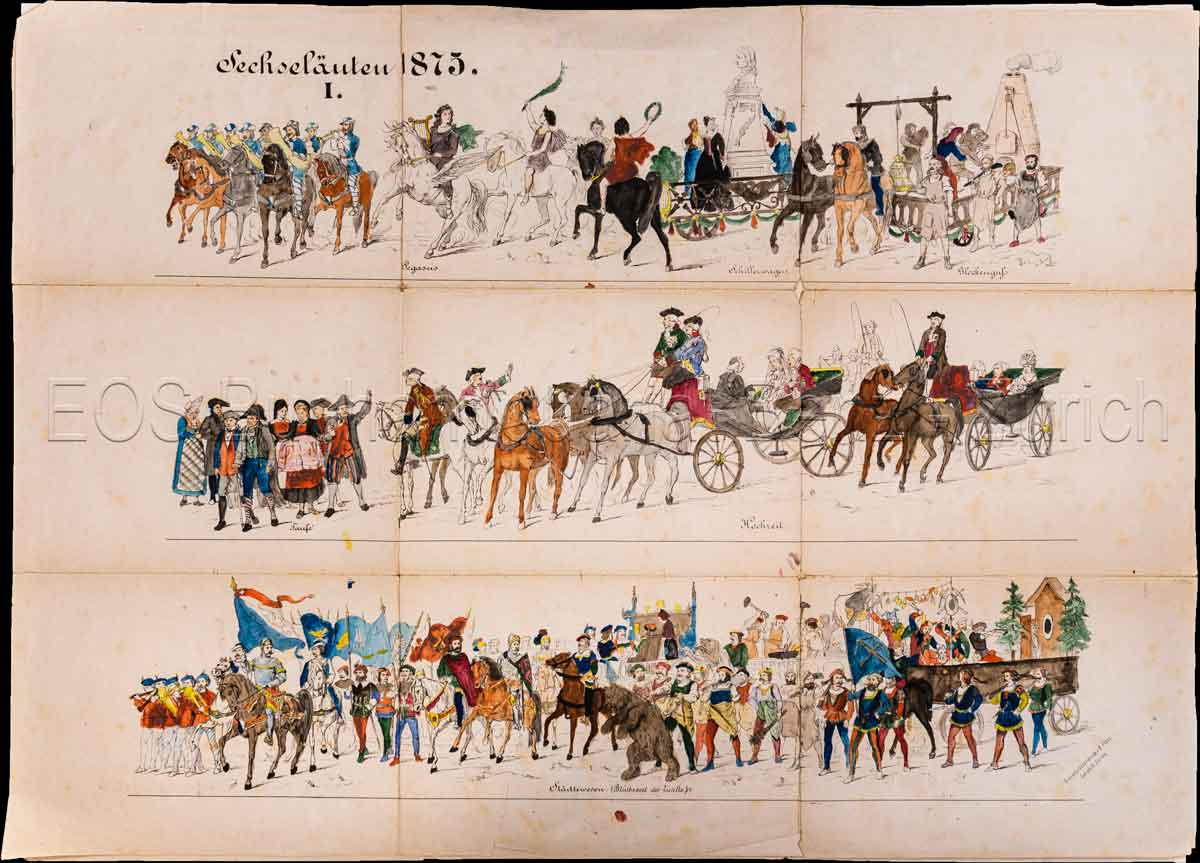
1872ref. 338BGZürich, 1872. 3 gef. lithogr. Blatt + Programm (4 S.). Blattgrösse: 46 x 62 cm. + Wichtig: Für unsere Kunden in der EU erfolgt der Versand alle 14 Tage verzollt ab Deutschland / Postbank-Konto in Deutschland vorhanden +, Abb.
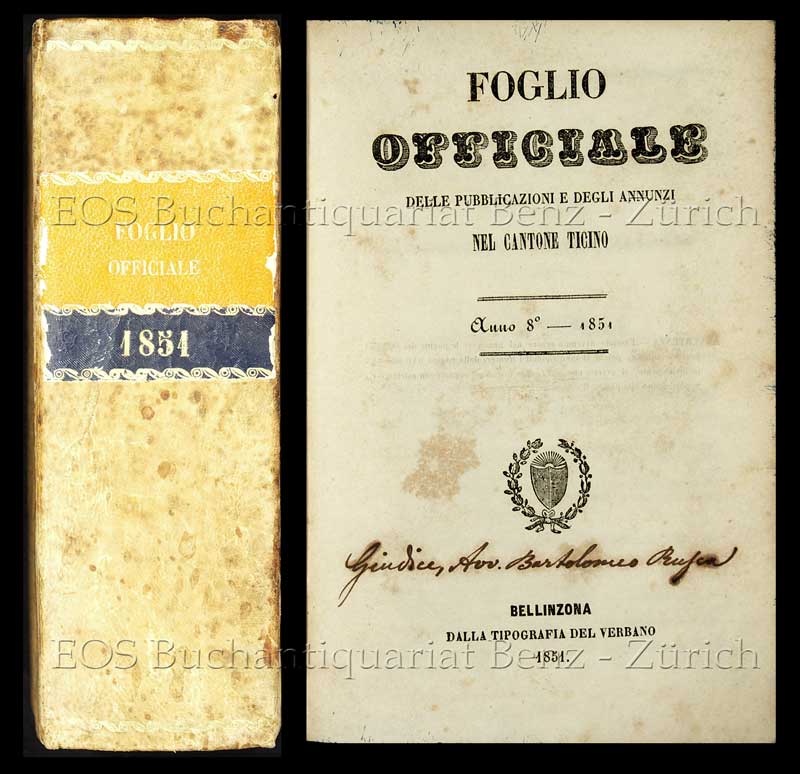
1851ref. 2591DBBellinzona, Dalla Tipografia del Verbano, 1851. 8°. XVI, 1196 S. Mit 4 mehrfach gef. Tabellen. Pappband der Zeit mit zweifarb. Rückenschild. + Wichtig: Für unsere Kunden in der EU erfolgt der Versand alle 14 Tage verzollt ab Deutschland / Postbank-Konto in Deutschland vorhanden +, 2591D
1863ref. 305BGZürich, Bürkli'sche Buchdruckerei, 1863. 3 kolorierte, lithogr., gef. Blatt + Programmheft (2 S.). Blattgrösse: 55 x 66 cm. + Wichtig: Für unsere Kunden in der EU erfolgt der Versand alle 14 Tage verzollt ab Deutschland / Postbank-Konto in Deutschland vorhanden +, Abb.
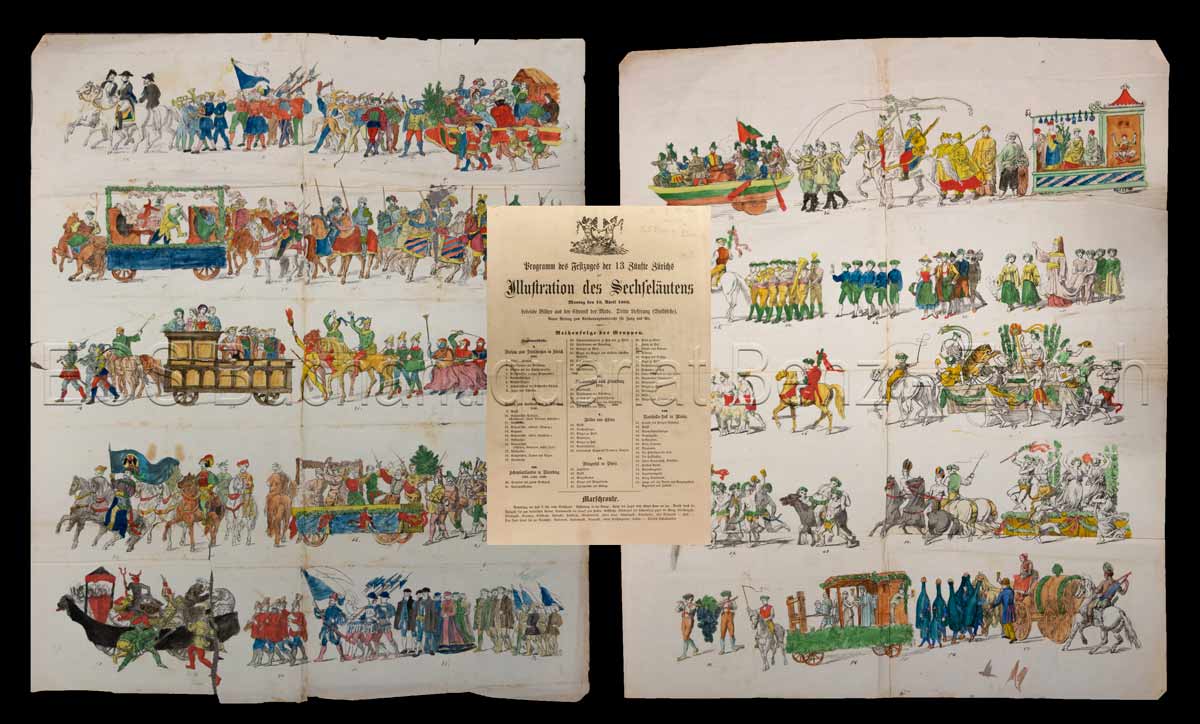
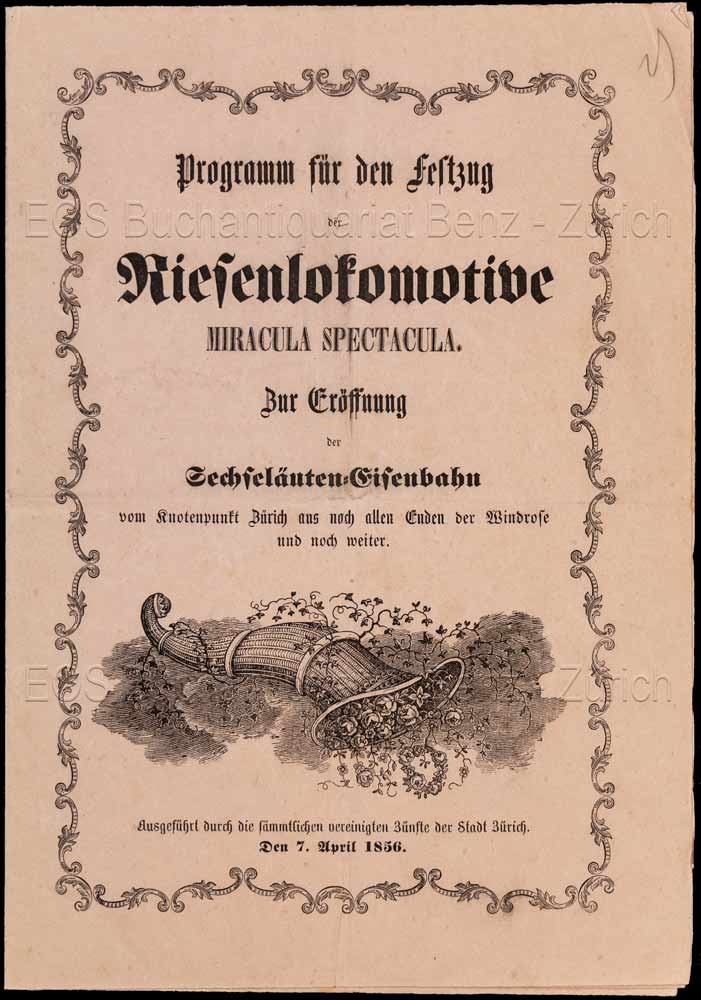
1856ref. 345BGZürich, David Bürkli, 1856. 4 gef. lithogr. Blatt + Programmheft (8 S.). Blattgrösse: 43 x 62 cm. + Wichtig: Für unsere Kunden in der EU erfolgt der Versand alle 14 Tage verzollt ab Deutschland / Postbank-Konto in Deutschland vorhanden +, Abb.
1875ref. 339BGZürich, R. Fretz u. C. Knüsli., 1875. 3 lithogr. kol. gef. Blatt + Programm (16 S.). Blattgrösse: 48 x 59 cm. + Wichtig: Für unsere Kunden in der EU erfolgt der Versand alle 14 Tage verzollt ab Deutschland / Postbank-Konto in Deutschland vorhanden +, Abb.
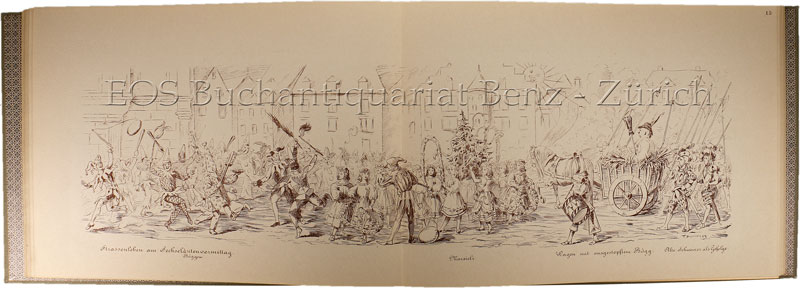
1897ref. 6645CBZürich, Gebr. Fretz, 1897. Quer-folio. Mit 30 doppelblattgrossen Tafeln. Orig.-Leinenband. + Wichtig: Für unsere Kunden in der EU erfolgt der Versand alle 14 Tage verzollt ab Deutschland / Postbank-Konto in Deutschland vorhanden +, Abb.
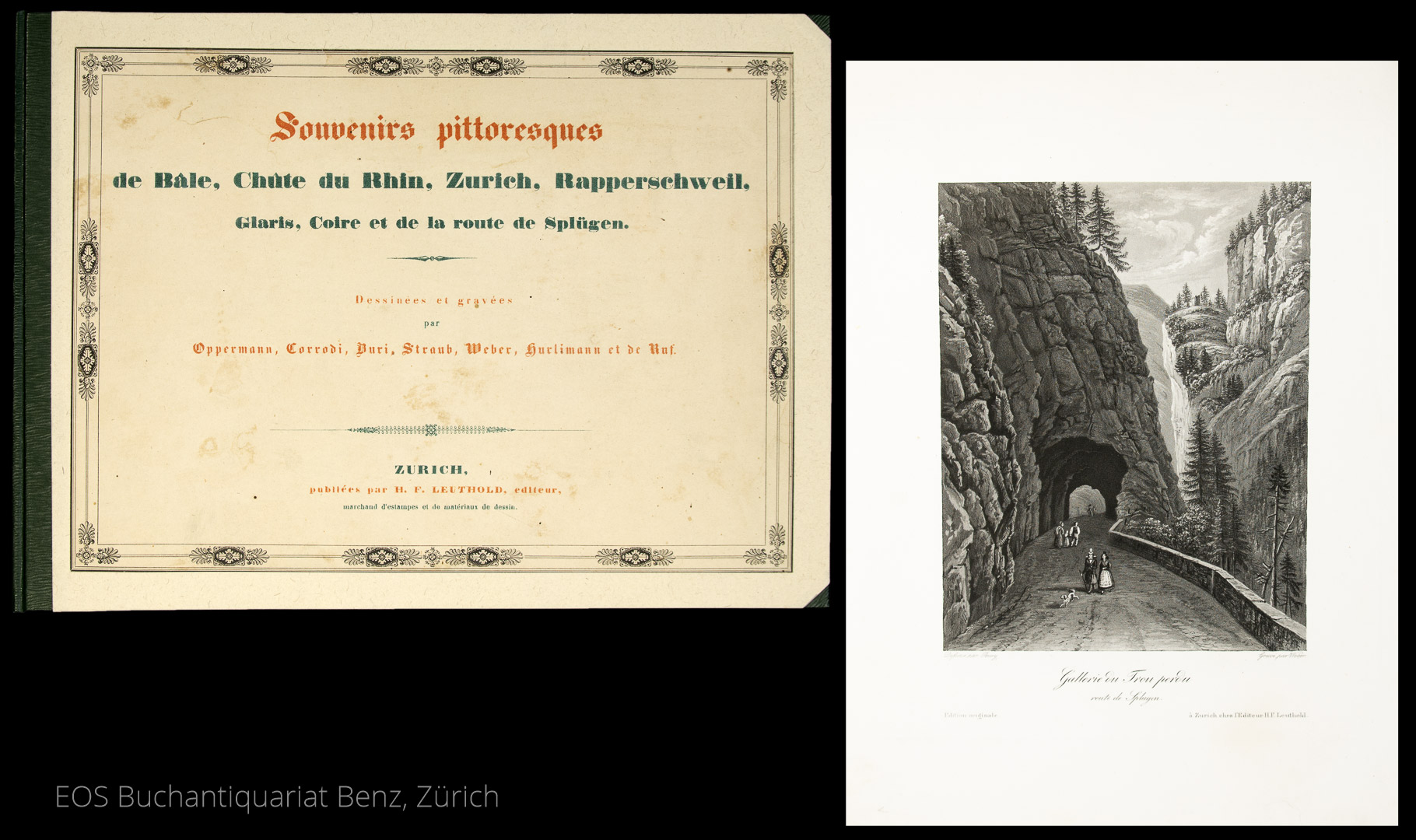
1830ref. 7645BBZürich, H. F. Leuthold, um 1830. Quer-4°. Titelblatt. Mit 18 Aquatinta-Tafeln. Moderner Halbleinenband mit montiertem alten Einbanddeckeln. + Wichtig: Für unsere Kunden in der EU erfolgt der Versand alle 14 Tage verzollt ab Deutschland / Postbank-Konto in Deutschland vorhanden +, 7645BB|7645BB_2|7645BB_3 [3 Warenabbildungen]
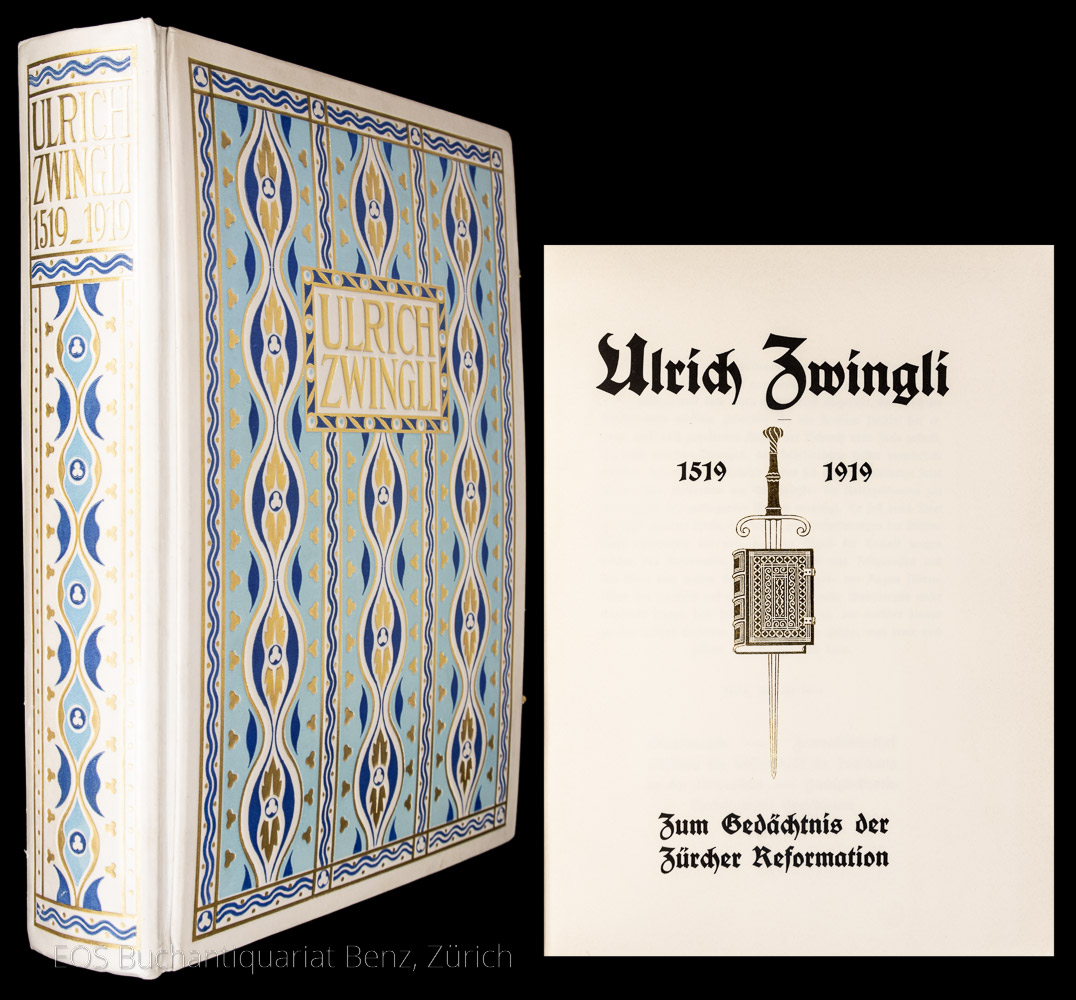
1919ref. 2612BBZürich, Berichthaus, 1919. Kl.-Folio. 1 Bl, XIV, 308 Spalten (recte 154 S.), (10) S. Mit 1 farb. Frontispiz u. 179 (dv. viele mont., farb.) Tafeln mit Portraits u. Illustr. nach alten Vorlagen. Farb- u. goldgepr. Orig.-Pergamentbd. über Holzdeckeln mit 2 Schliessen u. 3-s. Goldschnitt. + Wichtig: Für unsere Kunden in der EU erfolgt der Versand alle 14 Tage verzollt ab Deutschland / Postbank-Konto in Deutschland vorhanden +, 2612BB|2612BB_2 [2 Warenabbildungen]
ref. 19489Paris, Curmer, 840-1842. 9 vol. in-4, demi-veau vert de l'époque, dos long romantique orné d'arabesques dorées (petite restauration de la reliure du 1er, vol. dos insolés, pâles mouillures marginales, rousseurs, gravure du flâneur du tome III manquante).