10.198 resultados
Large 4to (180 x 255 mm). 26 watercolours on 25 ff. With several additional pencil sketches. Original black half leather with green cloth covers and pen holder. Impressive album of vibrant watercolours documenting an extensive journey from Shanghai to Sri Lanka via Hong Kong made by a female British artist, Frances de la Poer. The volume opens with a full-page depiction of a traditional Chinese lotus shoe captioned "The Brides shoe Shanghai Nov 30th 95", decorated with a sketch of two women in festive dress beneath a tree. The artist apparently had attended a wedding in Shanghai, as she also portrayed "The brides sisters" on the verso of the same leaf underneath a panorama of the Yangtze river crowded with junks. This latter watercolour is stated to have been drawn on deck of the Canadian ocean liner "RMS Empress of Japan", bound for Hong Kong. On 3 December, Frances de la Poer captured in an atmospheric watercolour the Lei Yue Mun channel ("Lymoon pass") that separates Kowloon and Hong Kong Island, followed by another river scene showing clothes drying on the shore of the Pearl River. The album continues with a portrait of two Chinese men in traditional attire and two more landscapes of the Pearl River (here captioned "Canton River") and its mountainous surroundings. On 13 December the artist had already reached Malaysia, as evidenced by an unfinished watercolour depicting a group of people with cattle. The journey continued on the German "Reichspostdampfer Preussen", documented in the caption of a stunning landscape of the Sumatran coastline from 16 December. - After a longer interruption, the Ceylonese section of the album starts with an impressive depiction of a lake near Bandarawela, dated 26 Jan. 1896. The artist explored the south of the island, painting a landscape in Badulla, a "lace seller" in Colombo, a river scene near a British fort, a young boy, a Buddhist stupa, acrobats in Yatawatta, huts in a village and a woman in Kandy province, a Tamil coolie working with tea and other labourers, but also a scorpion and, in pencil, a spider and lizards. Several drawings are also annotated in Sinhalese. A series of larger pencil drawings is followed by two final watercolours: a beautiful depiction of Galle Lighthouse, the oldest lighthouse on the island, and a charming scene on deck of the British ocean liner "RMS Ormuz", dated 22 February. - Frances de la Poer (ca. 1850-1925) was the youngest daughter of the Irish nobleman John William de la Poer (1816-51). In 1881 she married Thomas William Gaston Monsell, 2nd Baron Emly, son of the liberal politician William Monsell. - Spine professionally restored. Two leaves apparently excised, but generally well preserved.
Large 4to (180 x 255 mm). 24 watercolours on 22 ff. With several additional pencil sketches. Original black half leather with green cloth covers and pen holder. Impressive album of vibrant watercolours documenting the extensive Ceylonese journey of a female British artist, Frances de la Poer. The volume opens with a depiction of a "Madras Conjurer" in Kandy, performing the "great mango trick" with two cobras, wherein the performer gives the illusion of the sudden germination and growth of a mango tree (drawn from life and dated Kandy, 31 Dec. 1895). The second drawing shows a crowd gathered before a Buddhist temple in Kandy. - Setting out from Kandy, the artist explored the countryside, drawing landscapes in Yattawatta, the tea harvest on Coolbawn estate in Navalapitiya, a pandal in Bandarawala, the surroundings of Haldummulla, a verandah in Pelmadulla, two views of Adam's Peak, men riding elephants in Ratnapura, the famous Elephant Rock (Ethagala) of Kurunegala, and four impressions from the beaches of Bentota. The final watercolour in the album is a beautiful impression of a beach sunset, dated 18 February 1896. - Frances de la Poer (ca. 1850-1925) was the youngest daughter of the Irish nobleman John William de la Poer (1816-51). In 1881 she married Thomas William Gaston Monsell, 2nd Baron Emly, son of the liberal politician William Monsell. - Spine professionally restored; generally well preserved. Album bought from Roberson & Co., London, with his ticket to front pastedown.
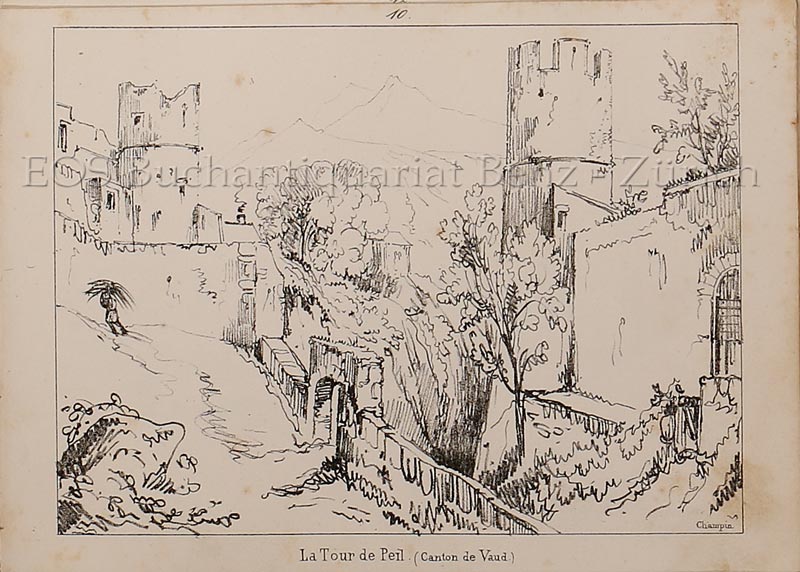
1850ref. 2112DBParis, (um 1850). Quer-8°. (2) 8, 8 S. Mit 31 (von 40) lithogr. Abb. auf Tafeln nach J.-J. Champin. Orig.-Pappband. + Wichtig: Für unsere Kunden in der EU erfolgt der Versand alle 14 Tage verzollt ab Deutschland / Postbank-Konto in Deutschland vorhanden +, bild
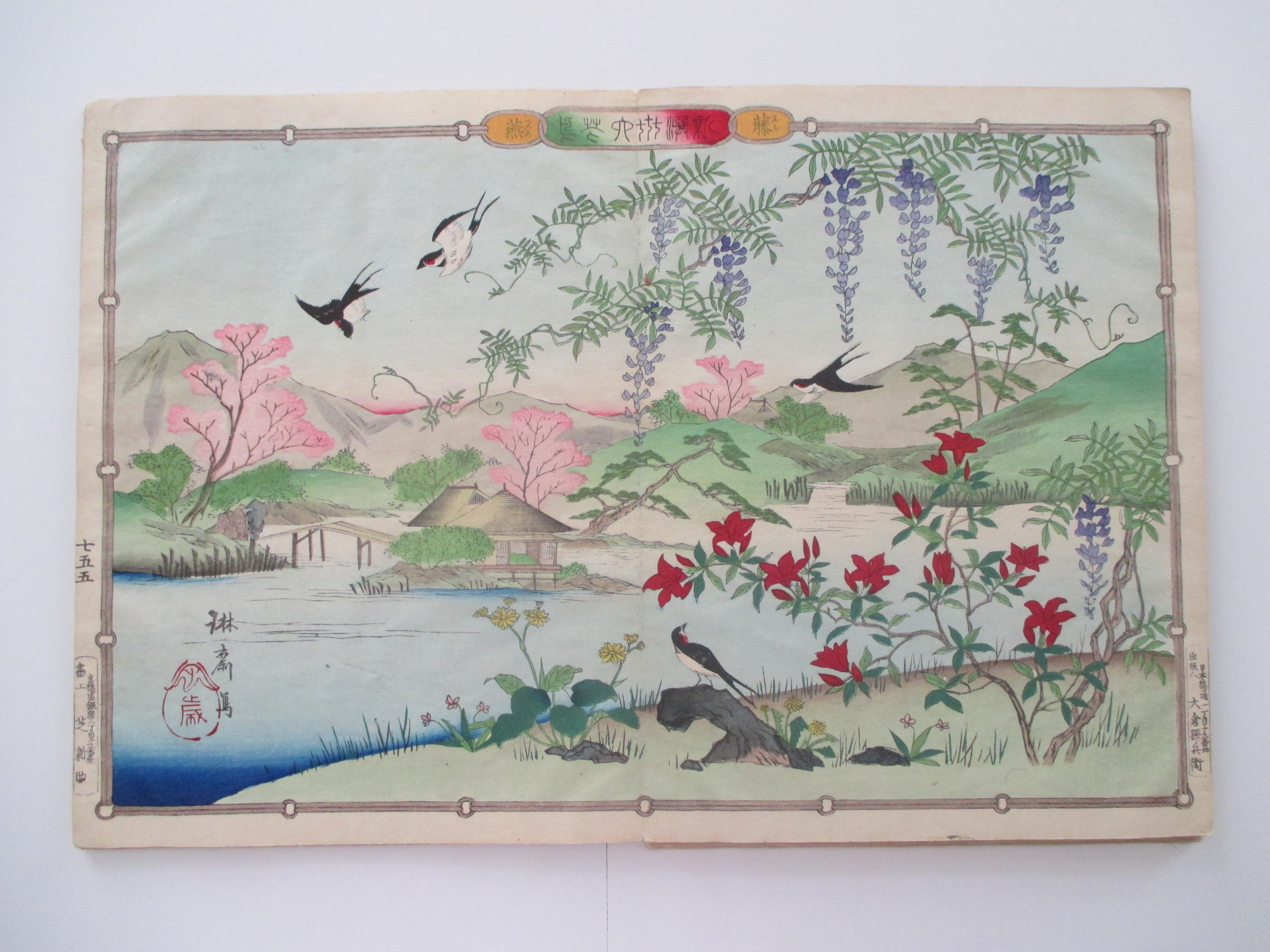
1900ref. 15849ABca. 1900. 24 : 18 cm. 8 double-page hand-coloured paltes, partly in aquatinta. Japanese boards with tile-label on front cover.
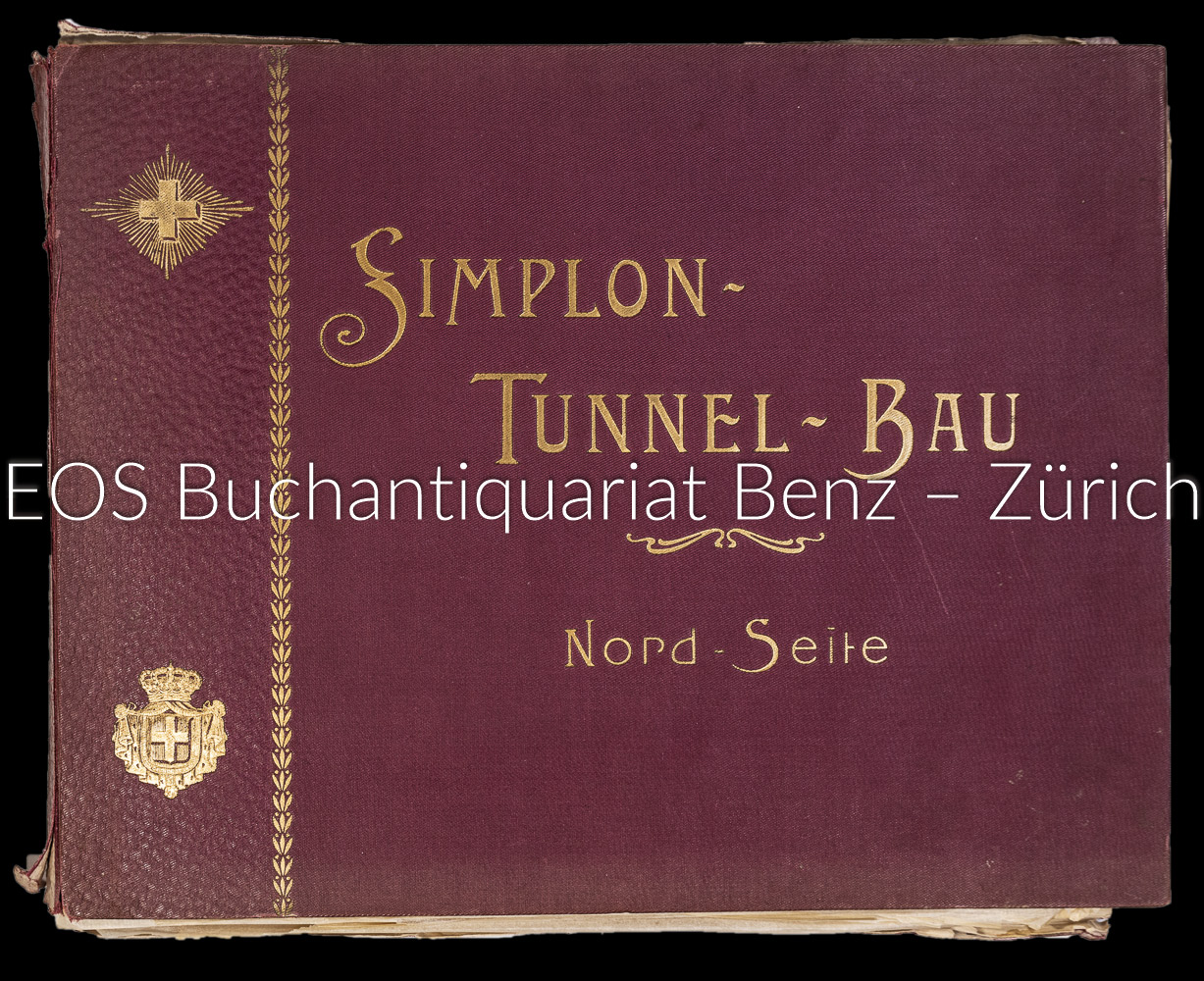
1906ref. 4245DBZürich, A. Bergeret & Co., Graph. Kunstanstalt, (um 1906). (2) Bl. Mit 30 fotografischen Tafeln. Lose Tafeln in Orig.-Leinenumschlag (kartoniert). + Wichtig: Für unsere Kunden in der EU erfolgt der Versand alle 14 Tage verzollt ab Deutschland / Postbank-Konto in Deutschland vorhanden +, A|B [2 Warenabbildungen]
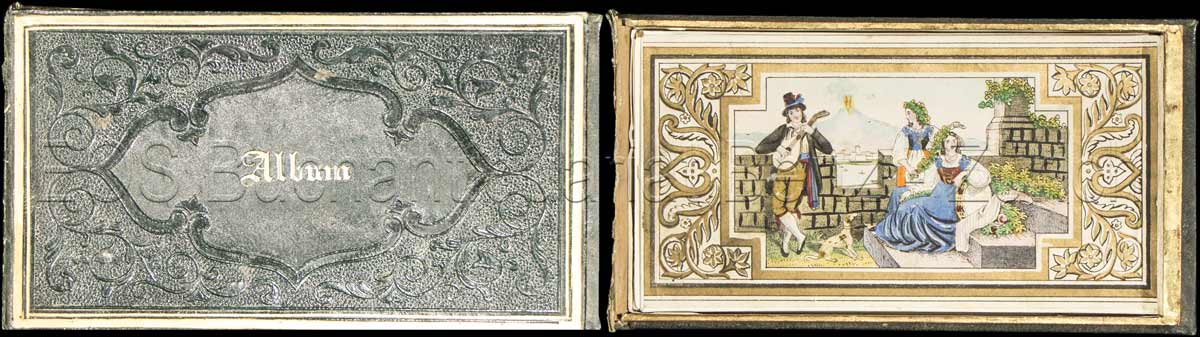
1840ref. 3656DBUm 1840. Lose in Papp-Schachtel, mit farb. Illustr. in Schuber der Zeit. + Wichtig: Für unsere Kunden in der EU erfolgt der Versand alle 14 Tage verzollt ab Deutschland / Postbank-Konto in Deutschland vorhanden +, Abb.
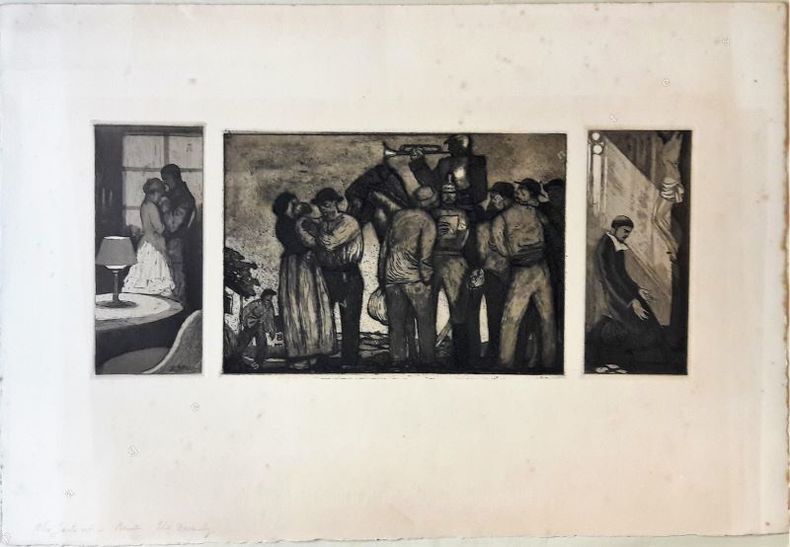
196512 litografie originali a piena pagina (firmate solo su lastra) di Aldo Calò. Testo critico di Corrado Maltese in italiano e inglese . 4to. pp. 44. . Molto buono (Very Good). legatura scollata (Loose binding). Edizione originale di 250 es. numerati. .
ref. 16307Devambez. 45 X 65 cm.
1983270X300 mm. 252 pages. Hardcover. Cover edges slightly stained. Ex Library copy with the usual markings. Else in good condition.
Profusely-illustrated monograph which provides the only catalogue raisonne of the work of Lunois, an important late-19th-century French artist fascinated by Spain, the Maghreb, and Scandinavia. ONE OF ONLY 50 NUMBERED COPIES PRINTED ON FINE OLD JAPAN PAPER. Illustrated with about 100 text illustrations and 26 full-page plates, each in two states. Most of the full-page plates are original etchings or lithographs by Lunois (some printed in color). Also includes the etching "Dame turque", which appears ONLY in this deluxe edition. 4to, original illustrated wraps. Uncut and unopened. With the prospectus. A bright, excellent copy of a rare book.
ref. 27331, Mechelen, Stevens, 1980, softcover onder uitgeverskarton, 155 x 245mm., 95pp., prachtige reprodukties van de prentkaarten, alle in kleur.
1959LIMITED EDITION of 300 COPIES - COPY No.81. RARE collection of 15 facsimiles of pan-and-ink drawings from various stages of his career by Alfred Leopold Isidor Kubin (1877-1959), an Austrian printmaker, illustrator and writer, an important representative of symbolism and expressionism in art. 430x320mm. Unpaginated. Handmade pale blue quarter-leather Hardcover laid in pale blue board slipcase. Gilt lettering on spine. Slipcase and spine stained. Slipcase edges and spine edges worn. Spine browned. Pages rough-cut as published. [SUMMARY]: This extremely rare collection of amazing drawings by an extraordinary 20th-century Austrian artist is in very good condition.
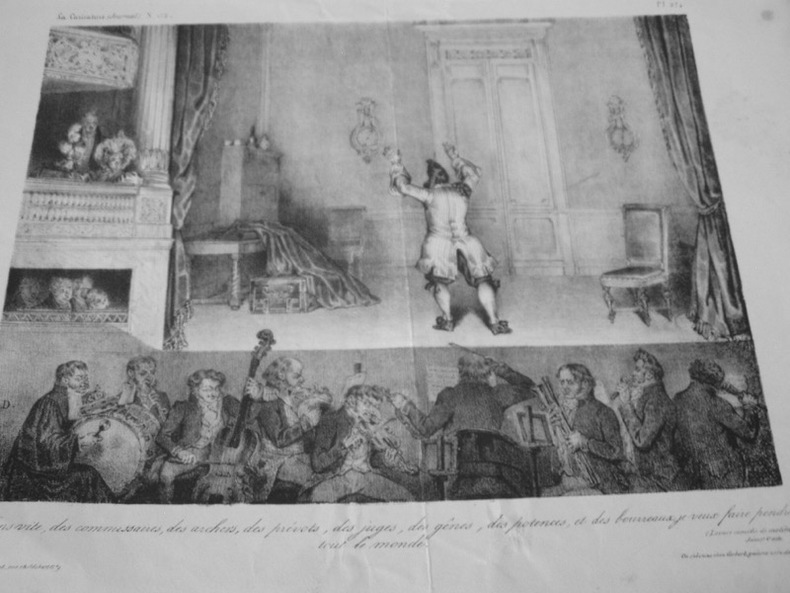
1833ref. 250771833 1833. Planche 274 de La Caricature N° 132.La Caricature, 16 mai, 1833. Lithographie originale sur Velin blanc. . . Belle épreuve en noir et pli vertical,plis;lithographie en noir sur velin blanc,,tirage bien noir malgré l'image jaunie
ref. 5726Aritmetica, Poesis, Geometria, Astronomia, Architectura (seule planche gravée par Frid. Lottes), Pictura, Sculptura. D'après les dessins très baroques de l'architecte et décorateur Paul Decker XVIIIè siècle 30,5 x 20
1822ref. 4733CBO. O., o. Dr., 1822. Kl.-8°. 22 S. Original-Interimsbroschur.
1924ref. 55191Lucien Vogel éditeur | Paris 1924-1925 | 18 x 24 cm | une feuille
1770ref. 8615Burin d'après Rubens. Dédié à Monsieur Caulet d'Hauteville. en feuille. Très bon Paris 1770 70 x 50 cm
ref. 0365850519.Gpaperback. Good. Access codes and supplements are not guaranteed with used items. May be an ex-library book. paperback
1995ref. TK254119Prestel & Museum of Modern Art New York 1995. 1st Edition. SOFTCOVER. Large 4to. in colour printed stiff glossy card covers 144pp on thick art paper colour plates etc. The first complete catalogue of Allen Jones' prints all are illustrated __CONDITION : An extremely well preserved AS NEW unread and unmarked copy. . To see more of our Art Monographs etc type DbbARTIST in the Keywords search box __We always ship in PROTECTIVE CARD PARCELS Prestel & Museum of Modern Art, New York paperback
1842ref. 38576Leipzig: Baumgärtner's Buchhandlung. Very Good-. Hardcover. 8vo; 2 vols pages; Contemporary diced calf leather over glazed paper covered boards. Two heavy volumes for which extra shipping charges may apply. Somewhat scuffed and worn but the bindings are sound with the thick covers well attached. Old ownership signatures partially covered by bookplates of St. Vincent's Abbey Westmoreland Pennsylvania. The Old Testament 978 pages occupies the first volume. The other volume contains the New Testament 360 pp. -- followed by supplements and corrections to the Testaments "Kurze Erläuterung der katholischen Bilder-Bibel - Supplement zum alten Testamente 124 pp. & -- Supplement zum neuen Testamente 32 p. only -- of 56 both these parts with the imprint matching: Leipzig Baumgärtner's Buchhandlung 1842. Text in German set in double columns of Fraktur type. With over 500 wood-engraved text illustrations. A significant illustrated Bible for Catholics which used the technical advances of the industrial revolution to make the large work available at a popular price -- "wohlfeile". . 1842. Baumgärtner's Buchhandlung hardcover
1740ref. 703979Ulm, Verlag Daniel Bartholomäi und Sohns, 1739-1740. 31 nnr. Bl., Text zweispaltig, 2304 Sp.; 25 nnr. Bl., Sp. 2305-4752, 3 3 nnr. Blätter (Gesamtregister). Schlichte Ganzpergamentbände der Zeit mit handschriftlichen Rückentiteln. Neueres Exlibris eines Vorbesitzers auf Innendeckel, Seiten teils schwach gebräunt, sonst von sehr guter Erhaltung.
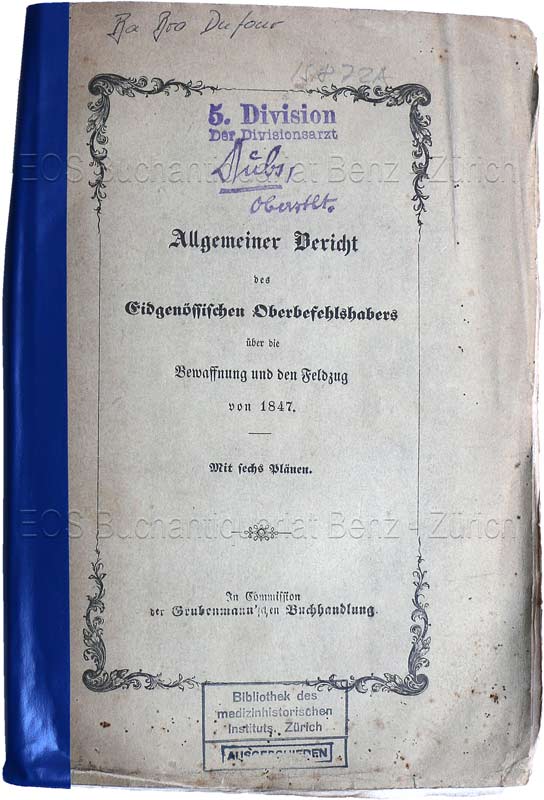
1848ref. 15872ABBern u. Zürich, Stämpfli u. Schulthess, 1848. 8°. 1 Bl, 82 S. 6 gef. Karten. Orig.-Broschur. + Wichtig: Für unsere Kunden in der EU erfolgt der Versand alle 14 Tage verzollt ab Deutschland / Postbank-Konto in Deutschland vorhanden +, Broschur
1822ref. 4733CBO. O., o. Dr., 1822. Kl.-8°. 22 S. Original-Interimsbroschur. + Wichtig: Für unsere Kunden in der EU erfolgt der Versand alle 14 Tage verzollt ab Deutschland / Postbank-Konto in Deutschland vorhanden +
1924- Lucien Vogel éditeur, Paris 1924-1925, 18x24cm, une feuille. - Original color print, printed on vergé paper, signed in the plate. An original print used to illustrate the Gazette du bon ton, one of the most attractive and influential 20th century fashion magazines, featuring the talents of French artists and other contributors from the burgeoning Art Deco movement. A celebrated fashion magazine established in 1912 by Lucien Vogel, La Gazette du bon ton appeared until 1925, with a hiatus from 1915 to 1920 due to the war (the editor-in-chief having been called up for service). It consisted of 69 issues printed in only 2,000 copies each and notably illustrated with 573 color plates and 148 sketches of the models of the great designers. Right from the start, this sumptuous publication "was aimed at bibliophiles and fashionable society," (Françoise Tétart-Vittu, "La Gazette du bon ton", in Dictionnaire de la mode, 2016) and was printed on fine vergé paper using a type cut specially for the magazine by Georges Peignot, known as Cochin, later used (in 1946) by Christian Dior. The prints were made using stencils, heightened in colors, some highlighted in gold or palladium. The story began in 1912, when Lucien Vogel, a man of the world involved in fashion (he had already been part of the fashion magazine Femina) decided, with his wife Cosette de Brunhoff - the sister of Jean, creator of Babar - to set up the Gazette du bon ton, subtitled at the time: "Art, fashion, frivolities." Georges Charensol noted the reasoning of the editor-in-chief: "'In 1910,' he observed, 'there was no really artistic fashion magazine, nothing representative of the spirit of the time. My dream was therefore to make a luxury magazine with truly modern artists...I was assured of success, because when it comes to fashion, no country on earth can compete with France.'" ("Un grand éditeur d'art. Lucien Vogel" in Les Nouvelles littéraires, no. 133, May 1925). The magazine was immediately successful, not only in France but also in the United States and Latin America. At first, Vogel put together a team of seven artists: André-Édouard Marty and Pierre Brissaud, followed by Georges Lepape and Dammicourt, as well as eventually his friends from school and the School of Fine Arts, like George Barbier, Bernard Boutet de Monvel and Charles Martin. Other talented people soon came flocking to join the team: Guy Arnoux, Léon Bakst, Benito, Boutet de Monvel, Umberto Brunelleschi, Chas Laborde, Jean-Gabriel Domergue, Raoul Dufy, Édouard Halouze, Alexandre Iacovleff, Jean Émile Laboureur, Charles Loupot, Chalres Martin, Maggie Salcedo. These artist, mostly unknown when Lucien Vogel sought them out, later became emblematic and sought-after artistic figures. It was also they who worked on the advertising drawings for the Gazette. The plates put the spotlight on, and celebrate, dresses by seven designers of the age: Lanvin, Doeuillet, Paquin, Poiret, Worth, Vionnet and Doucet. The designers provided exclusive models for each issue. Nonetheless, some of the illustrations are not based on real models, but simply on the illustrator's conception of the fashion of the day. The Gazette du bon ton was an important step in the history of fashion. Combining aesthetic demands with the physical whole, it brought together - for the first time - the great talents of the artistic, literary, and fashion worlds; and imposed, through this alchemy, a completely new image of women: slender, independent and daring, which was shared by the new generation of designers, including Coco Chanel, Jean Patou, Marcel Rochas, and so on... Taken over in 1920 by Condé Montrose Nast, the Gazette du bon ton was an important influence on the new layout and aesthetics of that "little dying paper" that Nast had bought a few years earlier: Vogue. [FRENCH VERSION FOLLOWS] Estampe originale en couleur, tirée sur papier vergé, signée en bas à droite de la planche. Gravure originale réalisée pour l'illu
1921- Lucien Vogel éditeur, Paris 1921, 18x24cm, une feuille. - Original color print, printed on vergé paper, signed in the plate. An original print used to illustrate the Gazette du bon ton, one of the most attractive and influential 20th century fashion magazines, featuring the talents of French artists and other contributors from the burgeoning Art Deco movement. A celebrated fashion magazine established in 1912 by Lucien Vogel, La Gazette du bon ton appeared until 1925, with a hiatus from 1915 to 1920 due to the war (the editor-in-chief having been called up for service). It consisted of 69 issues printed in only 2,000 copies each and notably illustrated with 573 color plates and 148 sketches of the models of the great designers. Right from the start, this sumptuous publication "was aimed at bibliophiles and fashionable society," (Françoise Tétart-Vittu, "La Gazette du bon ton", in Dictionnaire de la mode, 2016) and was printed on fine vergé paper using a type cut specially for the magazine by Georges Peignot, known as Cochin, later used (in 1946) by Christian Dior. The prints were made using stencils, heightened in colors, some highlighted in gold or palladium. The story began in 1912, when Lucien Vogel, a man of the world involved in fashion (he had already been part of the fashion magazine Femina) decided, with his wife Cosette de Brunhoff - the sister of Jean, creator of Babar - to set up the Gazette du bon ton, subtitled at the time: "Art, fashion, frivolities." Georges Charensol noted the reasoning of the editor-in-chief: "'In 1910,' he observed, 'there was no really artistic fashion magazine, nothing representative of the spirit of the time. My dream was therefore to make a luxury magazine with truly modern artists...I was assured of success, because when it comes to fashion, no country on earth can compete with France.'" ("Un grand éditeur d'art. Lucien Vogel" in Les Nouvelles littéraires, no. 133, May 1925). The magazine was immediately successful, not only in France but also in the United States and Latin America. At first, Vogel put together a team of seven artists: André-Édouard Marty and Pierre Brissaud, followed by Georges Lepape and Dammicourt, as well as eventually his friends from school and the School of Fine Arts, like George Barbier, Bernard Boutet de Monvel and Charles Martin. Other talented people soon came flocking to join the team: Guy Arnoux, Léon Bakst, Benito, Boutet de Monvel, Umberto Brunelleschi, Chas Laborde, Jean-Gabriel Domergue, Raoul Dufy, Édouard Halouze, Alexandre Iacovleff, Jean Émile Laboureur, Charles Loupot, Chalres Martin, Maggie Salcedo. These artist, mostly unknown when Lucien Vogel sought them out, later became emblematic and sought-after artistic figures. It was also they who worked on the advertising drawings for the Gazette. The plates put the spotlight on, and celebrate, dresses by seven designers of the age: Lanvin, Doeuillet, Paquin, Poiret, Worth, Vionnet and Doucet. The designers provided exclusive models for each issue. Nonetheless, some of the illustrations are not based on real models, but simply on the illustrator's conception of the fashion of the day. The Gazette du bon ton was an important step in the history of fashion. Combining aesthetic demands with the physical whole, it brought together - for the first time - the great talents of the artistic, literary, and fashion worlds; and imposed, through this alchemy, a completely new image of women: slender, independent and daring, which was shared by the new generation of designers, including Coco Chanel, Jean Patou, Marcel Rochas, and so on... Taken over in 1920 by Condé Montrose Nast, the Gazette du bon ton was an important influence on the new layout and aesthetics of that "little dying paper" that Nast had bought a few years earlier: Vogue. [FRENCH VERSION FOLLOWS] Estampe originale en couleur, tirée sur papier vergé, signée en bas à gauche de la planche. Gravure originale réalisée pour l'illustrat