10.612 Ergebnisse
Heliogravüre und Vernis mou. Im unteren Rand eigenh. monogrammiert. 189 x 148 mm (Blattgröße 456 x 307 mm). Exsteens 438. Mascha 742.
1920Best.-Nr. 9742Beau portefeuille contenant 50 eaux-fortes originales de Sylvain Sauvage. Exemplaire tiré sur papier de Hollande, signé au colophon par l'artiste. On joint une lettre autographe signée de l'artiste sur son beau papier à en-tête. en feuille. Papier filigrané. Très bon Paris Cotinaud s.d. (1920) 1 volume in-folio.
Matted, framed and glazed (frame dimensions 315 x 270 mm). Charming study of the Arabian horse Kismet. "Kismet was bred at H. H. Prince Odescalchi's Inocencdvor Arabian Stud."
1792Best.-Nr. 703499Paris, ohne Verlag, ohne Jahr (um 1792). Groß-Folio. VI, 236 Seiten und 57 von 58 nummerierte Blätter.. Goldgeprägter Halbledereinband der Zeit. Einband mit stärkeren Gebrauchsspuren, Überzugspapier teils gelöst und mit Fehlstellen. Buchrücken fleckig und Vordergelenk mit 6 cm Einriß. Innen sauber. Die breitrandigen Tafeln in kräftigen Abdrucken. Titelblatt fehlt.
1543Best.-Nr. 1033312 épreuves de la suite qui en contient 14 d'après Bartsch. Nous présentons les planches décrites sous Bartsch 420, 421, 422,423, 424, 425, 426, 427, 429, 430, 432, 433.L'épreuve n° 420 est en tirage tardif avec l'inscription "Io. Jacobi de Rubeis …". Le numéro 432 avec un important manque de papier hors sujet en haut à gauche Toutes sont à très grandes marges, parfois avec des mouillures ou des taches, mais d'un beau tirage. Rare ensemble. En feuilles Bon s.l. s.n. 1543 43 x 29 cm la feuille
1899Best.-Nr. 131798Tokio, T. Hasegawa, Meiji 32 1899 In-12 18 x 14 cm. Reliure japonaise, [32] pp., 14 estampes sur bois en couleurs sur papier crêpe HoSho par Yoshimune Arai. Ouvrage peu fréquent sur les conteurs publics japonais publié en français trente ans seulement après l’avènement de l’ère Meiji. Pliures angulaires.
- Lucien Vogel éditeur, Paris 1921, 18x24cm, en feuilles. - Set of eight original prints in color, drawn on laid paper, signed lower right and left boards. The boards are introduced by a text signed Jean Cocteau and represent costumes for Shakespeare (two Bergeres Paulina or Time). Original prints made ??for the illustration of The Gazette fashionable, one of the finest and most influential twentieth century fashion magazines, celebrating the talent of creators and artists French burgeoning art deco. Famous fashion magazine founded in 1912 by Lucien Vogel, The Gazette fashionable appeared until 1925 with an interruption during the War of 1915 to 1920, due to mobilization of its editor. She is 69 Deliveries from just 2000 copies and is illustrated including 573 color plates and 148 sketches depicting models of fashion designers. Upon publication, these luxury publications "are for bibliophiles and worldly aesthetes" (Françoise Tétart-Vittu "good Gazette of tone" in the fashion dictionary, 2016). Printed on fine laid paper, they use a typeface created specifically for the magazine by Georges Peignot, the Cochin character, taken in 1946 by Christian Dior. The prints are made with the technique of metal stencil, enhanced color and some outlined in gold or palladium. The adventure began in 1912 when Lucien Vogel, man of the world and fashion - it has already participated in Femina magazine - decided to found with his wife Cosette de Brunhoff (John's sister, the father of Babar) Gazette good tone in which the subtitle is then "Art, fashions and frivolities." Georges Charensol quotes the editor: "In 1910, he observed, there was no truly artistic fashion magazine and representative of the spirit of his time. So I thought of making a glossy magazine with truly modern artists [...] I was certain of success because for any fashion country can compete with France. "(" A great art editor. Lucien Vogel "in literary News, No. 133, May 1925). The success of the magazine is immediate, not only in France but also the US and South America. Originally, Vogel therefore brings together a group of seven artists: André-Édouard Marty and Pierre Brissaud, followed by Georges Lepape and Dammicourt; and finally his friends from the School of Fine Arts as are George Barbier, Bernard Boutet de Monvel or Charles Martin. Other talents come quickly reach the equipped Guy Arnoux, Léon Bakst, Benito, Boutet de Monvel, Umberto Brunelleschi, Chas Laborde, Jean-Gabriel Domergue, Raoul Dufy, Edward Halouze Alexander Iacovleff, Jean Emile Laboureur Charles Loupot, Charles Martin, Maggie Salcedo. These artists, mostly unknown when Lucien Vogel appealed to them, will eventually become iconic figures and artistic sought. These are the same illustrators who make the drawings advertisements Gazette. The boards highlight the dresses and sublime seven artists of the time: Lanvin, Doeuillet, Paquin, Poiret, Worth, Vionnet and Doucet. The designers provide for each number of exclusive models. Nevertheless, some of Illustrations contained no real model, but only the idea that the illustrator is done in the fashion of the day. Gazette fashionable is a milestone in the history of fashion. Combining the aesthetic requirement and plastic unit, it brings together for the first time the great talents of the world of arts, literature and fashion and imposed by this alchemy, a new image of women, slender, independent and bold, also driven by the new generation of designers Coco Chanel, Jean Patou, Rochas Marcel ... Recovery in 1920 by Condé Montrose Nast, Gazette fashionable modeled for the new composition and the aesthetic choices of the "little dying newspaper" that Nast had bought a few years ago: the Vogue magazine. [FRENCH VERSION FOLLOWS] Réunion de carnets extraits de la Gazette du Bon Ton ainsi constituée : Intérieurs modernes par MAM (Croquis, La Gazette du Bon ton, 1921 n°1). Ensemble de quatre lithographies originales en couleur, tirées sur papier vergé. Installation mode
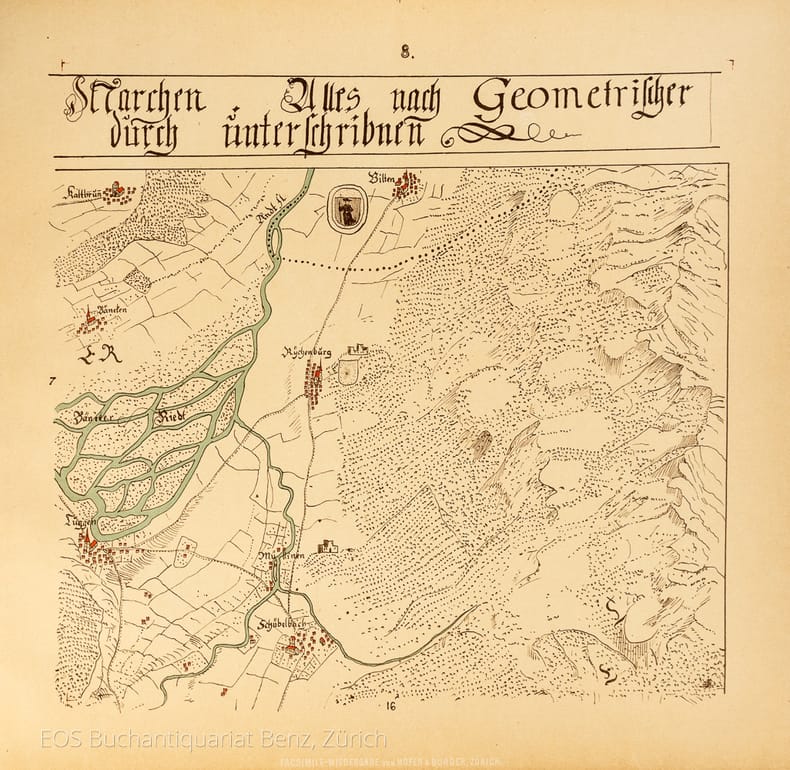
1891Best.-Nr. 7594CBZürich, Hofer & Burger, 1891. Quer.-folio. (7) Bl. Mit Frontisp., Übersichtskarte und 56 Karten (chromolithogr. Reproduktionen). Illustr. Orig.-Halbleinenband.
1759Best.-Nr. 6700CB82 Heft in 1 Band. Zürich, 1759–1841. 4°. Pro Heft meist 8 Seiten mit 82 Kupfertafeln von Gessner, Bullinger, Schellenberg, Usteri u. a. Pappband der Zeit mit Marmorpapierbezug.
1836Best.-Nr. 12808AB2 Bände. London, George Virtue, (1836). 4°. IV, 188 S.; (1) Bl.; (2), 152, (2) S. Mit 2 gest. Titel und 106 Stahlstiche von William Henry Bartlett sowie 1 gef. Karte. Spätere Halblederbände.
1920Best.-Nr. 901DGZürich. Art. Institut Orell Füssli, ca. 1920. Fotografie. Fotoformat: 10 x 71,5 cm. Bildgrösse: 26.5 x 88 cm
1985Best.-Nr. 5335DB1 Band. Luzern, Faksimile Vlg., 1985. Gross-4°. (2)1035 (1) faksimil. S.; 306 S.Mit 199 farb. faksimil. Buchillustr. Blindgepr. alaungegerbter Orig.-Schweinslederbd. über Holzdeckeln mit 2 Metallschliessen im Stile d. Zt. sowie Orig.-Halblederbd. mit goldgepr. Rücikenschild.
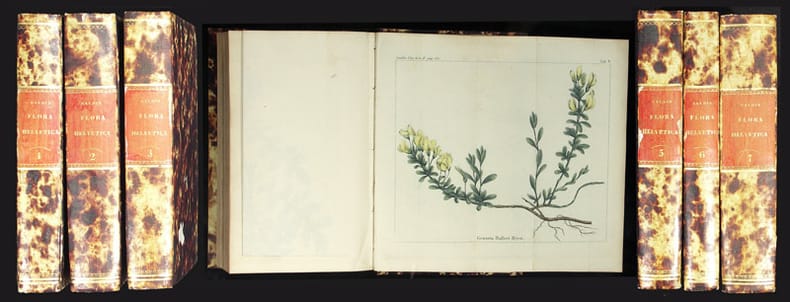
1828Best.-Nr. 30176AB7 Bände. Zürich, Orell Fuessli, 1828–1833. 8°. Mit 28 kol. Kupfertafeln. Pappbände aus der Zeit mit verg. Rückenschild und Rückenvergoldung.
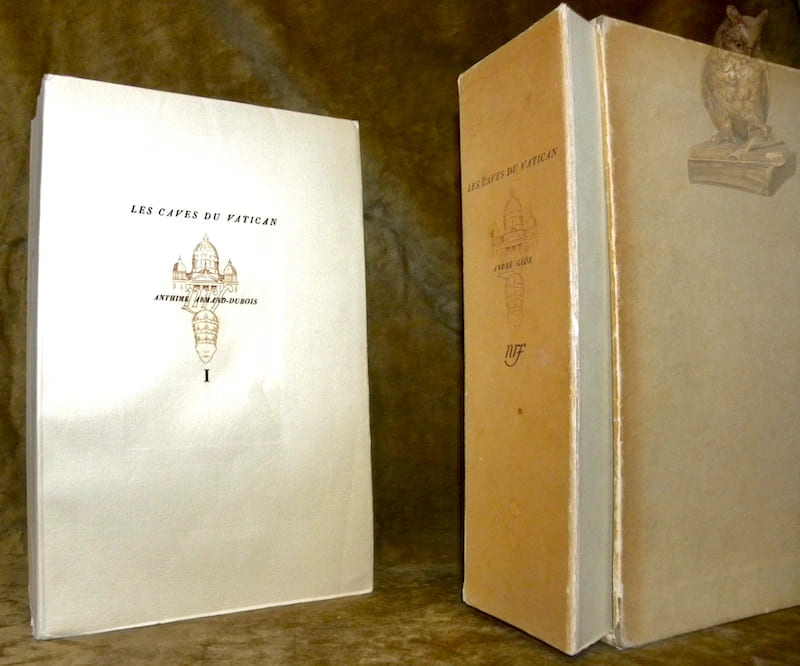
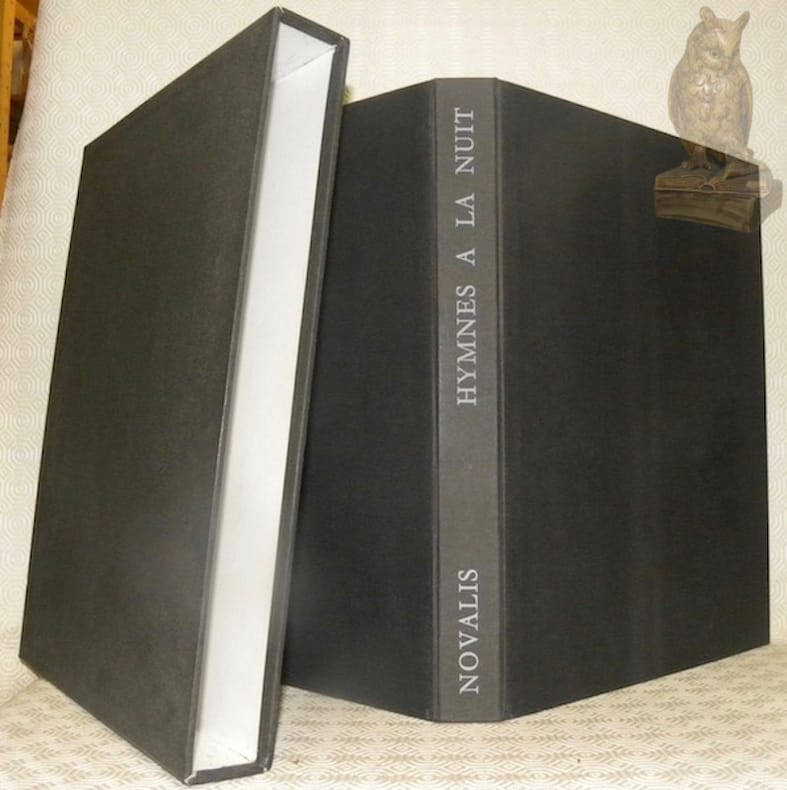
Best.-Nr. 121410Paris, Gallimard 1929 - 1930, 270x185mm, broché. Couverture rempliée, sous chemise et emboitage rigides. Mors de la chemise légèrement fendillés et dos insolé. Coins de l’emboitage frottés. Intérieur très propre. Tiré sur papier hollande, numéroté n° 10 / 300. Bel exemplaire.
1826Best.-Nr. 7160CB4 Bände. Zürich, J. Esslinger, (1826–1834). Kl.-8°. Mit 287 kol. Lithographien von Jonas David Labram. Halblederbände der Zeit mit verblasster Rückenvergoldung.
1817Best.-Nr. 7702CBBern, J. J. Burgdorfer, 1817. Quer-kl.-4°. (8) S., (1) Bl. (Verlagsanzeigen). Mit 15 Kupfertafeln. Orig.-Umschlag.
1696Best.-Nr. 5113DBZürich, Verlag nicht ermittelbar, 1696. Folio. Gestochener Titel, 57 Porträts in Kupfer. Lose Blatt in neuerer Leinenmappe.
Best.-Nr. 78672Albeuve, Paul Castella 1966, 400x300mm, 50pages, en feuilles sous couverture rempliée. Avec emboitage et chemise rigide. Exemplaire sur papier vélin de Rives, numéroté n° 130 / 167, signé par l’artiste. Illustré d’un gravure sur pierre à la couverture, reprise par fragments dans le texte et de lithographies originales. Bords latéral de la première page de garde avec des rousseurs, tout le reste très propre. Catalogue raisonné A.-E. Yersin, n°419. Très bel exemplaire.
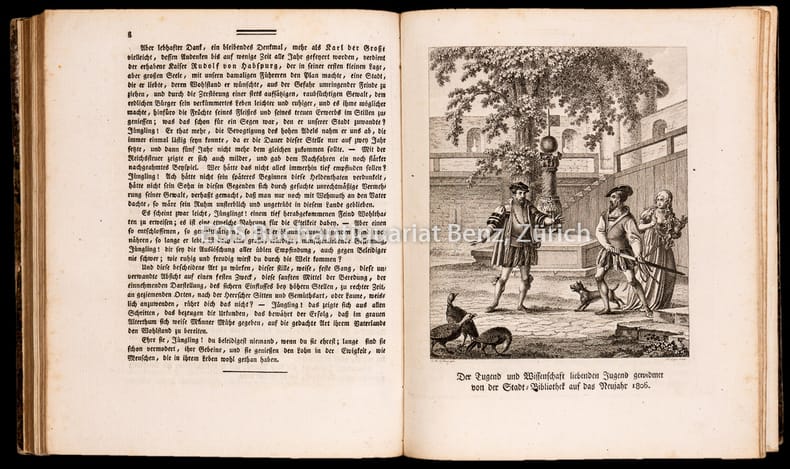
1744Best.-Nr. 30071ABZürich, Übers, 1744. 8°. (6) Bl., 645 S., (1) Bl. Mit 6 (von 7) gef. Kupferstichen von Johann Heinrich Freytag. Pappband aus der Zeit.
1961Best.-Nr. 265DGZürich, 1961. Poster - Offset printing. Illustration by Nikolaus Schwabe. 102 x 64 cm.
1658Best.-Nr. 3152DBLutetia (Ulm?), 1658. 8°. (3) Bl. (gedruckter Titel und Clavis), (5) Bl. (handschr. Clavis), (7) leere Bl., (2) Bl. (Vorrede), S. 1 - 234, S. 237 - 297, 1 leeres Bl., (S 235/36 in der Pagination übersprungen). Mit 1 gest. Titel. Neuer Pergamentband im Stile der Zeit.
1840Best.-Nr. 31170AB(Bern, um 1840). 8°. 12, 18, 13, 13, 32 S. Mit 219 (von 225) Tafeln. Späterer Halblederband.
1840Best.-Nr. 4793BB10 Mappen. Bern, Verlag der lithogr. Anstalt von J. F. Wagner, o. J. (1840). Quer-Gross-8°. 32 S.; 12 S.; 13 S.; 18 S.; 12 S. Mit 199 lithogr. Tafeln, (+ 1 zusätzliche lithogr. Tafel) nach Zeichnungen von J. F. Wagner. Lose Blatt in Papierumschlägen unter Verwendung der Orig.-Titel (diese auf vord. Deckel mont.)
1756Best.-Nr. 13690ABKempten, 1756, 1756. Folio. 24 S. Titel in Rot und Schwarz gedruckt. Mit 1 gest., allegorischen Frontisp., 1 gest. Titelvignette, 60 Kupfer-Portraits (in Schabmanier) nach J. C. Füssli von Val. Dan. Preisler und Sebastian Walch, 13 leere Blatt. Halbpergamentband der Zeit.
Best.-Nr. 3095Paris: Editions des Bibliotheques Nationales de France 1937. The catalogue raisonne of Bejot's prints. 2 leaves 279 pp. 437 items thoroughly described. Profusely illustrated. Index. Edition limited to 350 numbered copies printed on fine wove paper with THREE ORIGINAL ETCHINGS BY BEJOT L. 347 411 and 412 PRINTED ON VERY FINE SPECIALLY-MADE LAID PAPER. Folio. Bound in the original quarter vellum and marbled boards with morocco labels on front cover and spine. Uncut. A tiny wisp of wear to extremities of binding else FINE AND BRIGHT WITH NO DEFECTS. An excellent copy of a very scarce book usually found worn and/or re-bound. Paris: Editions des Bibliotheques Nationales de France, 1937 hardcover