10.989 Ergebnisse
1493Best.-Nr. 0005337Nuremberg Germany: Anton Koberger 1493. First edition. Very Good. Woodcuts by the Workshop of Michael Woldgemut & Wilhelm Pleydenwurff. Folio conjoined leaves measuring approximately 455mm by 320mm very minor breaks at fold minor soiling matted but not glazed or framed. LIBER CHRONICARUM is the most famous travel book of the 15th century and the most exhaustively illustrated book of the incunable era. The complete work contains 1809 woodcuts of which only 29 are double-page town views:: these conjoined leaves is one of those 29 town views specifically "Colonia" i.e. Cologne Germany. The verso of leaf XCI is a half-page view of "Augusta" i.e. Augsburg Germany with descriptive text. Also smaller portraits of historical personages including Cleopatra Alexander the Great Herodias L. Pomponius Leoneus and M. Agrippa. et alios Notes: this is from the Latin edition. The German-language edition DAS BUCH DER CHRONIKEN has different woodblock portraits for Pomponius Leoneus and Agrippa. Also the view of Augsburg is only the left half of the scene which is one of the double-page views. Goff S-307; Hain - Cop 14508x; Klebs 889.1; Oates 1026; Procter 2084; BMC II 437 . Woodcuts by the Workshop of Michael Woldgemut & Wilhelm Pleydenwurff. Anton Koberger unknown
19312 vols., folio, First and Sole Edition, with 277 reproductions of engravings and 25 head- and tail-pieces; original white buckram, covers mildly age-soiled else a very good, clean copy. EDITION LIMITED TO 210 COPIES.
19268vo., First Edition thus, with engraved frontispiece, 40 engravings (a number full-page) and large folding map; elegantly bound in full dark green crushed morocco, sides with gilt frame border, back with raised bands, second and fourth compartments lettered and ruled in gilt, all other compartments tooled in gilt, gilt edges, gilt doublures, hand-made endpapers, ribbon marker, in custom-made marbled slip-case, an elegant copy ideal as a gift or for presentation. navy buckram, gilt back, bevelled boards, gilt top, covers very lightly age-soiled. backstrip sunned (but all gilt wholly legible) else a very good, bright, clean copy. EDITION LIMITED TO 1500 COPIES. Printed from the plates of Macmillan's definitive Wessex Edition and so including both the expanded Preface of 1912 and the episode of the dance at the hay-trusser's (pp.76-79) present there for the first time. See Purdy p.77.
1832Best.-Nr. ST15199b-eLondon 1832-58. Quartos. 26 leaves; 40 leaves of text 1 leaf ads; iv 4 256 pp. errata slip; 2 p.l. 192 pp. Four separately published works. Court Album in blue publisher's cloth decorated in gilt and blind; "Waverley Gallery" in green half morocco over green cloth raised bands spine gilt in compartments with central fleuron; "Heath's Picturesque Annual" in publisher's red morocco decorated in gilt and blind; "Tourist in Wales" in half calf over purple buckram raised bands spine panels with gilt floral sprig at center. Court Album with 14 engraved portraits of female aristocrats; "Waverley Gallery" with 36 engravings of the principal female characters in Sir Walter Scott's romances; "Heath's Picturesque Annual" with extra engraved title page and 26 engravings by Ritchie after drawings by Clarkson Stanfield; "Tourist in Wales" with extra engraved title page and 49 engravings of views. ◆Bindings with minor imperfections but all solid and pleasing; occasional mild offsetting or minor marginal foxing a couple of short marginal tears to text leaves bur excellent copies internally the text clean and fresh the plates bright with fine impressions. These are appealing examples of the illustrated works that were so popular in the Victorian era providing readers with glimpses of the nobility images of their favorite literary characters and the opportunity to enjoy dramatic scenery from the comfort of their drawing rooms. The first two works here contain portraits of beautiful women both real society belles and heroines of bestselling romances. The latter two transport the armchair traveller to the wilds of Wales to the Austrian and Italian Alps and to the Rhine River. Although in black and white the engravings are so detailed and finely executed particularly in the use of shadow and light that both portraits and landscapes come to life. In the days before photography--much less streaming videos--books like these brought beauty and imagination into everyday lives.
1832Best.-Nr. ST15199b-eLondon 1832-58. Quartos. 26 leaves; 40 leaves of text 1 leaf ads; iv 4 256 pp. errata slip; 2 p.l. 192 pp. Four separately published works. Court Album in blue publisher's cloth decorated in gilt and blind; "Waverley Gallery" in green half morocco over green cloth raised bands spine gilt in compartments with central fleuron; "Heath's Picturesque Annual" in publisher's red morocco decorated in gilt and blind; "Tourist in Wales" in half calf over purple buckram raised bands spine panels with gilt floral sprig at center. Court Album with 14 engraved portraits of female aristocrats; "Waverley Gallery" with 36 engravings of the principal female characters in Sir Walter Scott's romances; "Heath's Picturesque Annual" with extra engraved title page and 26 engravings by Ritchie after drawings by Clarkson Stanfield; "Tourist in Wales" with extra engraved title page and 49 engravings of views. ◆Bindings with minor imperfections but all solid and pleasing; occasional mild offsetting or minor marginal foxing a couple of short marginal tears to text leaves bur excellent copies internally the text clean and fresh the plates bright with fine impressions. These are appealing examples of the illustrated works that were so popular in the Victorian era providing readers with glimpses of the nobility images of their favorite literary characters and the opportunity to enjoy dramatic scenery from the comfort of their drawing rooms. The first two works here contain portraits of beautiful women both real society belles and heroines of bestselling romances. The latter two transport the armchair traveller to the wilds of Wales to the Austrian and Italian Alps and to the Rhine River. Although in black and white the engravings are so detailed and finely executed particularly in the use of shadow and light that both portraits and landscapes come to life. In the days before photography--much less streaming videos--books like these brought beauty and imagination into everyday lives. books
1971CONTAINS AN ORIGINAL LITHOGRAPH AND SEVEN LINOCUTS BY PABLO PICASSOÁ. RARE issue of the prestigious art publication "XXe siècle". This issue is dedicated to the work of Pablo Picasso, and features numerous articles written by his friends, both artists and art critics. The texts are accompanied by numerous color and b&w reproductions of his works. 320x250mm. 138 pages [+2]. Red cloth Hardcover with illustrated dust-jacket. Jacket slightly rubbed, dirty and yellowing. Jacket upper corners and edge wrinkled. Cover edges dirty. Cover corners and spine edges slightly bumped. [SUMMARY]: This extremely rare issue of an influential art periodical, which features an original lithograph and seven linocuts by one of 20th-century most illustrious artists, is in good condition.
Best.-Nr. 3095Paris: Editions des Bibliotheques Nationales de France 1937. The catalogue raisonne of Bejot's prints. 2 leaves 279 pp. 437 items thoroughly described. Profusely illustrated. Index. Edition limited to 350 numbered copies printed on fine wove paper with THREE ORIGINAL ETCHINGS BY BEJOT L. 347 411 and 412 PRINTED ON VERY FINE SPECIALLY-MADE LAID PAPER. Folio. Bound in the original quarter vellum and marbled boards with morocco labels on front cover and spine. Uncut. A tiny wisp of wear to extremities of binding else FINE AND BRIGHT WITH NO DEFECTS. An excellent copy of a very scarce book usually found worn and/or re-bound. Paris: Editions des Bibliotheques Nationales de France, 1937 hardcover
1926Best.-Nr. 176360Paris: Societe d'edition "le livre" Emile Chamontin directeur 1926. No. 10 of 20 of this edition. Paperback. VG but with soiling to covers where glassine was lacking minor age toning to extremities of some pages not bad overall a tight copy that could have been stored better. The front cover is slightly cattywampus from the two extra sets of engravings being inserted in the front of the book as might be expected. Printed wraps with glassine remnants on inside flaps. 24 pp. 15 engravings etchings withing the text and two extra sets of these illustrations each set representing a different state are included only 20 such sets were issued of the overall edition of 430 copies. Text is in French. The book itself has been printed on Imperial Japon and the extra engraving printed on Imperial Japon and on Holland Van Gelder it appears from the colophon and limitation at the rear of the book. Quite rare as a result of this limited configuration. Each set of plates is wrapped in glassine and the extremities of these plates show age-toning or light soiling. Societe d'edition "le livre", Emile Chamontin, directeur paperback
1926Best.-Nr. 176360Paris: Societe d'edition "le livre" Emile Chamontin directeur 1926. No. 10 of 20 of this edition. Paperback. VG but with soiling to covers where glassine was lacking minor age toning to extremities of some pages not bad overall a tight copy that could have been stored better. The front cover is slightly cattywampus from the two extra sets of engravings being inserted in the front of the book as might be expected. Printed wraps with glassine remnants on inside flaps. 24 pp. 15 engravings etchings withing the text and two extra sets of these illustrations each set representing a different state are included only 20 such sets were issued of the overall edition of 430 copies. Text is in French. The book itself has been printed on Imperial Japon and the extra engraving printed on Imperial Japon and on Holland Van Gelder it appears from the colophon and limitation at the rear of the book. Quite rare as a result of this limited configuration. Each set of plates is wrapped in glassine and the extremities of these plates show age-toning or light soiling. Societe d'edition "le livre", Emile Chamontin, directeur paperback books
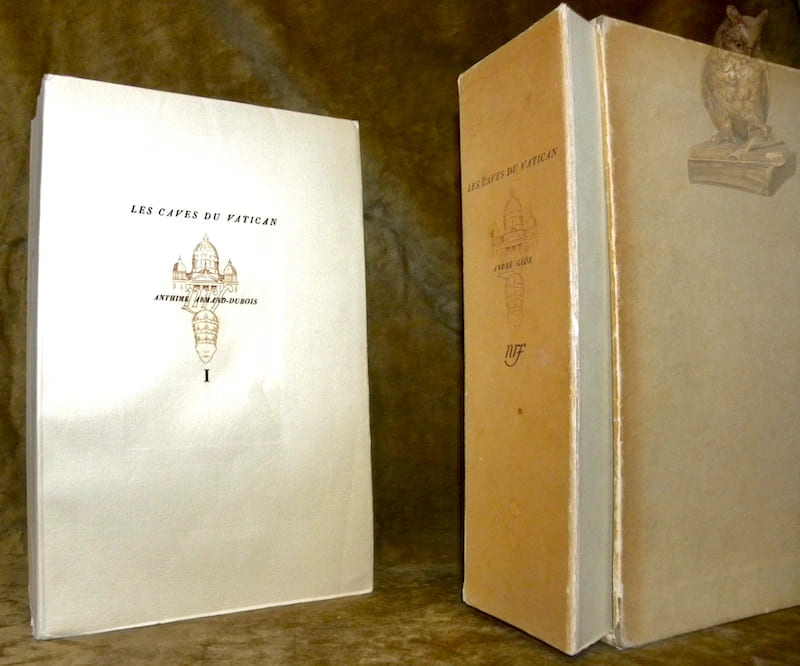
Best.-Nr. 121410Paris, Gallimard 1929 - 1930, 270x185mm, broché. Couverture rempliée, sous chemise et emboitage rigides. Mors de la chemise légèrement fendillés et dos insolé. Coins de l’emboitage frottés. Intérieur très propre. Tiré sur papier hollande, numéroté n° 10 / 300. Bel exemplaire.
Best.-Nr. 78672Albeuve, Paul Castella 1966, 400x300mm, 50pages, en feuilles sous couverture rempliée. Avec emboitage et chemise rigide. Exemplaire sur papier vélin de Rives, numéroté n° 130 / 167, signé par l’artiste. Illustré d’un gravure sur pierre à la couverture, reprise par fragments dans le texte et de lithographies originales. Bords latéral de la première page de garde avec des rousseurs, tout le reste très propre. Catalogue raisonné A.-E. Yersin, n°419. Très bel exemplaire.
1921- Lucien Vogel éditeur, Paris 1921, 18x24cm, en feuilles. - Set of eight original prints in color, drawn on laid paper, signed lower right and left boards. The boards are introduced by a text signed Jean Cocteau and represent costumes for Shakespeare (two Bergeres Paulina or Time). Original prints made ??for the illustration of The Gazette fashionable, one of the finest and most influential twentieth century fashion magazines, celebrating the talent of creators and artists French burgeoning art deco. Famous fashion magazine founded in 1912 by Lucien Vogel, The Gazette fashionable appeared until 1925 with an interruption during the War of 1915 to 1920, due to mobilization of its editor. She is 69 Deliveries from just 2000 copies and is illustrated including 573 color plates and 148 sketches depicting models of fashion designers. Upon publication, these luxury publications "are for bibliophiles and worldly aesthetes" (Françoise Tétart-Vittu "good Gazette of tone" in the fashion dictionary, 2016). Printed on fine laid paper, they use a typeface created specifically for the magazine by Georges Peignot, the Cochin character, taken in 1946 by Christian Dior. The prints are made with the technique of metal stencil, enhanced color and some outlined in gold or palladium. The adventure began in 1912 when Lucien Vogel, man of the world and fashion - it has already participated in Femina magazine - decided to found with his wife Cosette de Brunhoff (John's sister, the father of Babar) Gazette good tone in which the subtitle is then "Art, fashions and frivolities." Georges Charensol quotes the editor: "In 1910, he observed, there was no truly artistic fashion magazine and representative of the spirit of his time. So I thought of making a glossy magazine with truly modern artists [...] I was certain of success because for any fashion country can compete with France. "(" A great art editor. Lucien Vogel "in literary News, No. 133, May 1925). The success of the magazine is immediate, not only in France but also the US and South America. Originally, Vogel therefore brings together a group of seven artists: André-Édouard Marty and Pierre Brissaud, followed by Georges Lepape and Dammicourt; and finally his friends from the School of Fine Arts as are George Barbier, Bernard Boutet de Monvel or Charles Martin. Other talents come quickly reach the equipped Guy Arnoux, Léon Bakst, Benito, Boutet de Monvel, Umberto Brunelleschi, Chas Laborde, Jean-Gabriel Domergue, Raoul Dufy, Edward Halouze Alexander Iacovleff, Jean Emile Laboureur Charles Loupot, Charles Martin, Maggie Salcedo. These artists, mostly unknown when Lucien Vogel appealed to them, will eventually become iconic figures and artistic sought. These are the same illustrators who make the drawings advertisements Gazette. The boards highlight the dresses and sublime seven artists of the time: Lanvin, Doeuillet, Paquin, Poiret, Worth, Vionnet and Doucet. The designers provide for each number of exclusive models. Nevertheless, some of Illustrations contained no real model, but only the idea that the illustrator is done in the fashion of the day. Gazette fashionable is a milestone in the history of fashion. Combining the aesthetic requirement and plastic unit, it brings together for the first time the great talents of the world of arts, literature and fashion and imposed by this alchemy, a new image of women, slender, independent and bold, also driven by the new generation of designers Coco Chanel, Jean Patou, Rochas Marcel ... Recovery in 1920 by Condé Montrose Nast, Gazette fashionable modeled for the new composition and the aesthetic choices of the "little dying newspaper" that Nast had bought a few years ago: the Vogue magazine. [FRENCH VERSION FOLLOWS] Réunion de carnets extraits de la Gazette du Bon Ton ainsi constituée : Intérieurs modernes par MAM (Croquis, La Gazette du Bon ton, 1921 n°1). Ensemble de quatre lithographies originales en couleur, tirées sur papier vergé. Installation mode
1899Best.-Nr. 131798Tokio, T. Hasegawa, Meiji 32 1899 In-12 18 x 14 cm. Reliure japonaise, [32] pp., 14 estampes sur bois en couleurs sur papier crêpe HoSho par Yoshimune Arai. Ouvrage peu fréquent sur les conteurs publics japonais publié en français trente ans seulement après l’avènement de l’ère Meiji. Pliures angulaires.
1840Best.-Nr. 598DG(um 1840). Kol. Lithographie. Bildgrösse: 20,2 x 30,7 cm. Blattgrösse: 28,5 x 38 cm.
1826Best.-Nr. 8219CB80 Hefte in 6 Bänden Zürich, J. Esslinger, 1826–1834. Kl.-8°. (2 Bl.), pro Band je 1 Titelblatt und pro Tafel 1 Textblatt. Mit 479 (von 480) kolorierten, lithografierten Tafeln. Halbledebände der Zeit mit reicher Rückenvergoldung.
1754Best.-Nr. 29710AB1 Band. Zürich, Joh. Kasp. Ziegler, 1754- Kl.-4°. Titel in rot/schwarz, 134 S., 17 gefalteten, 67 ganzseitigen Tafeln, 1 Textillustration. Verziierter Pergamentband.
1752Best.-Nr. 6620CBZweyte und verbesserte Auflage. 3. (von 3) Band. Zürich, bey Heidegger und Comp., 1752. 4°. (8) Bl., 336 S. Mit 18 Kupfertafeln mit 179 Abb. Lederband der Zeit mit Rückenschild.
1980Best.-Nr. 20162AB3 Bände Luzern, Faksimile Verlag, 1980-1983. Folio. 200 Bl. Mit 132 farb. Illustr.; 334 Bl. Mit 116 farb. Illustr.; 410 S. Mit 13 Illustr. (Kommentarband). Blindgepr. Orig.-Lederbdände mit 10 ziselierten Buckel-Beschlägen u. 4 Metall-Schliessen in Leinen-Schubern mit Lederrückenschildern, bzw. Orig.-Halblederband
1823Best.-Nr. 31215AB1823–1835. Div. Formate.
1 S. Mit einem Kupferstich (ca. 12 x 17 cm). 4to. Hübsches Neujahrsblatt eines Laternenwächters. Der Kupferstich zeigt wohl Christoph Weiß in Ausübung seiner Tätigkeit beim Nachfüllen von städtischen Laternen mit frischem Talg (Klauenfett). Darunter ein Neujahrsgedicht in zwei Spalten: "Heunte kommen grosse Hauffen | Für die Thüren hergelauffen | Wünschen uns ein Neues Jahr. | Da das Fenster kaum geschlossen, | Und ein Augenblick verflossen, | Meldt sich schon ein neue Schaar. | Hat der Thorner sich verschlichen, | Kommt der Wächter angestrichen | Nebst den Hörnleins-Wächter her. | Schlott- und Brunnen-Feger wollen | Kommen auch Neu Jahr zu holen | Weil es ist ein alte Mähr. | Ballenbinder und Feldwebel | Und bey theils auch die Constäbel, | Zeigen sich nach ihren Brauch. | Auch der Pritscher mit der Trommel | Machet ein Neu Jahr Getrommel, | Ja die Haupt-Wacht find sich auch. | Solt ich nun bey solchen Sachen | Mein Aufwartung nicht auch machen, | Zum Neu Jahr was bitten aus, | Der ich hab so vieles Oele | Ein halb Jahr auf meiner Seele, | Lampen, Tacht, in meinem Hauß. | Jezund will ich auch anfangen, | Da ein Jahr ist hin gegangen | Daß ich diese Sorge trag. | Gott erhalt die werthen Männer, | Und den hoch lateinschen Gönner, | Die drauf dachten Nacht und Tag [...] Denn will ich auf meiner Leiter | Mein Amt warten treulich weiter, | Daß kein Garn nicht wird versehrt. | Mehr, ich will zu jeden Nutzen | Fleißig gehen, um zu butzen, | Holten die Laternen rein. | Ja ich will in meiner Hütten, | Sonst kein Tropffen Oel verschütten | Als nur zum Salat allein [...]". - Vereinzelt kleine Braunflecken; leicht knittrig.
Federzeichnungen, tw. aquarelliert und mit Goldfarbe gehöht, auf 10 originale Untersatzkartons montiert. Handsigniert und mit Namensstempel. Folio. Die Entwürfe des "k. k. Professors und Architekt Dr. Adolf Machatschek" zeigen Ausstellungsmöblierungen diverser Wiener Firmen für deren Produktpräsentationen auf Welt- und Gewerbeausstellungen zwischen 1867 und 1872, darunter Portale für "die Ausstellung in Paris 1867", für Lehrmittel, die "Gypsbrüche Schottwien", für Hardtmuth in Budweis, für einen Tabak-Pavillon, Vitrine für Friseurarbeiten etc.
1890Best.-Nr. 18429ABTokyo, ca. 1890. 17,5 : 12 cm. 12 grabados de madera de doble pagina en colores. Encuadernación original en colores.
1890Best.-Nr. 15847ABTokyo, ca. 1890. 17,5 : 12 cm. 12 double-page coloured origina woodblock prints. Coloured original boards.
Best.-Nr. 23406Paris, Alphonse Lemerre, 1869. In-12, 109 pp. 5 pl., reliure de Jean de Gonet, plats de Revorim moulé, dos long de basane beige, lanières rouges, couverture conservée (quelques minuscules rousseurs, pâles décharges).
1982Acquaforte a colori Firma e numerazione a matita. Timbro a secco dello stampatore Giorgio Upiglio, Grafica Uno, Milano. Esemplare 13/70. cm 77x53 (Foglio 99x70). . . Ottimo (Fine). . Tiratura 70 + XII esemplari. .