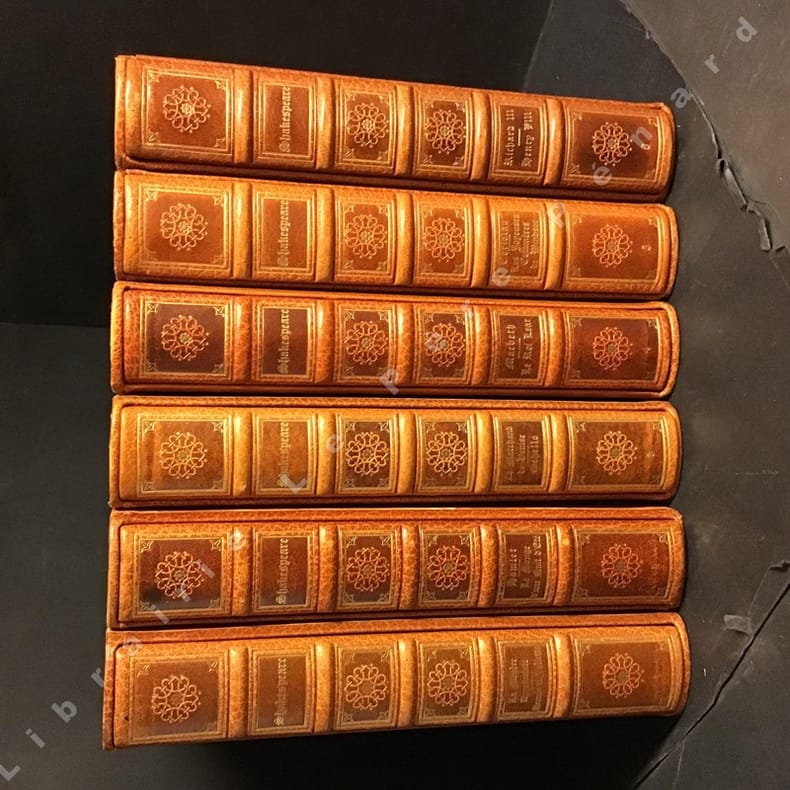
SHAKESPEARE - Illustrations de Jean Gradassi (miniaturiste) - Traduction de F-Victor HugoLivre Rare Book
10.930 risultati
1969rif. 1233121969-1974 Editions A l'enseigne du champ des sphère - 1969-1974 - Douze volumes in-quarto, plein cuir maroquiné marron, décor à froid et dorures sur les plats, dos à cinq nerfs, pièce de titre, caissons et fleurons et décor en doré, tranche de tête dorée, emboitage cartonné avec ourlet de cuir aux ouvertures - 203 pages + 200 pages + 196 pages + 197 pages + 211 pages + 223 pages (première série en six volumes, avec certificat d'authenticité à l'intérieur du sixième tome, pour cette première série tirage à 3500 exemplaires sur vélin de Lana à la forme filigrané Sefer avec Léopard au parchemin, EX. N°2361) + 195 pages + 195 pages + 188 pages + 182 pages + 174 pages + 180 pages (deuxième série en six volumes, avec certificat d'authenticité à l'intérieur du douzième tome, pour cette deuxième série tirage à 3500 exemplaires sur vélin de Lana à la forme filigrané Sefer avec Léopard au parchemin, EX. N°2361)- Très belles illustrations en couleurs in-texte (miniatures), hors-texte et pleine page de Jean Gradassi
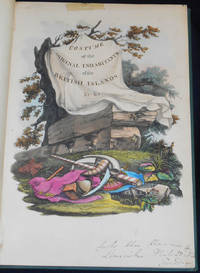
1828rif. 007773London: Republished by the New Proprietor J. Dowding 1828. Hardcover. Very Good. An Improved Edition." 90 p. added engraved title page and 24 leaves of color plates; 38 cm. Dark green library buckram with gilt-stamped spine title and call number. Plates state: "Aquatinted by R. Havell. Published June 1 1815 by R. Havell." No date of publication. The first edition appeared in 1815; this "improved" edition was published in the 1820s. Stamped "Brooklyn Public Library" on upper and lower page edges and back fixed endpaper; performated library stamp on added endgraved title page and title page; library number stamped at lower edge of title page. Official withdrawn stamp of the Brooklyn Public Library on back free endpaper. Former owner inscription on added engraved title page: Charles John Kean Limerick 185. Charles John Kean 1811-1868 was an Irish actor and the son of actor Edmund Kean. He acquired this volume in the 1850s when he was acting and managing the Princess Theatre in London where it most likely influenced costume design. A heavy book; for international shipping it will have to be sent by priority international. In Very Good Condition: engraved title page and title page are starting to separate at tail; old repair along upper edge of engraved title page; old repairs of a few closed tears from edges of text; light finger soiling in margins; plates are clean and bright. Republished by the New Proprietor, J. Dowding hardcover
1925- Lucien Vogel éditeur, Paris 1925, 18x24cm, relié. - Set of eight original prints in color, drawn on laid paper. The boards are introduced by a text signed LRF Sketches L, LII, LIII, LV, are signed David, respectively on the lower right and left boards. Original prints made ??for the illustration of The Gazette fashionable, one of the finest and most influential twentieth century fashion magazines, celebrating the talent of creators and artists French burgeoning art deco. Famous fashion magazine founded in 1912 by Lucien Vogel, The Gazette fashionable appeared until 1925 with an interruption during the War of 1915 to 1920, due to mobilization of its editor. She is 69 Deliveries from just 2000 copies and is illustrated including 573 color plates and 148 sketches depicting models of fashion designers. Upon publication, these luxury publications "are for bibliophiles and worldly aesthetes" (Françoise Tétart-Vittu "good Gazette of tone" in the fashion dictionary, 2016). Printed on fine laid paper, they use a typeface created specifically for the magazine by Georges Peignot, the Cochin character, taken in 1946 by Christian Dior. The prints are made with the technique of metal stencil, enhanced color and some outlined in gold or palladium. The adventure began in 1912 when Lucien Vogel, man of the world and fashion - it has already participated in Femina magazine - decided to found with his wife Cosette de Brunhoff (John's sister, the father of Babar) Gazette good tone in which the subtitle is then "Art, fashions and frivolities." Georges Charensol quotes the editor: "In 1910, he observed, there was no truly artistic fashion magazine and representative of the spirit of his time. So I thought of making a glossy magazine with truly modern artists [...] I was certain of success because for any fashion country can compete with France. "(" A great art editor. Lucien Vogel "in literary News, No. 133, May 1925). The success of the magazine is immediate, not only in France but also the US and South America. Originally, Vogel therefore brings together a group of seven artists: André-Édouard Marty and Pierre Brissaud, followed by Georges Lepape and Dammicourt; and finally his friends from the School of Fine Arts as are George Barbier, Bernard Boutet de Monvel or Charles Martin. Other talents come quickly reach the equipped Guy Arnoux, Léon Bakst, Benito, Boutet de Monvel, Umberto Brunelleschi, Chas Laborde, Jean-Gabriel Domergue, Raoul Dufy, Edward Halouze Alexander Iacovleff, Jean Emile Laboureur Charles Loupot, Charles Martin, Maggie Salcedo. These artists, mostly unknown when Lucien Vogel appealed to them, will eventually become iconic figures and artistic sought. These are the same illustrators who make the drawings advertisements Gazette. The boards highlight the dresses and sublime seven artists of the time: Lanvin, Doeuillet, Paquin, Poiret, Worth, Vionnet and Doucet. The designers provide for each number of exclusive models. Nevertheless, some of Illustrations contained no real model, but only the idea that the illustrator is done in the fashion of the day. Gazette fashionable is a milestone in the history of fashion. Combining the aesthetic requirement and plastic unit, it brings together for the first time the great talents of the world of arts, literature and fashion and imposed by this alchemy, a new image of women, slender, independent and bold, also driven by the new generation of designers Coco Chanel, Jean Patou, Rochas Marcel ... Recovery in 1920 by Condé Montrose Nast, Gazette fashionable modeled for the new composition and the aesthetic choices of the "little dying newspaper" that Nast had bought a few years ago: the Vogue magazine. [FRENCH VERSION FOLLOWS] Ensemble de douze estampes originales à l'or fin, tirées sur papier vergé. Les planches présentent des modèles de robes réalisés par quatre grands créateurs, Lanvin, Poiret, Vionney et Worth. Reliure à la bradel en plein papier à motif décoratif, dos lisse, tête dorée.
1830rif. 7642BBParis, div. Verleger, um 1830. Quer-Folio. 20 Lithographien u.a. von Lemercier. Halblederband der Zeit.
1825rif. 1742AGJ. L. Gsell, Lithograph. 1825. Altkolorierte Kreidelithografie. Blattformat: 19,5 x 25 cm.
1840rif. 2910DBSolothurn, Jent und Gassmann, 1840. 8°. 96 S. Mit 4 Radierungen von Martin Disteli. Illustr. Orig.-Pappband.
1946rif. 2809BB8 (16) Bände. o.O., 1946-1988. 4°. Mit zahlreichen teils farbigen Abbildungen. 8 Bände goldgeprägter Orig.-Lederband, 2 Broschur, 6 Hefte (Lederbände minim bestossen, Broschur und Hefte teilweise leicht fleckig).
1784rif. 4382CB17 Neujahrsblätter in 1 Band. Zürich David Bürkli, 1784-1800. 19 x 22 cm. 136 S. Mit 17 gest. Titelvignetten nach Zeichnungen von Heinrich Freudweiler und Martin Usteri, gestochen von J.R. Holzhalb, Johann Rudolf Schellenberg, J.H. Meyer, Daniel Beyel und Heinrich Lips. Pappband der Zeit mit Marmorpapierbezug
1916rif. 4414DBMappe mit 8 Plänen, Berichten, Korrespondenz, Kostenvoranschlägen, etc. Zürich. 1916. Mappe mit Schliessbändern aus Stoff.
rif. 592DG20. Jh. Aquarell. Bildformat: 19 x 32 cm. Blattgrösse: 36 x 49 cm.
rif. 593DG20. Jh. Aquarell. Bildformat: 19 x 32 cm. Blattgrösse: 36 x 49 cm.
1940rif. 3010CB1940. Gr.-8°. (54) Bl. Mit 3 Tafeln (Originalzeichnungen) sign. AP. G. und 12 mont. Fotografien (9 x 7 cm). Leinenband der Zeit.
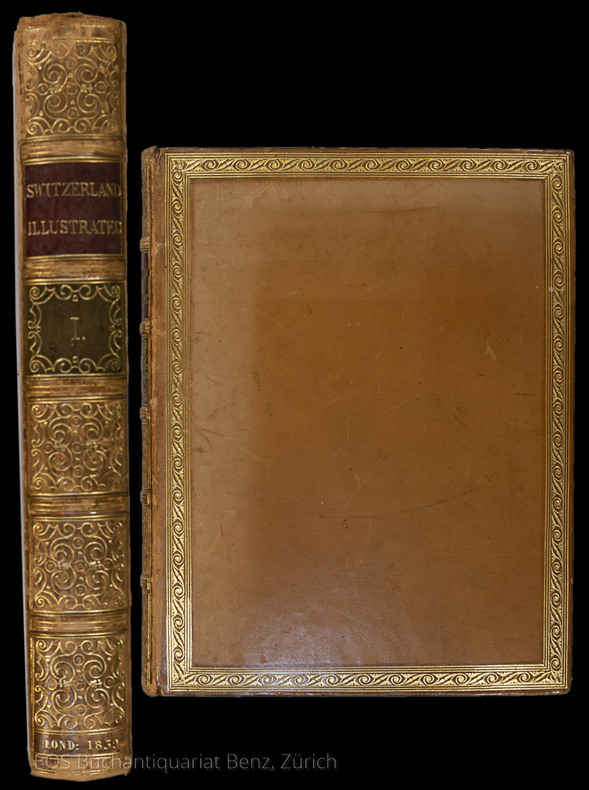
1838rif. 7888CB2 Bände. London, George Virtue, 1838. 4°. (2), IV, (2), 188 S.; (1) Bl.; (4), 152 S. Mit 2 gest. Titel und 106 Stahlstiche von William Henry Bartlett sowie 1 gef. Karte. Grüne Kalblederbände mit vergold. Rückensch. und dreiseitigem Goldschnitt.
1839rif. 7207CB2 Bände. London, George Virtue, 1839 4°. (2), IV, (2), 188 S.; (1) Bl.; (4), 152 S. Mit 2 gest. Titel und 106 Stahlstiche von William Henry Bartlett sowie 1 gef. Karte. Okerfarbige Kalblederbände mit reicher Deckel- und Rückenvergoldung, marmorierte Vorsätze und dreiseitigem Goldschnitt.
1835rif. 7951CBSchaffhausen, um 1835. Bildausschnitt: 18,5 x 28,5 cm. Kolorierte Aquatinta von Johann Jakob Falkeisen nach Johann Ludwig Bleuler. Hinter Passepartout in Goldrahmen.
1890rif. 6627CBBern, ca. 1890. Gr.-folio. Titeblatt, 24 lithographierte Karten. Es fehlt das Übersichtsblatt. Blind- und goldgeprägter Leinenband der Zeit (Rücken fehlt).
1770rif. 278BGO. O., ca. 1770. Kolorierter Kupferstich von Balthasar Frederic Leizel nach Perignan. Bildgrösse: 38 x 25 cm. Blattgrösse: 39,5 x 28 cm.
1821rif. 40532DB2 Bände + Supplement in 2 Bänden. Basel, J. Georg Neukirch, 1821–1843. 8°. XVIII, 450 S., 1 Bl.; VIII, 537 S; 2 Bl, 220 S. Mit einem gestochenen Portrait im ersten Band, 2 kol. lithograph. Tafeln in Band eins und einer lithograph., kol. Tafel im Supplement von Labram. Grüne Halblederbände aus der Zeit mit klassizistischer Rückenvergoldung.
1829rif. 2719DB4 Bände. Basel, Schweighauser, 1829-1838. 8°. XVI, 375 S.; VIII, 522 S.; X, 460 S.; XV(1), 704 S. Mit 4 Frontisp. und 4 lithogr. Titel. Pappbände der Zeit mit handschr. Rückensch.
rif. 1691AGAquarell. Blattformat: 43 x 61 cm.
1923rif. 730DGLa Chaux-des-Fonds, W. Perrenoud, 1923. Lithographie. Alpenpanorama: 23 x 184 cm. Jurapanorama: 18 x 184 cm.
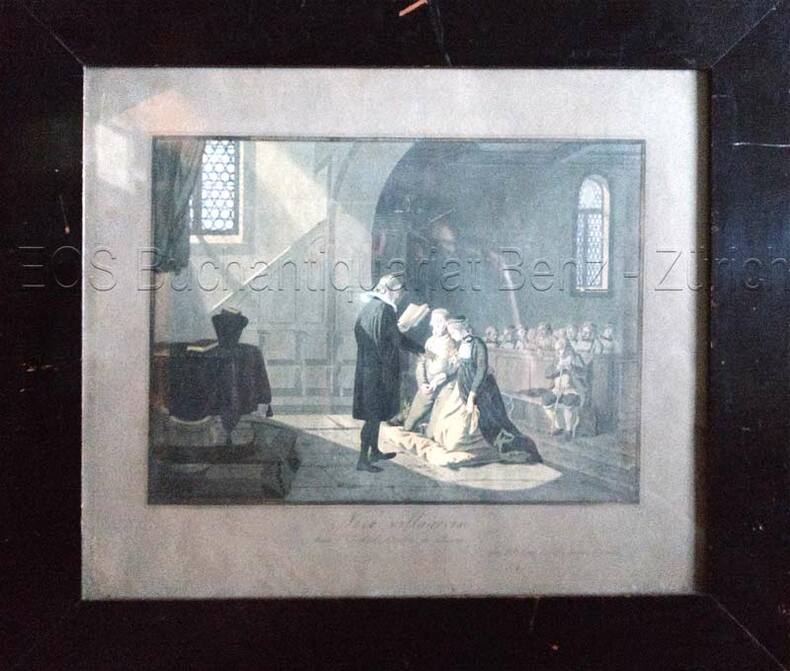
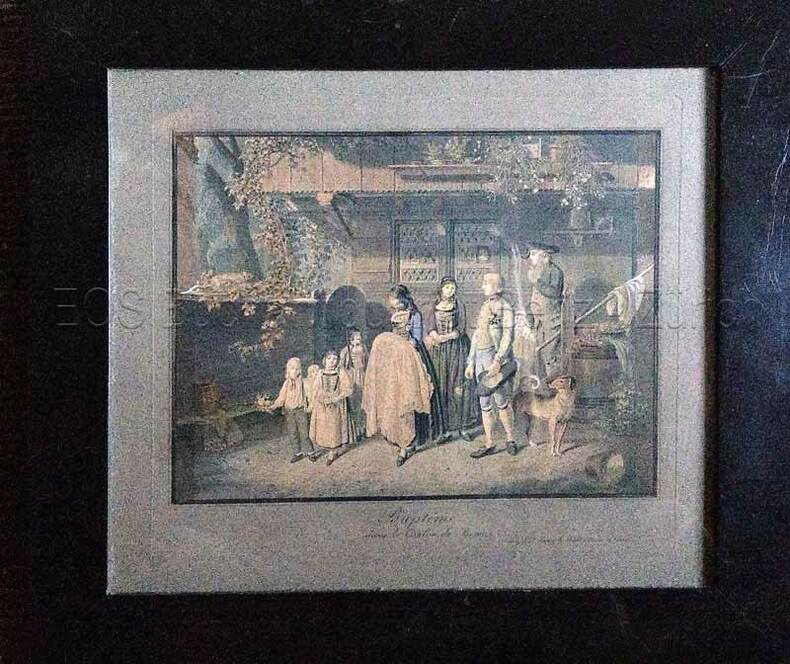
rif. 797CGBasel, Bern u. Genf, J. P. Lamy, Kol. Aquatinta. Bildgrösse: 20,5 x 27 cm. Rahmengrösse: 38 x 43 cm
rif. 798CGBasel, Bern u. Genf, J. P. Lamy, Kol. Aquatinta. Bildgrösse: 21 x 27,5 cm. Rahmengrösse: 38 x 43 cm.
1784rif. 5979CB3 Bde. Winterthur, Bey Heinrich Steiner und Comp., 1784-85. 8°. VII, 373 (1) S.; VI, 461 (1) S.; (3) Bl., 348 S., (1) Bl. Marmor. Ppbde. mit hs. Rückenschildchen.
rif. 1793AGGouache auf Karton. Bildgrösse: 35,5 x 27 cm.