10 990 résultats
1940réf. 1780AGca. 1940. Lithografien auf festem Papier. Blattgrösse: 24,5 x 31 cm.
1961This is a very good hardcover copy in a very good heavy clear mylar wrapper and a very good hardshell slipcase. Completely clean inside and out. This is Volume 1: Early Religious Prints, only of the 8 volume series, 'The Art of the Japanese Print'. Text in Japanese with 2 pages of notes in English at the end. This volume reproduces nearly all existing examples of prints from the Nara to Momoyama Periods (8th through 17th centuries). 304 illustrations including 32 tipped-in color plates. 14" high X 11" wide, 207 pages. This book will be securely wrapped and packed in a sturdy box and shipped with tracking.
1833réf. 2779BBBasel, R. Müller, 1833. 8°. IV, 151 S. Mit 1 gest. Frontispiz. Orig.-Broschur + Wichtig: Für unsere Kunden in der EU erfolgt der Versand alle 14 Tage verzollt ab Deutschland / Postbank-Konto in Deutschland vorhanden + (Rücken restauriert).
1833réf. 2779BBBasel, R. Müller, 1833. 8°. IV, 151 S. Mit 1 gest. Frontispiz. Orig.-Broschur (Rücken restauriert).
2000Book shows light edge wear to covers, remainder mark on bottom page ends in red has bled 1/4" into the bottom of each page, making a small red mark next to each of the page numbers. Binding is solid and square, text/interior is clean and free of marking of any kind, save previously noted. B&W photos throughout in large format, usually full page. 96 pages. Photographers include: Constantino Arias Miranda, Raul Corrales Fornos, Alberto Diaz "korda", Jose Alberto Figueroa, Mario Diaz Leyva, Jose Julian Marti, Lazaro Miranda Vera, Pedro Abascal, Raul Canibano Ercilla, Cristobal Herrera Ulashkevich, Keith Cardwell. Artist's bios at back. copyright Pistil Books, 2011
réf. 30037953Mosman Art Gallery Sydney 2009 . 27.0 x 24.0cms 92pp colour illusts. very good hardback & dustwrapper artist's signature These works were inspired by the flowers of the Hawkesbury River Kurrajong Hills and the Blue Mountains. The essays are: an appreciation; days of summer 2007-2008; notes to 'Days of Summer'; bellbirds at Kurrajong. Mosman Art Gallery Sydney 2009 hardcover
réf. 13932Notre épreuve est une héliogravure Amand-Durand, d’après l’épreuve de la collection Galichon. Tous ces tirages sont réalisés sur un superbe papier et sont de grande qualité. Encadrée Très bon 1 volume in-8°
1999réf. 147112Stuttgart 1999. Ein Blatt in orangerotem Umschlag "Frohe Weihnachten und ein gutes Neues Jahr". Neuwertig 21x15 cm
First Edition, 4to, 224pp., 51 illustrs., orig. cloth, d.w. Covering a wide range of subjects and methods, annotated lists of painters and engravers, detailed bibliographies and explanations of methods of printmaking.
1878With 35 plates and a map. 188 pages. Small tear at top of spine, wear to spine and joints of spine and cover corners. A few marks on covers. Front and last free endpapers very browned. Penned name at top corner of front free endpaper.
1945réf. 1691DBO. O., (gedruckt bei Klaus Menigs, Visp), 1945. 8°. 157 S. Orig.-Leinenbd. + Wichtig: Für unsere Kunden in der EU erfolgt der Versand alle 14 Tage verzollt ab Deutschland / Postbank-Konto in Deutschland vorhanden +
1945réf. 1691DBO. O., (gedruckt bei Klaus Menigs, Visp), 1945. 8°. 157 S. Orig.-Leinenbd.
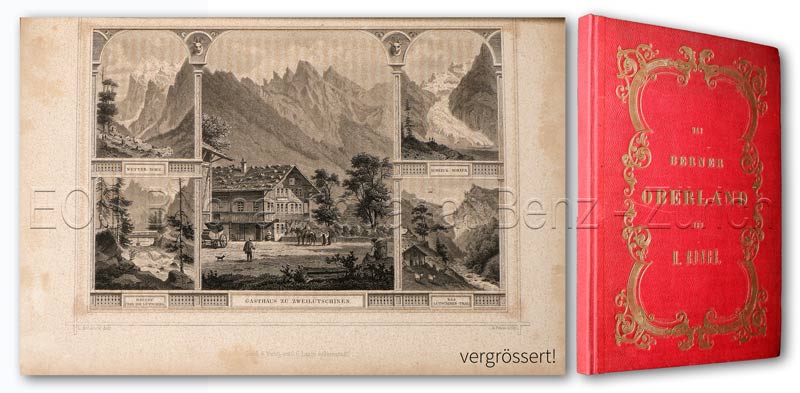
1868réf. 2416CBDarmstadt, Gustav Georg Lange, (1868). 4°. 85 S., 20 Tafeln. Roter Maroquinband mit Goldprägung. + Wichtig: Für unsere Kunden in der EU erfolgt der Versand alle 14 Tage verzollt ab Deutschland / Postbank-Konto in Deutschland vorhanden +, Einband und Tafel
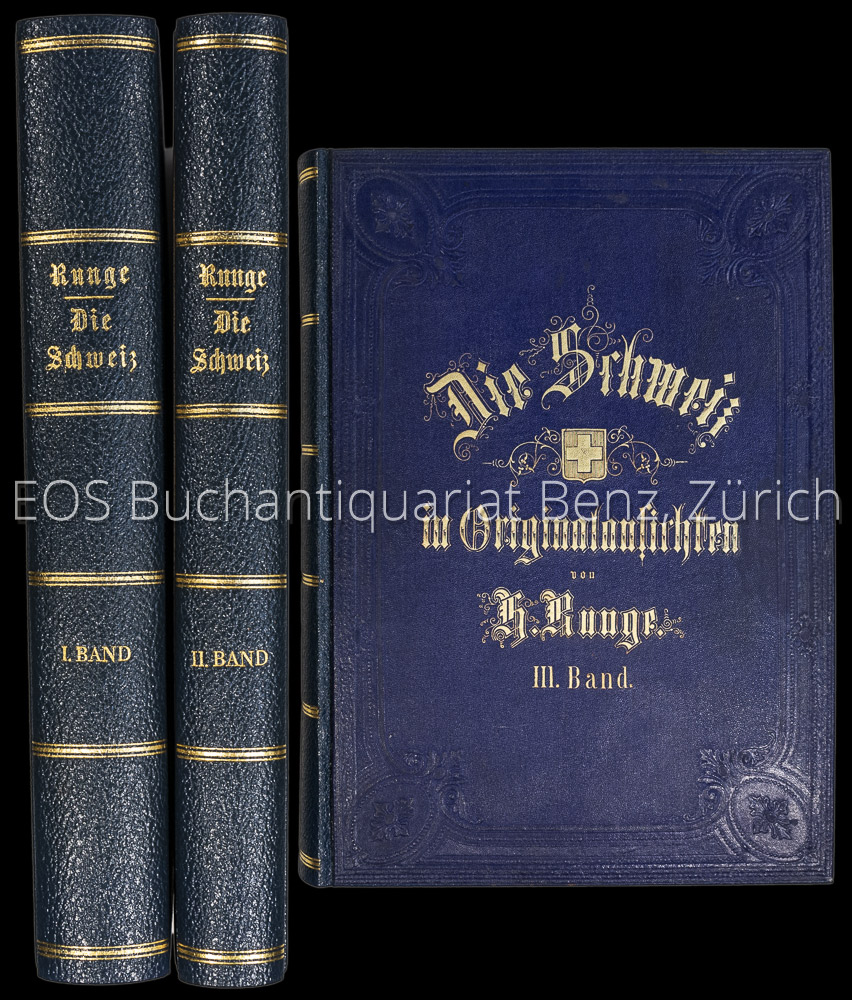
1861réf. 7238ABDarmstadt, G.G. Lange, 1861-1866. 8°. 1,: 2 Blatt, 319 Seiten, 2.: 2 Blatt, 300 Seiten, 3.; 2 Blatt, 408 Seiten. 3 gestochenen Titeln mit Vignetten, 195 Stahlstiche von L. Rohbock mit Ansichten aus der Schweiz. Original mit blaue, goldgeprägte Leinenbände. + Wichtig: Für unsere Kunden in der EU erfolgt der Versand alle 14 Tage verzollt ab Deutschland / Postbank-Konto in Deutschland vorhanden +, A|B|C 3 Bände. [3 Warenabbildungen]
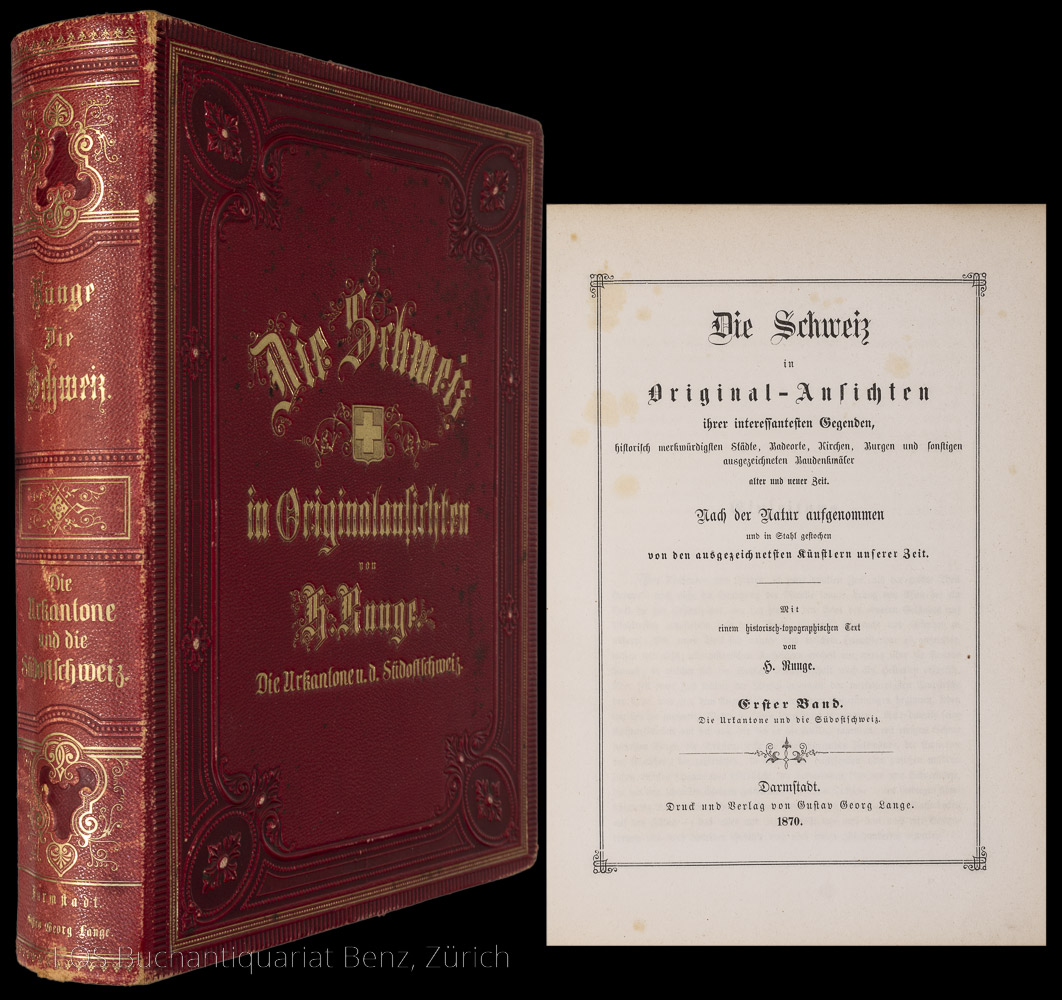
1870réf. 7509CBDarmstadt, Gustav Georg Lange, 1870. 8°. 320, (2) S. Mit Titelvignette und 62 Stahlstichtafeln. Blind- und goldgeprägter roter Orig.-Lederband mit dreiseitigem Goldschnitt. + Wichtig: Für unsere Kunden in der EU erfolgt der Versand alle 14 Tage verzollt ab Deutschland / Postbank-Konto in Deutschland vorhanden +, 7509CB|7509CB_2 1 Band (von 3). [2 Warenabbildungen]
1868réf. 2416CBDarmstadt, Gustav Georg Lange, (1868). 4°. 85 S., 20 Tafeln. Roter Maroquinband mit Goldprägung.
1870réf. 7509CB1 Band (von 3). Darmstadt, Gustav Georg Lange, 1870. 8°. 320, (2) S. Mit Titelvignette und 62 Stahlstichtafeln. Blind- und goldgeprägter roter Orig.-Lederband mit dreiseitigem Goldschnitt.
1861réf. 7238AB3 Bände. Darmstadt, G.G. Lange, 1861–1866. 8°. 2 Bl., 319 S.; 2 Bl., 300 S.; 2 Bl., 408 S. Mit 3 gestochenen Titeln mit Vignetten und 195 Stahlstiche von L. Rohbock mit Ansichten aus der Schweiz. Blaue, goldgeprägte Orig.-Leinenbände.
1972réf. ART7213M1972, Bonvent, Genève. In-8 relié carré, 127pages, nombreuses illustrations.
1711réf. 002657Lugduni Batavorum (Leide, Leyde), Apud Petrum Van der Aa, Bibliopolam, 1711 In-folio (41 x 27 cm), (1) ff., 15 pp., (8) pp., veau marbré, dos à six nerfs orné, pièce de titre de maroquin rouge, triple filet à froid entourant les plats, double filet doré sur les coupes, tranches rouges (reliure d'époque). Illustré d'un frontispice, un portrait de l'auteur, 1 vignette de titre, 4 vignettes dans le texte, et 60 planches gravées. Première édition en latin du "Cabinet des raretés de l'île d'Amboine" (Amboinsche Rariteitkamer), publié en hollandais en 1705 ; l'auteur, atteint de cécité, est ici représenté dans son cabinet. Précieux exemplaire provenant de la famille de Charles de MONTESQUIEU, de la bibliothèque du Château de la Brède, avec l'ex-libris des Secondat, barons de la Brède et de Montesquieu, "Virtutem Fortuna Secondat, Ex Bibliotheca Bredanense", et les initiales C. M. à l'encre. Bel exemplaire. // Folio (41 x 27 cm), (1) ff., 15 pp., (8) pp., marbled calf, spine tooled raised on six bands, red morocco title label, triple blind fillet borders on covers, double gilt fillet on turns-in, red edges (contemporary binding). Illustrated with a frontispiece, a portrait of the author, 1 vignette on title, 4 vignettes in the text, and 60 engraved plates. First edition in latin of the "Ambonese Curiosity Cabinet" (Amboinsche Rariteitkamer), first published in german in 1705 ; the author, blind, is here depicted in his office. Precious copy from Charles de MONTESQUIEU family, from the "Château de la Brède" library, with the book-plate of the Secondat, barons de la Brède et de Montesquieu "Virtutem Fortuna Secondat , Ex Bibliotheca Bredanense", and initials C. M. hand-written. Fine copy (Nissen ZBI 3520)
réf. 5245Excudit de KILIAN Georg Chrystoph (1709 - 1781) 485 x 370 très bon
1924- Lucien Vogel éditeur, Paris 1924, 19,5x25cm, une feuille. - Original color print, printed on vergé paper, signed in the plate. An original print used to illustrate the Gazette du bon ton, one of the most attractive and influential 20th century fashion magazines, featuring the talents of French artists and other contributors from the burgeoning Art Deco movement. A celebrated fashion magazine established in 1912 by Lucien Vogel, La Gazette du bon ton appeared until 1925, with a hiatus from 1915 to 1920 due to the war (the editor-in-chief having been called up for service). It consisted of 69 issues printed in only 2,000 copies each and notably illustrated with 573 color plates and 148 sketches of the models of the great designers. Right from the start, this sumptuous publication "was aimed at bibliophiles and fashionable society," (Françoise Tétart-Vittu, "La Gazette du bon ton", in Dictionnaire de la mode, 2016) and was printed on fine vergé paper using a type cut specially for the magazine by Georges Peignot, known as Cochin, later used (in 1946) by Christian Dior. The prints were made using stencils, heightened in colors, some highlighted in gold or palladium. The story began in 1912, when Lucien Vogel, a man of the world involved in fashion (he had already been part of the fashion magazine Femina) decided, with his wife Cosette de Brunhoff - the sister of Jean, creator of Babar - to set up the Gazette du bon ton, subtitled at the time: "Art, fashion, frivolities." Georges Charensol noted the reasoning of the editor-in-chief: "'In 1910,' he observed, 'there was no really artistic fashion magazine, nothing representative of the spirit of the time. My dream was therefore to make a luxury magazine with truly modern artists...I was assured of success, because when it comes to fashion, no country on earth can compete with France.'" ("Un grand éditeur d'art. Lucien Vogel" in Les Nouvelles littéraires, no. 133, May 1925). The magazine was immediately successful, not only in France but also in the United States and Latin America. At first, Vogel put together a team of seven artists: André-Édouard Marty and Pierre Brissaud, followed by Georges Lepape and Dammicourt, as well as eventually his friends from school and the School of Fine Arts, like George Barbier, Bernard Boutet de Monvel and Charles Martin. Other talented people soon came flocking to join the team: Guy Arnoux, Léon Bakst, Benito, Boutet de Monvel, Umberto Brunelleschi, Chas Laborde, Jean-Gabriel Domergue, Raoul Dufy, Édouard Halouze, Alexandre Iacovleff, Jean Émile Laboureur, Charles Loupot, Chalres Martin, Maggie Salcedo. These artist, mostly unknown when Lucien Vogel sought them out, later became emblematic and sought-after artistic figures. It was also they who worked on the advertising drawings for the Gazette. The plates put the spotlight on, and celebrate, dresses by seven designers of the age: Lanvin, Doeuillet, Paquin, Poiret, Worth, Vionnet and Doucet. The designers provided exclusive models for each issue. Nonetheless, some of the illustrations are not based on real models, but simply on the illustrator's conception of the fashion of the day. The Gazette du bon ton was an important step in the history of fashion. Combining aesthetic demands with the physical whole, it brought together - for the first time - the great talents of the artistic, literary, and fashion worlds; and imposed, through this alchemy, a completely new image of women: slender, independent and daring, which was shared by the new generation of designers, including Coco Chanel, Jean Patou, Marcel Rochas, and so on... Taken over in 1920 by Condé Montrose Nast, the Gazette du bon ton was an important influence on the new layout and aesthetics of that "little dying paper" that Nast had bought a few years earlier: Vogue. [FRENCH VERSION FOLLOWS] Estampe originale en couleur tirée sur papier vergé, signée en bas à droite dans la planche. Gravure originale réalisée pour l'illus
1730réf. 7560BB4 Bde. Amsterdam, Wetstein & Smith, 1730. 8°. Titel in Rot und Schwarz. (1) Bl., XXXVIII, 484 S.; (3) Bl., 495 S.; (3) Bl., 426 S.; (3) Bl., 507 S.Mit gest. gef. Frontispiz von J. Folkema nach B. Picart, gest. Titelvignette, gest. Kopfstück von G. F. Debrie, 10 gef. Karten, 68 Kupfertafeln (davon 51 gef.) nach Merian, Scheuchzer u. a. Kalblederbände der Zeit mit reicher Rückenvergoldung, zwei Rückenschildchen und Stehkantenverg.
1714réf. 7878CB4 Bände. Leiden, Pierre van der Aa, 1714. Kl.-8°. (18) Bl., 220 (recte 224) S.; (2) Bl. S. 221–228, 233–434; (2) Bl. S. 435–676; (2) Bl., S. 677–1027. Mit gest. Titelblatt (doppelblattseitig), 1 gest. Frontispiz (doppelblattseitig), 68 (davon 50 gef.) und 5 (von 6) gef. Kupferkarten. Lederbände der Zeit mit reicher Rückenvergoldung.
1778réf. 7902CBNouvelle édition. 2 Bände. Neuchâtel, Fauche, 1778. 4°. (4), IV, 454, (2) S.; (4), 391, (1) S. Mit 2 gest. Frontisp. und 77 Kupfertafeln (davon 15 gef.) Lederbände der Zeit mit Rückenschild und Rückenvergoldung.