rif. 25989Planche HT parue dans La Caricature politique, morale, littéraire et scénique, volume 6, 1er août 1833, (Planche n°296-297) Hauteur: 26cm Largeur: 70cm;marge du haut rognée court au dessus du numéro,fente en marge au pli central-sinon bon.Titre en bas au centre : « Marche de la Banlieue venant au secours des Cent mille hommes de troupe réglée assiégés par quelques centaines de lâches républicains. » ; légende plus bas au centre : « (Cette caricature fut exécutée après les evènemens [événements] de Juin 1832. Nous en retardames [retardâmes] la publication pour ne pas envenimer les haines politiques aujourd’hui nous la donnons comme une bonne et vieille charge) » ; indications : en ht à gche : « La Caricature Journal (N°142) », en ht à dte : « Pl. 296, 297 »Inscription - Dans la lettre : « Lith. de Becquet, rue Chilbert N°9. » [imprimeur] ; dans l’image, en bas à gche, signature : « CJ Traviès. // 1832 » [Charles-Joseph Traviès, dessinateur], réagissant à l’insurrection républicaine à Paris des 5, 6 et 7 juin 1832. Traviès met en lumière l’énorme différence entre le faible nombre d’insurgés républicains et le nombre d’hommes de troupe (garde municipale, garde nationale) mobilisés pour briser la révolte.
1924- Lucien Vogel éditeur, Paris 1924-1925, 18x24cm, une feuille. - Original color print, printed on vergé paper, non signed. An original print used to illustrate the Gazette du bon ton, one of the most attractive and influential 20th century fashion magazines, featuring the talents of French artists and other contributors from the burgeoning Art Deco movement. A celebrated fashion magazine established in 1912 by Lucien Vogel, La Gazette du bon ton appeared until 1925, with a hiatus from 1915 to 1920 due to the war (the editor-in-chief having been called up for service). It consisted of 69 issues printed in only 2,000 copies each and notably illustrated with 573 color plates and 148 sketches of the models of the great designers. Right from the start, this sumptuous publication "was aimed at bibliophiles and fashionable society," (Françoise Tétart-Vittu, "La Gazette du bon ton", in Dictionnaire de la mode, 2016) and was printed on fine vergé paper using a type cut specially for the magazine by Georges Peignot, known as Cochin, later used (in 1946) by Christian Dior. The prints were made using stencils, heightened in colors, some highlighted in gold or palladium. The story began in 1912, when Lucien Vogel, a man of the world involved in fashion (he had already been part of the fashion magazine Femina) decided, with his wife Cosette de Brunhoff - the sister of Jean, creator of Babar - to set up the Gazette du bon ton, subtitled at the time: "Art, fashion, frivolities." Georges Charensol noted the reasoning of the editor-in-chief: "'In 1910,' he observed, 'there was no really artistic fashion magazine, nothing representative of the spirit of the time. My dream was therefore to make a luxury magazine with truly modern artists...I was assured of success, because when it comes to fashion, no country on earth can compete with France.'" ("Un grand éditeur d'art. Lucien Vogel" in Les Nouvelles littéraires, no. 133, May 1925). The magazine was immediately successful, not only in France but also in the United States and Latin America. At first, Vogel put together a team of seven artists: André-Édouard Marty and Pierre Brissaud, followed by Georges Lepape and Dammicourt, as well as eventually his friends from school and the School of Fine Arts, like George Barbier, Bernard Boutet de Monvel and Charles Martin. Other talented people soon came flocking to join the team: Guy Arnoux, Léon Bakst, Benito, Boutet de Monvel, Umberto Brunelleschi, Chas Laborde, Jean-Gabriel Domergue, Raoul Dufy, Édouard Halouze, Alexandre Iacovleff, Jean Émile Laboureur, Charles Loupot, Chalres Martin, Maggie Salcedo. These artist, mostly unknown when Lucien Vogel sought them out, later became emblematic and sought-after artistic figures. It was also they who worked on the advertising drawings for the Gazette. The plates put the spotlight on, and celebrate, dresses by seven designers of the age: Lanvin, Doeuillet, Paquin, Poiret, Worth, Vionnet and Doucet. The designers provided exclusive models for each issue. Nonetheless, some of the illustrations are not based on real models, but simply on the illustrator's conception of the fashion of the day. The Gazette du bon ton was an important step in the history of fashion. Combining aesthetic demands with the physical whole, it brought together - for the first time - the great talents of the artistic, literary, and fashion worlds; and imposed, through this alchemy, a completely new image of women: slender, independent and daring, which was shared by the new generation of designers, including Coco Chanel, Jean Patou, Marcel Rochas, and so on... Taken over in 1920 by Condé Montrose Nast, the Gazette du bon ton was an important influence on the new layout and aesthetics of that "little dying paper" that Nast had bought a few years earlier: Vogue. [FRENCH VERSION FOLLOWS] Estampe originale en couleur, tirée sur papier vergé, non-signée. Gravure originale réalisée pour l'illustration de La Gazette du bon ton
rif. 110152o.J. Kupferstich. Mit dem gestochenen Titel. Auf breitrandigem Bütten. 43,5 x 28,8 cm. Papier: 52,5 x 37,8 cm.
198844 page catalogue with many color and b&w plates, a short article by J.R. Bakker, another by Feay Coleman, exhibition history, bibliography. 1" tear at lower spine, otherwise very clean with lightly bumped corners, interior/text is flawless.
rif. 20495114A Ure Smith Publication Sydney nd . 33.0 x 25.0cms c 60pp 27 tippd in colour plates very good hardback no dustwrapper artist's / author's signature This book reproduces 27 of Preston's prints including Hawkesbury River kangaroos Aboriginal still-life Middle Harbour Patonga native flowers Gymea lily etc. Preston designed the end papers A Ure Smith Publication Sydney nd hardcover
1850rif. GRAP0046Ldn., Kershaw & Son ca. 1850. quer 18,5 x 13, 5 cm, 12 Stahlstiche (Format ca. 9 x 6 cm), OBr., am Umschlag Gebrauchsspuren, nur vereinzelt etwas stockfl., meist nur im w. Rd.
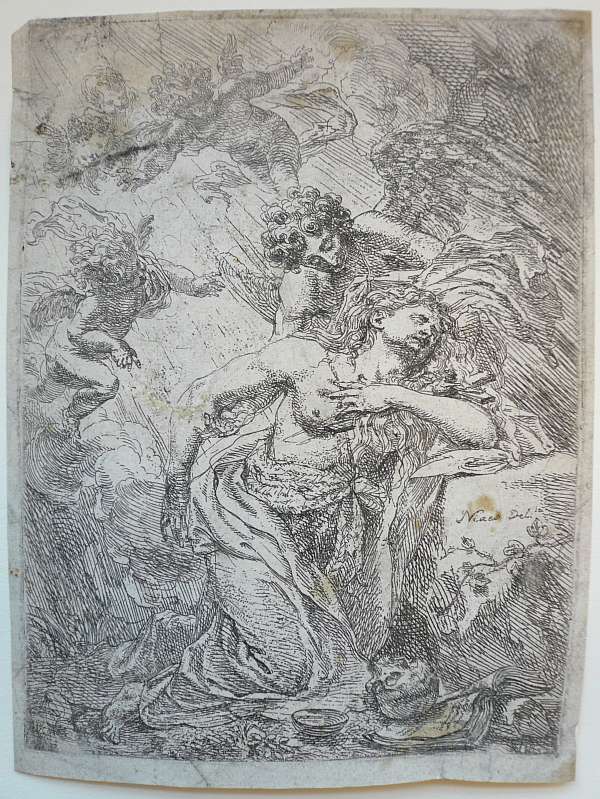
rif. 110151o.J. In der Platte bezeichnet "Maes Del.". Auf Bütten mit schmalem Rand um die Plattenkante. 17,5 x 13,2 cm. Papier: 18,5 x 14 cm.
1924- Lucien Vogel éditeur, Paris 1924-1925, 36x24cm, une feuille. - Double original color print heightened with palladium, printed on vergé paper, signed in the plate. An original print used to illustrate the Gazette du bon ton, one of the most attractive and influential 20th century fashion magazines, featuring the talents of French artists and other contributors from the burgeoning Art Deco movement. A celebrated fashion magazine established in 1912 by Lucien Vogel, La Gazette du bon ton appeared until 1925, with a hiatus from 1915 to 1920 due to the war (the editor-in-chief having been called up for service). It consisted of 69 issues printed in only 2,000 copies each and notably illustrated with 573 color plates and 148 sketches of the models of the great designers. Right from the start, this sumptuous publication "was aimed at bibliophiles and fashionable society," (Françoise Tétart-Vittu, "La Gazette du bon ton", in Dictionnaire de la mode, 2016) and was printed on fine vergé paper using a type cut specially for the magazine by Georges Peignot, known as Cochin, later used (in 1946) by Christian Dior. The prints were made using stencils, heightened in colors, some highlighted in gold or palladium. The story began in 1912, when Lucien Vogel, a man of the world involved in fashion (he had already been part of the fashion magazine Femina) decided, with his wife Cosette de Brunhoff - the sister of Jean, creator of Babar - to set up the Gazette du bon ton, subtitled at the time: "Art, fashion, frivolities." Georges Charensol noted the reasoning of the editor-in-chief: "'In 1910,' he observed, 'there was no really artistic fashion magazine, nothing representative of the spirit of the time. My dream was therefore to make a luxury magazine with truly modern artists...I was assured of success, because when it comes to fashion, no country on earth can compete with France.'" ("Un grand éditeur d'art. Lucien Vogel" in Les Nouvelles littéraires, no. 133, May 1925). The magazine was immediately successful, not only in France but also in the United States and Latin America. At first, Vogel put together a team of seven artists: André-Édouard Marty and Pierre Brissaud, followed by Georges Lepape and Dammicourt, as well as eventually his friends from school and the School of Fine Arts, like George Barbier, Bernard Boutet de Monvel and Charles Martin. Other talented people soon came flocking to join the team: Guy Arnoux, Léon Bakst, Benito, Boutet de Monvel, Umberto Brunelleschi, Chas Laborde, Jean-Gabriel Domergue, Raoul Dufy, Édouard Halouze, Alexandre Iacovleff, Jean Émile Laboureur, Charles Loupot, Chalres Martin, Maggie Salcedo. These artist, mostly unknown when Lucien Vogel sought them out, later became emblematic and sought-after artistic figures. It was also they who worked on the advertising drawings for the Gazette. The plates put the spotlight on, and celebrate, dresses by seven designers of the age: Lanvin, Doeuillet, Paquin, Poiret, Worth, Vionnet and Doucet. The designers provided exclusive models for each issue. Nonetheless, some of the illustrations are not based on real models, but simply on the illustrator's conception of the fashion of the day. The Gazette du bon ton was an important step in the history of fashion. Combining aesthetic demands with the physical whole, it brought together - for the first time - the great talents of the artistic, literary, and fashion worlds; and imposed, through this alchemy, a completely new image of women: slender, independent and daring, which was shared by the new generation of designers, including Coco Chanel, Jean Patou, Marcel Rochas, and so on... Taken over in 1920 by Condé Montrose Nast, the Gazette du bon ton was an important influence on the new layout and aesthetics of that "little dying paper" that Nast had bought a few years earlier: Vogue. [FRENCH VERSION FOLLOWS] Estampe double originale en couleur rehaussée au palladium, tirée sur papier vergé, signée en bas
1981Contains b&w and color plates. 265x355 mm. 189 pages. Gilt hardcover with dust jacket. DJ edges worn. Cover upper edge slightly faded. Pages yellowing. Else in good condition. PLEASE NOTE: This item is overweight. We may ask for extra shipping costs.
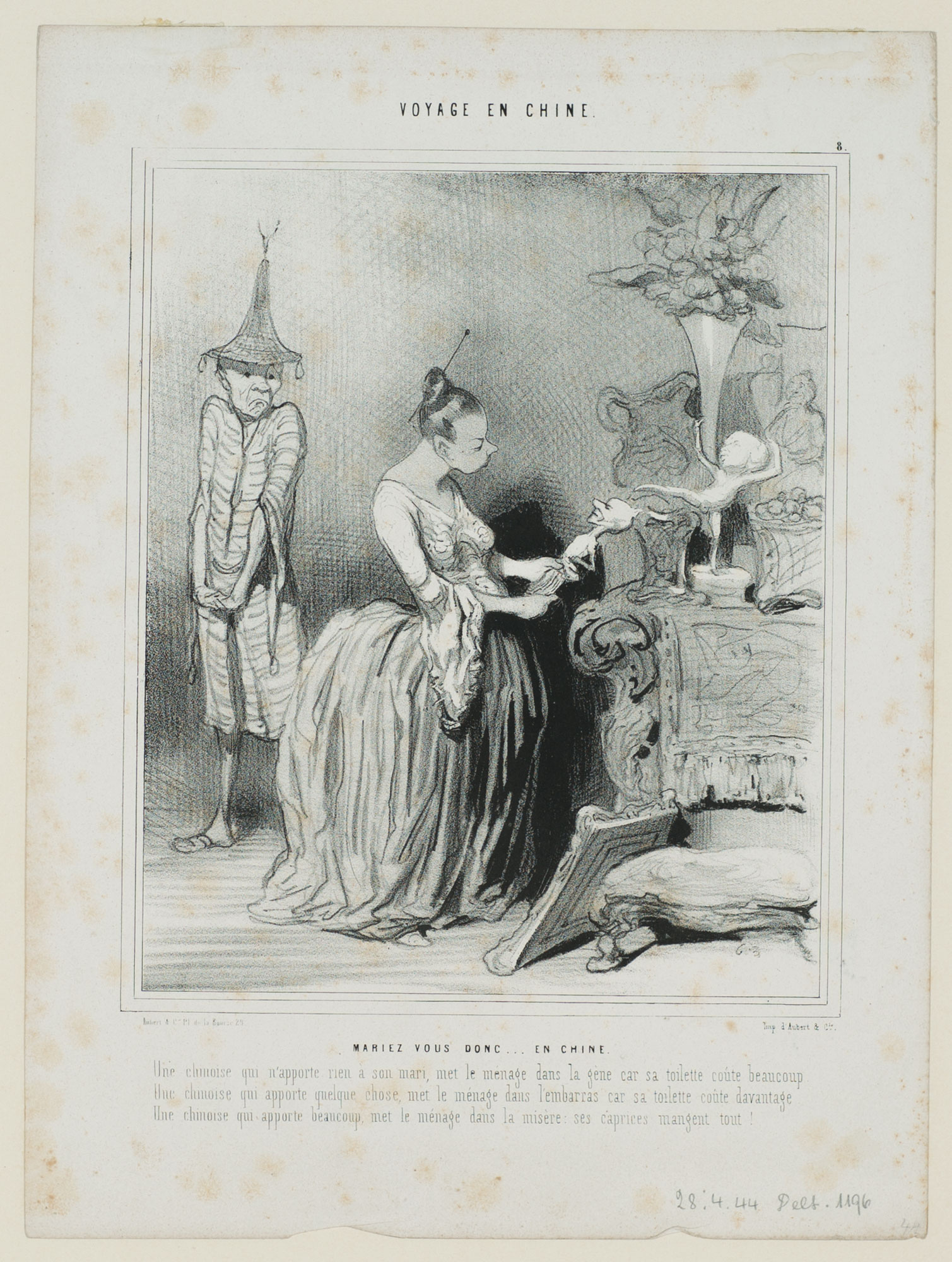
rif. HD-176o.J. HEIRATEN SIE DOCH... IN CHINA. Eine Chinesin ohne Mitgift belastet den Haushalt, denn ihre Kleidung kostet viel Geld. Eine Chinesin mit einer kleinen Mitgift ist eine noch grössere Belastung, denn ihre Kleidung kostet noch mehr Geld. Eine Chinesin mit einer grossen Mitgift stürzt den Haushalt ins Unglück, denn ihre Launen fressen alles. Lithographie, auf chamoisfarbenem Velin, mit den Adressen: Chez Aubert & Cie. Pl. de la Bourse,29., sowie: Imp. d'Aubert & Cie. Darstellungsgröße 23,1:18,9 cm, Blattgröße 34,2:25,4 cm. Literatur: Daumier-Register 1196 II (von 2); Delteil 1196 II (von 2), Blatt 8 der Folge ?VOYAGE EN CHINE.?, erschienen 14.05.1844 in ?LE CHARIVARI?. ? Sur blanc!
Catalogue raisonne of the lithographs. About 100 items illustrated and thoroughly described. Six tipped-in color plates. Large 4to. Publisher's cloth. Fine in a very good dustjacket.
1976This is a very good hardcover copy in a very good dust jacket. Completely clean inside and very clean outside as well, just a small piece chipped out of the top edge of the front jacket panel. Text in Italian. Introduction by Alfonso Gatto. Illustrated in color and black & white. 12" high X 10" wide, 213 pages. A beautiful copy. This book will be securely wrapped and packed in a sturdy box and shipped with tracking.
First Edition, 4to, 290 illustrs., orig. cloth, d.w. slightly creased. Represents 250 of the finest Maritime prints from Breughel, by way of Rembrandt and his pupil Bol, to Johan Barthold Jongkind.
rif. 39472Vertretung J. E. Wolfensb. As New. Portfolio with 17 In. FREE UPGRADE to Courier/Priority Shipping Upon Request – – IN STOCK AND IMMEDIATELY AVAILABLE FOR SHIPMENT - TEXT PRISTINE - Consists of a portfolio style folder with 17 inserts each one a 3 page illustrated black and white brochure on one or more artists whose prints are offered for sale. Among the artists represented: K. Armitage; Kokaschka; V. Passmore; and others. -- with a bonus offer--; T-Marletal; 8 3/4" x 8 3/4"; Marlborough Prints London; Deutsche Vertretung Baukunst Koln; Schweizer Vertretung J. E. Wolfensberer Zurich - Prints Offered for Sale . Vertretung, J. E. Wolfensb unknown
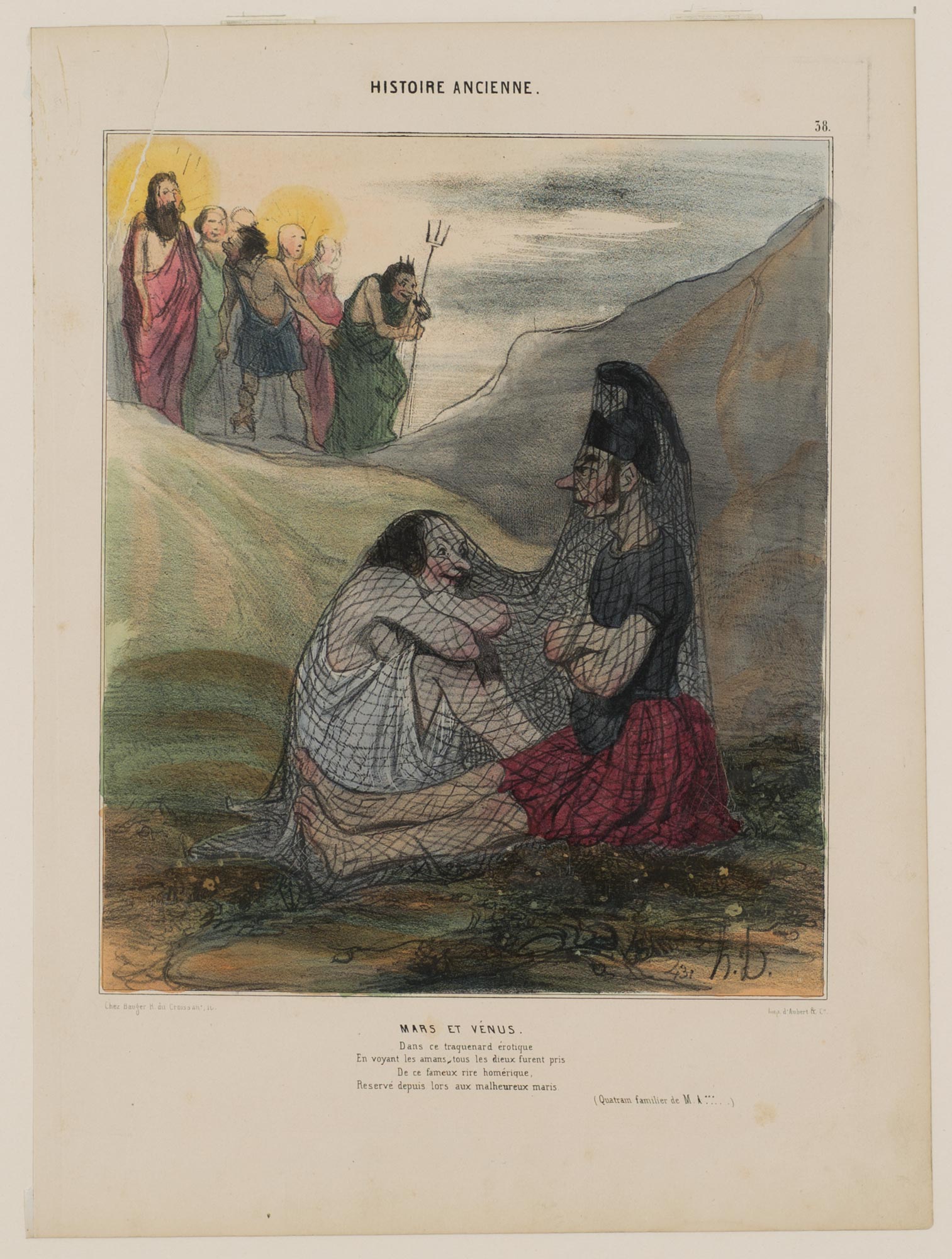
rif. HD-138o.J. MARS UND VENUS. Als sie die Liebenden in der Falle erblickten, brachen die Götter in "homerische Gelächter" aus, Welches sie dann zur Erde hinschickten als betrogener Ehemänner' Los. (Bekannter Vierzeiler von Monsieur A.).Zeitgenöss. aquarellierte Lithographie, auf chamoisfarbenem Velin, mit der Adresse: Chez Bauger R. du Croissant 16, sowie: Imp. d?Aubert & Cie. Blattgröße 33,7:24,7 cm. ? Reste alter Verklebung am linken Rand verso. Literatur: Daumier-Register 962, II (von 3); Delteil 962, II (von 3), Blatt 38 der Serie ?Histoire Ancienne?. ? Sur blanc.
1991271pp.richement illustré, in-4, br.orig., catalogue d'exposition (Paris, Musée du Petit Palais, 14 novembre 1991 - 16 février 1992), bon état, S84562
The catalogue raisonne. 319 items illustrated and thoroughly described. 4to. Publisher's illustrated boards. FINE AND BRIGHT. Like new.
The standard catalogue raisonne of the color prints of Mary Cassatt. All items decribed in great detail, with numerous color illustrations of different states and impressions of each print. 4to. Publisher's cloth, dustjacket. LIKE NEW.
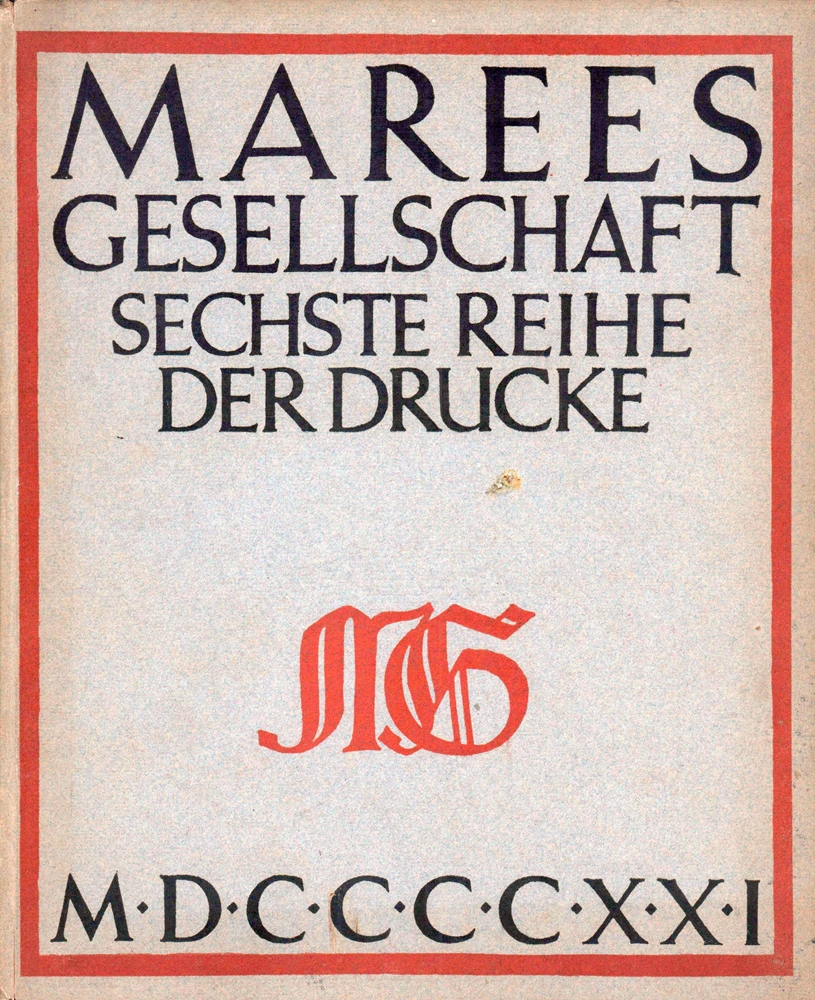
1921rif. 18082München, Verlag der Marees-Gesellschaft R. Piper & Co. 1921. 36 S. Mit 3 Heliogravüren nach Radierungen v. E. R. Weiß, René Sintenis und Otto Schubert u. 2 Kupferdrucken nach Boucher u. Rubens sowie 5 Initialen v. E. R. Weiß. Groß-4to. 31,5 cm. OPp.
rif. 8619Eau-forte. 3 pliures. Tirage chez Odieuvre d'une gravure XVIIè. en feuille Bon Odieuvre Paris XVIIIè 27 x 38 cm
2003rif. RO40082154Massol S.A.. 2003. In-4. Broché. Bon état, Couv. convenable, Dos satisfaisant, Intérieur frais. 24 pages. Illustré de photos en couleur et en noir et blanc.. . . . Classification Dewey : 769-Estampes
rif. 15498PAULIN LE CHEVALLIER Editeurs de l'Illustration rue Richelieu 60. s.d. (1857). Grand in-folio (31x 43,5 cm).broché, en feuilles sous 10 chemises Collection de 100 splendides lithographies originales de GAVARNI, tirées par LEMERCIER, lithographies en noir numérotées de 1 à 50 dans les séries PAR CI PAR LA et PHYSIONOMIES PARISIENNES , 2 suites « Masques et visages ». Edition sur grand papier,bon etat
rif. 1379Mouceaux : chez Levachez père & à Paris chez Vilquin, s. d. [vers 1797]. PORTRAIT DE MASSÉNA GRAVÉ ET MIS EN COULEURS
SECOND AND LAST EDITION of the "Mascara Real", the greatest Spanish fete-book of the 18th century and the apex of Spanish etching of the period. Originally printed in 1764 (Palau 156971, "Magnifica publicacion....") in a very small edition, this is the second edition, with ALL TWELVE OF THE FULL-PAGE ETCHINGS (by Defehrt after Tramullas) PRINTED FROM THE ORIGINAL PLATES. Since the original edition was so small, the plates were in a perfect state of conservation when this second edition was printed, and ALL OF THE ETCHINGS ARE ABSOLUTELY BRIGHT AND SHARP. Edition limited to 150 numbered copies, all printed on extremely fine handmade Guarro wove paper. Oblong large folio (22 x 26 inches). Loose as issued in the original portfolio case with ties. BRIGHT AND FINE, WITH NO DEFECTS. Spectacular.
Massol S.A.. 2003. In-4 Carré. Broché. Bon état. Couv. convenable. Dos satisfaisant. Intérieur frais. 24 pages. Illustré de photos en couleur et en noir et blanc. Pinatel. Carzou. Rops...