10 928 résultats
1920réf. 54803Lucien Vogel éditeur | Paris 1920 | 18 x 24 cm | une feuille
1979réf. 007446Edinburgh : A. Bell and C. Macfarquhar 1771 c1979 1979. Hardcover. Fine/No Jacket. 3 volumes :160 plates including facsimiles maps music; some folded ; 27 cm ; by a society of gentlemen in Scotland.; LC: AE5.E3631771 ; OCLC: 277954529 ; 5 raised bands spine labels in red and black leather with decorations and lettering in gold rubric textblock ; an exact facsimile of a 3-volume set of the 1st edition of the Encyclopedia Britannica reproducing the plates with foxing ; "For three years sections of the encyclopaedia were issued periodically. The first two numbers came in December 1768 . The first volume 'Aa' to 'Bzo' was completed and bound in 1769 the second 'Caaba' to 'Lythrum' a year later and the third 'Macao' to 'Zyglophyllum' in 1771"--Herman Kogan The great EB./ Edited by William Smellie who was employed by Colin Macfarquhar publisher and Andrew Bell engraver./ "In order to give some idea of the materials of which this dictionary is composed we shall conclude the preface with a list of the principal authors made use of in the compilation."--Preface.; thick heavy volumes ; FINE Edinburgh : A. Bell and C. Macfarquhar, 1771, c1979 hardcover
réf. 45572596-6Used - Very Good. Former library copy. Pages intact with possible writing/highlighting. Binding strong with minor wear. Dust jackets/supplements may not be included. Includes library markings. Stock photo provided. Product includes identifying sticker. Better World Books: Buy Books. Do Good. unknown
réf. 16369La Caricature d'Art. 25X33 cm.
réf. HIS4829MSans page de garde, donc manque d'information exacte de date. (1751-1772) Partie de l'Encyclopédie Diderot-d'Alambert. 59 plaques, gravures et diagrammes d'art militaire d'époque. Pages brochées sous carton de protection moderne.
1832réf. 252481832 Lithographie - Planche HT parue dans La Caricature morale, religieuse, littéraire et scénique, volume 3, 9 février 1832, (Planche n°135) - Œuvre :Hauteur: 27cmx Largeur: 35.6cm - Image: Hauteur: 19.1cmx Largeur: 23.4cm- Titre en bas au centre : « Encore une fois… Madame, voulez vous ou ne voulez vous pas divorcer, vous êtes parfaitement libre. » ; indications, en ht au centre : « La Caricature (Journal) / (N°67.) », en ht à dte : « Pl. 135. »- Dans la lettre : « Lith. de Delaporte. » [imprimeur], « On s’abonne chez Aubert, galerie véro dodat. » [éditeur] ; dans l’image, en bas à gche, signature : « JJ. Grand / E. For. / H. Del. » [Jean-Jacques Grandville, dessinateur, Eugène Forest, lithographe, et « H. Del. » ( ?)]Inscription - Sur le papier tenu par Louis-Philippe : « Loi Du / Divorce / 1831 / Article » ; sur les papiers posés sur la table : « Promesse / avec […] », « Allian[…] [Alliance] / Liber[…] [Liberté] », « HOTEL / DE / VILLE » (allusion au prétendu programme de l’hôtel de ville auquel se référa fréquemment l’opposition républicaine, mais dont Louis-Philippe nia l’existence); sur les journaux jonchant le sol en bas à dte : « NÉMÉSIS », « LA CARICATURE », « La Tribune », « La Révolu[…] [Révolution] / de 1830 » (journaux de l’opposition); sur les cadres accrochés au mur du fond : « VALMY », « Jemmapes » ; à gche sur le mur, étiquettes d’un calendrier avec les dates des Trois GlorieusesDescription iconographique:La table des matières donne une précision sur le titre : « Le divorce d’Harpagon et de la Liberté ». Scène de ménage entre Louis-Philippe et la figure de la France républicaine, incarnée par une femme portant un bonnet phrygien à cocarde tricolore. Le roi brandit la loi du divorce de 1831 de la main gche et une masse de la main dte. Tous les éléments présents dans cet intérieur tendent à rendre sensible le décalage entre la fidélité aux idées républicaines rappelée par le roi (pendule de l’hôtel de ville, pavé de la révolution de juillet sous verre, tel une relique, son engagement révolutionnaire dans les batailles de Jemmapes et Valmy rappelé dans les tableaux accrochés au mur), et la réalité, c’est-à-dire, son éloignement de l’idéal révolutionnaire (coq enchaîné, buste brisé de La Fayette, journaux de l’opposition jetés à terre), et traitement infligée à la République, son épouse, dont il veut divorcer. La pl. met ainsi en lumière la volonté du roi de rompre avec les principes républicains.En outre, la pl. constitue une allusion à la loi sur le rétablissement du divorce qui venait d’être votée par la Chambre des députés (janvier 1832) et rejetée par les Pairs. Sur le même thème, cf. article du numéro 47, p. 367-370.Personne / Personnage représenté:Du Motier de La Fayette, Gilbert, marquis; Louis-Philippe Ier, roi des Français
1914- Lucien Vogel éditeur, Paris Février 1914, 19x24,5cm, une feuille. - Original color print, printed on vergé paper, signed in the plate. An original print used to illustrate the Gazette du bon ton, one of the most attractive and influential 20th century fashion magazines, featuring the talents of French artists and other contributors from the burgeoning Art Deco movement. A celebrated fashion magazine established in 1912 by Lucien Vogel, La Gazette du bon ton appeared until 1925, with a hiatus from 1915 to 1920 due to the war (the editor-in-chief having been called up for service). It consisted of 69 issues printed in only 2,000 copies each and notably illustrated with 573 color plates and 148 sketches of the models of the great designers. Right from the start, this sumptuous publication "was aimed at bibliophiles and fashionable society," (Françoise Tétart-Vittu, "La Gazette du bon ton", in Dictionnaire de la mode, 2016) and was printed on fine vergé paper using a type cut specially for the magazine by Georges Peignot, known as Cochin, later used (in 1946) by Christian Dior. The prints were made using stencils, heightened in colors, some highlighted in gold or palladium. The story began in 1912, when Lucien Vogel, a man of the world involved in fashion (he had already been part of the fashion magazine Femina) decided, with his wife Cosette de Brunhoff - the sister of Jean, creator of Babar - to set up the Gazette du bon ton, subtitled at the time: "Art, fashion, frivolities." Georges Charensol noted the reasoning of the editor-in-chief: "'In 1910,' he observed, 'there was no really artistic fashion magazine, nothing representative of the spirit of the time. My dream was therefore to make a luxury magazine with truly modern artists...I was assured of success, because when it comes to fashion, no country on earth can compete with France.'" ("Un grand éditeur d'art. Lucien Vogel" in Les Nouvelles littéraires, no. 133, May 1925). The magazine was immediately successful, not only in France but also in the United States and Latin America. At first, Vogel put together a team of seven artists: André-Édouard Marty and Pierre Brissaud, followed by Georges Lepape and Dammicourt, as well as eventually his friends from school and the School of Fine Arts, like George Barbier, Bernard Boutet de Monvel and Charles Martin. Other talented people soon came flocking to join the team: Guy Arnoux, Léon Bakst, Benito, Boutet de Monvel, Umberto Brunelleschi, Chas Laborde, Jean-Gabriel Domergue, Raoul Dufy, Édouard Halouze, Alexandre Iacovleff, Jean Émile Laboureur, Charles Loupot, Chalres Martin, Maggie Salcedo. These artist, mostly unknown when Lucien Vogel sought them out, later became emblematic and sought-after artistic figures. It was also they who worked on the advertising drawings for the Gazette. The plates put the spotlight on, and celebrate, dresses by seven designers of the age: Lanvin, Doeuillet, Paquin, Poiret, Worth, Vionnet and Doucet. The designers provided exclusive models for each issue. Nonetheless, some of the illustrations are not based on real models, but simply on the illustrator's conception of the fashion of the day. The Gazette du bon ton was an important step in the history of fashion. Combining aesthetic demands with the physical whole, it brought together - for the first time - the great talents of the artistic, literary, and fashion worlds; and imposed, through this alchemy, a completely new image of women: slender, independent and daring, which was shared by the new generation of designers, including Coco Chanel, Jean Patou, Marcel Rochas, and so on... Taken over in 1920 by Condé Montrose Nast, the Gazette du bon ton was an important influence on the new layout and aesthetics of that "little dying paper" that Nast had bought a few years earlier: Vogue. [FRENCH VERSION FOLLOWS] Estampe originale en couleur, tirée sur papier vergé, signée en bas à droite de la planche. Gravure originale réalisée pour l
1873réf. 004109Helsinki Finland: F. Tilgmanns förlag 1873. Hardcover. Very Good. 100 p. 35 steel-engraved plates; 26 x 33 cm. Red cloth with gilt-tooled cover title; gilt rules on spine. Blind-ruled border on both boards with additional gilt ruled border on the front board. White moire endpapers. Bound without the engraved title page and preliminary pages 1-viii. The author Zacharias Topelius 1818-1898 through his work as a writer journalist and professor of history played a pivotal role in the creation of the Finnish identity in the 19th century. En Resa i Finland Travel in Finland employs illustrations by the most famous Finnish artists of the time. The beautiful steel-engraved plates are based on original paintings by Berndt Lindholm A. v. Becker B. Reinhold Hjalmar Munsterhjelm Karl Emanuel Jansson Robert Wilhelm Ekman J. Knutson W. Holmberg Oslar Kleineh and Albert Edelfelt. Originally issued in parts in 1872 and 1873 this copy was apparently taken to the binder without the title page and 8 preliminary pages. The text is in Swedish. The plates were engraved by A. Weger and are captioned in Finnish Swedish and French. This is the first edition not the modern reprint. In Very Good Condition: corners rubbed; cover slightly soiled; spine faded; corners of a few leaves faintly dampstained not impacting image or text; light foxing on a few plates; otherwise clean and bright. F. Tilgmanns förlag hardcover
1986EXTREMELY RARE retrospective on the works of Mexican painter Raul Anguiano. SIGNED by the artist. INCLUDES ORIGINAL LITHOGRAPH, "Three Women from Behind", signed by Anguiano, numbered 187/500. Includes dozens of color reproductions of Anguiano's drawings and paintings. Also includes photographs of Anguiano's process, an essay by Buxo on Anguiano's style (in English), and a short autobiographical piece by Anguiano himself (in English). 285x285mm, 175 pages. Blue leather hardcover with silver dust-jacket. [CONDITION:] Dust-jacket very lightly worn around all edges. Lithograph has a long crease that appears to be a defect caused DURING THE PRINTING PROCESS. Otherwise, this extremely rare book and original lithograph are in VERY GOOD CONDITION.
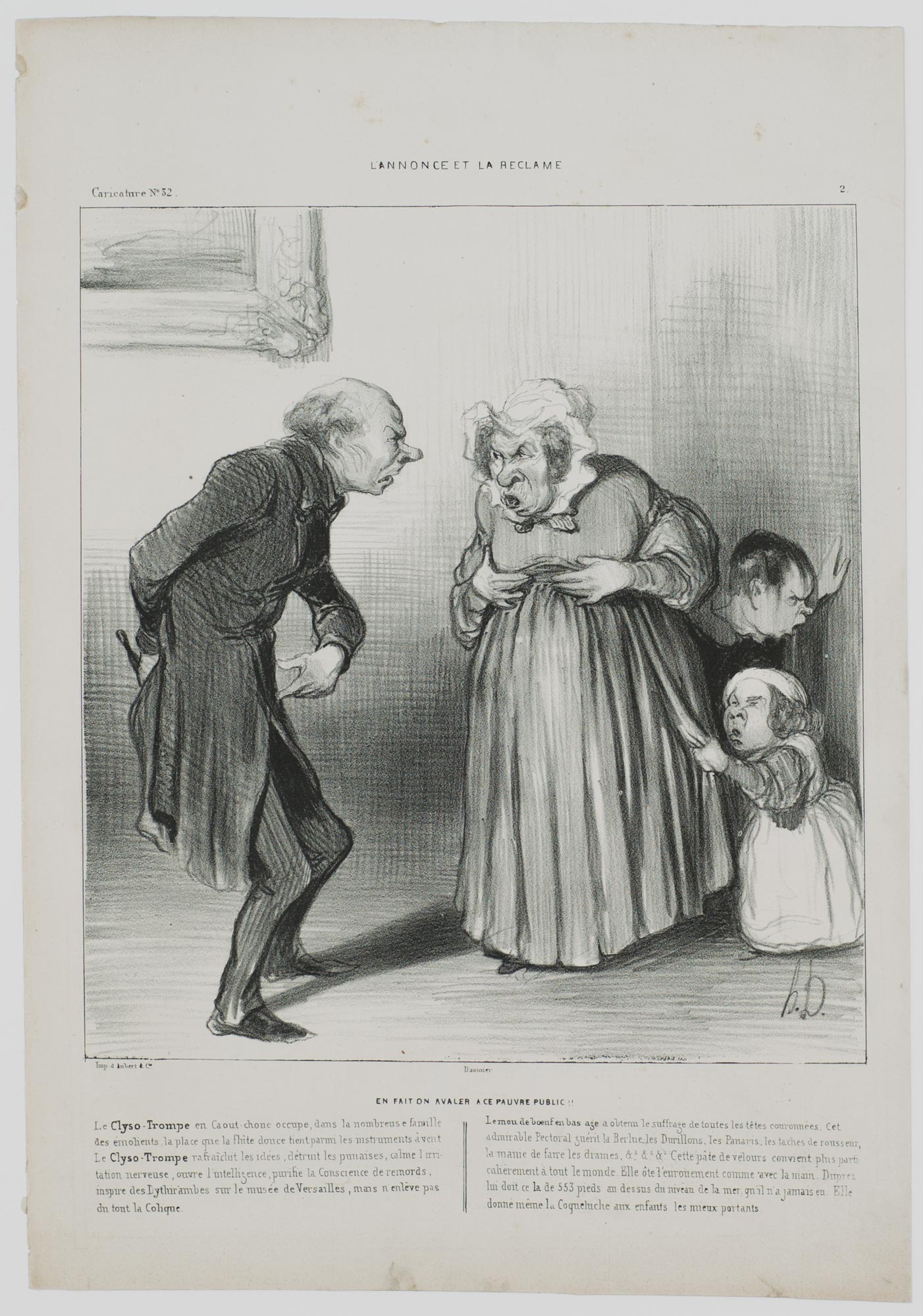
réf. HD-074o.J. (WAS LÄSST MAN DOCH DIE ARME ÖFFENTLICHKEIT NICHT ALLES SCHLUCKEN !!! Das ?Clyso-Trompe? aus Gummi nimmt in der Familie der Eulgatoren einen genauso bedeutenden Platz ein, wie die Flöte unter den Blasinstrumenten. ?Clyso-Trompe? erfrischt die Ideen, beseitigt die Wanzen, beruhigt das Nervensystem, erschließt die Intelligenz, reinigt von Gewissenbissen, inspiriert die Dithyramben zum Museum von Versailles, aber beseitigt in keinem Fall die Kolik. Lunge von ganz jungen Kälbern ist bei allen gekrönten Häuptern die erste Wahl. Dieses wunderbare Hustenmittel heilt auch Blindheit, beseitigt Hornhaut, Nagelgeschwür, Sommersprossen, und die Manie aus allem ein Drama zu machen, etc. etc etc. Diese zarte Paste ist daher ganz speziell für jedermann geeignet. Sie beseitigt außerdem Heiserkeit mit Leichtigkeit. Duprez schuldet ihr den hohen Kammerton A von 553 Fuß über dem Meeresspiegel, den er nie erreicht hatte. Sie verpasst sogar einen Keuchhusten, ganz gesunden Kindern). Lithographie, auf chamoisfarbenem Velin, mit der Adresse: Imp. D?Aubert & Cie. Blattgröße 35,8:24,9 cm. ? Heftspuren am linken Rand. Literatur: Daumier-Register 622; Delteil622. Blatt 2 der Folge ?L?Annonce et le Réclame?, erschienen 9.06.1839 in ?La Caricature Provisoire?. ? Sur blanc!
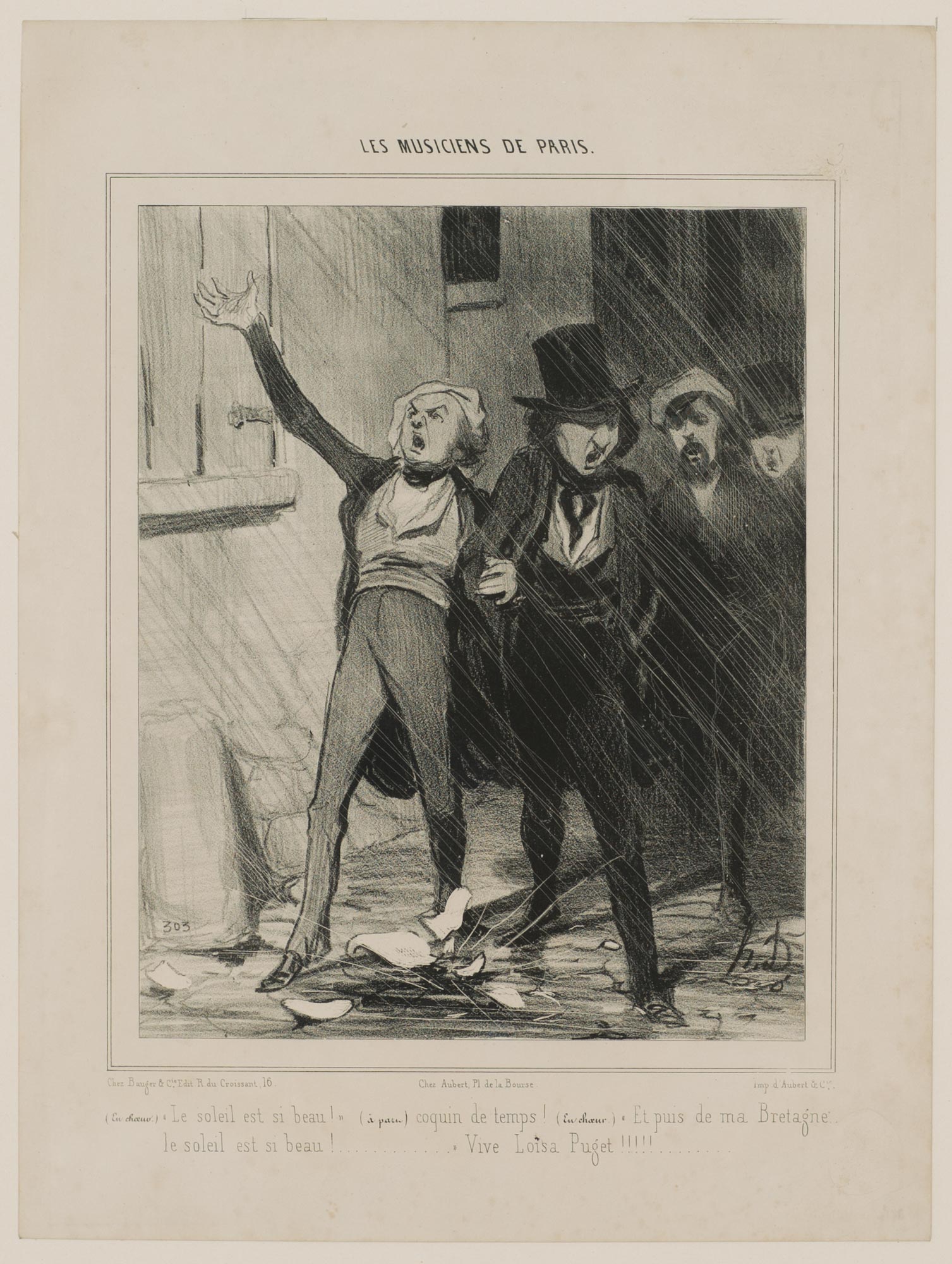
réf. HD-128o.J. (Im Chor) Die Sonne strahlt! (zu sich)...Verdammtes Wetter! (Im Chor): auch in meiner Betragne... Die Sonne strahlt... Es lebe Loisa Puget!!!... Lithographie, auf chamoisfarbenem Velin, mit der Adresse: Chez Banger & Cie. Éditeurs R. du Croissant 16, sowie: Chez Aubert Place de la Bourse, und: Imp. d?Aubert & Cie. Blattgröße 34,2:25,7 cm. Das Blatt erschien in La Caricature 2e série, 3e année, Nr. 44. Was den Text betrifft, ist zu beachten, dass die Bretagne für ihr verregnetes Wetter bekannt ist. Hier sehen wir ein Beispiel aus der Serie ?Les Musiciens de Paris?, erschienen im Charivari am 14.2.1843 (DR921): Blatt 3 zeigt eine angetrunkene Gruppe Pariser Bürger, die bei strömendem Regen vom Sonnenschein grölt. Will man den kritischen Tenor der Beispiele auf einen Nenner bringen, so geht es in ihnen um das nach außen gewandte prätentiöse Gehabe, das in Verkennung und Überschätzung der eigenen Lage und Möglichkeiten den realistischen Sinn für die Wirklichkeiten des sozial gesellschaftlichen Zusammenlebens verloren hat. Literatur: Daumier-Register 921, II (von 3); Delteil 921, II (von 3), Blatt 3 der Serie ?Les Musiciens de Paris?. Erschienen am 31.10.1841 in ?La Caricature?. ? Sur blanc.
réf. 17838Le Charivari. Journal illustre. 29e annee. 1860;1er trimestre,16.1.1860,La page 3 contient une lithographie en noir à 2/3 de page.image = 23,5x25 cm,sur feuille imprimée recto-verso,bon état.
1860réf. 254131860 charivari 1860 - vingt neuvième année -1860
réf. 25416Le Charivari. Journal illustre. 29e annee. 1860;1er trimestre, - 8.2.1860,La page 3 contient une lithographie en noir à 2/3 de page.23,5x25 cm
1914réf. 54627Lucien Vogel éditeur | Paris Février 1914 | 19 x 24.50 cm | une feuille
1914réf. 89459Paris Février 1914 | 19 x 24.50 cm | une feuille
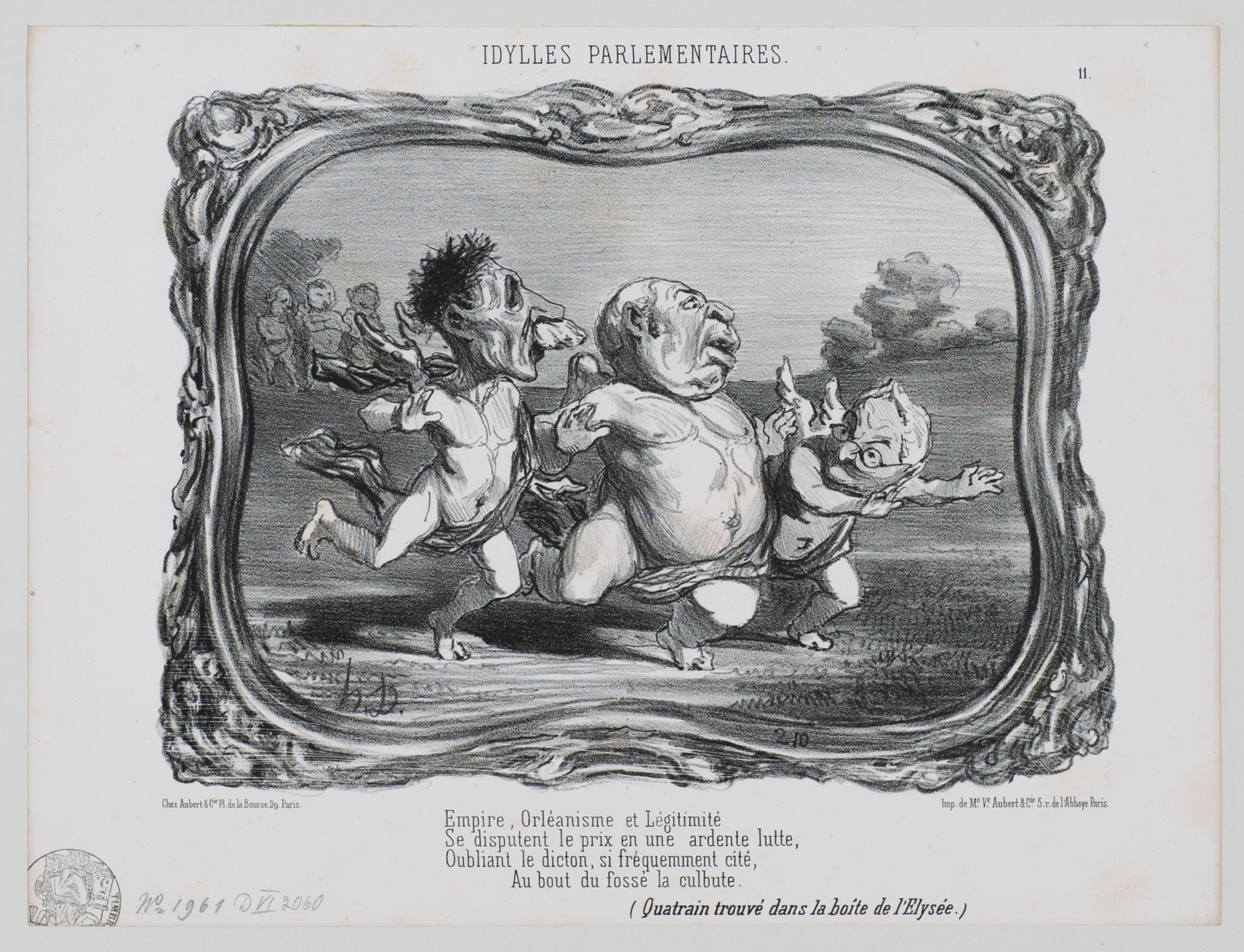
réf. HD-220o.J. Bonapartisten, Orleanisten und Legitimisten wetteifern im heftigen Kampf um den Siegespreis und vergessen das oft zitierte Sprichwort: wer anderen eine Grube gräbt, fällt selbst hinein. (Vierzeiler aus der Schatulle des Elysée.) Lithographie, auf chamoisfarbenem Velin, mit den Adressen: Chez Aubert & Cie Pl. de la Bourse,29., sowie: Imp. de Me.Ve.Aubert r.de l'Abbaye, 5,Paris. Darstellungsgröße 20,3:27,3 cm, Blattgröße 26,6:34,7 cm. Literatur: Daumier-Register 2060 I (von 1); Delteil 2060 I (von 1), Blatt Nr. 11 der Serie ?IDYLLES PARLEMENTAIRES.?, erschienen 04.11.1850 in ?LE CHARIVARI?. ? Sur blanc!
1877réf. biblio359London dec.29 1877. Fine. Sue. Chomolithography 265x395mm original proof impression “The second versions of the Vanity Fair caricatures are the proof prints or proofs before lettering First versions are the original watercolors; third versions are the widely available weekly/album prints Produced to verify the colours and lines of the lithograph no more than twenty copies were printed Not true many more than that These prints have no captions or dates or other descriptive type and the magazine bound them in numbered albums in green leather with gilt tooling They were offered for sale and also awarded as prizes in the magazine’s acrostic contests At the front of each volume is a printed note from Vanity Fair giving the number of the proof volume and the numbered volume in the series However these volumes were "broken" to sell individually and one never sees the complete volume The quality of the colours in the proof prints their clarity of line and detail and their scarcity make them of considerable interest to the collector” Roy T Matthews and Peter Mellini In “Vanity Fair” Berkeley: University of California Press 1982 203 hardcover
réf. 25249Lithographie - Planche HT parue dans La Caricature morale, religieuse, littéraire et scénique, volume 4, 10 mai 1832 (Planche n°160),pli central, - Œuvre : Hauteur: 27cmx Largeur: 35.6cm - Image : Hauteur: 20.2cmx Largeur: 27.5cm - Titre en bas au centre : « Emporté dans l’amas de ces noirs tourbillons, // Il ne voit plus du char les écarts vagabonds. » ; légende plus bas : « (Desaintonge [Saint-Ange], métamorphoses d’ovide) » ; indications, en ht au centre : « La Caricature (Journal) N°80. », en ht à dte : « Pl. 160. » - Dans la lettre : « Lith. de Becquet, rue Childebert N°9 » [imprimeur], « On s’abonne chez Aubert, galerie véro dodat » [éditeur]Inscription - Au-dessus du soleil à dte : « 27, 28, 29 » juillet 1830Description iconographique:Louis-Philippe, debout, de profil sur son char, associé à Phaëton. Les chevaux du char tombent. Les nuages noirs menacent de cacher le soleil des Trois Glorieuses. Ils entraînent dans leur chute les ministres du gouvernement. En ht à gche, le zodiaque du cancer visible à travers les nuages. La pl. compare le roi à Phaëton qui fut incapable de maîtriser le char de son père. Par ce parallèle, la pl. met ainsi en lumière l’incompétence de Louis-Philippe et de ses ministres de bien gouverner la France. Le titre est un extrait de la traduction par Ange-François Fariau de Saint-Ange des "Métamorphoses" d’Ovide.Personne / Personnage représenté:Louis-Philippe Ier, roi des Français
réf. CORV-BBP-14981Unknown. Loose Leaf. Very Good. Very good.Top half of folio sheet from the News featuring the illustration along with a single column on her visit to England and a bit of political/social background. 2pp. > Language: English > Size: 4to > Media/Binding: Unbound Unknown unknown
réf. 15178Épreuve sur beau papier filigrané. en feuille Très bon Paris 16 x 12 cm
1920- Lucien Vogel éditeur, Paris 1920, 18x24cm, une feuille. - Estampe originale en couleur réalisée par Marcel Fromenti, tirée sur papier vergé, signée en haut à droite de la planche. Sommaire du numéro de la Gazette dont provient la publicité au verso. Gravure originale réalisée pour l'illustration de La Gazette du bon ton, l'une des plus belles et des plus influentes revues de mode du XXème siècle, célébrant le talent des créateurs et des artistes français en plein essor de l'art déco. Célèbre revue de mode fondée en 1912 par Lucien Vogel, La Gazette du bon ton a paru jusqu'en 1925 avec une interruption durant la Guerre de 1915 à 1920, pour cause de mobilisation de son rédacteur en chef. Elle se constitue de 69 livraisons tirées à seulement 2000 exemplaires et est illustrée notamment de 573 planches en couleurs et de 148 croquis représentant des modèles de grands couturiers. Dès leur parution, ces luxueuses publications « s'adressent aux bibliophiles et aux mondains esthètes » (Françoise Tétart-Vittu « La Gazette du bon ton » in Dictionnaire de la mode, 2016). Imprimées sur beau papier vergé, elles utilisent une police typographique spécialement créée pour la revue par Georges Peignot, le caractère Cochin, repris en 1946 par Christian Dior. Les estampes sont réalisées grâce à la technique du pochoir métallique, rehaussées en couleurs et pour certaines soulignées à l'or ou au palladium. L'aventure commence en 1912 lorsque Lucien Vogel, homme du monde et de la mode - il a déjà participé à la revue Femina - décide de fonder avec sa femme Cosette de Brunhoff (sur de Jean, le père de Babar) la Gazette du bon ton dont le sous-titre est alors « Art, modes et frivolités ». Georges Charensol rapporte les propos du rédacteur en chef : « En 1910, observe-t-il, il n'existait aucun journal de mode véritablement artistique et représentatif de l'esprit de son époque. Je songeais donc à faire un magazine de luxe avec des artistes véritablement modernes [...] J'étais certain du succès car pour la mode aucun pays ne peut rivaliser avec la France. » (« Un grand éditeur d'art. Lucien Vogel » in Les Nouvelles littéraires, n°133, mai 1925). Le succès de la revue est immédiat, non seulement en France, mais aussi aux Etats-Unis et en Amérique du Sud. À l'origine, Vogel réunit donc un groupe de sept artistes : André-Édouard Marty et Pierre Brissaud, suivis de Georges Lepape et Dammicourt ; et enfin ses amis de l'École des beaux-arts que sont George Barbier, Bernard Boutet de Monvel, ou Charles Martin. D'autres talents viennent rapidement rejoindre l'équipée : Guy Arnoux, Léon Bakst, Benito, Boutet de Monvel, Umberto Brunelleschi, Chas Laborde, Jean-Gabriel Domergue, Raoul Dufy, Édouard Halouze, Alexandre Iacovleff, Jean Émile Laboureur, Charles Loupot, Charles Martin, Maggie Salcedo. Ces artistes, inconnus pour la plupart lorsque Lucien Vogel fait appel à eux, deviendront par la suite des figures artistiques emblématiques et recherchées. Ce sont ces mêmes illustrateurs qui réalisent les dessins des publicités de la Gazette. Les planches mettent en lumière et subliment les robes de sept créateurs de l'époque : Lanvin, Doeuillet, Paquin, Poiret, Worth, Vionnet et Doucet. Les couturiers fournissent pour chaque numéro des modèles exclusifs. Néanmoins, certaines des illustrations ne figurent aucun modèle réel, mais seulement l'idée que l'illustrateur se fait de la mode du jour. La Gazette du bon ton est une étape décisive dans l'histoire de la mode. Alliant l'exigence esthétique et l'unité plastique, elle réunit pour la première fois les grands talents du monde des arts, des lettres et de la mode et impose, par cette alchimie, une toute nouvelle image de la femme, élancée, indépendante et audacieuse, également portée par la nouvelle génération de couturiers Coco Chanel, Jean Patou, Marcel Rochas... Reprise en 1920 par Condé Montrose Nast, la Gazette du bon ton inspirera largement la nouvelle composition et les choix esthétiques du « petit journal moura
réf. 20557LE CHARIVARI,9/04/1866,numero complet,double feuille broche,texte imprime au dos,bon etat.
1996lxxiii + 1055pp.with bl/w illustrations, text printed in 2 columns, 22cm., editor's hardcover, very good condition, "Taschenausgabe", S87894