Felix Benoist- Adam- Sabatier, Philippe Benoist,Livre Rare Book

10 930 résultats
1873réf. 258811873 Henri Charpentier, Paris, 1873. une feuille In-folio ,bon état
1977IN ENGLISH AND RUSSIAN. 30x23 cm. 221 pages. Hardcover. Rear cover slightly stained. Few pages slightly stained - no damage to text and images. Else in good condition. PLEASE NOTE: This item is overweight. We may ask for extra shipping costs.
Portfolio of 10 exquisite landscape etchings by Pierre Bazire, each of which is JUSTIFIED (10/15) AND SIGNED IN PENCIL. These etchings evoke the rustic, pastoral landscapes of southern France, bathed in soft sunlight. Additionally there is a title/justification leaf (signed by Gustave Arthur Dassonville, for whom the edition was printed) with an eleventh etching, and another signed proof of that etching (so 12 etchings in all, of which 11 are full-page, loose, signed, and justified). Printed on fine Arches wove paper. Folio. Loose as issued in cloth portfolio with paper label. FINE AND BRIGHT, with no defects. Very rare (only 20 sets were printed: 1-15 and I-V).
A portfolio of eleven stunning cubist / surrealist etchings (with drypoint) by Philippon, each numbered (15/15) and signed by the artist in pencil. Edition limited to 15 sets, all printed on fine wove paper. Philippon, although little known, was a very talented printmaker. The images include three female nudes, four town views, one interior, one portrait, and two depictions of the port of St-Tropez. 4to. Loose as issued in folding sheet. Cover a bit soiled and damaged, but the etchings are fine and bright, and have never been matted or framed. Extremely rare.
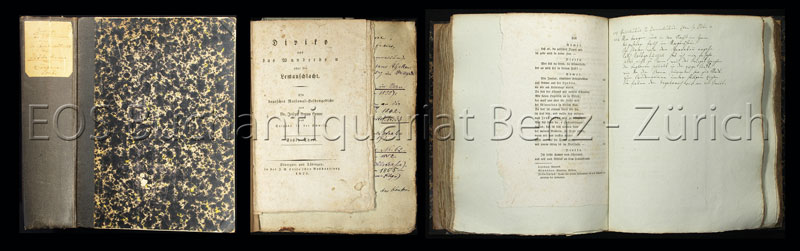
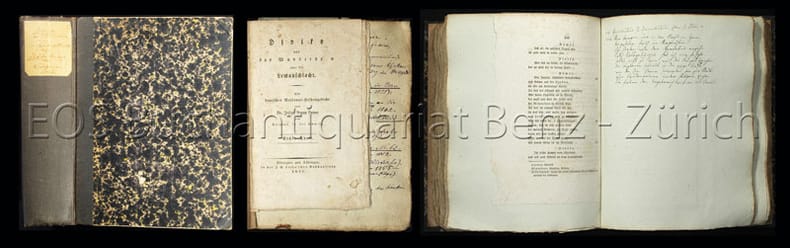
1826réf. 4831CBStuttgart und Tübingen, Cotta, 1826. 4°. XX S., (6) Bl. (Subskribentenliste), 370 S. Halbleinenband des 19. Jh. mit hs. Rückenschild. + Wichtig: Für unsere Kunden in der EU erfolgt der Versand alle 14 Tage verzollt ab Deutschland / Postbank-Konto in Deutschland vorhanden +, 4831C
réf. 500297397Sans date.
1826réf. 4831CBStuttgart und Tübingen, Cotta, 1826. 4°. XX S., (6) Bl. (Subskribentenliste), 370 S. Halbleinenband des 19. Jh. mit hs. Rückenschild.
réf. 25777retirage XIXe de Jeaurat, Paris 1706, titre et 21 pl.,en feuilles, certaines numérotées,toutes decoupées sans marges
1694réf. 6757Lyon, J. Bapt. et Nicolas De Ville, 1694 ; in-12 ; plein veau havane moucheté, dos à nerfs décoré et doré, pièce de titre grenat, roulette sur les coupes (reliure de l'époque) ; (14), 559, (3) pp., et 2 vignettes gravées dont 1 au titre, 2 planches gravées dépliantes (tables d'airain) et quelques figures dans le texte.
1921- Lucien Vogel éditeur, Paris 1921, 18x24cm, une feuille. - Original color print, printed on vergé paper, signed in the plate. An original print used to illustrate the Gazette du bon ton, one of the most attractive and influential 20th century fashion magazines, featuring the talents of French artists and other contributors from the burgeoning Art Deco movement. A celebrated fashion magazine established in 1912 by Lucien Vogel, La Gazette du bon ton appeared until 1925, with a hiatus from 1915 to 1920 due to the war (the editor-in-chief having been called up for service). It consisted of 69 issues printed in only 2,000 copies each and notably illustrated with 573 color plates and 148 sketches of the models of the great designers. Right from the start, this sumptuous publication "was aimed at bibliophiles and fashionable society," (Françoise Tétart-Vittu, "La Gazette du bon ton", in Dictionnaire de la mode, 2016) and was printed on fine vergé paper using a type cut specially for the magazine by Georges Peignot, known as Cochin, later used (in 1946) by Christian Dior. The prints were made using stencils, heightened in colors, some highlighted in gold or palladium. The story began in 1912, when Lucien Vogel, a man of the world involved in fashion (he had already been part of the fashion magazine Femina) decided, with his wife Cosette de Brunhoff - the sister of Jean, creator of Babar - to set up the Gazette du bon ton, subtitled at the time: "Art, fashion, frivolities." Georges Charensol noted the reasoning of the editor-in-chief: "'In 1910,' he observed, 'there was no really artistic fashion magazine, nothing representative of the spirit of the time. My dream was therefore to make a luxury magazine with truly modern artists...I was assured of success, because when it comes to fashion, no country on earth can compete with France.'" ("Un grand éditeur d'art. Lucien Vogel" in Les Nouvelles littéraires, no. 133, May 1925). The magazine was immediately successful, not only in France but also in the United States and Latin America. At first, Vogel put together a team of seven artists: André-Édouard Marty and Pierre Brissaud, followed by Georges Lepape and Dammicourt, as well as eventually his friends from school and the School of Fine Arts, like George Barbier, Bernard Boutet de Monvel and Charles Martin. Other talented people soon came flocking to join the team: Guy Arnoux, Léon Bakst, Benito, Boutet de Monvel, Umberto Brunelleschi, Chas Laborde, Jean-Gabriel Domergue, Raoul Dufy, Édouard Halouze, Alexandre Iacovleff, Jean Émile Laboureur, Charles Loupot, Chalres Martin, Maggie Salcedo. These artist, mostly unknown when Lucien Vogel sought them out, later became emblematic and sought-after artistic figures. It was also they who worked on the advertising drawings for the Gazette. The plates put the spotlight on, and celebrate, dresses by seven designers of the age: Lanvin, Doeuillet, Paquin, Poiret, Worth, Vionnet and Doucet. The designers provided exclusive models for each issue. Nonetheless, some of the illustrations are not based on real models, but simply on the illustrator's conception of the fashion of the day. The Gazette du bon ton was an important step in the history of fashion. Combining aesthetic demands with the physical whole, it brought together - for the first time - the great talents of the artistic, literary, and fashion worlds; and imposed, through this alchemy, a completely new image of women: slender, independent and daring, which was shared by the new generation of designers, including Coco Chanel, Jean Patou, Marcel Rochas, and so on... Taken over in 1920 by Condé Montrose Nast, the Gazette du bon ton was an important influence on the new layout and aesthetics of that "little dying paper" that Nast had bought a few years earlier: Vogue. [FRENCH VERSION FOLLOWS] Estampe originale en couleur, tirée sur papier vergé, signée en bas à droite de la planche. Gravure originale réalisée pour l'illustration de La G
1921- Lucien Vogel éditeur, Paris 1921, 18x24cm, une feuille. - Estampe originale en couleur, tirée sur papier vergé, signée en bas à droite de la planche. Gravure originale réalisée pour l'illustration de La Gazette du bon ton, l'une des plus belles et des plus influentes revues de mode du XXème siècle, célébrant le talent des créateurs et des artistes français en plein essor de l'art déco. Célèbre revue de mode fondée en 1912 par Lucien Vogel, La Gazette du bon ton a paru jusqu'en 1925 avec une interruption durant la Guerre de 1915 à 1920, pour cause de mobilisation de son rédacteur en chef. Elle se constitue de 69 livraisons tirées à seulement 2000 exemplaires et est illustrée notamment de 573 planches en couleurs et de 148 croquis représentant des modèles de grands couturiers. Dès leur parution, ces luxueuses publications « s'adressent aux bibliophiles et aux mondains esthètes » (Françoise Tétart-Vittu « La Gazette du bon ton » in Dictionnaire de la mode, 2016). Imprimées sur beau papier vergé, elles utilisent une police typographique spécialement créée pour la revue par Georges Peignot, le caractère Cochin, repris en 1946 par Christian Dior. Les estampes sont réalisées grâce à la technique du pochoir métallique, rehaussées en couleurs et pour certaines soulignées à l'or ou au palladium. L'aventure commence en 1912 lorsque Lucien Vogel, homme du monde et de la mode - il a déjà participé à la revue Femina - décide de fonder avec sa femme Cosette de Brunhoff (sur de Jean, le père de Babar) la Gazette du bon ton dont le sous-titre est alors « Art, modes et frivolités ». Georges Charensol rapporte les propos du rédacteur en chef : « En 1910, observe-t-il, il n'existait aucun journal de mode véritablement artistique et représentatif de l'esprit de son époque. Je songeais donc à faire un magazine de luxe avec des artistes véritablement modernes [...] J'étais certain du succès car pour la mode aucun pays ne peut rivaliser avec la France. » (« Un grand éditeur d'art. Lucien Vogel » in Les Nouvelles littéraires, n°133, mai 1925). Le succès de la revue est immédiat, non seulement en France, mais aussi aux Etats-Unis et en Amérique du Sud. À l'origine, Vogel réunit donc un groupe de sept artistes : André-Édouard Marty et Pierre Brissaud, suivis de Georges Lepape et Dammicourt ; et enfin ses amis de l'École des beaux-arts que sont George Barbier, Bernard Boutet de Monvel, ou Charles Martin. D'autres talents viennent rapidement rejoindre l'équipée : Guy Arnoux, Léon Bakst, Benito, Boutet de Monvel, Umberto Brunelleschi, Chas Laborde, Jean-Gabriel Domergue, Raoul Dufy, Édouard Halouze, Alexandre Iacovleff, Jean Émile Laboureur, Charles Loupot, Charles Martin, Maggie Salcedo. Ces artistes, inconnus pour la plupart lorsque Lucien Vogel fait appel à eux, deviendront par la suite des figures artistiques emblématiques et recherchées. Ce sont ces mêmes illustrateurs qui réalisent les dessins des publicités de la Gazette. Les planches mettent en lumière et subliment les robes de sept créateurs de l'époque : Lanvin, Doeuillet, Paquin, Poiret, Worth, Vionnet et Doucet. Les couturiers fournissent pour chaque numéro des modèles exclusifs. Néanmoins, certaines des illustrations ne figurent aucun modèle réel, mais seulement l'idée que l'illustrateur se fait de la mode du jour. La Gazette du bon ton est une étape décisive dans l'histoire de la mode. Alliant l'exigence esthétique et l'unité plastique, elle réunit pour la première fois les grands talents du monde des arts, des lettres et de la mode et impose, par cette alchimie, une toute nouvelle image de la femme, élancée, indépendante et audacieuse, également portée par la nouvelle génération de couturiers Coco Chanel, Jean Patou, Marcel Rochas... Reprise en 1920 par Condé Montrose Nast, la Gazette du bon ton inspirera largement la nouvelle composition et les choix esthétiques du « petit journal mourant » que Nast avait racheté quelques années auparavant : le magazine Vogue. [ENGLISH DES
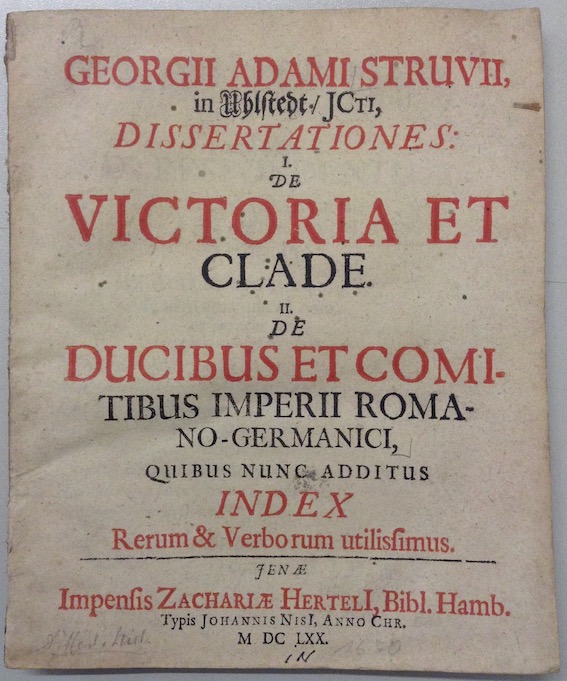
1670réf. 124883Jena, Hertel, 1670. 4to. 2 Bl., 186 S., 13 Bl. Index. Ohne Einband (geheftet).
1870réf. 21527Good. Antique woodcut lithograph plate is toned with light foxing. Overall size: 16" x 12".; Prints . 1870. unknown
1972réf. 014596Montpellier Fata Morgana 1972 In-8 En feuilles, couverture à rabats <
réf. 39984, Silvana - Koninklijke Musea voor Schone Kunsten van Belgie , 2012 Paperback met flapen, 297x240mm, 256p, 300 illustraties in kleur, French edition, etat neuf ! . ISBN 978883662371613.
1972réf. 016056Montpellier Fata Morgana 1972 In-8 En feuilles, couverture à rabats < Dédicacé par l'illustrateur
réf. LITT5947M1972, Fata Morgana. In-8, broché, non paginé. Illustrations de Camille Bryen. Exemplaire sur vergé Ivoire. Bon exemplaire
réf. 1636825x32 cm.
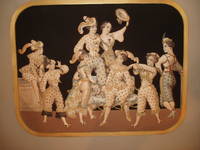
1870réf. 13079Paris: Unique. ca 1870. Original frame / Modern frame. Very good. Framed oblong scene of women harlequins and dancers rendered in subtle color lithography. Each of the figures is applied to the background in relief thereby producing a three dimensional effect for the viewer. Accompanying this is another framed "family scene" of nobility. Man woman and children composed of color lithographic figures with applied metallic highlights; gold braided tassle applied to the cushion at one corner as an embellishment. A anonymous unique composition of what appears to be a company of dancers or actors. Each is posed in a coquettish manner interacting as a group and looking at the viewer. Each is gayly attired in elaborate harlequin costumes in the manner of tinsel prints see Speaight Juvenile Drama . Chap. 11 with complicated silk ruffles and ties. The figures were produced through color lithography and mounted in relief to give the impression of depth to the scene. The item measures appx. 30 1/4 x 25 3/4 inches without the frame. There is no information available as to its origin. But given the quality of the lithography and subject matter a guess would be French. This is offered with a "noble family scene" of the same collage mode of representation. This is in a modern frame and measures appx. 12.5 x 16 inches without the frame. The relief effect is accomplished in the same manner. See Natl. Galleries of Scotland Collage #18 & #40. Unique. unknown books
réf. 5151Légende : Clarissimus Diodorus Tuldenus I. C. et professor regius in Academia Lovaniensi.Très expressif portrait de ce professeur de jurisprudence, d’après un tableau de Van Dyck. Le Blanc II - 433. En feuille Très bon 275 x 173
réf. 25636Planche HT parue dans La Caricature morale, religieuse, littéraire et scénique, volume 4, 24 mai 1832 (Planche n°165)- Lithographie - Œuvre: Hauteur: 27cmx Largeur: 35.6cm - Image: Hauteur: 16.9cmx Largeur: 30.9cm - Titre en bas au centre : « Digestion du Bugjet [Budget] // travail administratif, politique, moral et surtout économique. » ; indications, en ht au centre : « La Caricature (Journal.) // (N°82) », en ht à dte : « Pl. 165. »Inscription - Dans la lettre : « Lith. de Becquet, rue Childebert N°9. » [imprimeur], « On s’abonne chez Aubert, galerie véro dodat. » [éditeur] ; dans l’image, en bas à gche, signature : « J.J.G.E.F. » [Jean-Jacques Grandville, dessinateur, et Eugène Forest, lithographe]Inscription - Sur les liasses de feuilles en bas à gche, inscriptions : « CHATEA [CHATEAUX] », « DOTATIONS // N°150 [ ?] », [ ?] PROVISOIRE » ; sur la trappe ouverte à dte, inscription : « FONDS SECRETS »
1967réf. B30978fParis: Leonce Laget 1967. Reprint. Hardcover. Ex-Library. Reprint of 1776 original 1967 folio 5 pages of text 20 engravings all loose sheets in gray cloth chemise illustrated in b&w. Book ex-library with only indications being sticker to front pastedown of chemise and pocket to bottom flap contents show mild foxing to front title page otherwise clean bright and unmarked. No DJ. Text in French. THIS LARGE HEAVY BOOK WILL REQUIRE ADDITIONAL SHIPPING FEES. Leonce Laget hardcover
1740réf. 258691740 A Paris, Chez Huquier [1740--] leaves of plates : illustrations ; 34 cm- Chinoiseries- feuillets de planches gravées sur cuivre : eau-forte ; - serie A: pl.2,3,4,5,6,7,8,9,10 - soit 9 eau-fortes marges inegales,mouillures claires éparses,trés rare
réf. 7320Épreuves sur beau papier vergé. Bartsch XXI, 3 à 8. Série bien complète. D’après Polidore de Caravaggio 6 estampes
1543réf. 1033312 épreuves de la suite qui en contient 14 d'après Bartsch. Nous présentons les planches décrites sous Bartsch 420, 421, 422,423, 424, 425, 426, 427, 429, 430, 432, 433.L'épreuve n° 420 est en tirage tardif avec l'inscription "Io. Jacobi de Rubeis …". Le numéro 432 avec un important manque de papier hors sujet en haut à gauche Toutes sont à très grandes marges, parfois avec des mouillures ou des taches, mais d'un beau tirage. Rare ensemble. En feuilles Bon s.l. s.n. 1543 43 x 29 cm la feuille