Livre Rare Book
VILLAINLivre Rare Book
C’est elle
Best.-Nr. 5213D’après un dessin de Villeneuve Très bon XIXè siècle 21 x 15,5

Librairie Seigneur · Voingt, Frankreich15,00 €
10.990 Ergebnisse
1946Best.-Nr. 5279DBBasel, Basler Fasnachts-Comité, 1946. 4°. 170 S. Mit zahlr. Abbildungen Farb. illustr. Orig.-Halbleinenband.
Best.-Nr. 5213D’après un dessin de Villeneuve Très bon XIXè siècle 21 x 15,5
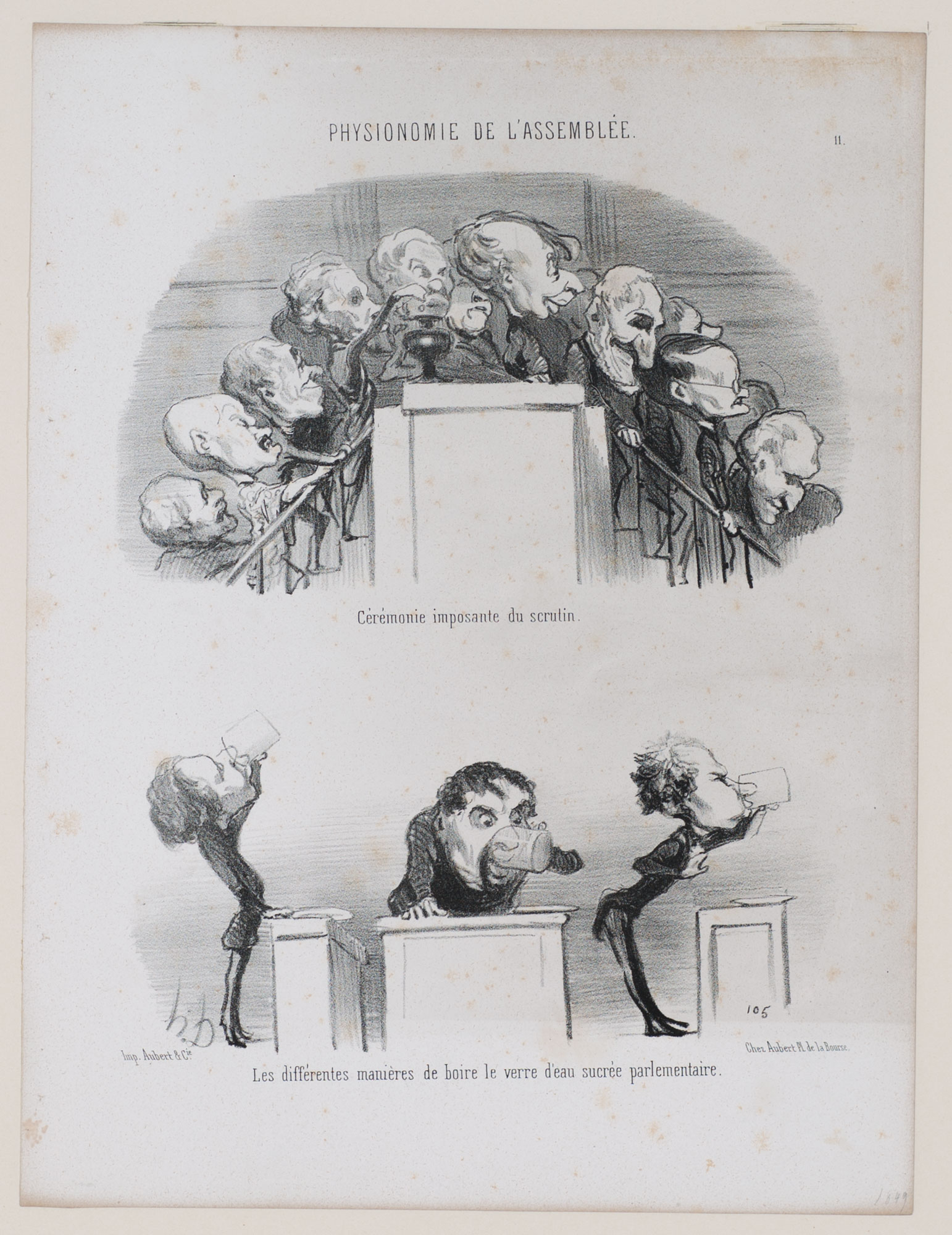
Best.-Nr. HD-205o.J. Eine imposante Abstimmungszeremonie. Verschiedene Arten, das parlamentarische Zuckerwasser zu trinken. Lithographie, auf chamoisfarbenem Velin, mit den Adressen: Chez Aubert, Pl. de la Bourse., sowie: Imp. Aubert & Cie. Darstellungsgröße 25,4:21,5 cm, Blattgröße 34,3:26 cm. Literatur: Daumier-Register 1957 II (von 2); Delteil 1957 II (von 2), Blatt Nr. 11 der Serie ?PHYSIONOMIES DE L'ASSEMBLÉE.?, erschienen 27.11.1849 in ?LE CHARIVARI?. ? Sur blanc!
1833Best.-Nr. 251961833 Planche HT parue dans La Caricature politique, morale, littéraire et scénique, volume 5, 28 février 1833 (Planche n°250) - Hauteur: 27.3cm x Largeur: 35.8cmDimensions - Image :Hauteur: 20cmx Largeur: 28cmTitre en ht au centre : « Cérémonie des cendres politiques. // (Suite) » ; légendes en bas, de gche à dte: « Pere [Père]-Scie, // ange de la morgue. », « Madrier-Longeau, // Girafe. », « Nargout », « Guizotin // doctrinain. », « Berthe en poissarde », « Bey-dok en marlou. », « Chonaine et // Stephanus // ivres…de joie. », « leur valet // en Figaro. », « M. Vienn.. », « Air du déserteur », et, sous une partition de musique : « Le roi pas-sait [passait] etc etc » ; indications : en ht à dte : « La Caricature (Journal) Pl. 250 // N°121. »Inscription - Dans la lettre : « L. de Becquet, rue Childebert N°9. » [imprimeur], « On s’abonne chez Aubert, galerie véro dodat. » ; dans l’image, en bas à gche, signature : « JJ. Grandville // E. Forest » [Jean-Jacques Grandville, dessinateur, et Eugène Forest, lithographe]Pl. n°2 de la série "Cérémonie des cendres politiques". Cf. pl. n°1 (pl. 248 du numéro 120) et pl. n°3 (pl. 251 du numéro 121). Suite du cortège dans lequel on peut reconnaître : Persil en bourreau, affublé d’un grand nez en forme de scie dont le bout est rougi par le sang, portant la coiffe de magistrat, portant un tablier de boucher où apparaît le portrait d’un homme et sur lequel peut se lire « PEINE // DE // MORT // TOUJOURS ! // 5000000000000 // AMENDES ». Il porte une hache de la main dte (décorée d’une poire), tandis que sa main gche est salie par du sang. Madier de Montjau chevauche une fausse girafe pourve de deux jambes d’hommes montées sur des échasses. La girafe est couverte par un carapaçon orné du motif de la poire à face humaine (Louis-Philippe). D’Argout en polichinelle vient ensuite, son costume ayant pris la forme de son grand nez au niveau du buste. Puis Guizot, en ecclésiastique tenant un petit ouvrage ouvert, fervent défenseur de la doctrine, « Berthe en poissarde », « Bey-dok en marlou » (identification difficile de ces deux personnages), puis Schonen, et la figure du "Constitutionnel", soutenu par l’incarnation du journal "Le Figaro" lequel, partageant depuis 1832 les idées du gouvernement, se fait maintenant le soutien de ses membres (« veut les relever de la boue dans laquelle il les a traînés si longtemps » in explication). Se trouve ensuite Viennet récitant des airs d’orgue de Barbarie décoré d’un motif de poire. La pl. se moque de son activité de poète.
Best.-Nr. 13931Notre épreuve est une héliogravure Amand-Durand, d’après l’épreuve de la collection Galichon. Tous ces tirages sont réalisés sur un superbe papier et sont de grande qualité. Encadrée Très bon 33 x 41,5 cm
Best.-Nr. 68433Limited Edition. Very Good. Slim quarto 28 cm Thirty loose woodcut plates on age-toned paper measuring 18.5 cm wide by 27 cm tall. No text or publication information present only the plates. Housed in a folder of 1/4 brown cloth with tan paper over boards and a gilt stamped title on the front board. The folder is toned and lightly rubbed at the edges. The first plate is signed by Molnár in pencil and numbered # 20 in an edition of only 36. The painter and graphic artist Pál Molnár-C. 1894-1981 born in Battonya Hungary lived and worked in a villa located in Ménesi Street on the hillside of Gellért Hill Budapest for 50 years. He held the surrealist style close to his heart throughout his life and he was also heavily inspired by the Symbolist works of Ferdinand Hodler. His illustrations of Shakespeare's Corialanus and Rostrand's Cyrano de Bergerac earned him gold medals at salons in Paris Milan and Warsaw. After his death his younger daughter Dr. Éva Csillag Pálné set up a family-owned private museum in 1984. “As a matter of fact all art is more or less surreal. The reality of everyday life differs from the reality of art which stands above reality.” - Pál Molnár-C. unknown books
Best.-Nr. 68433Limited Edition. Very Good. Slim quarto 28 cm Thirty loose woodcut plates on age-toned paper measuring 18.5 cm wide by 27 cm tall. No text or publication information present only the plates. Housed in a folder of 1/4 brown cloth with tan paper over boards and a gilt stamped title on the front board. The folder is toned and lightly rubbed at the edges. The first plate is signed by Molnár in pencil and numbered # 20 in an edition of only 36. The painter and graphic artist Pál Molnár-C. 1894-1981 born in Battonya Hungary lived and worked in a villa located in Ménesi Street on the hillside of Gellért Hill Budapest for 50 years. He held the surrealist style close to his heart throughout his life and he was also heavily inspired by the Symbolist works of Ferdinand Hodler. His illustrations of Shakespeare's Corialanus and Rostrand's Cyrano de Bergerac earned him gold medals at salons in Paris Milan and Warsaw. After his death his younger daughter Dr. Éva Csillag Pálné set up a family-owned private museum in 1984. “As a matter of fact all art is more or less surreal. The reality of everyday life differs from the reality of art which stands above reality.” - Pál Molnár-C. unknown
194241p., illus. Contains 192 plates, 32 in full color. Hardcover Good condition; edges worn. in worn d.j. fair
194241p., illus. Contains 192 plates, 32 in full color. Hardcover Very good condition
4 Vols., 4to, 331; 404; 406; 227pp., numerous illustrations throughout, orig. cloth, a little soiled.
1574Best.-Nr. 10151D'après Jules Romain. État "recouvert" mais non identifiable car la signature de Ghisi a été effaçé. Coupé à la cuvette, et contrecollé .Bartsch 15, 45. Bon 1574 32,5 x 23,5 cm
1950S.l., s.e., s.d. (vers 1950); 325/250 mm, 1 pp., une feuille. Gravure de costume militaire. Bon état.
1950Best.-Nr. A67S.l., s.e., s.d. (vers 1950) ; 325/250 mm, 1 pp., une feuille. Gravure de costume militaire. Bon état.
2000Book shows light edge wear to covers, remainder mark on bottom page ends in red has bled 1/4" into the bottom of each page, making a small red mark next to each of the page numbers. Binding is solid and square, text/interior is clean and free of marking of any kind, save previously noted. B&W photos throughout in large format, usually full page. 96 pages. Photographers include: Constantino Arias Miranda, Raul Corrales Fornos, Alberto Diaz "korda", Jose Alberto Figueroa, Mario Diaz Leyva, Jose Julian Marti, Lazaro Miranda Vera, Pedro Abascal, Raul Canibano Ercilla, Cristobal Herrera Ulashkevich, Keith Cardwell. Artist's bios at back. copyright Pistil Books, 2011
Best.-Nr. 16344P., Imprimerie Devambez. . 40X30 cm.
1994Best.-Nr. 3875Sans lieu [chez l'artiste] 1994 in-4 en feuilles Sans lieu, [chez l'artiste], 1994 (imp. Point & Marge). 33 x 21,5 cm, 6 gravures en taille-douce hors texte - 1 f. de justification, en feuilles sous chemise cartonnée et illustrée au premier plat.
1920- Lucien Vogel éditeur, Paris 1920-1922, 18x24cm, relié. - [FASHION] POIRET Paul & WORTH Charles Frederick & BEER & DOEUILLET Georges & LANVIN Jeanne & SIMON Mario & WOODRUFF André-Edouard. Croquis de mode Lucien Vogel éditeur, Paris 1920-1922, 18 x 24 cm, bound Set of 24 original lithographs in color, on vergé paper: - Croquis de mode d'été par Mario Simon ("Croquis", La Gazette du Bon ton, 1920 n° 3). - Les modes en l'an de grâce Mil neuf cent vingt un ("Croquis", La Gazette du Bon ton, 1921 n° 3) - Pour la Riviera. Robes garnies de fleurs naturelles, dans la mesure où l'on en a et où l'on ne préfère pas d'employer, moins coûteuses, les fleurs artificielles ("Croquis", La Gazette du Bon ton, 1921 n° 10). - Costumes tailleur de fantaisie ornés de colifichets ("Croquis", La Gazette du Bon ton, 1922 n° 4). Original prints used to illustrate the Gazette du Bon ton, one of the most attractive and influential 20th century fashion magazines, featuring the talents of French artists and other contributors from the burgeoning Art Deco movement. A celebrated fashion magazine established in 1912 by Lucien Vogel, la Gazette du Bon ton appeared until 1925, with a hiatus from 1915 to 1920 due to the war (the editor-in-chief having been called up for service). It consisted of 69 issues printed in only 2,000 copies each and notably illustrated with 573 color plates and 148 sketches of the models of the great designers. Right from the start, this sumptuous publication "was aimed at bibliophiles and fashionable society," (Françoise Tétart-Vittu, "La Gazette du Bon ton", in Dictionnaire de la mode, 2016) and was printed on fine vergé paper using a type cut specially for the magazine by Georges Peignot, known as Cochin, later used (in 1946) by Christian Dior. The prints were made using stencils, heightened in colors, some highlightened in gold or palladium. The story began in 1912, when Lucien Vogel, a man of the world involved in fashion (he had already been part of the fashion magazine Femina) decided, with his wife Cosette de Brunhoff - the sister of Jean, creator of Babar - to set up the Gazette du Bon ton, subtitled at the time: "Art, fashion, frivolities." Georges Charensol noted the reasoning of the editor-in-chief: "'In 1910,' he observed, 'there was no really artistic fashion magazine, nothing representative of the spirit of the time. My dream was therefore to make a luxury magazine with truly modern artists...I was assured of success, because when it comes to fashion, no country on earth can compete with France." ("Un grand éditeur d'art. Lucien Vogel" in Les Nouvelles littéraires, n° 133, May 1925). The magazine was immediately successful, not only in France but also in the United States and Latin America. At first, Vogel put together a team of seven artists: André-Édouard Marty and Pierre Brissaud, followed by Georges Lepape and Dammicourt, as well as eventually his friends from school and the School of Fine Arts, like George Barbier, Bernard Boutet de Monvel and Charles Martin. Other talented people soon came flocking to join the team: Guy Arnoux, Léon Bakst, Benito, Boutet de Monvel, Umberto Brunelleschi, Chas Laborde, Jean-Gabriel Domergue, Raoul Dufy, Édouard Halouze, Alexandre Iacovleff, Jean Émile Laboureur, Charles Loupot, Chalres Martin, Maggie Salcedo. These artist, mostly unknown when Lucien Vogel sought them out, later became emblematic and sought-after artistic figures. It was also they who worked on the advertising drawings for the Gazette. The plates put the spotlight on, and celebrate, dresses by seven designers of the age: Lanvin, Doeuillet, Paquin, Poiret, Worth, Vionnet and Doucet. The designers provided exclusive models for each issue. Nonetheless, some of the illustrations are not based on real models, but simply on the illustrator's conception of the fashion of the day. The Gazette du Bon ton was an important step in the history of fashion. Combining aesthetic demands with the physical whole, it brought tog
1944In-folio, cartella originale rigida, che contiene in fogli sciolti il frontespizio della serie, le 12 litografie a colori, tutte numerate, con timbro a secco “La margherita” firmate dall’autore e con l’indicazione del soggetto; tiratura limitata. Ottimo esemplare.
1966Litografia a 2 colori Firma a matita. Opera tirata da Giorgio Upiglio. Esemplare 60/100. cm 52x30 (foglio 70x50). . . Ottimo (Fine). . 100 + XX + 3 prove. .
Best.-Nr. 500297997Sans date.
Best.-Nr. 2338343x32,8 cm
1849Best.-Nr. 255201849 LE CHARIVARI Aubert et Cie, imprimeur-lithographe. 1849- Lithographie - Hauteur: 35.9cmx Largeur: 27.6cm - Description:-1 feuillet (4 pages) numéro complet; illustration page 3.-- texte imprime au dos,bon etat,rousseurs.
Best.-Nr. 25537Le Charivari, trente-quatrième année, jeudi 2 et vendredi 3 novembre 1865- Lithographie - Trait carré- Hauteur: 25.3cmx Largeur: 23.8cm- Au dessus de l'image, centré : "CROQUIS PARISIENS PAR DAUMIER" ; et à droite : "16" ; signature en bas de l'image à gauche : "h.D." ; en dessous de l'image à gauche : "M[ais]on Martinet Paris" ; en dessous de l'image à droite : "Lith Destouches 28 r. Paradis Pre" ; en dessous, centré : "- Vous ne prenez rien ?... / - Non, j'ai peur... / - Allons, un grog au laudanum !..." -1 feuillet; illustration page 3.-- texte imprime au dos,bon etat.-
1920Best.-Nr. 55409Lucien Vogel éditeur | Paris 1920-1922 | 18 x 24 cm | relié