359 risultati
1948rif. 81476R. Bègue photo | Paris 1948 | 11 x 8.50 cm | une feuille
1948rif. 81542R. Bègue photo | Paris 1948 | 11 x 8.50 cm | une feuille
1948rif. 81476Paris: R. Bègue photo 1948. Fine. R. Bègue photo Paris 1948 11 x 8.50 cm une feuille Original photograph taken during the filming of ""L'armoire volante"" a humorous police intrigue starring Fernandel. The photograph shows Carlo Rim from behind his hands resting on a window balcony offering his advice to Fernandel facing him vintage silver gelatin print. Carlo Rim was a Provençal writer ""Ma belle Marseille"" a caricaturist a filmmaker and was notably the friend of Fernandel Raimu and Marcel Pagnol but also of Max Jacob and André Salmon whom he met in Sanary."" Manuscript annotations in pencil by Carlo Rim on the verso of the photograph: ""Carlo Rim Fernandel L'armoire volante 1948."" R. Bègue photo unknown
1948rif. 81542Paris: R. Bègue photo 1948. Fine. R. Bègue photo Paris 1948 11 x 8.50 cm une feuille Original photograph taken on the set of ""L'armoire volante"" a humorous police intrigue with Fernandel in the leading role. The photograph shows Carlo Rim standing to the right of Fernandel giving him advice with three people involved in the filming present in the background period silver gelatin print. Carlo Rim was a Provençal writer ""Ma belle Marseille"" a caricaturist a filmmaker and was notably the friend of Fernandel Raimu and Marcel Pagnol but also of Max Jacob and André Salmon whom he met in Sanary."" Manuscript annotations in pencil by Carlo Rim on the verso of the photograph: ""Carlo Rim Fernandel L'armoire volante 1948."" R. Bègue photo unknown
1957rif. 142883Paris: Cinedis 1957. Collection of 14 vintage photographs and color transparencies from the 1957 French-Italian film. Nearly all photographs are contact sheets with 34 color transparencies 24 are medium-format and 5 are mounted. Starring actors Fernandel and Gray comprise most of the collection and the contact sheets consist of candid images of Fernandel director Boyer noted director Christian-Jacques and Fernandel in various accouterments surrounded by female members of the cast. Only a few contact sheets have less than 12 numbered frames amounted to 146 images. Striking images of both Gray and Patrick are scattered throughout the transparencies. Fernandel stars as a talentless actor who fails to find work and turns to imitating people he sees on the street a stunt that lands him in court where he finally has a chance to showcase his acting ability. Fernandel was France's leading funny man for decades and Gray would go on to her best-known role in Federico Fellini's masterpiece "La Dolce Vita" 1960. Liliane Patrick's debut film later credits include "Maxime" 1958 "Julie the Redhead" 1959 and "A fleur de peau" 1962. Transparencies housed in original glassine and paper envelopes four with annotations in holograph ink. Two slips of paper one on Cinedis parchment noting various photo sizes and quantities in holograph ink and in French are included. Brief notation in holograph pencil on the verso of the 5 x 7 photograph. All housed in original French Kodak photo box French title label affixed to the lid with annotations in holograph ink. Sizes range from 2.25 x 4.75 to 7 x 9.25 inches. Very Good plus overall photos with light curling some with faint creases several contact sheets with bruises to one edge and light staining and wrinkling to mounted transparencies. Box Very Good overall. Complete collation upon request. Cinedis unknown books
1951rif. 80759S. n. | Carry-le-Rouet 18 Septembre 1951 | 16.50 x 10.50 cm | une feuille
1951rif. 80759Carry-le-Rouet: S. n. 1951. Fine. S. n. Carry-le-Rouet 18 Septembre 1951 16.50 x 10.50 cm une feuille Autograph signed letter card from Fernandel on letterhead from his property L'Oustau de la Mar at Carry-le-Rouet addressed to his great friend the Provençal writer caricaturist and filmmaker Carlo Rim who was also his biographer. 10 lines in turquoise ink the ink having smudged on three words. ""18 Sept 1951 My dear Carlo I leave tomorrow for Italy but I haven't forgotten you. You will receive documentation and manuscript pages ""My memoirs"" published by ""Ce soir"" in 1938 you will thus have all the details from my birth and my different jobs before being an artist at least I believe so. Affectionately Fernandel."" S. n. unknown
1948rif. 92534Marseille 7 avril 1948 | 21 x 28.7 cm | Une feuille
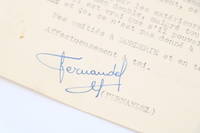
1948rif. 92534Marseille 1948. Fine. ""It is true that if he could replace me he would be an artist and that is not a gift given to everyone"" Marseille 7 avril 1948 21 x 28.7 cm Une feuille Typed letter dated and signed in blue ink by Fernandel addressed to his close friend Carlo Rim the Provençal writer caricaturist and filmmaker who was also his biographer concerning their joint film L'Armoire volante. One page on Fernandel's letterhead. Some light soiling and folds from mailing. A document that sheds light through the exchange between an actor and his director on the inner workings of French film production in the late 1940s. On 7 April 1948 Fernandel was working on his role as Alfred Puc in L'Armoire volante a black comedy written and directed by Carlo Rim which was released in cinemas on 29 October of the same year. It was the third film in which Carlo Rim directed Fernandel. Although shooting had begun in March the actor was still in April at the stage of reflection: in this letter he proposes to the director ""to shoot this film with a moustache for a change from the characters of his recent productions"". The letter also reveals how scant the material at his disposal was: in the absence of a screenplay Carlo Rim had sent him a synopsis supplemented by the shooting script a document setting out the staging of the film shot by shot. Fernandel is on the other hand delighted to have Antonin Berval as his partner with whom he had just made Si ça peut vous faire plaisir and whom he describes as ""a thoroughly decent fellow and what is more a talented artist"". Finally he returns to the difficulties encountered with his stand-in who ""for all his goodwill was unable to pull it off"" leaving him no choice but to reshoot his scenes himself. On this subject the actor displays a delightful self-satisfaction: ""It is true that if he could replace me he would be an artist and that is not a gift given to everyone"". Between these remarks on the production Fernandel slips in a more allusive paragraph on what in his eyes was at stake in the success of L'Armoire volante at a time of crisis for French cinema: ""This film must succeed; first for our own sake then for the others. They are waiting for you to slip up and I want the film-world menagerie to acknowledge that it is possible in friendship -and with talent- to succeed in France despite the growing number of detractors in making a production worthy of this country; which remains in spite of everything and against all comers one of the foremost in the film industry."" Fernandel is here echoing a topical issue: the decline of French cinema in the face of the influx of American films. In May 1946 the Blum-Byrnes agreements signed in Washington had opened French screens wide to Hollywood productions reserving only four weeks of screen time out of every thirteen for domestic films. Between 1946 and 1948 American films thus accounted for more than half of all films released in France provoking a vigorous response from the profession. Founded in December 1947 on the initiative of Claude Autant-Lara among others with the backing of the Communist Party and the CGT trade union the Comité de défense du cinéma français Committee for the Defence of French Cinema organised a demonstration on the grands boulevards of Paris on 4 January 1948. Thousands of film workers technicians filmmakers and filmgoers marched alongside stars such as Jean Marais and Simone Signoret. In referring to the ""detractors"" of French cinema Fernandel may have had in mind certain members of the profession itself. Many distributors and exhibitors had indeed taken advantage of the new import regime to programme American films on a massive scale as these were available in large numbers and often on more favourable terms than French films a practice regularly denounced by the Defence Committee. The profession's mobilisation met with partial success: in September 1948 the agreements were revised unknown