8 784 résultats
1928Generously illustrated with black and white photos and illustrations. Features: A Baptism of Fire - A young British Columbia Forest Service Ranger helps to save 100 people trapped in a logging camp from forest fire; Through Arctic Seas - Part II - Wonderful photos accompany this continuation of the cruise of the Hudson Bay Company steamer Baychimo to the Western Arctic to study the Eskimos and wild life; "Kruger's Millions" - ;A diagram is found which may lead to an enormous quantity of gold hidden by President Kruger after the Boer War; How We Fought the Famine - In East Africa Captain Anthony Parsons needed meat to trade to the Angonis for flour for his "boys"; Through Spain in Disguise - Part VI - Count and Countess Malmignati sing and dance their way across Spain disguised as Arab beggars; Photo of river gardens in Siam; The Adventures of a "Sand-Hog" - Photos of brutal subterranean conditions accompany this story of the men who dig tunnels and tubes beneath the Hudson River, between New York and Jersey City; The Thief Who Lost His "Luck" - A Chinese burglar lucks out; "Crawling Cavern" - Close call for Mark Howard in the spring of 1907 while on outpost duty on the coast of Mindanao; Across Central Africa from East to West - Part I - Major Frederick G. Jackson describes his 6,000 mile trans-African trek - with nice photos; The "Phantom Bandits" - In 1923 Joe Tanko and Floyd Hall escaped from San Quentin Prison and terrorized the countryside before they were finally subdued - includes facsimile of their wanted poster; The Mystery Man of Arnhem's Land - a man goes wrong so flees to the wilds, intent on earning enough to make restitution, but ends up in a lonely grave on the Australian coast; The Hakim - A doctor in Kenya includes fortune-telling in his treatment of disease. 84 pages plus 12 pages of nostalgic ads. Bits of peripheral nibbling, otherwise clean and unmarked with moderate wear. A quality copy of this fascinating vintage issue. Book
19731003 pages. Name index. Many dozens of black and white reproductions of wonderful archival photos. Provides a history of the Alberta districts of Blindman River, Bluff Centre, Harmonier, Iola, Lavesta, Montgreenar, Pineville, Riverview, Western Sunset and Willesden Green. Documents the history of the land sections and the families who occupied them. Includes sections on cattle and horse brands, sawmills, and cowboys. Covers the years 1900-1973. Gift greetings upon first blank leaf otherwise unmarked with moderate wear. Binding intact. A sound copy of this excellent local history and genealogical reference. Krotki (2) 544. Strathern 3089. Book
1960Half-leather binding. Telephone Talk was the glossy bimonthly publication of the British Columbia Telephone Company. It was written by employees for employees to present information of interest to those engaged in the plant, traffic, commercial, operating, accounting and other departments of the service. Each issue is replete with black and white photos and information on topics such as: company, industry and technological news, traffic levels, expansion plans, personnel announcements, publicity and social events, deaths, weddings, lists of exchanges, and more. As such, these issues serve as a vital preserve of rare and fascinating British Columbia history. This volume covers topics including: Rate increase approval; explansion plans for 1959, including new purchasing, warehousing and repair centre to be built at Manitoba Street and Southeast Marine Drive in Vancouver; Operator Distance Dialing Nears Reality; B.C.'s Biggest Television Events in 1958 as covered by mobile television links, including the Ripple Rock blast, the visit of H.R.H. Princess Margaret, and the Grey Cup; Changes to Sales Organization; Automating Accounting; Expanding the Personnel Department; Conversion of manual systems to dial operation; Conversion of Glenburn to Cypress; New Long Distance Route to Kamloops; Dial phones come to Sidney, Keating and James Island; Pension Plan Personalized; Adoption of Irregular Base Rate Areas; Closing of two historic switchboards in Victoria and Vancouver; Teletype Sale Made to East Asiatic; R.W.J. Angus becomes new General Commercial Manager; The Birth of N.P.A. 604 (the 604 area code); High cost of workplace accidents; Long Distance Anniversary greetings to a New Westminster Rotary Club from around the Western Hemisphere; Removal of high-wire span that linked Agassiz and Chilliwack since 1910 (6 pnotos); Conversion jobs sparked romances; Maintenance men to match our mountains; The visit of the queen (14 photos); "Follow Me" - a child's-eye view of the telephone company through the medium of C.B.C. television; Vancouver General Hospital (3 photos); Electronic 'Detectives' Guard Microwave; The FW-1 intertoll switching installation in the William Farrell Building - the brain and heart of toll; Logging by Radio - New Switchboard serves radiotelephone subscribers; Laying cable in the Pitt River (2 photos); Opening of new headquarters in 700 block of Seymour Street in Vancouver (3 photos); A new approach to serving the public in the new addition; Activation of a new radiotelephone long distance system through the Cariboo - illustrated; Traffic Signs for Toll; New Woodland Central Office serves Whalley (photos); Phone fashion; Network Television reaches the Interior; 500,000th telephone installed; Night move of revenue accounting to 555 Seymour (photos); Terrace phones now automatic (photos); Traffic, Staff Metering - Instantly; Service at New Denver is Personalized; The Heave-Ho Boys - name your antenna and they'll put it up! (with great photos); new building for Gibsons, Sechelt; Kamloops Editorial salutes operators; Transmission Levesl - an FW-1 Problem; Plans for 1960, including completion of Burnaby centre; Graph of telephone growth in B.C. since 1880; History of the Alma Central Office; The Happy Islanders on Calvert, Trutch and Swindle Islands; Machines take over in the Accounting Field; Rough weather at Newcastle Ridge; and more. Unmarked with moderate wear. Binding tight and square. Marbled endpapers. Name of E.P. LaBelle stamped on bottom edge of text. A photo and announcement re: Mr. Labelle is found in the July/August 1959 issue. Book
1945Unpaginated. 12" x 9" x 0.7". Contains issues from January 1945 through December 1946, a tumultuous time for labour in the wake of World War II. Topics include: Tennessee Poll Tax Fight; A New Revision of Marxian Economics, by Raya Dunayevskaya; Barriers on the Way to Socialism, by CARP; C.C.F confusion, by C. Luff; Marxism in New Zealand by R.R. Everson; Labor Conscription - the May-Bailey bill calls for a compulsory labor draft of 18 million workers from 18 to 45 years of age; Labor and Political Action, by Harmo; Vocationalism in Ireland; Comrade Adolph Kohn; The Future of Cartels; Capitalist Justice; An admittedly Imperfect World; 60 million jobs?; Will War Delay Socialism?; Success Story; The Meaning of Social Revolution; When G.I. Joe Comes Home; The Tinplate War; The Jinni and the Master; Inquiring Student Answered; Mexico; Do away with the Working Class; Human Nature as it Really is; Parasites in Fact and Fiction; Is the Status Quo Unchangeable?; Blood and Iron - contemplating the effect of WWII; Is Socialism Inevitable?; Scientific Socialism; Now that Germany has been knocked out, What Next?; The Nature of Co-ops; A Will for Socialism; Who ar the Workers?; Edward Bellamy; The Irish Scene; Franklin D. Roosevelt; Welcome Home, Joe; Canada Goes to the Polls; A Summer Morning in Dublin; Whom the States Serves; Forced Labor in Russia; A Philosopher Squelched - San Francisco Conference; British Election Message; Willow Run - this massive plant will soon be closed after making B-24 bombers for the war; The Great Divide; Guaranteed Annual Wage; Tobin and the Teamsters; S.P.G.B. Election Message; The War's End; Socialism in Britain?; War Memorials and Poverty; Detroit seething with unrest due to postwar industrial reconversion; Russia as she is; Poverty in New Zealand; From Military to Trade Wars; Atomic Energy; Has Britain Turned Socialist?; A Job with the City; Economics of Control; The Case for Socialism; Reformers Emasculate Unions; The Communications Revolution; Guaranteed Annual Wage; Insurance and Security; So this is Peace!; Wages and Prices; A Soldier Thinks; A Program for Workers; Yours - When you want it; The General Motors Strike - the union wants 30%; An American Seaman in India; Homeward Bound; Delusions of A White Collar Worker; Veterans are workers too; Who owns large corporations?; The Truth about Russia; Socialism and Personal Ethics; The Lenin Legend; Tale of Two Continents; Kaiser-Frazer Bonus Plan; Atomic Policy; Fetish of Full Production; What? - No Money!; Growing Tensions of Capitalism; Two Worlds; India; Henry in Wonderland; Family and Education in U.S.S.R.; How to Deal with the Atomic Bomb; Recruits Wanted; Opportunity under Capitalism; United Nations and War; Catholicism in America; The Rail Strike; From Boom to Bust; T.B. and Capitalism; Stocks don't make a capitalist; Know the Enemy; Fruits of Victory; Unions in Politics; A Note on American Culture; British Labor Government; Between Two Wars; Who Owns America; Materialist Basis of Religion; Selfishness; Occupational Trends in America; Letter to a Jewish worker; OPA - The Price Sieve; Ireland Today; Serfdom in a Free Society; Questions and Answers; Paris "Peace" Conference and World War III; The Sacred Cow; Full Employment and the Liberals; Berlin Letter; The Worker - That's You!; Unity; The Atomic Age; Where are the Unions Going?; Land of Plenty; The "Flood-Like" Form; Socialism or Capitalism?; An introduction to Economics; How About a 51% Majority; What do we mean by Socialism?. Sturdily bound in maroon boards. Unmarked. Average external wear. Contents clean and gently toning with age. Lettering upon backstrip dull but legible. A sound copy. Book
1919Pages 354-440 plus 24 pages of nice vintage advertisements. Features: The Bullet-proof Scotchman - an adventure of John Mundell in the Pampas of Uruguay; ; A Woman's Travels in Unknown Asia - part I - wonderful photos in China; An Exciting Trading Trip - efforts to trade with a warlike tribe in East Africa; Some Strange WWI Escapes from Germany - part II; Interesting photo and short article of Dog Rib Indians in Canada receiving their annual grant of one pound, as well as presents, from the Canadian government; Among the Wild Tribes of Darien - exploring the native tribes of Panama - with great photos; Stories of the War - Thirty Hours in No Man's Land - in WWI an Australian trooper on the Western Front is wounded and must make his way back to his own lines; Siringa's Last Battle - a native boy helps in one of the first fights in German East Africa, A Week in a Lens Dungeon - McLean and Ebbs of the 87th Canadian Battalion hid in a cellar for a week before making their way back to their lines; Miraculous Escapes from Sunken Submarines; An Adventurous Hunt After Man-eating Crocodiles - in Victoria Nyanza; The Mountain Warriors of France - excellent photos; The Zulu Love Medicine - part II of what happend when Zulus killed an Englishman to use his body for love medicine; Wonders of Northern Syria - article with many great photos of architectural remains; Carter's Exoneration - a stirring story of the Australian Mounted Police. Great multi-page advertising feature on the Waterproof Products Corporation. Average wear. Small protective pieces of tape at each end of backstrip. Binding intact. Unmarked. A sound vintage copy. Book
1928Generously illustrated with black and white photos and illustrations. Features: Policing the Great White North - A photo-illustrated account of the manifold perils and hardships that are the daily portion of the gallant handful of men who represent law and order in the Vast Canadian Arctic; Pathetic fate of two missing WWI Sheffield soldiers revealed - William Thompson and George Walter Howard; Bill's Bear-Cub - An American trapper adopts a bear cub and his partner foretells disaster; Three Months on an Island Inferno - J.K. Wilson explains his 'holiday' on White Island, near Tauranga, New Zealand - with photos; Further Adventures of a Tenderfoot in Canada - Part I - What happened after H.P. Musson, a transplanted London paper-pusher, lost his job as a hired hand in Western Canada and began looking for his own homestead; Trapping Wild Animals in Northern Siam - The ingenious methods by which the jungle folk trap fierce whild beasts, with great photos; Cycling Round the World - Part III of III of Kai Thorenfeldt's amazing 20,000 mile journey which took over two years - with map and nice photos; Forgotten Fortunes - Frances Dickie describes the remarkable circumstances in which two of the most amazing 'finds' in the history of European art have lately come to light in France - with photo of Mrs. M.L. Westmoreland, who discovered a valuable Goya in a Paris second-hand shop; In Quest of the Dragon Lizards - Part II - Seeking the prehistoric Komodo dragon on a remote Dutch East Indies (Indonesian) island; A Terrible Journey - Joseph Metcalf fell into an underground conduit conveying water from a dam to Port Elizabeth - forty-five miles away!; The Greatest of All Thrills - A wonderfully photo-illustrated article on the new sport of parachuting from aircraft; "Heir Number Six" - A Winnipeg real estate agent goes to the North-West territory in search of an obscure half-breed regarding a dispute over land ownership. 84 pages plus 12 pages of nice vintage ads. Unmarked with moderate wear. A sound copy of this nice vintage issue. Book
1945152 pages. Large oblong book measuring 10" x 14.5". "Because war censorship forbade publicity there is a widespread lack of knowledge of the outstanding production job for the war effort done by British Columbia industry... Few British Columbians - certainly very few Eastern Canadians, United States business men or British Empire industrialists - realize the extent of the accomplishments and the facilities that are now available here for manufacturing of all kinds. This survey has been prepared to place on record the information that is felt should be known. It is in two parts: First, an illustrated news section graphically telling the story of leading manufacturing developments; second, a concise factual compilation of statistics giving complete authoritative basic data." - from title page. The section on leading manufacturers is profusely illustrated with glorious black and white photos. Companies presented include: West Coast Shipbuilders Ltd.; Western Bridge and Steel Fabricators Ltd.; Vivian Engine Works Ltd.; Vivian Diesels and Munitions Ltd.; Arrow Transfer Co. Ltd.; Canada Western Cordage Co. Ltd.; Burrard Dry Dock Co. Ltd.; Boyles Bros. Drilling Company Ltd.; Canadian Mixermobile Company; United Distillers Ltd.; The H.R. Macmillan Export Company Limited; Industrial Engineering Ltd. (power/chain saw manufacturer); British Columbia (B.C.) Packers; W.R. Carpenter (Canada) Ltd. - crushers of copra and oil seeds; Edward Lipsett Ltd - commercial fishing supplies; Vancouver Iron Works Limited; British Columbia Telephone Company The Canadian Fishing Company Ltd; British Columbia Distillery Company Limited; Hammond Furniture Company Ltd; American Can Company Limited; Empire Sheet Metal Works Ltd; Canada Chain and Forge Company; Vancouver Engineering Works Ltd; Dominion Bridge Company Limited - including a grand photo of their new Pattulo Bridge looking toward the barrens of Surrey, plus a photo of the Hotel Vancouver's underlying steel structure during construction; Smith Bros. & Wilson Ltd - General Contractors; Heaps Engineering (1940) Limited; Marwell Construction Company; Canadian Sumner Iron Works; McDonnell Metal Manufacturing; Jones Tent and Awning Limited; Leek & Company Limited; McCarter & Nairne - Architects and Structural Engineers; Stewart-Lovick Ltd - Advertising; Terminal City Iron Works; Westland Foundries; British American Paint Co. Ltd; Bloedel Stewart & Welch Ltd.; Straits Towing and Salvage Co. Ltd.; Island Tug and Barge Ltd.; Standard Oil Company of British Columbia Limited; The Vancouver Sun; The Vancouver Daily Province; A-1 Steel and Iron Foundry Ltd.; A-1 Pattern Shop & Brass Foundry Ltd; Pacific Coast Terminals Co. Ltd.; Canadian Forest Products Limited; Alaska Pine Co. Ltd; Newcastle Ship Building Co. Ltd; Bennett & White Construction Co. Ltd; Evans Coleman & Evans Ltd; Falconer Marine Industries Limited; Yarrows Ltd.; Victoria Daily Times; The Daily Colonist; The Consolidated Mining and Smelting Company of Canada Limited. Also included in this section are photo illustrated features on power generation, brewing, the pulp industry, technical education, tourism, mining, highways, mining, printing, the British Columbia Police Force, New Westminster, Victoria, and Prince Rupert. A very uncommon and informative publication which proudly and abundantly presents the bold industrial might of Canada's pacific province in the immediate aftermath of the second world war. Unmarked. Average wear. Binding intact. A sound copy of this important record of British Columbia's industrial history. Book
réf. RO20183392EICHLER A.. DEBUT XXeme. In-8. Relié. Bon état, Couv. convenable, Dos satisfaisant, Intérieur frais. fascicule de 32 pages par numero - texte en 2 colonnes.. . . . Classification Dewey : 791.4362-Western
18941st edition. Later boards with original front paper wrapper bound in, 8vo, 139 pages. Singerman 4769. The first Jewish book pubished in St. Joseph, Missouri, which was the base of the pony express. Nice 19th Century Western Americana Jewish imprint. SUBJECT (S) : Rosh Hashanah. New Year. OCLC lists 7 copies worldwide. Boards show heavy wear; paper shows some damp-waviness, otherwise Good Condition. (Spec-9-3A)
900Pacific Ocean Western part latitude 28"N. to 20"S. and longitude 94"E. to 160"E. including Eastern Archipelago - Magnetic variation curves are for 1930. Washington D.C., published Oct. 1931, at the Hydrographic Office, under the authority of the Secretary of the Navy. Small corrections. Folded editorially. Autore: Admiralty Charts. Luogo: Pacific Ocean Western. Anno: '900. Tecnica: incisione. Dimensioni: 777x1031 mm
1798- EDIZIONE ORIGINALE, COLORITURA COEVA -Importante e decorativa mappa tratta dal "Nuovo Atlante Geografico Universale delineato sulle ultime osservazioni", edito a Roma dal 1792 fino al 1801, opera che la Calcografia Camerale commissionò al Cassini al fine di sostituire l’ormai obsoleto "Mercurio Geografico".Giovanni Maria Cassini, Chierico Regolare Somasco fu geografo e cartografo, ma anche intagliatore di architetture e prospettive - uno dei migliori discepoli di Giovanni Battista Piranesi - Cassini fu uno degli ultimi sferografi italiani del Settecento ed i suoi globi ebbero una notevole diffusione, come pure questo "Nuovo Atlante Geografico".Incisione in rame, coloritura coeva dei contorni, leggere bruniture, per il resto in ottimo stato di conservazione.L'Atlante del Cassini fu ristampato dalla Calcografia Camerale nel primo quarto del XIX secolo, prima del 1839. Solo gli esemplari di prima edizione come questo sono stampati su carta vergata coeva e sono colorati a mano in epoca. Le tirature del XIX secolo sono già su carta meccanica, priva di vergelle, e generalmente in bianco e nero. - FIRST EDITION, CONTEMPORARY OUTLINE COLOUR -The Italian painter and engraver, Giovanni Maria Cassini, produced this splendid map of as part of his epic three-volume atlas. Published in: Nuovo atlante geografico universale delineato sulle ultime osservazioni. Roma, Calcografia camerale, 1792-1801.Cassini was geographer and cartographer but he was also good at engraving architectural items and perspectives – he was one of the best disciples Giovanni Battista Piranesi had. Moreover, Cassini was one of the last artists to engrave spheres in the XVIII century and his globes were quite famous and widespread, and realized the most important Italian Atlas of the XVIII century; his maps always bear a cartouche, extremely rich in colours and details. Copperplate with fine original hand colour, some foxing, otherwise in very good condition.The Cassini's Atlas was reprinted by the Calcografia Camerale in the first quarter of XIXth century (before 1839). Only the first edition of the atlas is printed on contemporary laid paper, while the late issue are on XIXth century paper and often without colour.
réf. 41384Printed folio document 10-1/4" x 15-1/2." Completed in ink manuscript. Signed by the President S. N. Felton and Secretary Chas. Hinchman of the Western Land Association. Docketed on the verso with manuscript release of portion of a mortgage from the Association. Usual folds Very Good plus. A Jay Cooke project to give him access to the lands along a Minnesota Railroad. "One of the projects growing out of Jay Cooke's connection with the Lake Superior and Mississippi Railroad was the 'Western Land Association of Minnesota.' The purpose of this company was similar to George Francis Train's Credit Foncier of America. It sought to exploit Duluth and the town sites and land privileges along the right of way of a projected railroad. The first published report of the Western Land Association was made in 1871. The company had received cash of $200000 for its shares. Its receipts consisted of $97321 for real estate sold and $21166 in interest on deferred payments and it paid out $182390 for real estate purchases. But the most important item mentioned in the report is the stock interest acquired in the company by the Northern Pacific Railroad. In return for an agreement of the Northern Pacific to fix its eastern terminus at Duluth and to connect with the Lake Superior and Mississippi Railroad the Western Land Association sold 2000 shares of its stock for $120000 to the 'Lake Superior and Puget Sound Company' the real estate subsidiary of the Northern Pacific. "The president of the company Mr. Samuel M. Felton said 'The company will soon be attacked by the Press and in the Courts as a monopoly and being the creature of the law may be subject to continual and expensive annoyance.' Moreover 'the Western Land Association has now accomplished as a holder of a large number of town lots the object for which it was organized and kept out of the hands of unprogressive speculators the property they would otherwise have held to the detriment of all large plans of improvement". Sakolski THE GREAT AMERICAN LAND BUBBLE. Harper & Brothers. 1932. Chapter 14 page 294 et seq. Reprinted 1966. unknown
réf. 41384Printed folio document 10-1/4" x 15-1/2." Completed in ink manuscript. Signed by the President S. N. Felton and Secretary Chas. Hinchman of the Western Land Association. Docketed on the verso with manuscript release of portion of a mortgage from the Association. Usual folds Very Good plus. A Jay Cooke project to give him access to the lands along a Minnesota Railroad. "One of the projects growing out of Jay Cooke's connection with the Lake Superior and Mississippi Railroad was the 'Western Land Association of Minnesota.' The purpose of this company was similar to George Francis Train's Credit Foncier of America. It sought to exploit Duluth and the town sites and land privileges along the right of way of a projected railroad. The first published report of the Western Land Association was made in 1871. The company had received cash of $200000 for its shares. Its receipts consisted of $97321 for real estate sold and $21166 in interest on deferred payments and it paid out $182390 for real estate purchases. But the most important item mentioned in the report is the stock interest acquired in the company by the Northern Pacific Railroad. In return for an agreement of the Northern Pacific to fix its eastern terminus at Duluth and to connect with the Lake Superior and Mississippi Railroad the Western Land Association sold 2000 shares of its stock for $120000 to the 'Lake Superior and Puget Sound Company' the real estate subsidiary of the Northern Pacific. "The president of the company Mr. Samuel M. Felton said 'The company will soon be attacked by the Press and in the Courts as a monopoly and being the creature of the law may be subject to continual and expensive annoyance.' Moreover 'the Western Land Association has now accomplished as a holder of a large number of town lots the object for which it was organized and kept out of the hands of unprogressive speculators the property they would otherwise have held to the detriment of all large plans of improvement". Sakolski THE GREAT AMERICAN LAND BUBBLE. Harper & Brothers. 1932. Chapter 14 page 294 et seq. Reprinted 1966. unknown books
1908réf. 62495San Francisco CA & Portland OR: The Pacific Telephone and Telegraph Co. June 1908. 8vo. 4 x 354 2 69 1 pp. Supplement changes and business pages in pink-tinted paper and with early text illustrated ads. Gray-brown printed softcovers cover art of PT&T logo front cover original braid hanger still intact minor chipping head of spine creasing edgewear minor creasing to corners couple leaves w/ minor chipping at corners still VG- copy. First edition of this exceedingly scarce telephone directory for Portland & Oregon City OR un-incorporated Multnomah County as well as Vancouver WA in the Progressive Era. This exceptional reference not only offers an essential tool in tracking residents in the Portland-Vancouver area at the beginning of the 20th-Century but also lists many of the Chinese-American & Japanese-American residents in Portland’s very small Chinatown as well as businesses including restaurants. The Pacific Telephone & Telegraph Co. had been formed from the Pacific States Telephone Co. in 1907 just the year before and was headed by Scott and Glass who would later become subject to the California investigations into graft and bribery in San Francisco. No copies in Worldcat. The Pacific Telephone and Telegraph Co., paperback
1937réf. 813G1657Portland Oregon: The Timberman. Fair. 1937. First Edition. Paperback. 96 pages. Index of advertisers. Features: Cover photo of the vessel 'Orient City' fully loaded with lumber; Two-color ad for Broderick yellow-strand wire rope inside front cover; Nicely logging-theme illustrated Timken bearing full-page ad; American Tiger Brand Wire Rope ad features great photo circa 1885 of steam bull donkey and many loggers; R.G. LeTourneau ad features photo of their bulldozer and a Willamette-Hyster arch at work; Full-page two-color photo ad for Caterpillar features A.E. Baker of Fruit Growers Supply Susanville CA; Durable Douglas Fir Cross Arms used on telephone poles by the British Columbia Telephone Company - article with photo; Hand Methods Must Give Way to Mechanization in Eastern Canada - article; Photos of sawmill scenes in Sweden and Finland; Novel Effects in Wood at Paris Exposition - article with photos; Unique Power Plant of Vancouver Island Lumber Operation - Nootka Wood Products Ltd. mill at Port Tasis Tahsis is driven by wood gas - article with photos - including photo of John P. Blenkinsop and Harry Smith and another photo of plant manager Lute D. Rogers with George M. Cornwall of this publication; Fantastic two-page two-color illustrated ad for the Ross Lumber Carrier Model 90; S.A. Woods Machine Company ad features their new 412 planer and matcher; Magnificent full-page ad for Disston precision ground cross-cut saws includes photos of fallers at work with this two-man saw; Distinct saving shown to be possible with two-man bucking crews - article; Plywood's outdoor uses are increasing - photo-illustrated article; Meeting of the Wooden Box Association at San Francisco; Mark Markkula and his logging Bunks and Chunks - article with photos of products and Mr. Markkula; Nicely illustrated one-page ad for Hercules Engines of Canton Ohio; Logging in Tillamook - article with photos; Super one-page photo ad for Feenaughty Machinery Co.'s FWD trucks - with photo showing a massive load being hauled; Nice truck-logging themed photo ad for Waukesha engines; Awesome photos of Allis-Chalmers tractors at work for the Big Lakes Box Company in Klamath Basin; Fantastic full-page ad with photos of the Washington Diesel Yarder made by Washington Iron Works; Crazy photo of trucks driving 132' logs across the Bloedel Donovan Lumber Mills' narrow old logging bridge above Skykomish WA; Photo of a Dow low stump power saw at work; Small illustrated ad for P. Sharkey & Son Horse Collars; Photo of an FWD truck at work for Mr. W.S. Jeans of Culp Creek OR; Superheaters - their use on Donkeys and Locomotives - article; Oriental strife affects Pacific Lumber Trade - article; France decides between steel and wood rail cars; Foreign Lumber Fleet - list of lumber vessels visiting Washington Oregon and British Columbia - and their capacities; Three Bamfiled B.C. photos accompany brief article about Pacific Cable and Wireless Ltd. and their cable which extends from Bamfield to New Zealand; Photo of G.L. Graiff with redwood charcoal experimental wood gas-powered truck - Hammond Redwood Co. of Samoa CA; Reunion of pioneer members of the Southwestern Washington Lumber Manufacturers Association - with photos of T.H. MacLafferty C.A. Doty Charles Gilchrist W.C. Miles Jerry Startup S.S. Somerville; Obituary of August K. Berter; Nice illustrated ad for the Warren Axe and Tool Co. of Warren PA.; and more. Unmarked. Above-average but not excessive wear. Chips missing from backstrip. Binding intact. A rare surviving issue of this highly informative vintage lumber periodical.; Magazine; 4to - over 9¾" - 12" tall; The Timberman An International Lumber Journal November 1937 Volume XXXIX Number 1 McBride Bay vessel 'Orient City' fully loaded with lumber; Two-color ad for Broderick yellow-strand wire rope inside front cover; Nicely logging-theme illustrated Timke . The Timberman paperback
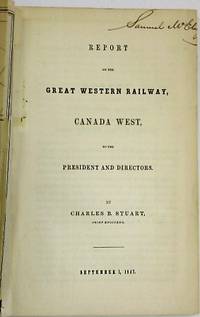
1847réf. 27881Ontario 1847. 47 1 blank pp plus two folding maps as issued: 'Map and Profile of the Great Western Railway Canada West' 48 1/2 cm x 32 cm; 'Map of the Route of the Great Western Railway Shewing its Connection with other Public Works' 35 1/2 cm x 29 cm. Versos with expertly repaired closed tears short margin tear else Very Good. The railroad is "on the precise ground that will enable it to control the trade and travel of such a vast portion of the Canadas and the prosperous American States." TPL 2850. Sabin 28478n. unknown
1847réf. 27881Ontario 1847. 47 1 blank pp plus two folding maps as issued: 'Map and Profile of the Great Western Railway Canada West' 48 1/2 cm x 32 cm; 'Map of the Route of the Great Western Railway Shewing its Connection with other Public Works' 35 1/2 cm x 29 cm. Versos with expertly repaired closed tears short margin tear else Very Good. The railroad is "on the precise ground that will enable it to control the trade and travel of such a vast portion of the Canadas and the prosperous American States." TPL 2850. Sabin 28478n. unknown books
1885réf. 41697Chicago: Rand McNally & Co. Printers and Engravers 1885. 1885. DAKOTA TERRITORY. RAILROAD. First edition. 7 5/8" x 5 3/8" original stapled printed wrappers 16 pp. map of the Chicago & North-Western Railway system on the back cover. Primarily a collection of signed testimonials from farmers and settlers solicited by the Railway offering firsthand accounts of their experiences farming and establishing homesteads in southeastern and central Dakota to include crop yields agricultural profits cattle raising land prices climate and the opportunities available to prospective settlers. Dakota is presented as a highly productive and desirable agricultural region emphasizing its inexpensive land abundant crops prosperous farms healthy climate and growing communities. The publication clearly intended to encourage immigration and settlement while promoting the railroad's extensive Dakota routes and the lands they served. Top corner of rear cover has been torn away but with minor influence on the railway system map else very good. Rand, McNally & Co., Printers and Engravers, [1885]. unknown
1927réf. 757H3005Vancouver British Columbia: Vancouver Girls' Corner Club 1927. Book. Good. Hardcover. First Edition. 8vo - over 7¾" - 9¾" tall. 127 pages. "The inspiration to compile this Cook Book came from an increasing desire to preserve the recipes of the delicious cakes served by the ladies of the various church organizations at the Tuesday night suppers of the club. This service has been faithfully rendered since 1917 when the Club was organized." - page 7. Several charming ads for local businesses including the British Columbia Electric Railway Co. which makes the case for housewives to convert to electric ranges "the modern method of cooking." Unmarked with moderate soiling and wear. A wonderful culinary memento of 1920s Vancouver. Bibliographic references: Driver B61.1 Hale 2606 Ferguson & Fraser p.233. Vancouver Girls' Corner Club Hardcover
1956réf. 732h5328British Columbia: Northern Sentinal Press 1956. Book. Illus. by Haddelsey Vincent. Good. Paperback. Signed by Authors. First Edition. 8vo - over 7¾" - 9¾" tall. Signed without inscription by author upon title page. pp. viii 46. "A selection of legends folk stories and customs of the Haisla people a branch of the Kwakiutl Indian language-group who live on the West Coast of British Columbia." - subtitle. Lovely line drawing illustrations. Sound and unmarked with light wear. A special first edition copy. Northern Sentinal Press Paperback
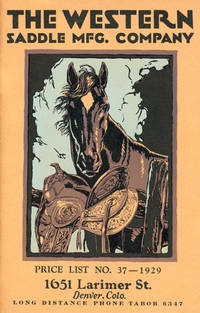
1929réf. 47745N. P. Denver: Privately printed 1929. 1929. SADDLES. First edition. 8vo. Pictorial wrappers front cover in color 72 pp. illustrated. The Western Saddle Mfg. Co. basically specialized in making and repairing saddles therefore the catalog offers 52 pages of various saddles and their descriptions. Also depicted are chaparejos bridles bits reins spurs spur straps saddle blankets and pads spur rowels cuffs etc. Fine bright copy with original order blank and addressed envelope laid-in. Also laid-in is the original addressed and stamped pictorial mailing envelope. Privately printed, 1929. unknown
1876réf. 143791876. The Press July 7 1876 is a Philadelphia newspaper issue preserving early Eastern reporting on the Battle of the Little Bighorn and the death of George Armstrong Custer one of the most widely mythologized military defeats of the American Indian Wars. The issue appeared less than two weeks after the June 25 to 26 1876 battle along the Little Bighorn River where Lakota Northern Cheyenne and Arapaho warriors fought the U.S. Army's 7th Cavalry in south-central Montana. Its front-page account is significant as a contemporary record of how Custer's death was immediately framed for urban newspaper readers during the nation's Centennial summer emphasizing sacrifice military honor and shock rather than the Indigenous defense of land and sovereignty now central to historical interpretation. The Press. Philadelphia Pennsylvania. July 7 1876. Four pages present comprising pages 1 2 7 and 8 only. The front page is dominated by war-related reporting with the lead story addressing dispatches to Generals William T. Sherman and Philip Sheridan and stating that the first reports of Custer's defeat were "only too true." The article suggests "Custer sacrificed himself and his command by blundering hardihood" while also elevating him in memorial language: "The name Custer is a household word" and "Custer fell-fell at the head of his command; fell where Death's sickle cut close and sure." The surviving front-page spread offers a concentrated example of immediate post-battle newspaper rhetoric combining battlefield uncertainty military chain-of-command reporting and heroic commemoration before later national mythologies of "Custer's Last Stand" had fully hardened. The issue's timing gives it research value for the study of Reconstruction-era print culture U.S. military expansion Indigenous resistance and the formation of public memory around the Plains Wars. As a Philadelphia paper published days after the battle became national news it shows how eastern readers encountered the event through telegraphic dispatches and editorialized martial language during a year otherwise dominated by Centennial commemoration. Incomplete with only pages 1 2 7 and 8 present; slight wear and small tears around edges; otherwise well preserved very good. A strong contemporary newspaper survival centered on the first wave of public reaction to Custer's defeat and the national reframing of Little Bighorn in the summer of 1876. unknown
1876réf. 143791876. The Press July 7 1876 is a Philadelphia newspaper issue preserving early Eastern reporting on the Battle of the Little Bighorn and the death of George Armstrong Custer one of the most widely mythologized military defeats of the American Indian Wars. The issue appeared less than two weeks after the June 25 to 26 1876 battle along the Little Bighorn River where Lakota Northern Cheyenne and Arapaho warriors fought the U.S. Army's 7th Cavalry in south-central Montana. Its front-page account is significant as a contemporary record of how Custer's death was immediately framed for urban newspaper readers during the nation's Centennial summer emphasizing sacrifice military honor and shock rather than the Indigenous defense of land and sovereignty now central to historical interpretation. The Press. Philadelphia Pennsylvania. July 7 1876. Four pages present comprising pages 1 2 7 and 8 only. The front page is dominated by war-related reporting with the lead story addressing dispatches to Generals William T. Sherman and Philip Sheridan and stating that the first reports of Custer's defeat were "only too true." The article suggests "Custer sacrificed himself and his command by blundering hardihood" while also elevating him in memorial language: "The name Custer is a household word" and "Custer fell-fell at the head of his command; fell where Death's sickle cut close and sure." The surviving front-page spread offers a concentrated example of immediate post-battle newspaper rhetoric combining battlefield uncertainty military chain-of-command reporting and heroic commemoration before later national mythologies of "Custer's Last Stand" had fully hardened. The issue's timing gives it research value for the study of Reconstruction-era print culture U.S. military expansion Indigenous resistance and the formation of public memory around the Plains Wars. As a Philadelphia paper published days after the battle became national news it shows how eastern readers encountered the event through telegraphic dispatches and editorialized martial language during a year otherwise dominated by Centennial commemoration. Incomplete with only pages 1 2 7 and 8 present; slight wear and small tears around edges; otherwise well preserved very good. A strong contemporary newspaper survival centered on the first wave of public reaction to Custer's defeat and the national reframing of Little Bighorn in the summer of 1876. unknown books
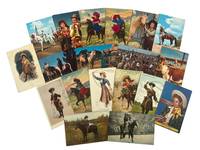
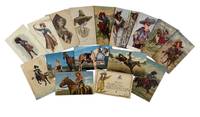
1890réf. 212411890. Archive of illustrated and photographic postcards documenting the popular image of the American cowgirl in late nineteenth- and early twentieth-century Western visual culture. Working in Cultural / Representational Mode the material traces how women participating in rodeo equestrian performance and frontier-themed entertainment were presented to mass audiences during a period when gender conventions in the United States remained heavily tied to domestic ideals. The postcards illustrate popular fascination with female riders engaged in activities associated with masculine frontier labor and spectacle including trick riding roping horse handling and armed performance. The archive also provides insight into the commercialization of the American West through souvenir imagery touring exhibitions rodeos and romanticized frontier iconography circulated through postcard publishing during the first half of the twentieth century. Collection consists of 19 postcards dating from approximately the 1890s through the 1950s including primarily colored lithograph and chromolithograph postcards alongside several later colored real photo postcards. Most measure approximately 3.5 x 5.25 inches. Images depict cowgirls mounted on horseback using lassoes pistols and whips in staged action scenes including bucking galloping roping demonstrations and parade formations. Earlier cards portray women riders wearing skirts or dresses while mounted reflecting transitional equestrian fashions prior to the widespread normalization of riding trousers for women during the 1920s. One postcard depicts a "Grand Entry" scene featuring numerous mounted cowboys and cowgirls carrying national flags from various countries suggesting an international rodeo or exhibition setting. Another early color postcard shows a man and woman posed together on horseback in cowboy attire. A postcard postmarked 1951 depicts a cowgirl tending to her horse and bears the handwritten verso inscription: "How we long for you in Fort Worth horses and more horses cowgirls too" addressed to Alabama. Several additional cards contain handwritten correspondence and postal markings dated between 1906 and 1908. The archive documents the enduring cultural construction of the cowgirl as both frontier laborer and commercial entertainment figure during the height of Western Americana imagery in American popular culture. The postcards capture changing attitudes toward women's athleticism mobility and public performance while preserving highly stylized depictions disseminated through inexpensive mass-produced print media. Particularly notable is the tension visible between conventional feminine presentation and physically demanding equestrian activity especially in the earlier cards depicting women riding aggressively while still dressed in skirts and formal attire. Minor edgewear scattered markings and light handling wear to some cards; overall very good condition. A cohesive visual archive of cowgirl imagery and the gendered mythology of the American West across more than half a century of postcard production. unknown
1890réf. 212421890. Archive of postcards documenting the popular image of the American cowgirl in Western Americana and early twentieth-century mass visual culture. Working in Cultural / Representational Mode the material illustrates how women participating in rodeo performance equestrian spectacle and frontier-themed entertainment were presented to national audiences during a period when women's public roles remained heavily circumscribed by conventional gender expectations. The postcards emphasize physical skill horseback mobility and frontier self-sufficiency through repeated depictions of women handling lassos firearms and bucking horses. Collectively the archive offers insight into the commercialization of the American West and the circulation of gendered frontier mythology through inexpensive illustrated print media from the late nineteenth century through the postwar period. Collection consists of 16 postcards dating approximately from the 1890s through the 1950s including early colored lithographs chromolithographs and colored real photo postcards. Each measures approximately 3.5 x 5.25 inches. Images portray cowgirls mounted on horseback in a variety of staged action scenes including lasso throwing galloping bucking and trick riding performances. Many women wear fitted riding outfits cowboy hats bandoliers holsters and western boots while posed with rifles pistols whips or ropes against rugged frontier backdrops. Several postcards emphasize dramatic movement with horses shown rearing trotting or in mid-action poses. The repeated use of lassos and firearms visually aligns the women with iconography traditionally associated with male cowboys in Wild West shows rodeo advertising and popular Western entertainment. Some postcards retain handwritten inscriptions on the versos. The archive preserves a long-running commercial visual tradition in which the cowgirl functioned simultaneously as frontier worker entertainer and symbol of female independence within American popular culture. Particularly notable is the tension between conventional femininity and the rugged physicality emphasized throughout the imagery with the women consistently portrayed as active riders and performers rather than domestic figures. The postcards also document the persistence of Western mythology across changing photographic and print technologies during the first half of the twentieth century. Minor edgewear and scattered markings to some cards; overall very good condition. A visually cohesive grouping documenting representations of women in frontier and rodeo culture across more than five decades of American postcard production. unknown