8 890 résultats
1927réf. 757H3005Vancouver British Columbia: Vancouver Girls' Corner Club 1927. Book. Good. Hardcover. First Edition. 8vo - over 7¾" - 9¾" tall. 127 pages. "The inspiration to compile this Cook Book came from an increasing desire to preserve the recipes of the delicious cakes served by the ladies of the various church organizations at the Tuesday night suppers of the club. This service has been faithfully rendered since 1917 when the Club was organized." - page 7. Several charming ads for local businesses including the British Columbia Electric Railway Co. which makes the case for housewives to convert to electric ranges "the modern method of cooking." Unmarked with moderate soiling and wear. A wonderful culinary memento of 1920s Vancouver. Bibliographic references: Driver B61.1 Hale 2606 Ferguson & Fraser p.233. Vancouver Girls' Corner Club Hardcover
1956réf. 732h5328British Columbia: Northern Sentinal Press 1956. Book. Illus. by Haddelsey Vincent. Good. Paperback. Signed by Authors. First Edition. 8vo - over 7¾" - 9¾" tall. Signed without inscription by author upon title page. pp. viii 46. "A selection of legends folk stories and customs of the Haisla people a branch of the Kwakiutl Indian language-group who live on the West Coast of British Columbia." - subtitle. Lovely line drawing illustrations. Sound and unmarked with light wear. A special first edition copy. Northern Sentinal Press Paperback
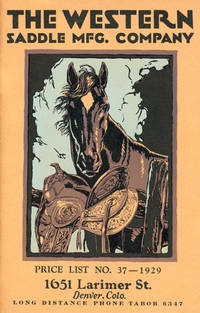
1929réf. 47745N. P. Denver: Privately printed 1929. 1929. SADDLES. First edition. 8vo. Pictorial wrappers front cover in color 72 pp. illustrated. The Western Saddle Mfg. Co. basically specialized in making and repairing saddles therefore the catalog offers 52 pages of various saddles and their descriptions. Also depicted are chaparejos bridles bits reins spurs spur straps saddle blankets and pads spur rowels cuffs etc. Fine bright copy with original order blank and addressed envelope laid-in. Also laid-in is the original addressed and stamped pictorial mailing envelope. Privately printed, 1929. unknown
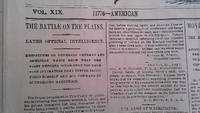
1876réf. 143791876. The Press July 7 1876 is a Philadelphia newspaper issue preserving early Eastern reporting on the Battle of the Little Bighorn and the death of George Armstrong Custer one of the most widely mythologized military defeats of the American Indian Wars. The issue appeared less than two weeks after the June 25 to 26 1876 battle along the Little Bighorn River where Lakota Northern Cheyenne and Arapaho warriors fought the U.S. Army's 7th Cavalry in south-central Montana. Its front-page account is significant as a contemporary record of how Custer's death was immediately framed for urban newspaper readers during the nation's Centennial summer emphasizing sacrifice military honor and shock rather than the Indigenous defense of land and sovereignty now central to historical interpretation. The Press. Philadelphia Pennsylvania. July 7 1876. Four pages present comprising pages 1 2 7 and 8 only. The front page is dominated by war-related reporting with the lead story addressing dispatches to Generals William T. Sherman and Philip Sheridan and stating that the first reports of Custer's defeat were "only too true." The article suggests "Custer sacrificed himself and his command by blundering hardihood" while also elevating him in memorial language: "The name Custer is a household word" and "Custer fell-fell at the head of his command; fell where Death's sickle cut close and sure." The surviving front-page spread offers a concentrated example of immediate post-battle newspaper rhetoric combining battlefield uncertainty military chain-of-command reporting and heroic commemoration before later national mythologies of "Custer's Last Stand" had fully hardened. The issue's timing gives it research value for the study of Reconstruction-era print culture U.S. military expansion Indigenous resistance and the formation of public memory around the Plains Wars. As a Philadelphia paper published days after the battle became national news it shows how eastern readers encountered the event through telegraphic dispatches and editorialized martial language during a year otherwise dominated by Centennial commemoration. Incomplete with only pages 1 2 7 and 8 present; slight wear and small tears around edges; otherwise well preserved very good. A strong contemporary newspaper survival centered on the first wave of public reaction to Custer's defeat and the national reframing of Little Bighorn in the summer of 1876. unknown
1876réf. 143791876. The Press July 7 1876 is a Philadelphia newspaper issue preserving early Eastern reporting on the Battle of the Little Bighorn and the death of George Armstrong Custer one of the most widely mythologized military defeats of the American Indian Wars. The issue appeared less than two weeks after the June 25 to 26 1876 battle along the Little Bighorn River where Lakota Northern Cheyenne and Arapaho warriors fought the U.S. Army's 7th Cavalry in south-central Montana. Its front-page account is significant as a contemporary record of how Custer's death was immediately framed for urban newspaper readers during the nation's Centennial summer emphasizing sacrifice military honor and shock rather than the Indigenous defense of land and sovereignty now central to historical interpretation. The Press. Philadelphia Pennsylvania. July 7 1876. Four pages present comprising pages 1 2 7 and 8 only. The front page is dominated by war-related reporting with the lead story addressing dispatches to Generals William T. Sherman and Philip Sheridan and stating that the first reports of Custer's defeat were "only too true." The article suggests "Custer sacrificed himself and his command by blundering hardihood" while also elevating him in memorial language: "The name Custer is a household word" and "Custer fell-fell at the head of his command; fell where Death's sickle cut close and sure." The surviving front-page spread offers a concentrated example of immediate post-battle newspaper rhetoric combining battlefield uncertainty military chain-of-command reporting and heroic commemoration before later national mythologies of "Custer's Last Stand" had fully hardened. The issue's timing gives it research value for the study of Reconstruction-era print culture U.S. military expansion Indigenous resistance and the formation of public memory around the Plains Wars. As a Philadelphia paper published days after the battle became national news it shows how eastern readers encountered the event through telegraphic dispatches and editorialized martial language during a year otherwise dominated by Centennial commemoration. Incomplete with only pages 1 2 7 and 8 present; slight wear and small tears around edges; otherwise well preserved very good. A strong contemporary newspaper survival centered on the first wave of public reaction to Custer's defeat and the national reframing of Little Bighorn in the summer of 1876. unknown books
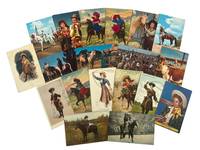
1890réf. 212411890. Archive of illustrated and photographic postcards documenting the popular image of the American cowgirl in late nineteenth- and early twentieth-century Western visual culture. Working in Cultural / Representational Mode the material traces how women participating in rodeo equestrian performance and frontier-themed entertainment were presented to mass audiences during a period when gender conventions in the United States remained heavily tied to domestic ideals. The postcards illustrate popular fascination with female riders engaged in activities associated with masculine frontier labor and spectacle including trick riding roping horse handling and armed performance. The archive also provides insight into the commercialization of the American West through souvenir imagery touring exhibitions rodeos and romanticized frontier iconography circulated through postcard publishing during the first half of the twentieth century. Collection consists of 19 postcards dating from approximately the 1890s through the 1950s including primarily colored lithograph and chromolithograph postcards alongside several later colored real photo postcards. Most measure approximately 3.5 x 5.25 inches. Images depict cowgirls mounted on horseback using lassoes pistols and whips in staged action scenes including bucking galloping roping demonstrations and parade formations. Earlier cards portray women riders wearing skirts or dresses while mounted reflecting transitional equestrian fashions prior to the widespread normalization of riding trousers for women during the 1920s. One postcard depicts a "Grand Entry" scene featuring numerous mounted cowboys and cowgirls carrying national flags from various countries suggesting an international rodeo or exhibition setting. Another early color postcard shows a man and woman posed together on horseback in cowboy attire. A postcard postmarked 1951 depicts a cowgirl tending to her horse and bears the handwritten verso inscription: "How we long for you in Fort Worth horses and more horses cowgirls too" addressed to Alabama. Several additional cards contain handwritten correspondence and postal markings dated between 1906 and 1908. The archive documents the enduring cultural construction of the cowgirl as both frontier laborer and commercial entertainment figure during the height of Western Americana imagery in American popular culture. The postcards capture changing attitudes toward women's athleticism mobility and public performance while preserving highly stylized depictions disseminated through inexpensive mass-produced print media. Particularly notable is the tension visible between conventional feminine presentation and physically demanding equestrian activity especially in the earlier cards depicting women riding aggressively while still dressed in skirts and formal attire. Minor edgewear scattered markings and light handling wear to some cards; overall very good condition. A cohesive visual archive of cowgirl imagery and the gendered mythology of the American West across more than half a century of postcard production. unknown
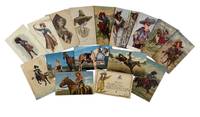
1890réf. 212421890. Archive of postcards documenting the popular image of the American cowgirl in Western Americana and early twentieth-century mass visual culture. Working in Cultural / Representational Mode the material illustrates how women participating in rodeo performance equestrian spectacle and frontier-themed entertainment were presented to national audiences during a period when women's public roles remained heavily circumscribed by conventional gender expectations. The postcards emphasize physical skill horseback mobility and frontier self-sufficiency through repeated depictions of women handling lassos firearms and bucking horses. Collectively the archive offers insight into the commercialization of the American West and the circulation of gendered frontier mythology through inexpensive illustrated print media from the late nineteenth century through the postwar period. Collection consists of 16 postcards dating approximately from the 1890s through the 1950s including early colored lithographs chromolithographs and colored real photo postcards. Each measures approximately 3.5 x 5.25 inches. Images portray cowgirls mounted on horseback in a variety of staged action scenes including lasso throwing galloping bucking and trick riding performances. Many women wear fitted riding outfits cowboy hats bandoliers holsters and western boots while posed with rifles pistols whips or ropes against rugged frontier backdrops. Several postcards emphasize dramatic movement with horses shown rearing trotting or in mid-action poses. The repeated use of lassos and firearms visually aligns the women with iconography traditionally associated with male cowboys in Wild West shows rodeo advertising and popular Western entertainment. Some postcards retain handwritten inscriptions on the versos. The archive preserves a long-running commercial visual tradition in which the cowgirl functioned simultaneously as frontier worker entertainer and symbol of female independence within American popular culture. Particularly notable is the tension between conventional femininity and the rugged physicality emphasized throughout the imagery with the women consistently portrayed as active riders and performers rather than domestic figures. The postcards also document the persistence of Western mythology across changing photographic and print technologies during the first half of the twentieth century. Minor edgewear and scattered markings to some cards; overall very good condition. A visually cohesive grouping documenting representations of women in frontier and rodeo culture across more than five decades of American postcard production. unknown
1890réf. 212411890. Archive of illustrated and photographic postcards documenting the popular image of the American cowgirl in late nineteenth- and early twentieth-century Western visual culture. Working in Cultural / Representational Mode the material traces how women participating in rodeo equestrian performance and frontier-themed entertainment were presented to mass audiences during a period when gender conventions in the United States remained heavily tied to domestic ideals. The postcards illustrate popular fascination with female riders engaged in activities associated with masculine frontier labor and spectacle including trick riding roping horse handling and armed performance. The archive also provides insight into the commercialization of the American West through souvenir imagery touring exhibitions rodeos and romanticized frontier iconography circulated through postcard publishing during the first half of the twentieth century. Collection consists of 19 postcards dating from approximately the 1890s through the 1950s including primarily colored lithograph and chromolithograph postcards alongside several later colored real photo postcards. Most measure approximately 3.5 x 5.25 inches. Images depict cowgirls mounted on horseback using lassoes pistols and whips in staged action scenes including bucking galloping roping demonstrations and parade formations. Earlier cards portray women riders wearing skirts or dresses while mounted reflecting transitional equestrian fashions prior to the widespread normalization of riding trousers for women during the 1920s. One postcard depicts a "Grand Entry" scene featuring numerous mounted cowboys and cowgirls carrying national flags from various countries suggesting an international rodeo or exhibition setting. Another early color postcard shows a man and woman posed together on horseback in cowboy attire. A postcard postmarked 1951 depicts a cowgirl tending to her horse and bears the handwritten verso inscription: "How we long for you in Fort Worth horses and more horses cowgirls too" addressed to Alabama. Several additional cards contain handwritten correspondence and postal markings dated between 1906 and 1908. The archive documents the enduring cultural construction of the cowgirl as both frontier laborer and commercial entertainment figure during the height of Western Americana imagery in American popular culture. The postcards capture changing attitudes toward women's athleticism mobility and public performance while preserving highly stylized depictions disseminated through inexpensive mass-produced print media. Particularly notable is the tension visible between conventional feminine presentation and physically demanding equestrian activity especially in the earlier cards depicting women riding aggressively while still dressed in skirts and formal attire. Minor edgewear scattered markings and light handling wear to some cards; overall very good condition. A cohesive visual archive of cowgirl imagery and the gendered mythology of the American West across more than half a century of postcard production. unknown books
1890réf. 212421890. Archive of postcards documenting the popular image of the American cowgirl in Western Americana and early twentieth-century mass visual culture. Working in Cultural / Representational Mode the material illustrates how women participating in rodeo performance equestrian spectacle and frontier-themed entertainment were presented to national audiences during a period when women's public roles remained heavily circumscribed by conventional gender expectations. The postcards emphasize physical skill horseback mobility and frontier self-sufficiency through repeated depictions of women handling lassos firearms and bucking horses. Collectively the archive offers insight into the commercialization of the American West and the circulation of gendered frontier mythology through inexpensive illustrated print media from the late nineteenth century through the postwar period. Collection consists of 16 postcards dating approximately from the 1890s through the 1950s including early colored lithographs chromolithographs and colored real photo postcards. Each measures approximately 3.5 x 5.25 inches. Images portray cowgirls mounted on horseback in a variety of staged action scenes including lasso throwing galloping bucking and trick riding performances. Many women wear fitted riding outfits cowboy hats bandoliers holsters and western boots while posed with rifles pistols whips or ropes against rugged frontier backdrops. Several postcards emphasize dramatic movement with horses shown rearing trotting or in mid-action poses. The repeated use of lassos and firearms visually aligns the women with iconography traditionally associated with male cowboys in Wild West shows rodeo advertising and popular Western entertainment. Some postcards retain handwritten inscriptions on the versos. The archive preserves a long-running commercial visual tradition in which the cowgirl functioned simultaneously as frontier worker entertainer and symbol of female independence within American popular culture. Particularly notable is the tension between conventional femininity and the rugged physicality emphasized throughout the imagery with the women consistently portrayed as active riders and performers rather than domestic figures. The postcards also document the persistence of Western mythology across changing photographic and print technologies during the first half of the twentieth century. Minor edgewear and scattered markings to some cards; overall very good condition. A visually cohesive grouping documenting representations of women in frontier and rodeo culture across more than five decades of American postcard production. unknown books
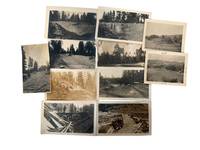
1920réf. 235991920. Western logging and resource extraction photo archive circa 1925 to 1940 documenting the engineering labor and transportation systems that supported industrial development across the American West. The photographs record the transformation of forests and mountain landscapes into organized production sites through road construction surveying bridge building temporary camps and mechanized earthmoving. Their emphasis falls not on harvested timber alone but on the infrastructure that allowed western pine forests and mineral resources to be exploited on an industrial scale during the period when the Western Pine Association promoted standardized forestry practices and expanding commercial lumber production throughout the Pacific Coast states. Photo archive of 11 silver gelatin photographs approximately 3.5 x 4.5 inches Northern California Oregon and Arizona circa 1925 to 1940. The photographs show crews grading wide logging roads with early bulldozers and earthmoving equipment; surveyors laying out roadbeds with transits and leveling rods; timber bridges and heavy wooden structures under construction; logging camps with canvas bunkhouses and workers posed outside camp buildings; cultivated fields and company gardens established beside mountain camps; and forest clearings where wagons equipment and draft animals remain in use alongside mechanized machinery. Two photographs depict Arizona mining operations and retain contemporary manuscript captions on the versos. One reads "This is a view of the sluice box before it is quite done has a large or tall gin pole to be put up above hopper for pulleys to work on." Another identifies a camp and garden noting "This is a picture of the camp and garden and in the back ground can see the sluice box in the canyon." Several images appear to have been produced as documentation of western pine logging operations possibly in connection with the Western Pine Association or a related lumber concern. The archive belongs to the decades when western timber companies shifted from rail centered logging toward increasingly extensive truck roads crawler tractors and mechanized grading allowing commercial harvesting to penetrate previously inaccessible stands of ponderosa pine and mixed conifer forests in Northern California and Oregon. Founded in 1916 the Western Pine Association encouraged scientific forestry standardized lumber grading and modern logging methods as western pine became one of the nation's principal building materials during the interwar years and the approach to the Second World War. The Arizona views complement this narrative by documenting comparable engineering practices in western mining where sluice boxes temporary camps and improvised lifting systems illustrate the labor required before mechanized extraction reached full capacity. Particularly notable is the absence of hard hats and modern protective equipment reflecting industrial work before federal occupational safety regulations fundamentally altered logging and construction practices after the creation of OSHA in 1970. Light surface wear occasional corner rubbing and minor silvering; overall in very good condition. A concentrated visual record of the engineering labor and temporary infrastructure that made large scale timber and mineral extraction possible across the early twentieth century American West. unknown
1920réf. 235991920. Western logging and resource extraction photo archive circa 1925 to 1940 documenting the engineering labor and transportation systems that supported industrial development across the American West. The photographs record the transformation of forests and mountain landscapes into organized production sites through road construction surveying bridge building temporary camps and mechanized earthmoving. Their emphasis falls not on harvested timber alone but on the infrastructure that allowed western pine forests and mineral resources to be exploited on an industrial scale during the period when the Western Pine Association promoted standardized forestry practices and expanding commercial lumber production throughout the Pacific Coast states. Photo archive of 11 silver gelatin photographs approximately 3.5 x 4.5 inches Northern California Oregon and Arizona circa 1925 to 1940. The photographs show crews grading wide logging roads with early bulldozers and earthmoving equipment; surveyors laying out roadbeds with transits and leveling rods; timber bridges and heavy wooden structures under construction; logging camps with canvas bunkhouses and workers posed outside camp buildings; cultivated fields and company gardens established beside mountain camps; and forest clearings where wagons equipment and draft animals remain in use alongside mechanized machinery. Two photographs depict Arizona mining operations and retain contemporary manuscript captions on the versos. One reads "This is a view of the sluice box before it is quite done has a large or tall gin pole to be put up above hopper for pulleys to work on." Another identifies a camp and garden noting "This is a picture of the camp and garden and in the back ground can see the sluice box in the canyon." Several images appear to have been produced as documentation of western pine logging operations possibly in connection with the Western Pine Association or a related lumber concern. The archive belongs to the decades when western timber companies shifted from rail centered logging toward increasingly extensive truck roads crawler tractors and mechanized grading allowing commercial harvesting to penetrate previously inaccessible stands of ponderosa pine and mixed conifer forests in Northern California and Oregon. Founded in 1916 the Western Pine Association encouraged scientific forestry standardized lumber grading and modern logging methods as western pine became one of the nation's principal building materials during the interwar years and the approach to the Second World War. The Arizona views complement this narrative by documenting comparable engineering practices in western mining where sluice boxes temporary camps and improvised lifting systems illustrate the labor required before mechanized extraction reached full capacity. Particularly notable is the absence of hard hats and modern protective equipment reflecting industrial work before federal occupational safety regulations fundamentally altered logging and construction practices after the creation of OSHA in 1970. Light surface wear occasional corner rubbing and minor silvering; overall in very good condition. A concentrated visual record of the engineering labor and temporary infrastructure that made large scale timber and mineral extraction possible across the early twentieth century American West. unknown books
1842réf. 75315London: C. Dolman 1842. First Edition. Hardcover. Very Good. London C. Dolman 1842. Octavo 27 pages in a total of ii 564 2 pages. Original ribbed cloth with a paper title-label on the spine; cloth a little marked and sunned; label a little chipped and sunned; small blank piece torn from the bottom corner of eight leaves not part of the relevant article; endpapers and first and last leaves foxed; an excellent copy. Pages 74-100 contain an article drawn from Grey's 'Journals of Two Expeditions of Discovery in North-West and Western Australia' published the previous year and George Moore's extremely rare pamphlet 'Evidences of an Inland Sea collected from the Natives of the Swan River Settlement' Dublin 1837. C. Dolman hardcover
2012réf. Manohar-9780415695398Routledge 2012. Hardcover. New. Routledge hardcover
2012réf. Manohar-9780415695398Routledge 2012. Hardcover. New. Routledge hardcover
2012réf. SKU0206858Routledge 2012-01-26. Hardcover. Good. Textbook May Have Highlights Notes and/or Underlining BOOK ONLY-NO ACCESS CODE NO CD Ships with Tracking Routledge hardcover
19228vo., First Edition, with plates and 4 maps on 3 folders at end, some relevant annotation in red pencil; handsomely bound in dark red full morocco, sides ruled in gilt, back with raised bands lettered and ruled in gilt, divisional insignia from upper board preserved and mounted on new leaf at front, a most attractive copy ideal as a gift or for presentation. This copy was formerly in the library of a member of 16th Devon (Yeomanry) Battn, attached 74th Division, and bears his signature on front free endpaper. 'The division was formed in the course of the Palestine Campaign from dismounted Yeomanry regiments. It undoubtedly contained some of the finest material that Britain ever put into the field. Having taken a leading part in the Third Battle of Gaza and the capture of Jerusalem, it was sent to France in the Spring of 1918 where it again distinguished itself. A clear and well-informed record of its career.' (Falls). VERY SCARCE. Enser, p62; Falls. p.132 (star for quality)
réf. 65830, Brepols, 2020 Hardback, xliv + 670 pages, Size:155 x 245 mm, Languages: Latin, French, English. ISBN 9782503004150.
19498vo., First Edition, with portrait frontispiece, 14 plates on 11 and 3 folding maps (2 coloured), some barely discernible offsetting from fold-ins to free endpapers; red cloth, gilt back, red top, fore-edge lightly spotted else a near fine copy copy in unclipped dustwrapper, the latter lightly browned at backstrip. A classic of its time, recalling Maclean's Buchan-like experiences before and during WWII. Includes coverage of the Moscow State Trials, operating with LRDG in the Western Desert, kidnapping a general and being dropped in occupied Europe as Churchill's personal envoy to Tito. THE ORIGINAL EDITIONS IS SCARCE IN THIS CONDITION. Enser, p.481.
1849réf. 89449Agra: The Secundra Orphan Press 1849-51. First editions. Interesting collection of technical papers relating to the government of the North Western Provinces. Includes the description of a bridge built at Seoni by Major Boileau with plan; detailed plans for the cutting of a canal from the Sutlej at Tihara with excellent maps; an account of the "Oothaeegeeras" or Sunoreahs "professional thieves of Bundelcund" including a glossary of "Bolee" their argot; a important "Report upon the Tea Plantations in the North Western Provinces" by Robert Fortune noted botanist and plant collector for the HEIC; together with some revenue surveys of the region submitted by William Muir as secretary of the revenue board to John Thomason the lieutenant-governor. Attractive group of uncommon Indian imprints. Octavo 200 x 126 mm Twentieth-century blue cloth title gilt to the spine original upper wrappers bound in. pp. ii 66-108 3 folding lithographic maps with colour; pp. ii 213-250 folding lithographic map and 3 folding letter-press table; ii 251-286pp. folding letter-press table and tables to the text. Cloth clean and sound Patent Office Library ink-stamps to the wrappers maps and occasionally to the text light toning overall very good. hardcover
1966réf. ZB393059Western Literature Association 1966. Volumes 1-17 1966-1983 an uninterrupted run of complete volumes partly bound library markings textually clean & tight price is for the lot. - If you are reading this this item is actually physically in our stock and ready for shipment once ordered. We are not bookjackers. Buyer is responsible for any additional duties taxes or fees required by recipient's country. Photos available upon request. Western Literature Association unknown
réf. 12215La collection Pilote présente une aventure du Lieutenant BLUEBERRY. In 4 cartonné couverture illustrée en couleurs, gardes illustrées, titre illustré en couleurs, 48 pages de dessins en couleurs de J. GIRAUD. Titre en long, en noir au dos. DARGAUD S.A éditeur troisième trimestre 1963. N°553. Editeur n°158, 16 titres au dernier plat. Très bon état. Edition originale.
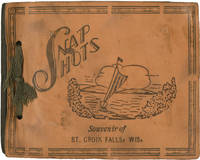
1940réf. 154291St. Croix Falls WI: N.p. 1940. Vintage string bound photograph album containing 31 black-and-white snapshot photographs including four hand-tinted in blue and yellow documenting a school costume day. Manuscript ink annotation to the inside front cover provides the date and album title: "Dress-Up-Day Pictures / April 5 1940". Many photographs with manuscript ink annotation captions to the bottom edges identifying the subjects. The outfits run the gamut: while some teens opted for simple cross-dressing costumes many were more creative dressing as cowboys hula girls hoboes married couples and the like. Notably unusual costumes include an ice box Life Magazine a beer barrel a telephone directory several rolls of Tums and a record player with a paper sign noting the record title as Rhapsody in Blue. A humorous assortment. Photographs generally 2.5 x 3.5 inches. Mounted on black cardboard album leaves rectos and versos. Near Fine. N.p. unknown
1940réf. 154291St. Croix Falls WI: N.p. 1940. Vintage string bound photograph album containing 31 black-and-white snapshot photographs including four hand-tinted in blue and yellow documenting a school costume day. Manuscript ink annotation to the inside front cover provides the date and album title: "Dress-Up-Day Pictures / April 5 1940". Many photographs with manuscript ink annotation captions to the bottom edges identifying the subjects. The outfits run the gamut: while some teens opted for simple cross-dressing costumes many were more creative dressing as cowboys hula girls hoboes married couples and the like. Notably unusual costumes include an ice box Life Magazine a beer barrel a telephone directory several rolls of Tums and a record player with a paper sign noting the record title as Rhapsody in Blue. A humorous assortment. Photographs generally 2.5 x 3.5 inches. Mounted on black cardboard album leaves rectos and versos. Near Fine. N.p. unknown books
1941réf. TB33750Washington DC: U.S. Department of the Interior National Park Service WPA and CCC 1941. First Edition. Both volumes of this complete two volume set are in very good and near fine conditions. Both are small quartos of 10 1/4 by 7 3/4 inches bound in adhesive bindings in light brown cloth covered boards with darker brown text on the spines and front boards. The cloth at the head and heel of volume I is rubbed and worn and the upper fore corners of the front and rear boards are bumped but professionally straightened and strengthened. Volume II shows only light wear to the cloth at the head of the spine and the text block for this volume was made from two-hole punched paper. Volume I is made from standard un-holed paper. Both volumes contain four index tabs each. In volume I: Northwest Inland States; Pacific States; Yellowstone; and Yosemite; Volume II: Central States Southwestern National Monuments; Southwestern States; and Territorial Parks and Monuments. These two volumes contain 664 pages of bibliographies on 79 national parks and national monuments each one with its own pagination. This bibliography is not listed in any of the WPA or American Guide resources held by Town's End Books. OCLC locates only five institutions owning the book version of this title. The forward contained in volume I mentions that this project started in 1936 with: where "much credit is due Mrs. Hazel Hunt Voth for originally laying out the program and directing it until her resignation in April 1939." Hazel Voth's other other major accomplishment was A Bibliography of Yellowstone National Park which is reprinted in this set. U.S. Department of the Interior, National Park Service, WPA and CCC hardcover
1941réf. TB33750Washington DC: U.S. Department of the Interior National Park Service WPA and CCC 1941. First Edition. Both volumes of this complete two volume set are in very good and near fine conditions. Both are small quartos of 10 1/4 by 7 3/4 inches bound in adhesive bindings in light brown cloth covered boards with darker brown text on the spines and front boards. The cloth at the head and heel of volume I is rubbed and worn and the upper fore corners of the front and rear boards are bumped but professionally straightened and strengthened. Volume II shows only light wear to the cloth at the head of the spine and the text block for this volume was made from two-hole punched paper. Volume I is made from standard un-holed paper. Both volumes contain four index tabs each. In volume I: Northwest Inland States; Pacific States; Yellowstone; and Yosemite; Volume II: Central States Southwestern National Monuments; Southwestern States; and Territorial Parks and Monuments. These two volumes contain 664 pages of bibliographies on 79 national parks and national monuments each one with its own pagination. This bibliography is not listed in any of the WPA or American Guide resources held by Town's End Books. OCLC locates only five institutions owning the book version of this title. The forward contained in volume I mentions that this project started in 1936 with: where "much credit is due Mrs. Hazel Hunt Voth for originally laying out the program and directing it until her resignation in April 1939." Hazel Voth's other other major accomplishment was A Bibliography of Yellowstone National Park which is reprinted in this set. U.S. Department of the Interior, National Park Service, WPA and CCC hardcover books