8 906 résultats
1906réf. 9347London 1906. Edwardian station map approx 40 x 60 inches this example 101 x 150.5 cm printed in colours some restoration with small areas of loss along the folds made good blank verso. Un-titled undated and without a printer this exceptionally scarce early poster was created for display in stations but establishing which ones presents a challenge. We can date it with reasonable confidence to 1906 or perhaps a fraction earlier. Our map predates the western extension of the Central London Railway to Wood Lane which opened for the Franco-British Exhibition in 1908. Angel is still shown as the terminus of the City & South London Railway but the western extension to Euston which opened in May 1907 is under construction. The use of a green border appears to be a nod to the successful series of green-bordered UERL Underground Group maps but as those were introduced in 1907 it might be the other way around. Another unusual design feature is the two tone shading in line colours of the names of interchange stations such as The Bank. The Bakerloo Line which opened in March 1906 appears to be shown as a thin dotted black line but as it was owned by the rival UERL its use for dating purposes cannot be guaranteed: this is most emphatically not a UERL map. Just three underground lines are highlighted none of which was under the UERL umbrella in 1906: The Central London Railway the City & South London Railway and the Great Northern & City Railway the first two purchased by the UERL and the latter by the Metropolitan Railway all in 1913. Two mainline companies are featured: the Great Northern Railway with its terminus at Finsbury Park and the Great Western Railway which served Paddington. Of these two the GWR is far more prominent with an inset showing the route to Reading. The map promotes travel across London using the highlighted routes at the expense of all others including the UERL: all are razor thin black and unobtrusive with no further differentiation between underground mainline and suburban services and seemingly haphazard naming of stations. It seems likely that our map was a joint response by three of the independent underground railway companies to the growing power of the UERL possibly in co-operation with the GWR and was created for display in any of their stations. We have been unable to locate another example. Map unknown
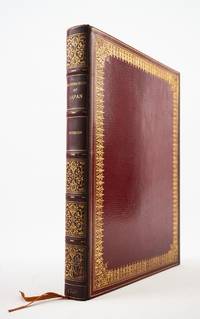
1822réf. ST20877London: Printed for R. Ackermann 1822. First English Edition. 300 x 235 mm. 11 3/4 x 9 1/2". xvi 325 1 pp.Translated by Frederic Shoberl. Imposing contemporary crimson straight-grain morocco gilt covers with filigree frame with densely massed scrolling fleurons raised bands spine gilt in compartments with radiating viny scrolls surrounded by leaves and annular dots marbled endleaves all edges gilt. WITH 13 HAND-COLORED PLATES in etching and aquatint many after Japanese artworks one folding. Bookplate removed from front flyleaf. Bookseller's ticket of J. L. Thompson & Co Kobe Japan on front pastedown. Abbey Travel 557; Tooley 489; Martin Hardie "English Coloured Books" pp. 113-14. See also E. F. Strange "Japanese Illustration" pp. xxiii-xxiv. Spine and fore-edge of upper board slightly darkened a few minute flakes to lowest spine compartment but the binding extremely well preserved with very lustrous boards. Final 10 leaves slightly creased one repaired marginal tear but still A FINE COPY INTERNALLY exceptionally bright smooth and entirely fresh and clean. This generously proportioned production illustrated with 13 vibrant colored plates is a rare European account of Japan during the period in which the country was "closed" to the west offered here in its first English edition. Originally published in French in 1820 "Illustrations of Japan" is comprised of a history and description of the Tokugawa shogunate which Titsingh had translated from the Japanese plus Titsingh's own observations on the language customs and ceremonies of the Japanese people. The present English edition is accompanied by plates in etching and aquatint enhanced with hand coloring. Our author Dutch diplomat Isaac Titsingh 1745-1812 spent 14 years in Nagasaki for the Dutch East India company and between 1779-84 he served as trade director-cum-ambassador travelling to Edo now Tokyo for audiences with the shogun and other high officials in the shogunate. Unlike most of his Western contemporaries Titsingh was open-minded and curious about the people he encountered engaging with their art and culture; in fact art historian and Victoria & Albert Museum keeper Edward F. Strange tells us that Titsingh is the earliest known European collector of Japanese prints of which a number appear in the present volume. Our publisher Rudolph Ackermann 1764-1834 made his living issuing sumptuously illustrated books such as the present volume and was an early adopter of color aquatint and lithography technologies; Hardie writes that he was "the great presiding genius before whose magic wand so many pictorial books sprang into existence." In very attractive period morocco this is a particularly appealing copy of the work free of the foxing and offsetting that often plague copies of this and other large-format color illustrated books. Printed for R. Ackermann unknown
1924A modern Jew, perhaps for the first time, analyzes western civilization as an expression of the Gentile way of life and shows where this clashes with the nature and spiritual impulses of the Jew. - paraphrased from front flap of replica dust jacket included with this copy. "We Jews, we, the destroyers, will remain the destroyers for ever. Nothing that you will do will meet our needs and demands - The wretched fate which scattered us through your midst has thrust this unwelcome role upon us." - p. 155. "I console myself with the thought that if this book offends by its assertiveness, God knows that the infinite tactfulness of thousands of other Jews seems to have offended no less. Whatever we do we are damned - and I would rather be damned standing up than lying down." - p. 221. "Born in Romania, Maurice Samuel [1895-1972] moved to the United States in 1914. A Jewish intellectual and writer, he is best known for You Gentiles." - Wikipedia. [6], 7-221pp. 7.75" x 5.5". Narrow opening in binding at title page. Unmarked with average wear and soiling. Book
1891réf. BB009CHINA: Propaganda against Western Missionaries The Cause of the Riots in the Yangtse Valley. A "Complete Picture Gallery" by CHOU HAN. Hankow China 1891. With 32 full=page woodblock plates printed in color. Oblong 4to original printed wrappers sewn spine soiling minor repairs. The author Chou Han is described by the translator Griffith John 1831-1912 as 'a gentleman of high official rank Taotai in Hunan' and was part of an orchestrated propaganda campaign aimed at discouraging Western Christian missionaries from working and traveling in China. This volume was perhaps his most significant and horrific attack on western culture managing a "reptile press" in Hunan creating unrest and distrust amongst the Chinese people see John's "A Voice from China" 1907 p. 220. Chou Han himself is probably represented in plates IX XIII XXVI and XXIX; the images are virulently anti-foreigner and specifically anti-Christian. John translated and circulated the present work to draw attention to the British authorities of the problems faced by missionaries in Asia. Very Rare. ONLY 3 COPIES CAN BE TRACED AT AUCTION IN THE PAST 40 YEARS ABPC & RBH. paperback books
1837réf. ABC_46027London Calcutta etc.: various publishers 1837. Half calf with marbled sides and lettering in gold on spine or cloth with marbled sides and a spine label. 8vo. Some illustrated with plates and maps. 107 volumes many containing multiple articles. Handsomely bound extraordinary collection of important scientific journal articles by 19th and 20th century Western explorers of Afghanistan Central Asia China the Himalayas India including Assam Bengal Kashmir and Punjab Karakoram Pakistan including Sindh and Tibet with content covering anthropology archaeology exploration geography geology glaciology history language and grammar mountaineering and politics. At the time these were the far outskirts of the world for Western science where a lot was yet to be learned. Often the maps in these journals are the first modern maps of such regions and findings were the first to be scientifically published.Generally in very good condition.Please inquire for a full list of contents. various publishers, hardcover
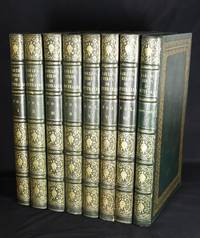
1869réf. 29221London: by the author printed by Richard and John E. Taylor 1840-_ 1869. First edition. A FINE COPY OF GOULD'S MOST IMPORTANT WORK which was issued in 41 parts over 30 years and occupied more than half of his career. In the original publishers' full morocco gilt stamped binding. Provenance: Presented to the Right Reverend Mathew Blagden Hale by the members of the Church of England and other Denominations of Christians of Western Australia Perth October 28th 1876. With large presentation label printed in gold dated in each volume. Mathew Blagden Hale 1811-1895 was the first Bishop of Western Australia and founder of Hale School. Gould started work on the Birds of Australia in 1837 but ceased this effort when he found he did not have enough material to work from in England. He and his family departed for Australia where his wife had two brothers and remained there for 18 months collecting new specimens in New South Wales and Tasmania. John Gilbert was sent to collect specimens from Western Australia Queensland and South Australia. As Gould had introductions to the explorers working at the time he also received contributions of specimens from Sturt and Grey. As a result of this intensive effort 300 new species were claimed by Gould. AUSTRALIAN EXPLORERS' CONTRIBUTION TO GOULD'S BIRDS OF AUSTRALIA In May 1838 Gould his wife Elizabeth John Gilbert their zoological collector one of their sons a nephew & two servants sailed for Australia. On their 27 montsh stay in the Colonies they received assistance from all sides ~ the Colonial Governors and most importantly the early explorers of Australia's interior. In Tasmania the Goulds were looked after by the Governor Sir John Franklin of later Arctic fame and Lady Franklin who were greatly interested in the flora and fauna of the country. Gould and Gilbert explored much of Tasmania and the Bass Strait islands. In February 1839 John Gilbert departed for an eleven month stay in the Swan River Colony. Gilbert made further explorations to the Northern Territory with Ludwig Leichhardt but during Leichhardt's overland expedition in 1845 from Brisbane to Port Essington was tragically killed by aboriginals. Book - Journal of an Overland Expedition in Australia. 1847. In June of 1839 Gould began a journey with Captain Charles Sturt from Adelaide to "the Murray Scrubs" the Mallee returning to Adelaide in July from where he visited Kangaroo Island before returning to Hobart. Books- Two Expeditions into the Interior of Southern Australia. 1833 & Narrative of an Expedition into Central Australia. 1849. Contributions of specimens & information came from all quarters. George French Angas contributed eggs and information about the Yellow- eared Black Cockatoo. Book- South Australia Illustrated one of the great Australian topographical view books. In the course of his hydrographical voyage on the H.M.S. Rattlesnake John MacGillivray contributed information about the Great Palm Cockatoo. Book- Narrative of the Voyage of H.M.S. Rattlesnake commanded by the late Captain Owen Stanley. 1852 Cape York area. T.L. Mitchell surveyor general of New South Wales supplied descriptions of the Leadbeater's Cockatoo commonly known as the "Major Mitchell". Books- Three Expeditions into the Interior of Eastern Australia.1838 & Journal of an Expedition into the Interior of Tropical Australia.1848. The last voyage of the "Beagle" was in Australian waters from 1837 to 1843. In 1841 Capt. Wickham suffering ill-health was relieved of his command by Lieut. John Lort Stokes Book - Discoveries in Australia; with an account of the Coasts and Rivers explored and surveyed during the Voyage of H.M.S. Beagle In the Years 1837- 1843. 1846. The task of the expedition was to survey those parts of the northern coast of Australia not already charted by Flinders or King. Accompanying them on this trip was the young lieutenant George Grey whose duty it was to explore the land in Australia's northwest with a view to establishing a permanent settlement there. Book - Journals of Two Expeditions of Discovery in North-West and Western Australia. 1841 The scientific appendices in volume two of Grey's "Journals" include one on birds by John Gould ~ " Mr. Gould kindly forwarded the following enumeration of the species which have come under his notice as inhabiting that part of the country Western Australia." There follows a 7 pp listing of birds of W.A. "Officers of the Beagle" are credited by Gould's "Handbook to the Birds of Australia" as supplying information on the Rose-breasted Cockatoo. To conclude the history of Australia's inland exploration is inextricably bound up with Gould's masterwork The Birds of Australia. It was an extremely fertile and productive time in Australia ~ Sturt Mitchell & Angas in eastern & southern Australia; Leichhardt MacGillivray Stokes & Grey in the north & west. Reading the letter-press that accompanies each color plate of Gould's Birds bears witness to the combined efforts of Gould and the explorers and settlers of Australia ~ Gould constantly refers to specimens and information on the birds' customs and habitat sent to him by various explorers. Many times this spirit of cooperation overflows into the naming of the bird itself. Gould was the touchstone who pulled together the contributions of Australia's explorers into the foundation work on Australia's ornithology. This combined with Gould's work with Darwin interpreting the specimens from the famous "Beagle" voyages takes Gould's Birds of Australia out of a strictly natural history realm and places it firmly alongside the great scientific discovery expeditions of the 19th century. GOULD'S CONTRIBUTION TO DARWIN'S THEORY OF EVOLUTION Before the Goulds' plans for the work on the Birds of Australia came to fruition John Gould became involved in a co-operative project with another scholar - Charles Darwin. In October 1836 Darwin returned to England from his 5 year circumnavigation on the H.M.S. Beagle on which John Lort Stokes served for 18 years- rising from midshipman in 1825 to commander in 1841. Darwin needed expert help in the description & identification of the preserved birds insects rocks shells & insects for his production of the Zoology of the Voyages of H.M.S. Beagle. Darwin had heard of Gould's books from Thomas Campbell Eyton a naturalist friend from Cambridge days who had bought Gould's Toucan prints. They were expensive he wrote but of good value as he had since been offered a higher price! Through the Zoological Society where Gould had established his reputation as a premier taxidermist Darwin initially made contact with Gould about a special Rhea seen during his travels in Northern Patagonia. This Rhea was an ostrich of dark mottled color with shorter legs than the Common Rhea. Conrad Martens the artist on the Beagle expedition shot one for food and it was cooked and eaten before Darwin realized that it was a less-known species. Fortunately the head neck feathers & skin had been preserved and were sent to the Zoological Society where it was put together and a nearly perfect specimen made for display. Gould classified the Rhea as a new species "Rhea Darwinii". The third volume of the "Zoology of the Voyage of the H.M.S. Beagle" contained fifty bird plates which was advertised by Darwin as "taken from sketches made by Mr. Gould himself and executed on stone by Mrs. Gould". When Gould & Darwin were examining the birds brought from the Galapagos Islands they were fascinated by a group of about thirteen finches of the same species which had curiously different-sized beaks. These modifications occurred on different islands and it was the investigation of this and other scientific data accumulated over a long period that led to Darwin's theories of evolution by adaptation formulated many years later. Frank Sulloway Harvard University 1982 has investigated Gould's part in Darwin's theory of evolution and shows that Gould astutely realised the basic peculiarities of these birds thus paving the way for Darwin's first notes on the "Transmutation of Species". Gould presented descriptions of the Galapagos finches and mockingbird specimens at the Zoological Society in January 1837. However he was unable to finish his work for Darwin. Due to the rush before the Goulds' departure to Australia parts of his manuscript were left unresolved and the work was completed by George Robert Gray of the British Museum. As Gould only published 250 sets of "The Birds of Australia" the number of complete copies which could possibly come on the market is significantly diminished by many factors ~ the work was issued in parts and not all copies were bound which would contribute to their demise over time. Many of the sets that survive are in institutional hands and unlikely to come onto the market. Over the last 20 years at least 10 copies have been "broken up" and sold as plates. This loss of a number of complete sets will certainly lead to a complete and undisturbed Gould attracting a premium by virtue of its increasing scarcity. 8 imperial folio volumes including supplement 2 pp list of subscribers 681 hand-colored lithograph plates including 3 double-page by John and Elizabeth Gould or by Gould and H.C. Richter. Printed by Hullmandel and Walton. Occasional minor spotting. Uniformly bound in publisher's green period full green morocco sides with gilt borders spines gilt in 6 compartments gilt edge by Clyde. The books are presently in the UK. Nissen IVB 370; Anker 174 and 179; Fine Bird Books p. 78; Wood p. 365; Zimmer pp 255-6 and 259; Sauer 9 and 18; Ferguson 4773 & 10032a. Bibliography: Lambourne Maureen Wm. McEvoy & Dr. Gordon Sauer. "John Gould - BIRD MAN" London 1987 Wantrup Jonathan "Australian Rare Books 1788-1900" Sydney 1987. by the author, printed by Richard and John E. Taylor, (1840-_ unknown