10 210 résultats
réf. DADAX0415119618New unknown
réf. DADAX0415584647New unknown
réf. DADAX1482299755New unknown
réf. DADAX0415087562New unknown
réf. SONG0198166958Used: Good unknown
réf. DADAX0415809185New unknown
1910réf. 62498San Francisco CA & Portland OR: The Pacific Telephone and Telegraph Co. October 1910. 4to. xix 1 210 2 72 47 1 pp. business pages in pink-tinted paper and with early text illustrated ads. With text photo illustrations of women telephone operators and 2 colour-printed inserted ads for Bushong Printers & the forthcoming Yeon Building to be completed in 1911. Gray-brown printed softcovers cover art of PT&T logo front cover original braid hanger still intact minor uniform interior toning couple corners w/ creasing minor scuffing still a VG bright copy w/ ink MS note indicating “Relieved by a new one April 31 1911.” First edition of this exceedingly scarce telephone directory for Portland & Oregon City OR un-incorporated Multnomah & Clackamas Counties as well as Vancouver WA and Clark County in the Progressive Era. Of additional interest is the first inclusion of Salem OR in the PT&T Telephone directory. This exceptional reference not only offers an essential tool in tracking residents in the Portland-Vancouver area at the beginning of the 20th-Century but also lists many of the Chinese-American & Japanese-American residents in Portland’s very small Chinatown as well as businesses including restaurants groceries & laundries. Of note are listings for such notable Chinese-Americans as Seid Gain Back and Seid Gain Back Jr. who at the time were two of the wealthiest businessmen on the West Coast as well as James & Nellie Brown Chinese-American photographers in Portland OR. The Pacific Telephone & Telegraph Co. had been formed from the Pacific States Telephone Co. in 1907 just 3 years before and nearly 30000 more telephones than those just 11 years before. No copies in Worldcat. The Pacific Telephone and Telegraph Co., paperback
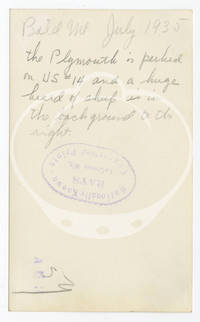
1935réf. 152267N.p.: N.p. 1935. Archive of 24 vernacular photographs documenting a 1935 summer road trip through the badlands of South Dakota Idaho and Wyoming. Each photograph with manuscript ink annotations identifying location to the margins and manuscript pencil annotations to the verso noting locations and dates along with the stamp of Rays photography studio in LaCrosse WI. Captured in the archive are various natural landmarks including Shoshone Canyon IXL Ranch and Bighorn Mountains in Wyoming Bald Mountain in Idaho and the Black Hills Badlands and Missouri River in South Dakota. Also included are a few photographs taken along US Route 14 one of the original US highways of 1926 an east-west route running 1398 miles. An alternately charming and chilling collection of Depression-era travel photography in the Midwest and Mountain West. 23 photographs 4.5 x 2.17 inches 1 photograph 3.5 x 2.75 inches. Generally Very Good plus some with light fading and age toning. N.p. unknown
1899réf. 64765St. Louis MO: Nixon-Jones Printing Co. 1899. 8vo. xxii 719 1 pp. Photo frontisp. numerous photo plates text illustrations. Brown embossed & decorated publisher’s cloth gilt lettering on front cover & spine ruling & decoration in embossed blind-stamp decorated endpapers inner hinges starting minor closed tears at gutter margin slightly shaken still VG bright copy from the library of the Black Hills & Fort Pierre Railroad in Englewood SD w /ownership stamp indicating it was received March 3 1900 by J.C. Morse station agent. First edition of this excellent memoir and history of the Dakotas by the South Dakota woman pioneer & teacher who had originally traveled as the first Euro-Caucasian woman with the illegal Gordon Party Collins-Russell Expedition into Lakota territories in defiance of the Fort Laramie Treaty with her husband and 24 other men and were subsequently removed in 1875 by the US Cavalry. The family briefly settled in Wyoming and returned to the Black Hills in 1876 where they settled in Deadwood and she became one of the first educators in Pennington County schools and went onto organize schools throughout the County. Along with sections on gold miners and mining wars with local Native Americans Custer Wild Bill Hickok and Calamity Jane she also writes about setting up schools library associations fire departments fighting cattle rustlers establishment of hospitals and the suppression of the Ghost Dance religious movement which swept through the Lakota Sioux reservations in 1889. Tallent 1827-1901 firmly believed in “Manifest Destiny” and advancement of Euro-Caucasian western civilization and re-education of Native American Indigenous Peoples and later served as president of the Rapid City Board of Education. Graff 4061; Howes T14. Nixon-Jones Printing Co., hardcover
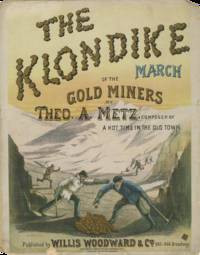
1897réf. Cat358New York: Willis Woodward & Co 1897. Folio sheet music complete. Illustrated color lithograph title page by Robert Teller. Covers detached contents complete good with lithographed cover in particularly bright and attractive condition. Sheet music issued at the height of the Klondike Gold Rush capitalizing directly on the surge of public interest following the discoveries in the Yukon in 1896–1897. The lithographed title page signed in style by Robert Teller shows a dramatic scene of prospectors working a gold deposit in the mountains with two miners in the foreground bent over a pile of freshly uncovered gold tools in hand. Theodore August Metz was a German-born musician trained on violin in Hanover who emigrated to the United States and worked various trades before establishing himself as a bandleader and composer in Chicago’s late 19th-century popular music scene. He achieved national prominence with “There’ll Be a Hot Time in the Old Town Tonight” 1896–97 a widely performed marching tune that became especially popular during the Spanish-American War and in minstrel and touring band repertories. OCLC 726910235 locating a single copy at the Levy Collection. Willis Woodward & Co unknown
1897réf. Cat358New York: Willis Woodward & Co 1897. Folio sheet music complete. Illustrated color lithograph title page by Robert Teller. Covers detached contents complete good with lithographed cover in particularly bright and attractive condition. Sheet music issued at the height of the Klondike Gold Rush capitalizing directly on the surge of public interest following the discoveries in the Yukon in 1896–1897. The lithographed title page signed in style by Robert Teller shows a dramatic scene of prospectors working a gold deposit in the mountains with two miners in the foreground bent over a pile of freshly uncovered gold tools in hand. Theodore August Metz was a German-born musician trained on violin in Hanover who emigrated to the United States and worked various trades before establishing himself as a bandleader and composer in Chicago’s late 19th-century popular music scene. He achieved national prominence with “There’ll Be a Hot Time in the Old Town Tonight” 1896–97 a widely performed marching tune that became especially popular during the Spanish-American War and in minstrel and touring band repertories. OCLC 726910235 locating a single copy at the Levy Collection. Willis Woodward & Co unknown books
1935réf. 152267N.p.: N.p. 1935. Archive of 24 vernacular photographs documenting a 1935 summer road trip through the badlands of South Dakota Idaho and Wyoming. Each photograph with manuscript ink annotations identifying location to the margins and manuscript pencil annotations to the verso noting locations and dates along with the stamp of Rays photography studio in LaCrosse WI. Captured in the archive are various natural landmarks including Shoshone Canyon IXL Ranch and Bighorn Mountains in Wyoming Bald Mountain in Idaho and the Black Hills Badlands and Missouri River in South Dakota. Also included are a few photographs taken along US Route 14 one of the original US highways of 1926 an east-west route running 1398 miles. An alternately charming and chilling collection of Depression-era travel photography in the Midwest and Mountain West. 23 photographs 4.5 x 2.17 inches 1 photograph 3.5 x 2.75 inches. Generally Very Good plus some with light fading and age toning. N.p. unknown books
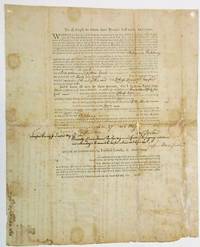
1805réf. 33731Fairfield County 1805. Broadsheet 12-1/2" x 15-1/2". Printed document completed in ink manuscript. Old folds with some repaired splits and one 6" unrepaired split. Some small chips along a few splits with minimal loss. Light tanning scattered spotting. Good. The original grant for this land was to Nehemiah Phippeny who lost title for nonpayment of taxes. The land was sold to Lothrop Lewis of Fairfield Connecticut on May 27 1805. On the verso are hand written transfers of the same piece of property: from Lothrop Lewis to William Hawley of Woodbury January 21 1806; from Hawley to Nehemiah Dibble of Stamford February 7 1806; from Dibble to Zalmon & Seymour Wildman of Danbury October 20 1806. There is also a voided transaction crossed out from Hawley to William Lamson of Waterbury January 31 1806. In 1800 the State of Connecticut granted to her citizens who were sufferers by fire caused by the British during the Revolutionary War a half million acres of land lying within the State of Ohio which was to be taken off the west part of the "Western Connecticut Reserve" now embraced in the counties of Huron and Erie. By an 1803 Act of Ohio the sufferers were incorporated as "The proprietors of the half million acres of land lying south of Lake Erie called 'Sufferers' Land'." The Act required management of the Company by a Board of Directors. The Board was to locate and survey the granted land and to partition it among the different claimants. This part of the Western Reserve was inhabited by Indians who engaged in warfare with the settlers. On July 4 1805 a treaty between the United States and the Wyandot Ottawa Chippewa Munsee and Delaware Shawanee and Pattawatamy nations was signed whereby those Indian nations in consideration of $18916.68 released their claims to all the lands owned by the company. unknown
1805réf. 33731Fairfield County 1805. Broadsheet 12-1/2" x 15-1/2". Printed document completed in ink manuscript. Old folds with some repaired splits and one 6" unrepaired split. Some small chips along a few splits with minimal loss. Light tanning scattered spotting. Good. The original grant for this land was to Nehemiah Phippeny who lost title for nonpayment of taxes. The land was sold to Lothrop Lewis of Fairfield Connecticut on May 27 1805. On the verso are hand written transfers of the same piece of property: from Lothrop Lewis to William Hawley of Woodbury January 21 1806; from Hawley to Nehemiah Dibble of Stamford February 7 1806; from Dibble to Zalmon & Seymour Wildman of Danbury October 20 1806. There is also a voided transaction crossed out from Hawley to William Lamson of Waterbury January 31 1806. In 1800 the State of Connecticut granted to her citizens who were sufferers by fire caused by the British during the Revolutionary War a half million acres of land lying within the State of Ohio which was to be taken off the west part of the "Western Connecticut Reserve" now embraced in the counties of Huron and Erie. By an 1803 Act of Ohio the sufferers were incorporated as "The proprietors of the half million acres of land lying south of Lake Erie called 'Sufferers' Land'." The Act required management of the Company by a Board of Directors. The Board was to locate and survey the granted land and to partition it among the different claimants. This part of the Western Reserve was inhabited by Indians who engaged in warfare with the settlers. On July 4 1805 a treaty between the United States and the Wyandot Ottawa Chippewa Munsee and Delaware Shawanee and Pattawatamy nations was signed whereby those Indian nations in consideration of $18916.68 released their claims to all the lands owned by the company. unknown books
1969réf. 553H1602Vancouver B.C.: Seaforth Highlanders of Canada 1969. Book. Illus. by Connorton Cy Dust Jacket. Fine. Hardcover. First Edition. 8vo - over 7¾" - 9¾" tall. xxiv 559 65 pages. Eight fold-out maps. Black and white photographic plates. "Almost sixty years have passed since the Seaforth Highlanders of Canada was authorized as a regiment in the Canadian Militia. This volume covers the story of the regiment from the time it returned home in 1919 up to the present day." - from dust jacket. Clean bright and unmarked with negligible wear. Dust jacket now preserved in archival-grade Brodart. A superb copy. Edwards & Lort 3060. Hale 2487. Cuddy & Scott page 77 Cooke 2nd Edn page 185. Seaforth Highlanders of Canada Hardcover
1928réf. 47750N. P. Denver: Privately printed n. d. ca 1928. 1928. TRADE CATALOG. First edition. 8vo. Pictorial wrappers front cover in color 68 pp. illustrated. The Western Saddle Mfg. Co. basically specialized in making and repairing saddles therefore the catalog offers 36 pages of various saddles and their descriptions. Also depicted are chaparejos bridles bits reins spurs spur straps saddle blankets and pads spur rowels cuffs etc. Also a section of Trophy Art Goods for Christmas and Birthday gifts. It is noted in this catalog "Prices are subject to change without notice. Due to the unsettled market conditions as we go to press with our catalog "THIS YEAR ESPECIALLY" we can not guarantee for any definite period of time the prices listed." Covers worn and used but still a tight and usable catalog in good condition. Privately printed, n. d. (ca 1928). unknown
réf. SONG0006458718Used: Good unknown
1925Very Good English In contemporary Ottoman cloth. 4to. (32 x 23 cm). In Ottoman script. 165, 9, [2] p., 8 b/w plates. Roumi: 1341 = Gregorian: 1925. Ozege: 10331. First Edition. Extremely rare. Kastamonu âsâr-i kadimesi. Anadolu Türk âsâr ve mahkûlâti tetebbuâtina esas.
2015réf. 220817001High Noon Western Americana 2015. Hardcover. Good. 0x0x0. Text is LIKE NEW. Very Clean. No writing or tears to text. Has minor cover wear. Dust Jacket is only fair. DJ has heavy creasing. Still a great Reading Copy. High Noon Western Americana hardcover
réf. DADAX008043357XNew unknown
réf. DADAX0195130537New unknown
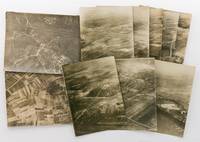
réf. 118696Very Good. All are gelatin silver prints on thick stock; eight are oblique photographs 207 × 154 mm; two are vertical views approximately 165 × 220 mm; the larger ones are slightly creased at the corners one of them a little more so; the others are in excellent condition. All images are captioned in the negative. All eight oblique views carry the same date 25 June 1918 preceded by 'A3 AEO 62°' ranges from 110 to 121. Place names on them are Hamel Hamel Wood Somme Accroche Wood Tailloux Wood and Vaire Wood. The vertical images are dated 3 May and 27 June 1918 and carry a larger set of alpha-numeric references commencing 'A3 AE A 715' and '35 AE B 929' respectively. All ten prints have the signature 'Capt Sexton' in indelible pencil on the verso. Digitised service records indicate the signature is that of Eric James Sexton of the Adelaide suburb of Hindmarsh; he enlisted on 14 August 1914 shortly before his 21st birthday and was appointed to the 10th Battalion with the rank of lieutenant. He was wounded at the landing at Gallipoli promoted to captain the following day and later invalided back to Australia disembarking on 6 August 1915. By January 1916 he was declared fit again for active service and re-embarked in April for England where he performed various training roles. On 14 February 1917 he transferred to the Australian Machine Gun Training Depot with the rank of major. He embarked for Australia on 12 March 1918 arriving in Melbourne on 22 May 1918. Accordingly Sexton did not serve in France and was a major not a captain by the time these photographs were produced. We cannot explain the anomalies but will let the photographs speak for themselves. Significantly they show the area where the important Battle of Hamel was fought on 4 July 1918. 'Hamel was a big battle in miniature involving the experimentation of tanks and small ammunition drops as part of a broader all-arms offensive. While a coordinated offensive was not a new approach to warfare Hamel represented the culmination of three years of learning and innovation on the Western Front testing an all-inclusive approach to mobile warfare. The flawless execution of the operation resulted in Hamel becoming a model for future operations on the Western Front. In his account of the event Monash famously wrote that "the perfected modern battle plan is like nothing so much as a score for an orchestral composition where the various arms and units are the instruments and the tasks they perform are their respective musical phrases' Ellen Cresswell: 'The Experiment - Innovations at the Battle of Hamel' Australian War Memorial website. 10 items. unknown
réf. DADAX0367897911New unknown
1841réf. 018881New York: Killey and Lossing 1841. Book. NVG. Hardcover. 1st Edition. Full leather that is modestly worn missing less than 1/4" from the head of the spine rear fixed endpaper torn ex lib plate on front fixed endpaper with no other markings minor foxing. . Killey and Lossing Hardcover
1991réf. 2080502106914209Not Available 1991. Soft Cover. Fine. The book is in fine condition. Not Available paperback